@politicalham@AvalonResists@jkenney@JohnIbbitson Albertan’s are leaning into independence with info they believe is true but isn’t. For ex, that they make equalization payments. They don’t. They pay federal tax.
This mindset was planted by present & previous premiers for political gain.
They made their bed.
@El_GordoPB@isabell53888198@jkenney@menard_ray 2/3
There is no historical model in the world that connects to Alberta separation. This move is the first of its kind. Hence, your independence task will come down to one number.
That one number is the amount of $ an Albertan is willing to leave 🇨🇦 for.
@El_GordoPB@isabell53888198@jkenney@menard_ray So, you are saying you are wishing for independence from 🇨🇦 for a tidy stipend of $5227.27 a year extra income?
About $436 per month.
I’ll refrain from converting to 🍎 .
@El_GordoPB@isabell53888198@jkenney@menard_ray Is this $5200 figure an annual stipend?
I’m trying to get a handle on the annual $ profit amount an Albertan has in their head which defines their YES vote on separation. Since this isn’t a vote on culture, only extra wealth.
Thoughts?
@isabell53888198@jkenney@menard_ray Ok. I’m not sure what my own personal annual profit would have to be to leave 🇨🇦 but I’m sure you have decided your number. I’m a math guy who balances stats, probability along with the opportunity cost in my decision making.
I hope this experiment gets you what you expect.
@isabell53888198@jkenney@menard_ray I agree there. Is that a guarantee?
I’m learning here and trying to put a $ amount per person (profit) when independence kicks in. I cannot find a model similar to the Alberta (separation) case.
@isabell53888198@jkenney@menard_ray Presently, one pays 8-10% prov income tax ($100k salary). ~16% fed tax. No sales tax. No equalization payments.
Independence: No fed tax BUT there will be a portion of that added to prov tax, say 8%. Save $8000/yr.
$667/month extra. Do you think you’ll get more?
@isabell53888198@jkenney@menard_ray You don’t pay equalization payments. You pay federal taxes. You don’t want to pay 🇨🇦 federal taxes.
You want to be independent so you can be wealthier. It will be a good experiment. No going back.
Thanks for the really kind words. I carry the reaction to that article with me every second. I learned that people need to feel understood. Imagine this- One woman told me her friend died by suicide and referenced the story it in the note she left behind. Here is what I wrote. Broke my heart to reread it. https://t.co/WGi0y2OVsh
#SickNotWeak
My rules for the "check in".
1. Ask. Regularly. Don't quit after one "I'm fine."
2. Explain why you're asking. Give specific evidence as to why your concerned. IE. "you dont seem like yourself, and here's why..."
3. Ask rhetorical questions like "I want to know if you're mentally okay. its fine if you don't want to answer me- but answer yourself, and be honest."
4. The key question for all of us: Does your mental health allow you to live your best life?
@heylandsberg These past two days athletes are reminding us to “check on our teammates and check on each other”. What does “check” look like, Michael? I don’t want to miss anything.
Thank you. - PG
✨💥✨💥Conic Section✨💥✨💥
👉✨#Circle
A circle is the set of all points equidistant from a fixed center.
Daily_life_application: Circles appear in wheels, coins, and clocks—symbols of motion and continuity.
👉✨#Ellipse
An ellipse is formed when a plane cuts a cone at an angle, creating a stretched circle.
Daily life application: Elliptical shapes define planetary orbits and whispering galleries, where sound travels smoothly.
👉✨#Parabola
A parabola represents the path of a point moving so that its distance from a focus equals its distance from a directrix.
Daily life application: Parabolic mirrors and antennas focus light and signals precisely, enhancing communication and vision.
👉✨#Hyperbola
A hyperbola consists of two open curves formed when a plane cuts both nappes of a cone.
Daily life application: Hyperbolas guide navigation systems and describe the shape of cooling towers and radio waves. Ẩn bớt
You know π belongs to circles… but what about e?
Imagine a magical bank offering 100% interest per year. You deposit $1, wait a year, and walk away with $2. Simple.
But what if the bank compounds your interest twice a year—50% every six months?
After 6 months: you have $1.50.
Now you earn interest not just on $1, but on $1.50.
By the end of the year: $1.50 + (1.50 × 0.5) = $2.25.
You just made more than doubling your money.
Naturally, you say: “Do it faster.”
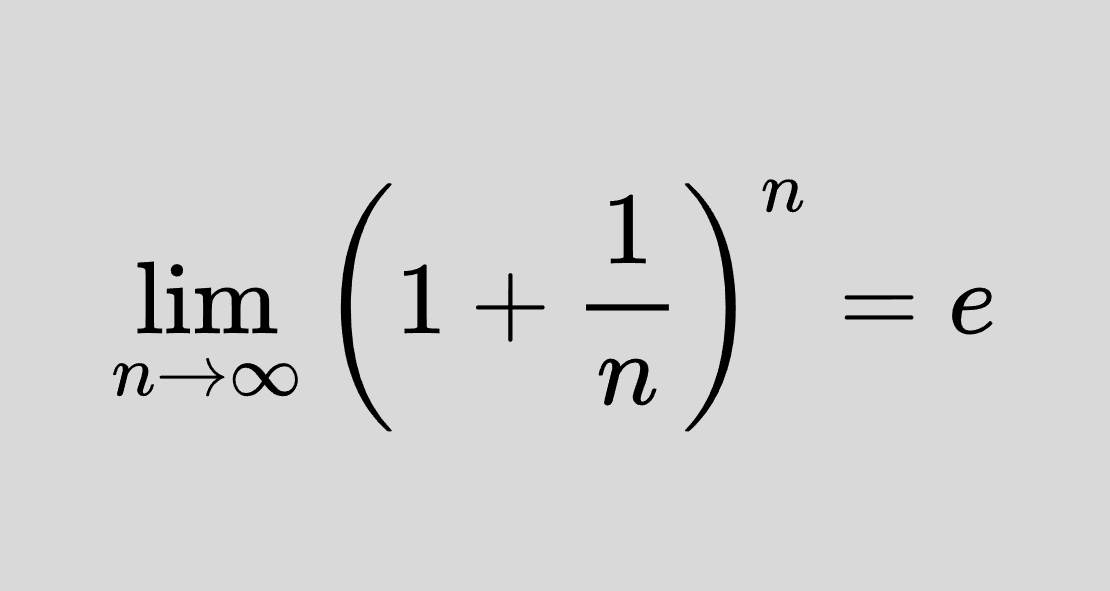
Daily. Every second. Continuously. Mathematically, this becomes:
(1 + 1/n)ⁿ
As n (the number of compounding periods) grows larger and larger, something incredible happens…
You hit a limit.
No matter how fast you compound, the value approaches 2.718…
In 1748, Leonhard Euler recognized this number as a universal constant and named it e.
And no—it wasn’t named after him. It simply emerged from the mathematics of growth itself. From finance to physics, from biology to probability—e is everywhere. Not bad for a number born from compounding interest.
This is the most important, most brilliant, and most well written thing you could read today.
If you’re an Albertan, or a Canadian, and read nothing else, fine. Just read this.
Goodness me. Every word. https://t.co/TliiUbwj6H