MSFT just reported. We called BEAT. It beat on both lines. The stock is up about 6% after hours.
ALMOST PERFECT
Street Adj. EPS: $4.72
Alphatica Adj. EPS: $4.92
Actual Adj. EPS: $4.89 ✅
Street Revenue: $90.75B
Alphatica Revenue: $91.8B
Actual Revenue: $92.28B ✅
$MSFT $SPY
Woah, stellar earnings from and AI market projections...
1. SK Hynix: "Memory supply shortage to persist through 2030".
2. There's the $4.8B operating profit beat ($62.8B vs. ~$58B est)... 80% operating margins.
So you had:
- Revenue: $78.84B vs. $74.02B
- Operating profit: $62.80B vs. $58.00B
- Operating margin: 79.7% vs. 78.3%
With forward projections of
3. "Our DRAM and HBM volumes through 2029 are effectively sold out."
4. Signed LTAs covering 50%+ of 2027–2028 capacity, while retaining pricing flexibility
5. The company intends to fulfill its commitment to return 50%+ of cumulative FCF for 2025-2027
6. "We have included deposits and other practical enforcement mechanisms" (LTAs have actual enforcement)
7. "We expect the profitability gap between HBM and conventional DRAM to narrow significantly" (hello broader memory industry)
8. SK Hynix announced $75B in shareholder returns (dividends/buybacks) for CY2026.
I'm not sure what there isn't to like here?
You have a memory company just printing... demand visibility super high from enforceable commitments... and now they're returning that via dividends/buybacks.
Everyone will watch whether GOOGL beats tomorrow.
That doesn't matter.
We tested GOOGL earnings back to 2004. Beat vs. miss has no statistically significant effect on SPY. Neither does pre-earnings volume.
One thing survived: how BIG the beat is.
SPY over the next 10 days, by beat size:
•Small ($0.00–0.01): +1.00%, 80% win rate
•Medium ($0.01–0.10): +0.56%, 75%
•Large ($0.10+): +2.06%, and +2.34% at 20 days
Any beat: SPY +1.22% at 10 days, 75% win rate (p = 0.0004).
🚨The live test since our June post:
July 22, GOOGL beat by $6.23. SPY was +2.99% 10 days later.
The setup:
•14 straight beats
•EPS consensus of $3.00, revenue consensus of $127.8B
•Revenue revisions 18 up, 2 down. EPS revisions 15 up, 9 down.
Analysts expect more sales but are split on how much reaches the bottom line.
The number to watch tomorrow isn't beat or miss. It's the size of the beat.
$GOOGL $SPY
🚨 TOMORROW IS FOMC DAY.
FINANCE'S MOST FAMOUS FED TRADE IS DEAD.
In 2015, researchers found the S&P gained 0.50% in the 24 hours before Fed announcements. FinTwit made it a rule: buy the day before FOMC.
We retested it across 183 meetings, including 66 since 2018 that the original study never saw.
Pre-FOMC return: +0.08%, p = 0.45. That's no different from any ordinary day.
The strategy turned $10,000 into $14,861. Buy and hold turned it into $70,142. It earned less than T-bills.
But the data showed a different signal: what happens AFTER the Fed.
FOMC day: +0.22%
Next session: -0.17%
Next two sessions: -0.31%, p = 0.002
Gains on Fed day tend to get given back within 48 hours.
If SPY rallies tomorrow after the decision, watch the next two sessions. That's where the edge is now.
$SPY $QQQ
Over the past few months we heard so much FUD from the Twitter/Substack bobos and the financial media bobos that the Chinese memory companies ie $CXMT and $YMTC were going to flood the global markets with cheap memory... guess what... it was bullshit... because in reality those two companies can't even meet the demand coming from Chinese companies which means there's no chance they're going to export their supply at lower prices (sorry Apple)... not to mention yields on more advanced memory ie HBM is not good enough yet.
Micron, Samsung and SK Hynix should not be trading at an average of 3.5x 2027 EPS with all the ai infrastructure/capex tailwinds plus higher ASPs plus LTAs plus record margins plus stock buybacks plus special dividends... bring on the 2x multiple re-rate 🎉
the $meta selloff due to equity dilution is really annoying
but at the same time...can we really blame them?
meta and google both did equity raises this year for about $100B each. they are the greatest businesses in the world.
google is flat ytd and meta is now red after peaking at $780.
they have both been opportunity costs, but not because they are small spec plays that you took a chance on...these are some of the greatest businesses in the world.
the problem is, they need capital. they dont have fcf anymore. they levered up their balance sheets. the only thing left is equity to offer. if we want them to be the giant compounders that the global economy depends on, they need capital for their AI buildout and that capital will come from dilution which unfortunately keeps their stocks stuck.
ever since google did their raise, they have gone nowhere but flat to down, even berkshire is bagholding 10b of $googl they bought at 350.
the $meta $25b offering today at $625 was 5x oversubscribed, just like google's was, which means smart money obviously knows these are amazing discounts/valuations to pay...but the street isnt going to easily let these names run with the threat of more shares entering into the market.
the fact that $nvda and $amd had to invest in $meta today also shows how much the chipmakers realize that these companies need cash and they will have to participate in financing these companies to make sure their chip sales are disrupted.
this all doesn't work if the capex isn't going to lead to an roi. if it will, then i expect them to continue diluting and that means we might have to deal with the hyperscalers potentially being stuck if the street can't get over their constant dillution.
now, $amzn and $msft haven't tapped equity markets yet...which means if they do, we know the playbook for how the street may react. if they don't, then they might have a better chance of avoiding that stagnation, but ultimately if you believe in the AI buildout, these companies need money and that money will have to come from shareholders.
we just get the opportunity, even if prolonged, to buy them at what are historically the lowest multiples they've ever had relative to their growth with the eventual ROI from all this capex coming over the next few years.
So China has this index specifically holding AI names called the Star 50 index.
Well it’s down 40% from their highs.
The Korean index KOSPI is also down 40% from their highs.
Is this some kind of foreshadow..?
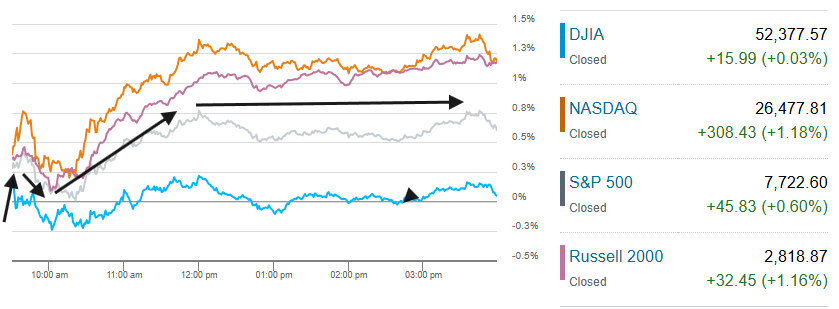
US equity indices again started higher and, after an early dip, climbed until around noon before flattening out.
Tech led again pushing the Nasdaq +1.2%. RUT also +1.2% while the SPX was +0.6%.
DJIA the only to see red today ending flat.
The top Democrat on the House Intelligence Committee said voter backlash against artificial intelligence data centers stems from a solvable cost-sharing problem and will not stop the infrastructure build-out. - 10/27/2026 12:43 PM EST.
@JNiLia1@BenzStanzie@alphaticaio If they are executed orders showing trade confirms is pretty easy. Well, maybe difficult for dummies like you and your bffs. There are zero trade confirms to speak of bc they don't exist. But of silly Ai reels.
@BenzStanzie@alphaticaio By the way, do you know what the word of the year is? its "maxing". ill put it in a sentence for you since you seem rather dense: You're maxing stupidity.
A TON OF THINGS HAPPENED IN THE STOCK MARKET TODAY.
Here's a full recap:
1. SpaceX $SPCX has signed a binding commitment letter with an Apollo Global Management-managed entity for a massive $40B GPU financing arrangement to support its expanding AI data center infrastructure. Under the proposed agreement, Apollo's entity would purchase GPU pods and related data center equipment and lease them to SpaceX, with approximately $40B in aggregate principal payments spread across lease terms of 5 to 5.25 years. The transaction is expected to close before year-end, with GPU deliveries and lease payments beginning in the first half of 2027. Importantly, the $40B figure excludes interest and additional financing costs, with the final borrowing rate still to be determined, highlighting the enormous capital requirements behind SpaceX's AI infrastructure expansion.
2. Anthropic has reportedly filed its S-1 for a U.S. IPO, seeking to list on the Nasdaq under ticker $ANT, with Goldman Sachs, Morgan Stanley, and JPMorgan leading the offering. The filing shows explosive growth, with H1 2026 revenue surging to $16.3B from $1.16B a year earlier, including $13.1B in consumption-based revenue and $3.2B from subscriptions. Anthropic now has more than 11,900 customers spending $100K+ annually, including 1,900 spending over $1M and approximately 250 spending over $10M, while net revenue retention reached roughly 900% as of September 30. Despite the growth, Anthropic reported an $80.7B net loss, largely driven by a $72.4B noncash fair-value charge tied to convertible notes, while its operating loss narrowed to $693M. The biggest revelation is the company's enormous AI infrastructure commitments extending as far as 2045, including approximately $161B in Broadcom TPU leases, $120.5B with SpaceXAI, $114.5B with Google, $110B with Amazon, $44.9B with Microsoft, and tens of billions more with Nscale, Lambda, and AMD, alongside roughly $245B in additional agreements signed after June 30. Anthropic also disclosed $131.7B in cash and short-term investments, plans to allocate 5% of its shares to a public benefit fund, and a governance structure preserving 50.1% voting control for its founders, highlighting both the extraordinary scale of its growth and the capital intensity of the frontier AI industry.
3. Barclays upgraded Tesla $TSLA to Overweight from Equal Weight, raising its price target to $450 from $370, as analyst Dan Levy sees an increasingly attractive risk/reward profile. Levy noted that much of the recent discussion surrounding Tesla has focused on a potential merger with SpaceX $SPCX, which he believes could result in a premium for Tesla shareholders. However, his bullish thesis extends beyond a possible combination, citing improving automotive demand, strong growth in Tesla's energy business, and a sharp acceleration in Robotaxi miles driven. Barclays also highlighted FSD adoption exceeding 75% of new North American vehicle deliveries, suggesting growing monetization opportunities for Tesla's autonomous driving technology. Together, these factors underpin the firm's more constructive outlook on Tesla's long-term growth potential.
4. Microsoft $MSFT is offering voluntary buyouts to approximately 60,000 employees, representing more than 25% of its global workforce, as the company moves to restructure parts of its operations. The program reportedly covers select teams across the United States, Canada, United Kingdom, and India, with eligible employees receiving severance packages in exchange for voluntarily leaving the company. Employees have until early December to decide whether to participate, with departures expected to take place by year-end. The move could represent one of Microsoft's largest workforce restructuring initiatives, although the final number of departures will depend on employee participation.
5. Samsung and SK Hynix are reportedly targeting Q2 2027 to begin mass production and shipments of 8-layer HBM4 memory for NVIDIA $NVDA, according to ZDNet Korea. The advanced memory is expected to be used in NVIDIA's next-generation Rubin Ultra rack-scale AI systems, supporting the growing memory requirements of increasingly powerful AI accelerators. While 12-layer HBM4 remains the primary focus throughout 2026, the share of 8-layer HBM4 shipments is expected to increase significantly beginning in mid-2027. The development highlights the continued expansion of the high-bandwidth memory market as Samsung and SK Hynix prepare additional capacity for NVIDIA's next generation of AI infrastructure.
6. The top 10 most active options today by contracts traded were $TSLA with 3.4M contracts, $NVDA with 3.1M contracts, $AAPL with 1.6M contracts, $MU with 1.3M contracts, $SPCX with 1.3M contracts, $META with 979K contracts, $AMZN with 884K contracts, $NFLX with 624K contracts, $INTC with 598K contracts, and $AMD with 550K contracts.
7. Meta $META announced plans to raise approximately $35B through new equity offerings, including $22.5B in Class A common stock through forward sale agreements and $12.5B in depositary shares tied to mandatory convertible preferred stock. The company is also considering a separate $60B offering program for its new nonvoting Class C shares beginning in Q1 2027, potentially bringing its total equity financing capacity to $95B, approximately $10B more than Google's $85B equity offering earlier this year. Interestingly, NVIDIA $NVDA, AMD $AMD, and Broadcom $AVGO have expressed nonbinding interest in purchasing up to $5B of Meta shares combined, potentially giving major AI chip suppliers direct equity exposure to one of their largest customers. The proposed financing comes as Meta prepares for unprecedented AI infrastructure spending, while its new Class C share structure, introduced alongside an effective 2-for-1 stock split, would allow the company to raise additional capital without issuing new voting rights. The full $95B remains potential financing capacity rather than a completed capital raise.
8. DoorDash $DASH is reportedly in advanced negotiations to acquire Instacart $CART, with a potential agreement expected as early as this week, according to the Wall Street Journal. The discussions follow earlier reports that Instacart had attracted takeover interest from both DoorDash and Uber $UBER, although talks with Uber are reportedly no longer active. A combination would significantly expand DoorDash's presence in online grocery delivery, combining Instacart's grocery partnerships and fulfillment technology with DoorDash's restaurant delivery network and logistics infrastructure. The potential acquisition could strengthen DoorDash's competitive position across local commerce, although no final agreement has been announced and negotiations could still fall apart.
9. The 10 largest U.S. leveraged equity ETFs attracted approximately $12B in net inflows over the past month, even as their combined market capitalization declined by $20B, highlighting aggressive dip-buying despite the broader market selloff. The surge was led by the Direxion Daily Semiconductor Bull 3X ETF $SOXL, which attracted a record $9B in inflows over just two weeks, while the ProShares UltraPro QQQ $TQQQ, which provides 3x leveraged exposure to the Nasdaq 100, recorded $1.3B in inflows, its second-largest two-week intake of 2026. Over the past five months, the 10 largest leveraged equity ETFs have collectively attracted $19B, suggesting that speculative investors are continuing to increase leveraged exposure to semiconductors and technology stocks even as market volatility and downside risks remain elevated.
10. Morgan Stanley strategist Michael Wilson expects the current U.S. equity market correction to eventually give way to a rebound as several major uncertainties begin to clear, including the midterm elections, AI infrastructure financing concerns, and tightening financial conditions. Wilson sees potential near-term downside for the S&P 500 $SPX to 7,100–7,200, but maintains a year-end base-case target of 8,000, suggesting meaningful recovery potential if market conditions improve. He identified liquidity constraints as the biggest immediate risk, while arguing that a potential Federal Reserve policy pivot could provide an important catalyst for equities. Morgan Stanley also pointed to historically strong 6–12-month stock market returns following midterm elections, supporting its view that the current correction could ultimately create buying opportunities rather than mark the end of the broader market cycle.
11. UBS pushed back against concerns that CoreWeave $CRWV could face a debt spiral as credit markets tighten, arguing that the company has multiple financing alternatives to support its AI infrastructure expansion. UBS highlighted opportunities to reduce reliance on traditional debt through private credit, vendor financing, and additional equity investments, similar to CoreWeave's recent transaction with Jane Street. Following meetings with private credit executives and data center developers, UBS said it “did NOT come away with a view that capital will be scarce in 2027,” suggesting financing conditions may remain more supportive than investors fear. Separately, Cantor Fitzgerald reiterated its Overweight rating and $176 price target on CoreWeave, citing the potential for delayed-draw term loan (DDTL) credit enhancements to attract additional lenders and new financing facilities to ease concerns over the company's access to capital.
12. The United States and Canada are reportedly negotiating a potential agreement to ease tariffs on Canadian steel and automobiles, according to Reuters, citing six sources familiar with the discussions. Negotiations are focused on Section 232 tariffs, including duties of up to 50% on Canadian steel and 25% on automobiles, with one Canadian source suggesting a deal could be reached before the November 3 midterm elections. U.S. officials are reportedly seeking additional concessions from Canada. The discussions come as President Trump has threatened to raise steel and auto tariffs to 50% beginning January 1, 2027, although he recently suggested the trade dispute could be resolved “soon.” Canadian officials described the negotiations as constructive, but no agreement has been finalized.
WALL STREET IS THE GREATEST SHOW ON EARTH.
@BenzStanzie@alphaticaio Unlike you and others, you believe everything someone throws up on X. Do you even know what trade confirms are? I doubt it. He can't screenshot trade confirms bc they don't exist. So move on chummy.