@EliasHeimisson @uni_iceland @Stanford@Caltech@ETH Hi Elias. Sorry to have not seen this till so late. Many many congratulations on the job! When do you start? And, more importantly, when can I come to visit you in Iceland?
What causes UHT metamorphism? - a question that has puzzled geoscientists for a long time!
Here is an attempt to constrain and categorize the mechanisms of UHT-M: https://t.co/wUKBLHN4xS
Was great working with Shujuan_Jiao, Mike Brown @RossMitchellGeo@chrisfpclark & others!
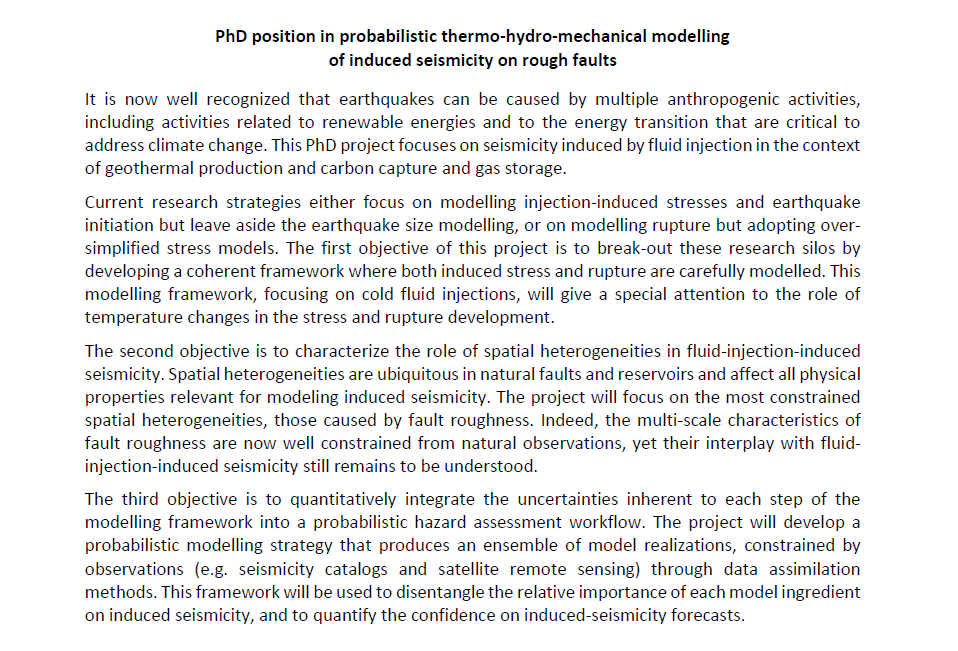
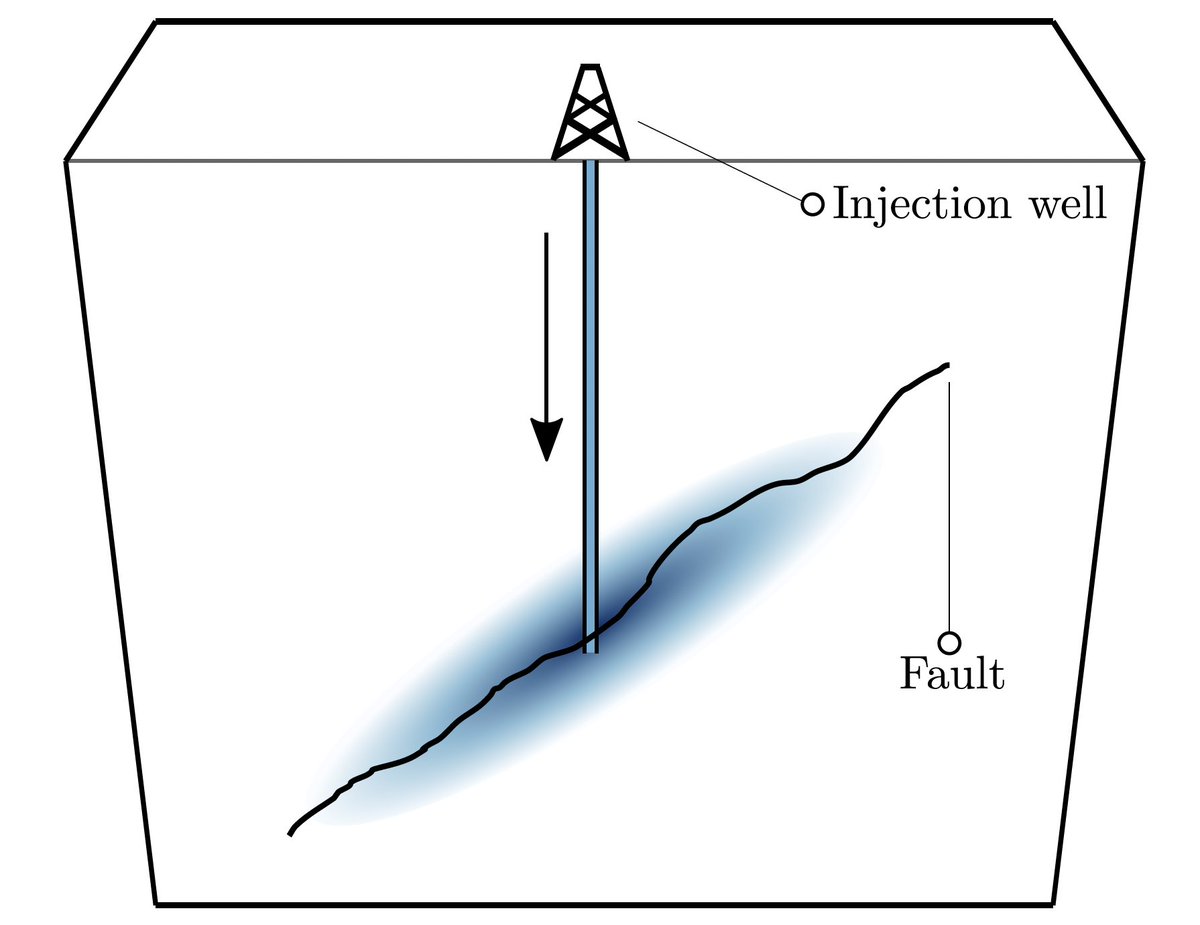
New PhD position on computational mechanics of induced seismicity for geothermal energy and carbon capture and gas storage, at @EQ_Geoazur@umrGeoazur (@Univ_CotedAzur French Riviera) and @TNO_Research (The Netherlands).
Apply by April 30 2023: https://t.co/WAedaHYS6a
First high-precision observation of postseismic deformation following ~600-km deep earthquake
+ and! the observation points to a low-viscosity layer at the bottom of upper mantle
+ a lot more to do in this "deep earthquake geodesy"!
https://t.co/nGt8UM6lfe
What is the fundamental relationship between silent earthquakes (slow slip event) and regular ones? A new theory accounting for finite rupture depth gives an insightful answer and can reconcile the current debates. Our @NatureComms paper with @DocTerremoto https://t.co/Yo3wqHrXQx
@DocTerremoto @GarethDLaT Is pulsed flow along fault zones consistent with the deposition and accumulation of fault-associated mineral deposits like many valuable (e.g., gold) and rare earth metals often found along fault zones? Mineralization along faults can be uniform for large distances.
@GarethDLaT @DocTerremoto For water to build up in a fracture, does the permeability in (within?) the region of the fracture not have to be larger than the surrounding flow paths? This was the motivation for thinking of permeability enhancement as a possible explanation for this squirting.
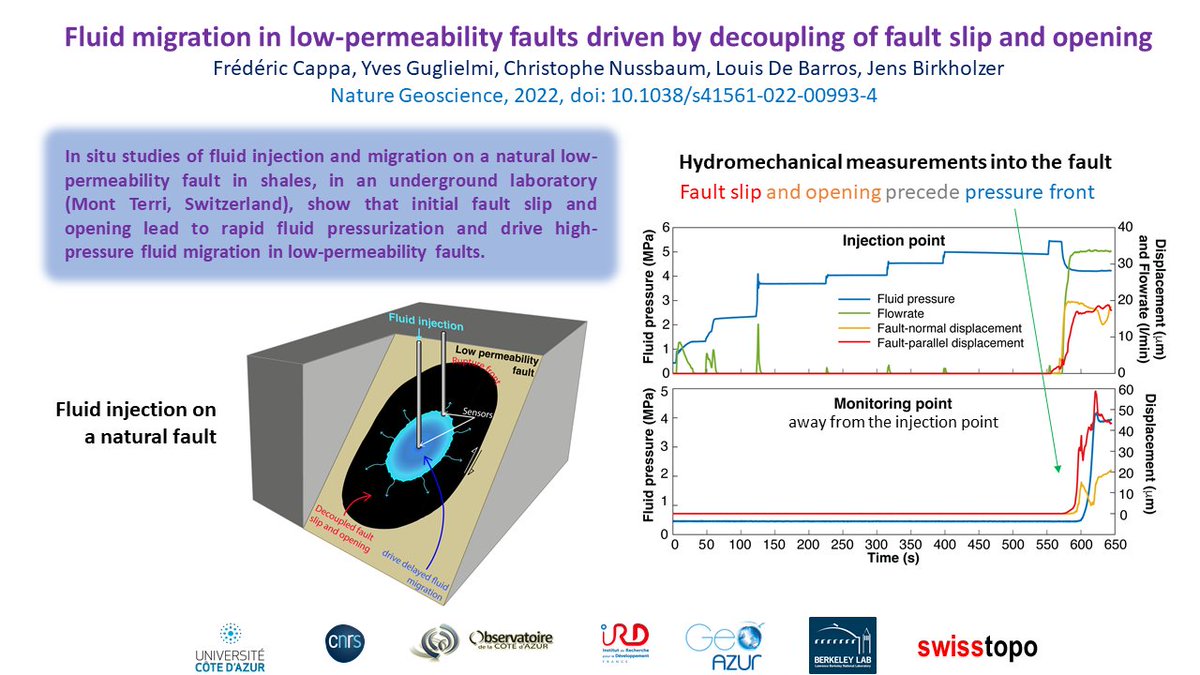
New water-injection experiments into faults crossing tunnels show how fluids migrate on low-permeability faults: fault slip and opening precede and drive the fluid pressure front.
New paper in @NatureGeosci led by @EQ_Geoazur's Fred Cappa: https://t.co/IX9OJAOfua
@EliasHeimisson@MCSlab_uiuc@ViescaRobert You are correct. But this is no better than what the Slip law does. Unfortunately we removed the Slip law counterpart of S19 during revisions. I will send it to you over email.
@EliasHeimisson@MCSlab_uiuc@ViescaRobert In the Ampuero Rubin world, instability length scale estimates (for at least the Aging law) do come from comparing this latter fracture energy with the energy release rate. You could be correct that the relevant fracture energy for cycles is the slide-hold-slide estimate.
@EliasHeimisson@MCSlab_uiuc@ViescaRobert Interestingly, if you estimated fracture energy in the classical sense, where the fault is being driven to failure from near steady state (most comparable to velocity steps), lab data are pretty consistent with the Slip law.