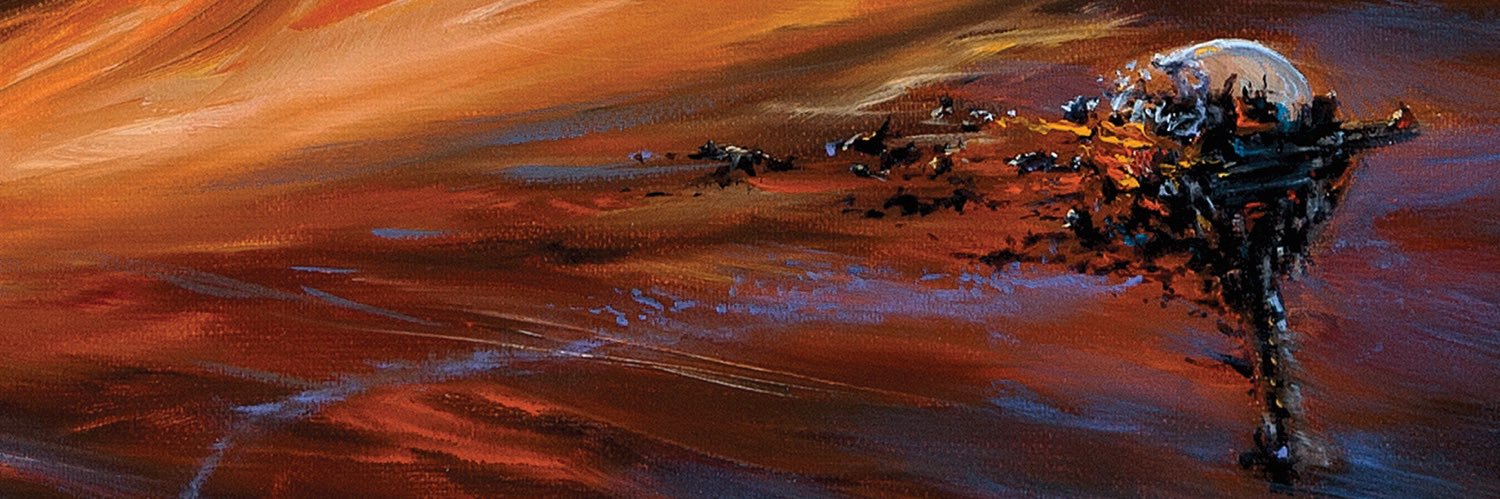
A Cold War-style technothriller…in spaaace. The FRONTIER audiobook is 60% OFF through June 2nd. Fun fact: screenplay is in development! https://t.co/y64epAU1e4
@AntonHernandez_@Ron071443531@NASCAR It’s like watching a 200 mph traffic jam and the stages are insulting. Let them race!
Meanwhile F1 is committing s—cide by regulation and IndyCar has turned into the Alex Palou Invitational. Maybe I should check out IMSA…
Coming November 2026 from @BaenBooks... my fourth (and probably final) anthology I edited, "Chaos and Consequences."
When there is chaos, there will be consequences . . . but for whom?
In "Chaos and Consequences" we find out.
Ten stories within all tell a tale of a single moment of chaos, an image built within each author’s tapestry. How they spin their chaotic yarn, though, is up to each weaver. With military science fiction stories ranging from the absurd to the deadly, there is something for everyone within.
Featuring authors @SarahAHoyt, @MelissaOlthoff, @thewriterike, Jacob @holowriting, @PatrickChiles, @JoellePresby, Jason Cordova, @KB_Carlisle, @steverson_nick, and @Marisa_comeaux, David Shadoin & H.Y. Gregor.
Because in the end, it’s not about the chaos involved.
It’s about those who give in to it, and those who choose to fight.
Only one chance in this lifetime…
Like watching sunset at the beach from the most foreign seat in the cosmos, I couldn’t resist a cell phone video of Earthset. You can hear the shutter on the Nikon as @Astro_Christina is hammering away on 3-shot brackets and capturing those exceptional Earthset photos through the 400mm lens. @AstroVicGlover was in window 3 watching with @Astro_Jeremy next to him.
I could barely see the Moon through the docking hatch window but the iPhone was the perfect size to catch the view…this is uncropped, uncut with 8x zoom which is quite comparable to the view of the human eye. Enjoy.
Super cool. “NASA is building the first nuclear reactor-powered interplanetary spacecraft. How will it work?” (MIT Technology Review) by by @SquigglyVolcano.
This will solve the radiation problem for Mars and beyond. Not only can we go faster but we can carry more shielding mass.
https://t.co/pCkVAYknAl
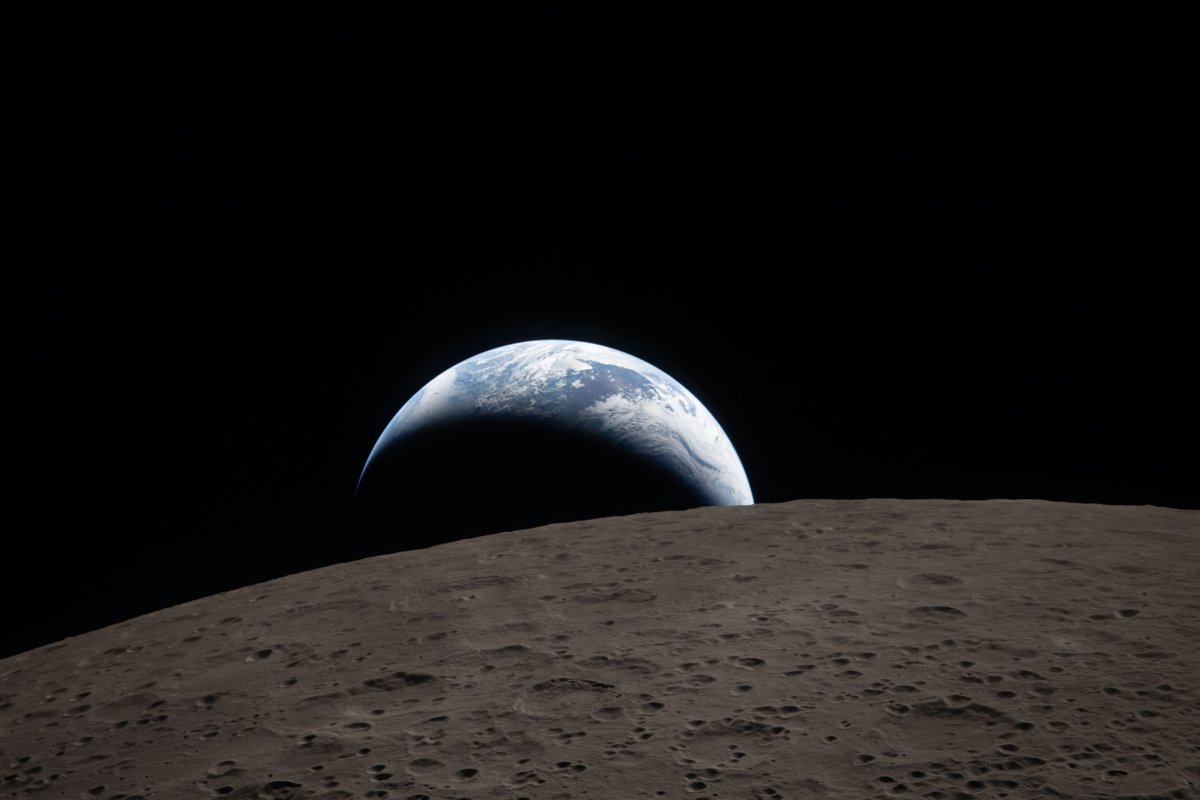
Earthset.
The Artemis II crew captured this view of an Earthset on April 6, 2026, as they flew around the Moon. The image is reminiscent of the iconic Earthrise image taken by astronaut Bill Anders 58 years earlier as the Apollo 8 crew flew around the Moon.
THE ARTEMIS II ECLIPSE.
April 6, 2026.
Totality, beyond Earth. From lunar orbit, the Moon eclipses the Sun, revealing a view few in human history have ever witnessed. Photo: NASA
History in the making
In this new image from our @NASAArtemis II crew, you can see Orientale basin on the right edge of the lunar disk. This mission marks the first time the entire basin has been seen with human eyes.
The world stopped to watch Artemis II.
Moments like this remind us what is possible and inspire the next generation to dream bigger and take us even further.
We are just getting started on this grand adventure. It is time to start believing again.
On October 15, 1991, something extraordinary hit Earth’s atmosphere, and for a moment, physics had to stop and look twice.
Detected by the Fly’s Eye Cosmic Ray Detector in Utah, this event became known as the “Oh-My-God particle.” The name wasn’t exaggerated. It was the only reasonable reaction.
What was observed was an ultra-high-energy cosmic ray carrying about 3.2 x 10^20 eV. That number is so extreme it almost loses meaning, even for physicists.
For comparison, the most powerful particle accelerators on Earth, like the LHC, reach energies of around 10^13 eV per particle. This wasn’t just higher. It was vastly beyond anything we can produce. Nature did it anyway.
There’s a more intuitive way to picture it. That tiny subatomic particle carried roughly the same kinetic energy as a professional baseball traveling at about 60 mph. Same energy. Completely different scale. It sounds absurd because it is.
When this particle entered the atmosphere, it didn’t simply collide and stop. It triggered what we call an extensive air shower, a cascade of secondary particles created as it smashed into atmospheric nuclei.
The original energy didn’t stay in one place; it spread out into a growing avalanche of particles that reached the ground over a wide area. Detectors like Fly’s Eye don’t see the original particle directly, they capture the footprint of this cascade.
And here’s where it gets interesting. Even at these extreme energies, we are still far below the Planck scale, where quantum gravity would take over and our current physics would break down. In principle, known physics should explain this. But in practice, it doesn’t fully.
Because the real question is not what happened when it arrived, but how it got that energy in the first place.
Events like this are extremely rare, but not unique. Similar ultra-high-energy cosmic rays have been detected since, though only occasionally. Their origin remains uncertain. Some possibilities fit within known astrophysics: environments like active galactic nuclei or powerful supernova remnants, where magnetic fields and shock waves could accelerate particles to extreme energies.
Others are more speculative, involving exotic phenomena like cosmic strings or primordial black holes. None of these explanations has been confirmed.
There is also a fundamental limitation to consider. The universe itself should act as an energy filter. High-energy particles interact with the cosmic microwave background and lose energy over long distances, a limit known as the GZK cutoff. In simple terms, particles this energetic shouldn’t be able to travel far without slowing down.
And yet, we detect them. That suggests either relatively nearby sources or gaps in our understanding.
What makes these particles even more striking is how elusive they are. We are detecting something almost ghost-like, a single particle traveling at about 99.99999999999999999999951% the speed of light, crossing vast cosmic distances only to leave a brief cascade in our atmosphere.
A needle in a cosmic haystack, and one that disappears the moment it’s found.
More than three decades later, the Oh-My-God particle remains a benchmark rather than a solved mystery. It marks the point where observation pushes beyond explanation.
We know it happened.
We measured it.
But we still don’t fully understand how the universe made it possible.
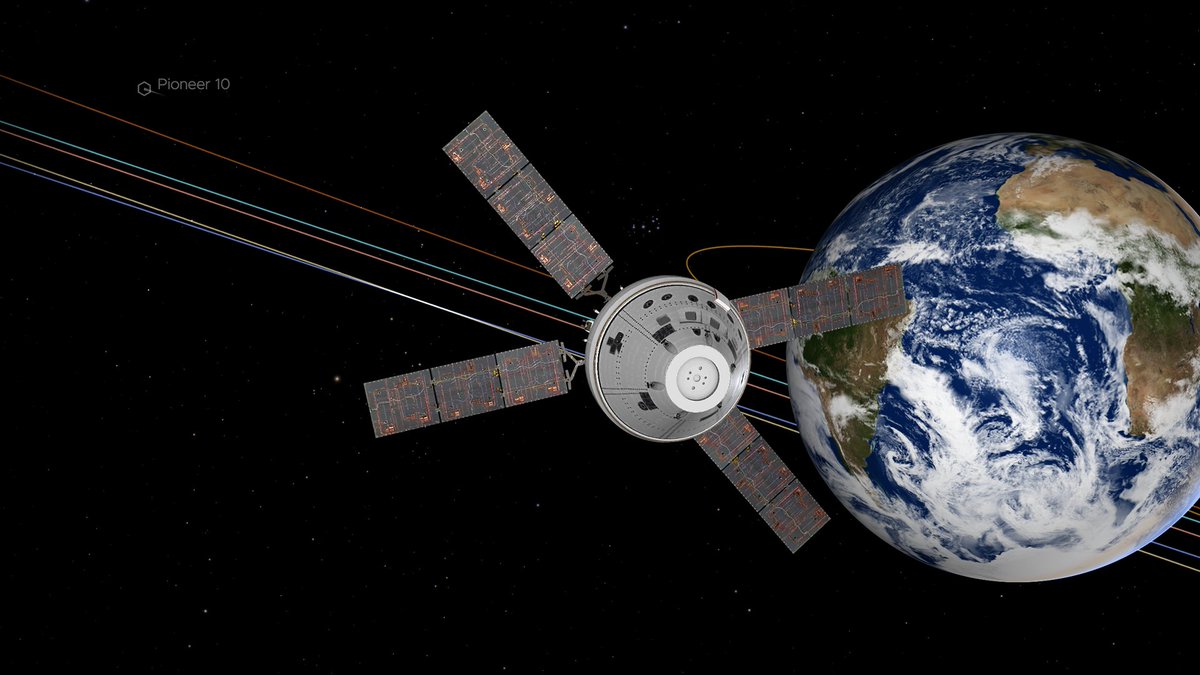
Which way to the Moon?
This interactive tool lets you follow Artemis’s journey – and even scroll forward and backward in time!
Follow along with Eyes on the Solar System:
https://t.co/tP3ecPR9GX
The corporate world built a religion around one lie.
That leadership is separable from understanding.
That you can run a machine you cannot read.
Musk: “At SpaceX, almost all my time is spent on engineering and design.”
Not strategy meetings. Not press tours. Not optics.
The weeds.
Musk: “If you don’t understand something at a detailed level, you cannot make a decision.”
If you need someone to translate the problem, you are not the decision-maker.
The translator is.
You are a rubber stamp with a corner office.
We built an entire economy rewarding people who speak in abstractions.
Strategy. Synergy. Alignment.
Physics does not care about synergy.
When the rocket is on the pad, the org chart does not matter.
The metallurgy does.
If you do not know where the alloy fails, you are not leading.
You are guessing with authority.
Most executives are operating on secondhand information.
Playing telephone with reality.
When you delegate the understanding, you forfeit the outcome.
They call it micromanagement.
It is the opposite.
When you understand the work, you know which failures matter and which ones are the price of moving fast.
The executive who cannot read the metal panics at every setback.
So he punishes it.
And the moment you punish failure, your team stops reaching.
They do not stop because they are lazy.
They stop because they are rational.
Nobody takes the shot when missing costs them everything.
You do not build rockets with a workforce optimizing for job security.
The further you get from the metal, the faster the company rots.
The era of the spreadsheet executive is over.
The future does not belong to the person with the best summary.
It belongs to the one who never needed one.
Today I am five years old again.
Glued to the TV, with my paper lunar lander from the Gulf station, my plastic command module from inside the Tang jar, and this book splayed in front of me:
@CynicalPublius It was the flight termination system, looks like it just cleared. Hands down the best person to follow for this stuff is Eric Berger, @SciGuySpace