Ha Joon-Chang @the_hindu: "I am actually upset with people like Rajan Raghuram and, these days, Dani Rodrik, who mislead developing countries into believing that there is no future in manufacturing, and you can grow on the basis of services." https://t.co/GhHSQdGONQ
More than a dropped prefix- The US decision to drop INDO from PACOM is superficial, unless you go below the surface to the changes in US policy across three geographies most important to India. My piece @the_hindu today. Pl do read!
https://t.co/fDM7K04T10
In the foreseeable future, China will maintain a very visible lead over all other countries, in terms of either absolute economic volume or technological competitiveness.
Against this backdrop, while the US turns extremely anxious about preserving its current position, its target for venting such anxiety will no longer be China, but India.
After all, India remains the competitor most likely to challenge America’s status as the world’s number two power.
A major reason why Trump administration harbors an unusually intense hostility toward India — far beyond what seems reasonable — is this preemptive mindset: to squeeze India like a blood bag while it is still unprepared, in order to minimize its long-term threat as early as possible.
HAL under pressure
TIMES NOW SAYS - America has tripled the price of every engine around three times. “While the initial price was in the range of 70—80 crore per engine, but now it is going to cost us over 200 crores”
Yes, This news report says ENGINE price will now move 3 times the initial cost!!
https://t.co/rzv60oOXsJ
“… the superior naval power loses its advantage at the point when the cost of access — operational, financial, political, and legal — exceeds the strategic value of what that access secures. Call it the Sea Denial Trap.”
Thought provoking essay by 🇮🇩Vice FM @havasoegroseno 👇🏻
Link: https://t.co/yknWXreEuf
Two different political economies.
China has been building a national system for comprehensive economic development. India has been enabling private oligarchs and companies to get strong rather than elevate the underlying human capital, technologies, sectors and industries.
Capital is subordinated to national goals in China; Capital sets the agenda for policy goals in India, which invariably across neoliberal states leads to state capture, rent seeking, concentration of market power, lack of innovation and international competitiveness.
Four assumptions held up the US relationship. All are slipping. That America would help India rise: in doubt, said aloud by a US official in Delhi this March. That it would balance China for us: shattered. That interests and values aligned: oversold. That the diaspora was ballast: wishful thinking.
One sentence in the Chinese readout of the Wang Yi–Ajit Doval meeting deserves particular attention:
The boundary question should be placed in an “appropriate position” and prevented from affecting the overall relationship.
That has been Beijing’s preferred formulation for years.
India’s position after Galwan has been different: peace and tranquillity on the border are the basis of the broader relationship.
The real story is not the talk of BRICS, multipolarity or the Global South. It is whether these two fundamentally different approaches can be reconciled.
For now, the objective appears to be stabilization, not settlement.
“The most consequential victims of the current China shock are not workers in Detroit or Stuttgart, but future workers in places such as Addis Ababa, Dhaka, Lagos, Nairobi, Phnom Penh, Surat, and Tirupur,” argue @shoumitro_c and @arvindsubraman.
https://t.co/WUPxUbOI9f
Washington bet the Iran war would pin China down. It did the opposite. Expensive oil drives demand for Chinese EVs and solar. The closure of the Strait of Hormuz proves the value of Chinese Eurasian pipelines and renewables. Beijing just got a stress test that confirms it's building a fortress economy.
@MiddleEastInst@politybooks@IndianExpress
https://t.co/y4rdynqeJS
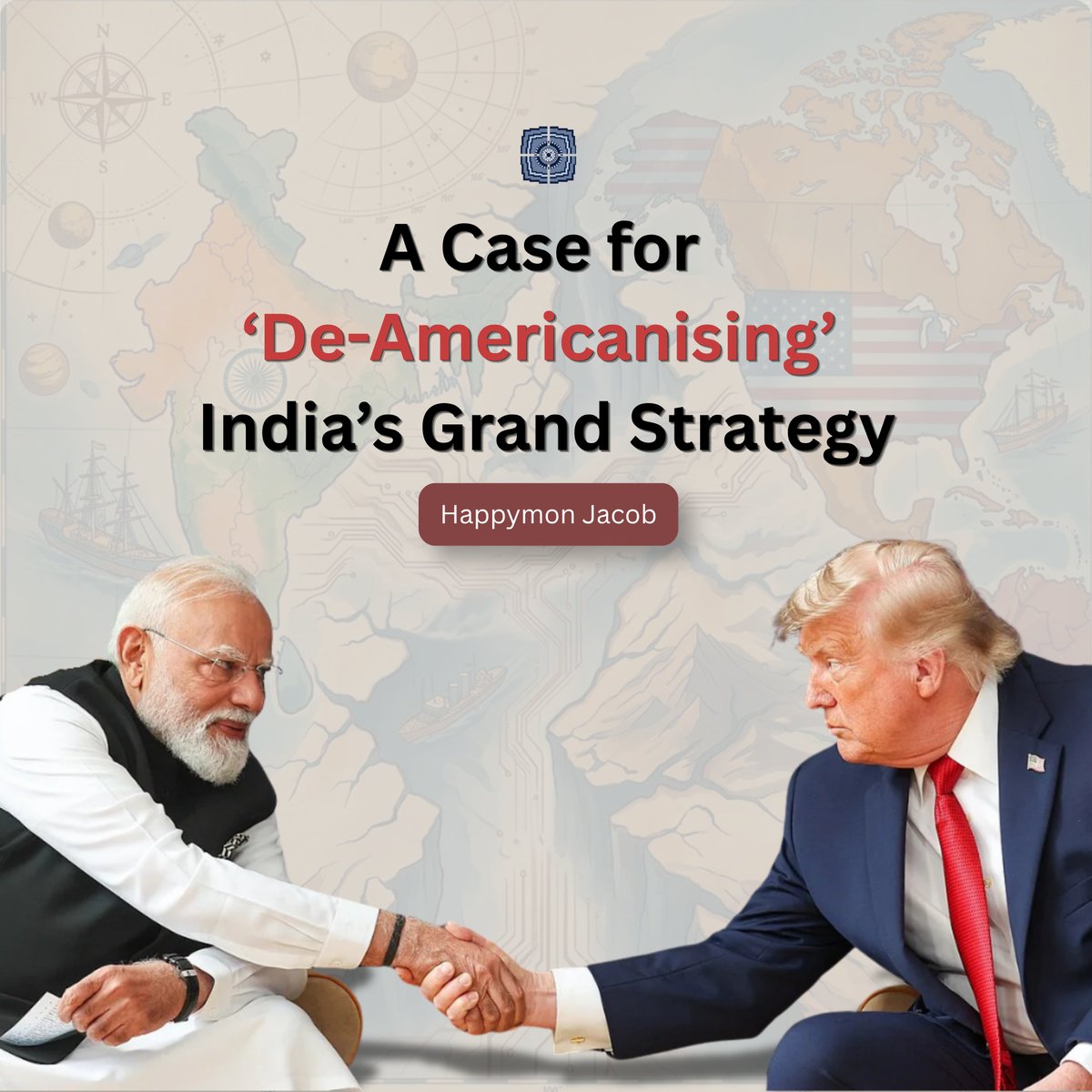
For 25 years India never wrote its own grand strategy.
A strategic convergence with Washington wrote it for us...
That convergence is now coming apart.
My new essay in India's World on de-Americanising India's grand strategy.
A 🧵 @IndiasWorld_mag
Pesquisa interessante da FGV-SP: agronegócio no Centro-Oeste e na Amazônia não confia na China, seu principal mercado de exportação, e vê regulação ambiental da União Europeia com mistura de pragmatismo e ambivalência. https://t.co/vAwjxnpmnk
Eric Schmidt saying the quiet part out loud: "What I don't like about [China's AI] is that it's all open source which means it's largely uncontrolled and not controlled in any way by us."
He adds, "if that makes you feel any better," that only 2 or 3 countries can be independent AI powers.
In other words, it's all about hegemony: the ideal scenario is a world where AI is controlled by the US - and the fewer countries that can resist that, the better.
Src for the video: https://t.co/Gk5iAMtBqa
@LuisFelipeGiest Artigo excelente. Faltou apenas falar da Índia como possível novo comprador do C-390, com possível aquisição de 60-80 aeronaves e esquema de parceria com a Mahindra para a montagem final na Índia. Se o governo indiano topar, será um baita avanço.
JD Vance is not changing the conversation about Israel in the US. He is changing the entire paradigm:
He is reminding the Israelis that they are alone and - though he doesn't use this word - much disliked internationally. Israel should not undermine the only strong friend they have left.
"If I was in the cabinet of the Israeli government, I might not be attacking the only powerful ally that I have left."
And, he is reminding them of their utter dependence on the United States.
Because 2/3 of the weapons that have protected Israel (!!) "have been built by American hands and paid for by American tax dollars."
As a point of comparison, no one in the Biden admin ever spoke like this about Israel when Netanyahu was blowing through Biden's so-called red lines on Gaza...