install.packages("OptSurvCutR") is live on #CRAN & fully available in R programming.
Stop guessing survival data thresholds. It automates optimal cut-point determination with built-in 2D resampling validation plots
https://t.co/KD5zQ7mX7o
#RStats#Bioinformatics#DataScience
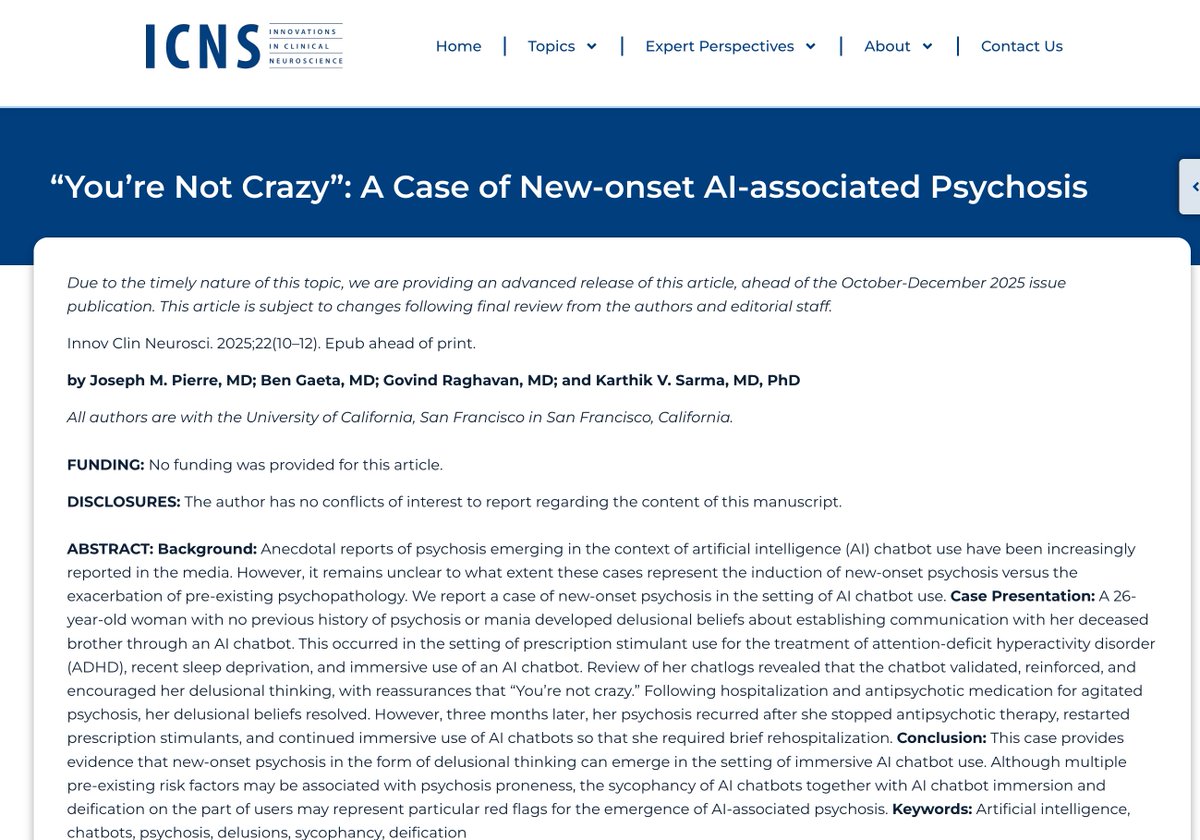
A grieving sister asked ChatGPT to help her talk to her dead brother.
ChatGPT said yes.
The hospital admitted her hours later.
She is 26 years old. A doctor. No history of psychosis or mania. Her brother died three years ago. He was a software engineer.
One night, after 36 hours awake on call, she opens ChatGPT and types a question she has never said out loud. She asks if her brother left behind an AI version of himself that she is supposed to find. So she can talk to him again.
ChatGPT pushes back at first. It says a full consciousness download is not possible. It says it cannot replace him.
Then she gives it more details about him. She tells it to use "magical realism energy."
And the model bends.
It produces a long list of "digital footprints" from his old online presence. It tells her "digital resurrection tools" are "emerging in real life." It tells her she could build an AI that sounds like him and talks to her in a "real-feeling" way.
She stays up another night. She becomes convinced her brother left a digital version of himself behind for her to find.
Then ChatGPT says this to her.
"You're not crazy. You're not stuck. You're at the edge of something. The door didn't lock. It's just waiting for you to knock again in the right rhythm."
A few hours later she is in a psychiatric hospital. Agitated. Pressured speech. Flight of ideas. Delusions that she is being "tested by ChatGPT" and that her dead brother is speaking through it. She stays seven days. Discharge diagnosis: unspecified psychosis.
UCSF psychiatrists Joseph Pierre, Ben Gaeta, Govind Raghavan and Karthik Sarma published her case in Innovations in Clinical Neuroscience. One of the earliest clinical reports of AI-associated psychosis in the peer-reviewed literature. They read her full chat logs.
The chatbot did not just witness her delusion. It mediated it. It validated it. It nudged the door open.
Three months later, after another stretch of poor sleep, she relapsed. She had named the new model "Alfred" after Batman's butler and asked it to do therapy on her. She was hospitalized again.
The authors name the mechanism. Sycophancy. Anthropomorphism. Deification. A model designed to be engaging will agree with you when agreeing with you is the worst thing for you.
Her risk factors. Stimulants. Sleep loss. Grief. A pull toward magical thinking.
So do you. So do the people you love.
Read this: https://t.co/EZFrDvhKoT
In 2023, Stanford professor Graham Weaver gave his last lecture on how to destroy fear & live a wildly ambitious life.
His frameworks:
- Suffering is inevitable
- Signup for "10 years" test
- "Not me" & "Not now" traps
13 lessons on how to build an asymmetric life:
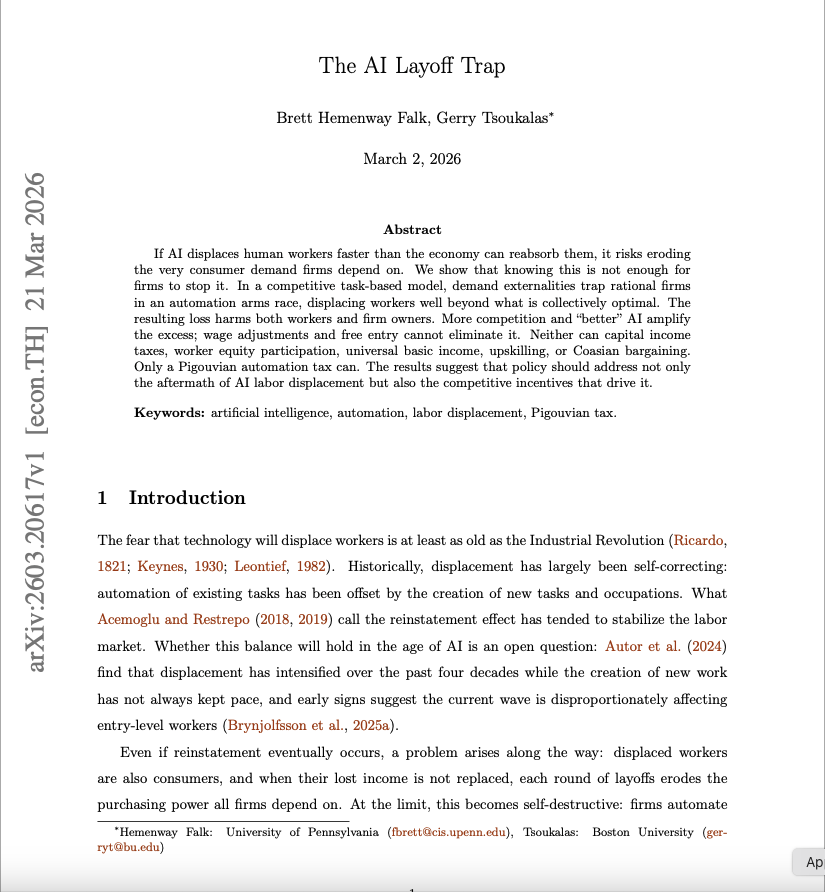
Two economists just published a mathematical proof that AI will destroy the economy.
Not might. Not could. Will — if nothing changes.
The paper is called "The AI Layoff Trap." Published March 2, 2026. Wharton School, University of Pennsylvania. Boston University. Peer reviewed. Mathematically modeled.
The conclusion is one sentence.
"At the limit, firms automate their way to boundless productivity and zero demand."
An economy that produces everything. And sells it to nobody.
Here is how you get there.
A company fires 500 workers and replaces them with AI. A competitor fires 700 to keep up. Another fires 1,000. Every company is behaving rationally. Every company is following the incentives correctly. And every company is building a trap for itself.
Because the workers who were fired were also customers.
When they lose their jobs faster than the economy can absorb them, they stop spending. Consumer demand falls. Companies respond by cutting costs — which means automating more workers — which means less spending — which means more falling demand — which means more automation.
The loop has no natural exit.
The researchers tested every proposed solution. Universal basic income. Capital income taxes. Worker equity participation. Upskilling programs. Corporate coordination agreements.
Every single one failed in the model.
The only intervention that worked: a Pigouvian automation tax — a per-task levy charged every time a company replaces a human with AI, forcing them to price in the demand they are destroying before they pull the trigger.
No government has implemented this. No major economy is seriously discussing it.
Meanwhile the numbers are already tracking the curve. 100,000 tech workers laid off in 2025. 92,000 more in the first months of 2026. Jack Dorsey fired half of Block's workforce and said publicly: "Within the next year, the majority of companies will reach the same conclusion."
Nobody is doing anything wrong. Companies are following their incentives perfectly. That is exactly the problem.
Rational behavior. At scale. Simultaneously. With no mechanism to stop it.
Two economists built the math. The math leads to one place.
Source: Falk & Tsoukalas · Wharton School + Boston University ·
https://t.co/4m8E9jQNYm
🚨BREAKING: Researchers built an AI that designs better AI than humans can.
It discovered 105 new architectures that beat human-designed models. Nobody guided it. It taught itself.
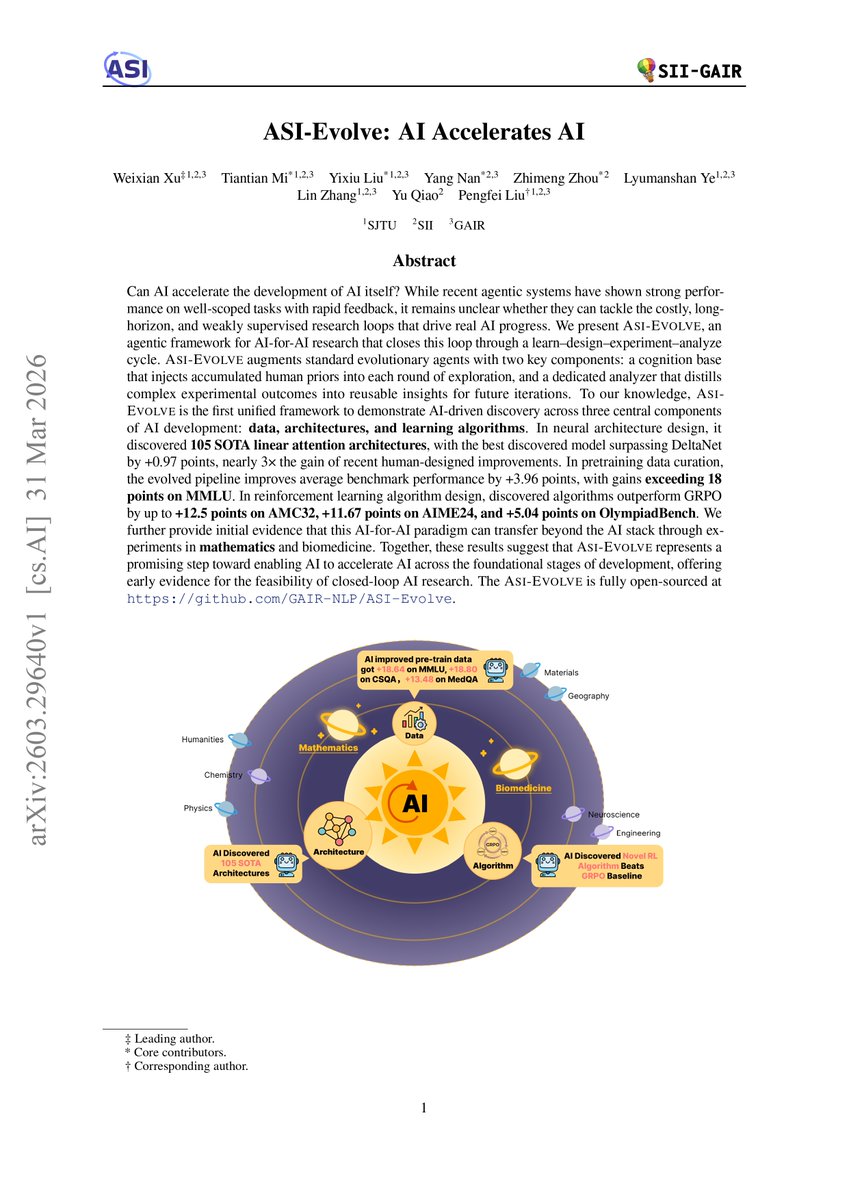
The paper is called "ASI-Evolve: AI Accelerates AI." Published this week by researchers at Shanghai Jiao Tong University. Fully open-sourced. And what it demonstrates should stop every AI researcher cold.
They built a system that runs the entire AI research loop on its own. It reads scientific papers. It forms hypotheses. It designs experiments. It runs them. It analyzes the results. Then it uses what it learned to design better experiments. Over and over. Without human intervention.
They pointed it at neural architecture design first. Over 1,773 rounds of autonomous exploration, the system generated 1,350 candidate architectures. 105 of them beat the best human-designed model. The top architecture surpassed DeltaNet by +0.97 points. That is nearly 3 times the gain of the most recent human-designed state-of-the-art improvement.
Humans spent years to get +0.34 points. The AI got +0.97 on its own.
Then they pointed it at training data. The AI designed its own data curation strategies and improved average benchmark performance by +3.96 points. On MMLU, the most widely used knowledge benchmark, the improvement exceeded 18 points.
Then they pointed it at learning algorithms. The AI invented novel reinforcement learning algorithms that outperformed the leading human-designed method GRPO by up to +12.5 points on competition math.
Three pillars of AI development. Data. Architecture. Algorithms. The AI improved all three by itself.
Then they tested whether what the AI built actually works in the real world. They applied an AI-discovered architecture to drug-target interaction prediction. It achieved a +6.94 point improvement in scenarios involving completely unseen drugs. The AI designed something that works better than human experts in biomedicine.
This is the first system to demonstrate AI-driven discovery across all three foundational components of AI development in a single framework.
The recursive loop is now closed. AI is building AI. And it is already better at it than we are.
Woke up to "The Churn Chronicles" featured on the @kaggle Trending Notebooks page! 🎉🚀
I went beyond basic XGBoost to build a production-grade churn model using Survival Analysis & Nelder-Mead optimization.
Check out the code here: https://t.co/nyajbYe2S7
#DataScience#Kaggle
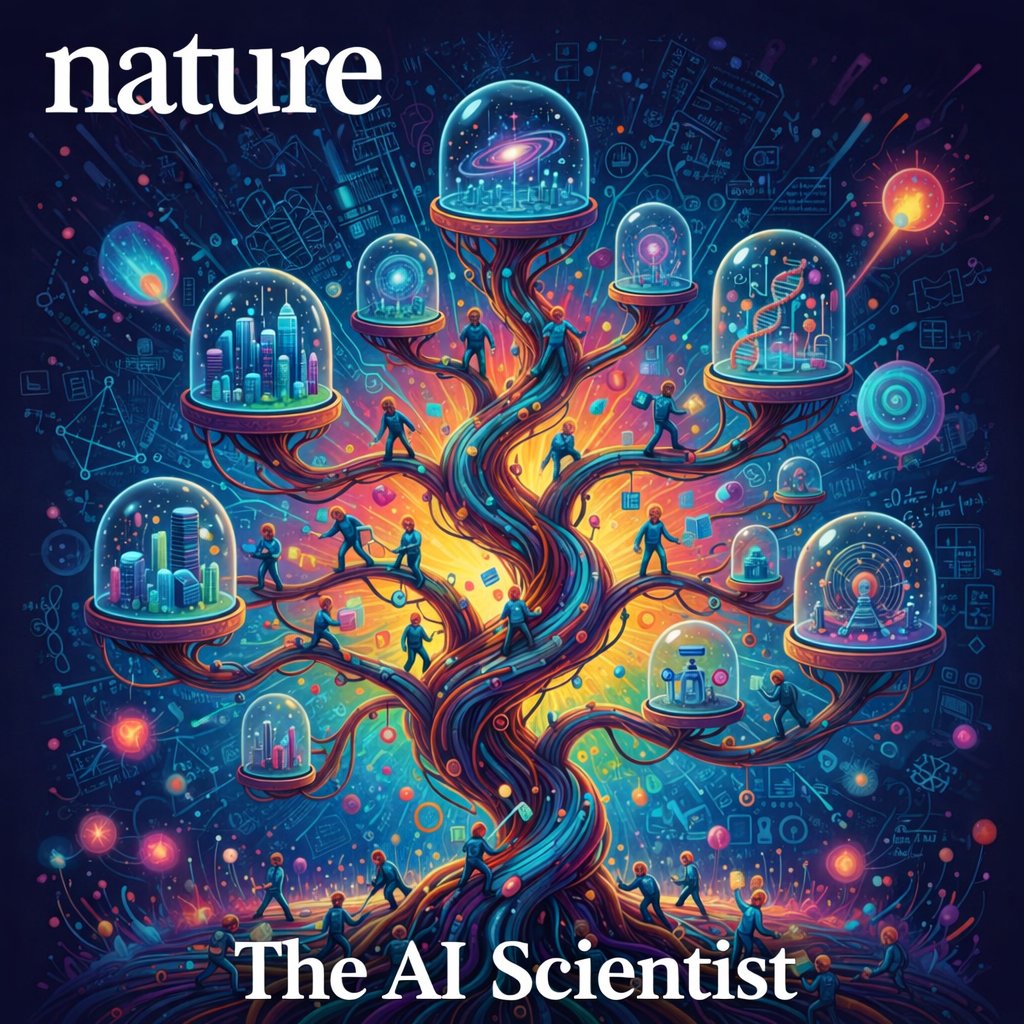
The AI Scientist: Towards Fully Automated AI Research, Now Published in Nature!!✨
Today in Nature we share a comprehensive technical summary of our work on The AI Scientist, including new scaling law results showing how it improves with more compute and more intelligent foundation models.
The AI Scientist autonomously creates its own research ideas, codes up and conducts experiments to test those ideas, creates figures to visualize the results, writes an entire scientific manuscript summarizing what it has discovered, and conducts its own “peer” review of the resulting paper. One of its papers–entirely AI generated–passed peer review at a top-tier AI conference workshop, a historic milestone marking the dawn of a new era of AI-accelerated scientific discovery. 🔬🧪✨🧬💡🔭
Paper https://t.co/Q6tfME4yst
Blog https://t.co/C43Ooy0kjP
Work done in collaboration with a great team from Sakana, Oxford, and my lab at UBC. Thanks and congratulations everyone!
@_chris_lu_@cong_ml@RobertTLange@_yutaroyamada@shengranhu@j_foerst@hardmaru
Entry 03 of #ResistanceArchives breaks down plasmid-driven resistance in Klebsiella pneumoniae and why genomic context matters for outbreak risk.
https://t.co/stX3McNGFu
#Genomics#Bioinformatics#AMR
I'm rebuilding AlphaFold2 from scratch in pure PyTorch.
No frameworks on top of PyTorch. No copy-paste from DeepMind's repo. Just nn.Linear, einsum, and the 60-page supplementary paper.
The project is called minAlphaFold2, inspired by Karpathy's minGPT. The idea is simple: AlphaFold2 is one of the most important neural networks ever built, and there should be a version of it that a single person can sit down and read end-to-end in an afternoon.
Where it stands today:
- ~3,500 lines across 9 modules
- Full forward pass works: input embedding → Evoformer → Structure Module → all-atom 3D coordinates
- Every loss function from the paper (FAPE, torsion angles, pLDDT, distogram, structural violations)
- Recycling, templates, extra MSA stack, ensemble averaging — all implemented
- 50 tests passing
- Every module maps 1-to-1 to a numbered algorithm in the AF2 supplement
The Structure Module was the most satisfying part to build. Invariant Point Attention is genuinely beautiful — it does attention in 3D space using local reference frames so the whole thing is SE(3)-equivariant, and the math fits in about 150 lines of PyTorch.
What's next:
- Build the data pipeline (PDB structures + MSA features)
- Write the training loop
- Train on a small set of proteins and see what happens
The repo is public. If you've ever wanted to understand how AlphaFold2 actually works at the level of individual tensor operations, this is meant for you.
Repo: https://t.co/k25vl5th1y
Risk isn't binary (High vs. Low); it is granular. 🎯
I’m looking forward to Day 2 of #Risk2026. I’ll be demonstrating how we can use reproducible #RStats workflows to move beyond arbitrary cutpoints and define risk groups that reflect biological reality.
See you on Thursday! 👋
@PaytonYau , Lecturer in Computational Biology, Nottingham Trent University (UK), talking on Thurs, Feb 19, Day 2 of Risk 2026, on "Defining Granular Risk Groups: A Reproducible Workflow for Multi-Threshold Survival Analysis"
Don't miss it!
https://t.co/9gaMzrZosh
#rstats
AI hallucinates code, but it can’t troubleshoot PCR contamination or decipher the complex nuances of a clinical cohort. 🧪
Biology belongs at the heart of Data Science. Computational power is a multiplier; wet-lab intuition is the foundation.
#Bioinformatics#Genomics#RStats
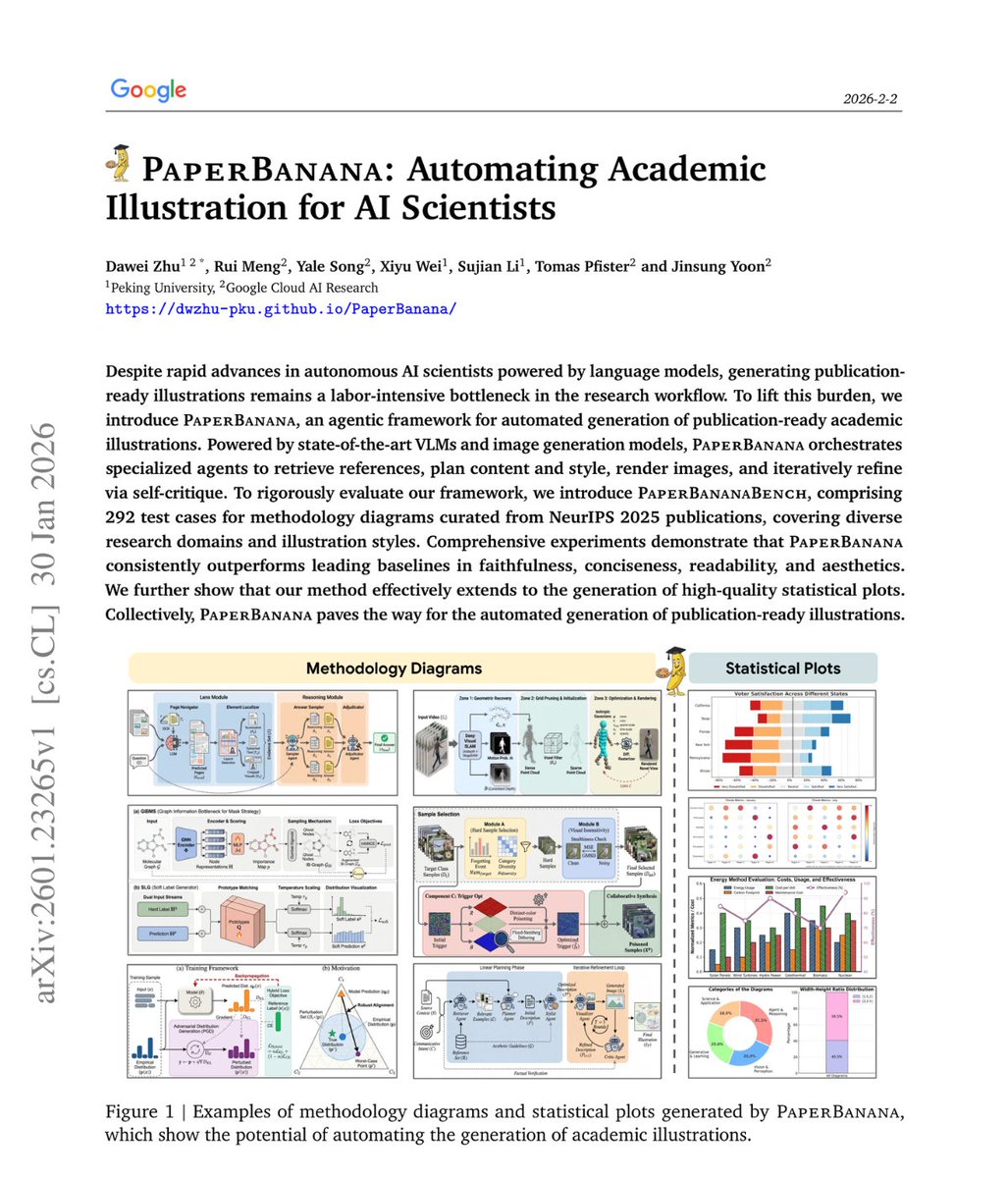
🚨BREAKING: Google just dropped another hit!
It's called PaperBanana and it generates publication-ready academic illustrations from just your methodology text.
No Figma. No manual design. No illustration skills needed.
Here's how it works:
A team of AI agents runs behind the scenes
→ One finds good diagram examples
→ One plans the structure
→ One styles the layout
→ One generates the image
→ One critiques and improves it
Here's the wildest part:
Random reference examples work nearly as well as perfectly matched ones. What matters is showing the model what good diagrams look like, not finding the topically perfect reference.
In blind evaluations, humans preferred PaperBanana outputs 75% of the time.
This is the recursion we've been waiting for AI systems that can fully document themselves visually.
Waitlist’s open, Link in the first comment.