Four years after Russia’s full-scale invasion, the war has settled into a grinding stalemate. Moscow has yet to achieve its central objective of seizing the entire Donbas region.
John Reed explains where the conflict stands now — and what comes next. https://t.co/HhdKsK77zE
Wowee!!!!
Payrolls grew a massive +172k in May, well above expectations.
April also revised up +64k to +179k, and March revised up +29k to +214k.
The labor market appears to be motoring along after a slow 2025.
Take that recession talk off the table.
The Trump administration proposed imposing additional duties of 10% or 12.5% on imports from 60 economies after determining their failures to curb trade in goods made with forced labor are unreasonable and restrict US commerce. More here: https://t.co/mEdWkrsf0s
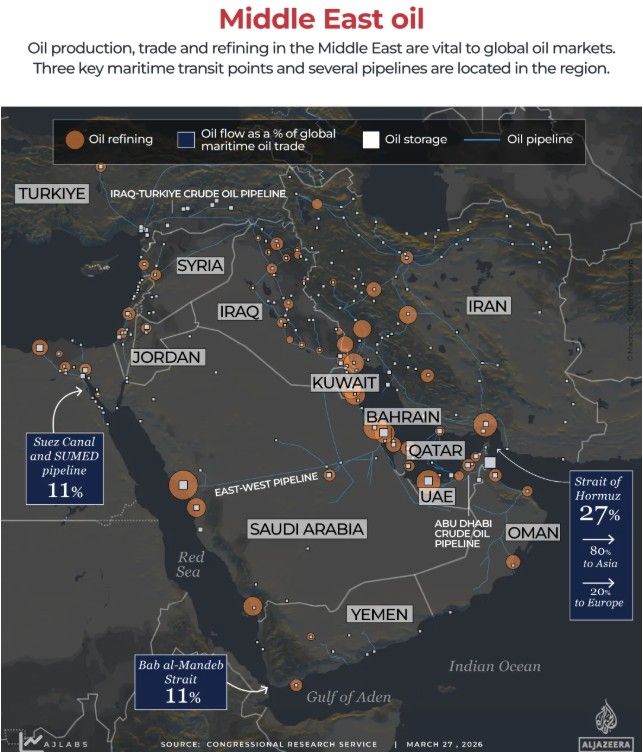
🚨Iran just threatened to close both Hormuz and Bab el-Mandeb simultaneously.
🛢️📈Oil jumped 6% in minutes.
This morning, Iran's state outlet Tasnim reported via Telegram:
→ Iran will halt indirect talks with the US
→ Iran and the "resistance front" will "completely block" the Strait of Hormuz
→ They will "activate other fronts" including Bab el-Mandeb
That's not one maritime chokepoint. That's both of them at once.
The oil market reacted immediately not because barrels stopped flowing today, but because the market is repricing the probability of a scenario it had not yet fully priced.
Brent was in the low-to-mid 90s.
A 5%+ intraday move pushes it toward the high 90s.
$100 is now the obvious psychological test.
Why this threat lands differently than previous rhetoric.
Hormuz alone carries roughly 20% of global crude and LNG trade.
The world has already been losing an estimated 4.5-5 mb/d since the conflict began the largest supply disruption on record before any declared full closure.
Bab el-Mandeb is the southern gate of the Red Sea and the Suez corridor the primary East-West shipping artery.
Attacks there close the Suez route for any cargo that hasn't already been rerouting around the Cape.
Both chokepoints disrupted simultaneously means there is no unaffected route from the Persian Gulf to Europe or Asia that doesn't add weeks to voyage time.
The strip is not yet pricing the worst case.
“China, North Korea, and Russia have found common cause in seeking to erode Washington’s power and influence,” writes @patricia_m_kim. Despite their “carefully choreographed display of unity,” however, the three countries “remain uneasy partners.”
https://t.co/62gcPnSgkW
“The United States has not defeated Iran, and thus cannot dictate a victor’s terms or expect Iran’s total capitulation,” argue @jekavanagh and @RKelanic. Achieving a deal will likely require “uncomfortable U.S. concessions.”
https://t.co/LDNsXMe6JX
“Oil analysts estimate that 83% of the increase in Chinese crude oil imports in 2025 was stock driven, rather than purely consumption driven. During the war in Iran, China became a shock absorber. China’s large inventory cushion allowed it to reduce imports sharply.”
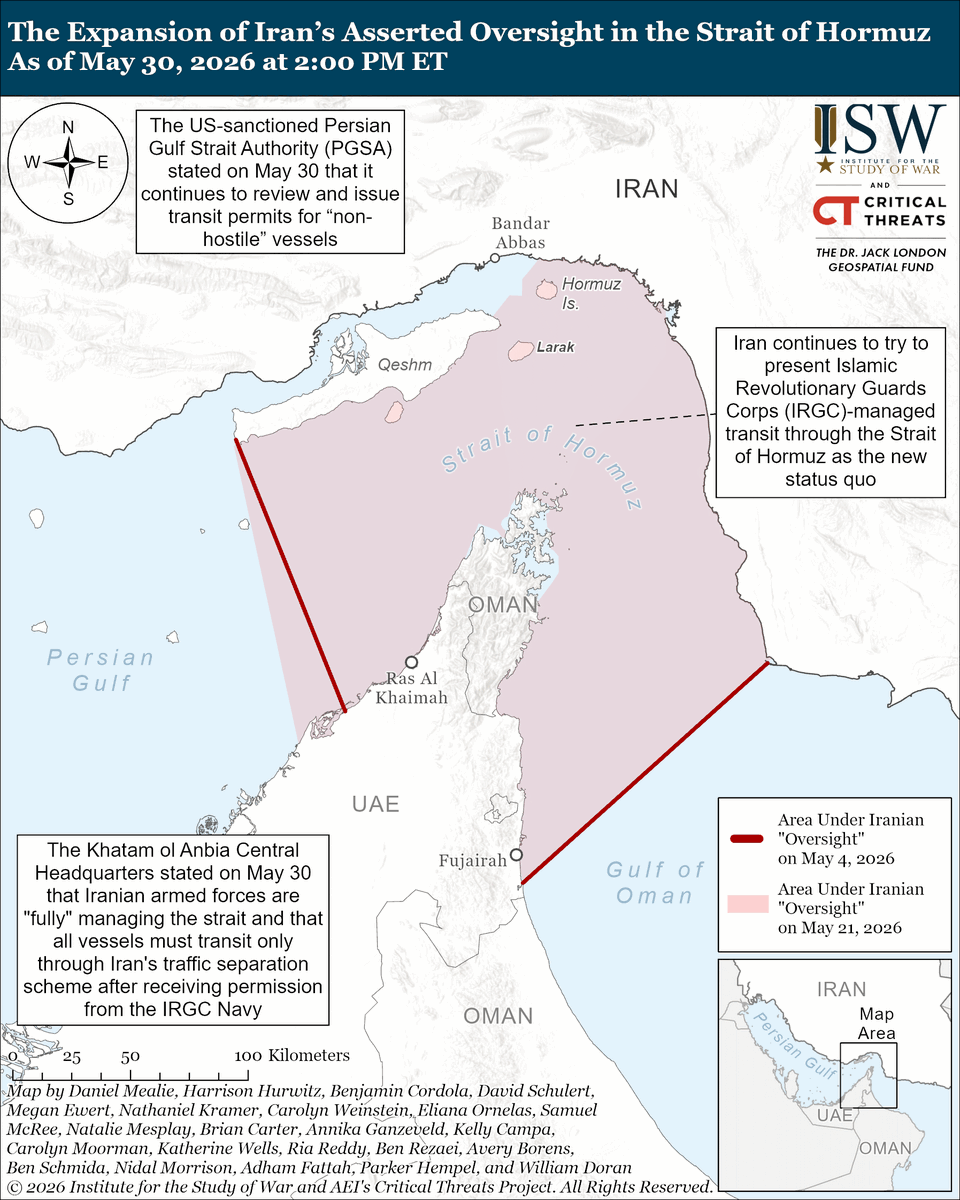
NEW: Iran continues to try to frame the Islamic Revolutionary Guards Corps (IRGC) “management” of transit through the Strait of Hormuz as the new status quo. The United States and international community must continue to reject Iranian efforts to try to establish this new status quo, as it is detrimental to international commercial interests and sets a dangerous precedent for freedom of navigation in international waterways.
Other Key Takeaways:
Neither the United States nor Iran has indicated that the two sides have narrowed gaps on key issues in the US-Iran negotiations, such as economic relief for Iran. Iran likely seeks unrestricted access to its frozen assets to reduce the effect of US sanctions and the naval blockade and support its military reconstitution.
The hardline faction within the Iranian regime is not a monolith but contains a spectrum of actors with varying priorities, opinions, and political positions. ISW-CTP continues to assess that hardline IRGC officials, particularly IRGC Commander Major General Ahmad Vahidi and his inner circle, are unwilling to make meaningful concessions in negotiations with the United States.
Iran may have used a Chinese-made man-portable air defense system (MANPADS) to target US aircraft during the war, according to three individuals familiar with the matter speaking to Western media. (1/2)
The war in Iran has exposed the U.S. and allied vulnerability to low-cost drones. "The United States should invest substantially more resources into drones and less into costly, manned systems," writes expert @MaxBoot. "China and Russia are likely to field even more advanced missile and drone forces than Iran. The United States needs to be ready—not only tactically and technologically but also strategically." Read more: https://t.co/t0eQhslqeV
“Even more important, the law of supply and demand will eventually become unavoidable: Countries are running through their stockpiled oil reserves quickly and could begin to exhaust them over the next month” https://t.co/NbrkW7HFiC
KEY TAKEAWAY: Any arrangement in which maritime traffic can only pass through Iran’s traffic separation scheme with Iranian approval contradicts the US demand for freedom of navigation, and such an arrangement would significantly undermine US interests and establish a dangerous precedent for the freedom of navigation in international waterways.
Read more ⬇️
Real personal income per capita is falling apart.
It's now $3,842 below the 2009-2020 trend and accelerating lower.
It keeps getting worse for the average American, and Main Street can feel it.
Meanwhile...
The Gulf’s carefully cultivated image as a stable investment destination has taken a blow that no amount of official reassurance can quickly repair, writes @ahandjani. https://t.co/2m9DOD9APY
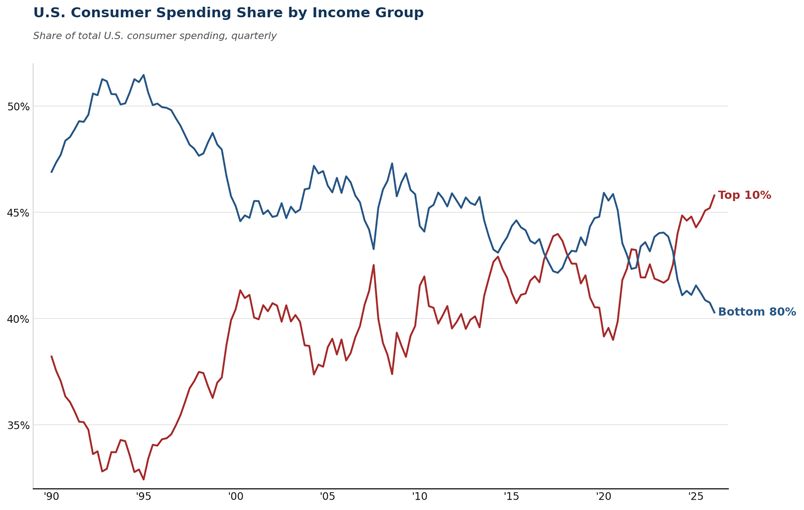
Under Trump, the highest income Americans are getting wealthier and spending more.
The bottom 80% are seeing their wealth eroded by inflation, forcing them to cut back drastically.
My @Morning_Joe Chart
NEW: Senior Iranian officials continue to frame Iranian control over the Strait of Hormuz as a strategic necessity and core element of Iranian deterrence against the United States and Israel.
Other Key Takeaways:
Iranian officials continue to insist that Iran will “reopen” the strait to civilian shipping under “Iranian arrangements.” Any arrangement in which maritime traffic can only pass through Iran’s traffic separation scheme with Iranian approval contradicts the US demand for freedom of navigation, and such an arrangement would significantly undermine US interests and establish a dangerous precedent for the freedom of navigation in international waterways.
Conflicting reports about the draft US-Iran agreement, as well as public statements from both sides, highlight continued disagreements on other key issues between the United States and Iran. Iran’s proposed sequencing of concessions would require the United States to surrender key sources of leverage before negotiations over Iran’s nuclear program begin, which would significantly reduce US leverage in any future nuclear negotiations.
Iranian media outlet Nour News published an op-ed that emphasized the need for Iran to convert its recent “military victory” into broader political success, which reflects a belief within the regime that Iran emerged from the recent conflict in a position of strength. Iran’s maximalist and uncompromising negotiating positions reflect the Iranian regime’s effort to translate its perceived success in the war into long-term strategic and political gains.
An Israeli open-source intelligence analyst posted satellite imagery that shows Iranian reconstitution efforts at the Yazd Missile Base in Yazd Province since the start of the US-Iran ceasefire in April 2026. These reconstitution efforts corroborate ISW-CTP’s assessment that Iran is exploiting the ceasefire period to reconstitute its military capabilities at the tactical and operational levels.
"The regime will not only have survived a major military onslaught from the U.S. and Israel but emerge with a deal better than any on offer before the war. Its officials reportedly feel that Iran has won the war, or at least not lost it" https://t.co/TA42Z5nKZK
Robin Brooks has posted a new analysis -- a very good one -- that agrees with my own: The situation in the global oil market really hits the fan by late July. However, I do have one major quibble 1/3:
https://t.co/XTOA800PWK
“For Trump to respond to this defiance by now calling for another 30 days of cease-fire and talks is a tacit admission of defeat. If he does launch a performative attack in the next few days, the Iranians will understand it for what it is” https://t.co/NCNiVylh6M