My college degree recommendations for fresh high school graduates in the age of AI to be prepared for the next frontier:
- Applied Physics (math and physics)
- Applied Materials (physical agentic)
- Agriculture (food production in space)
- Aerospace (frontier transportation)
- Civil Engineering (infra + life support from Earth and beyond)
- Electronic Engineering (scaling compute and communications to the solar system)
- Manufacturing (where things get made)
- Mechanical Engineering (packaging, manufacturability, tolerances and cycling)
- Medicine (personal drugs in space)
Europe wants digital sovereignty. So they forked a Russian company's software and called it their own.
Meet Euro-Office, the latest project under EuroStack, the EU's big push to reduce dependence on Big Tech.
The backers are impressive: Tuta, Nextcloud, IONOS, OpenProject, Open-Xchange, and several other European companies have put their names on it.
The problem? Euro-Office is a fork of OnlyOffice. And the OnlyOffice team did not take that news well.
OnlyOffice is technically registered in Latvia. But its origins trace back to Russian developers, and in the current geopolitical climate, that detail has clearly not been lost on European institutions.
The irony practically writes itself: a coalition of European companies building "digital independence" by taking over the codebase of a project they want to distance themselves from geopolitically.
Open source licenses allow this. That is not in question. But there is a difference between forking a project to improve it and forking a project to rebrand it under a politically motivated banner while the original developers watch from the sidelines.
The OnlyOffice team built something genuinely good. It is used by millions. Now a well-funded European consortium is essentially saying: "We like what you built. We just do not want it to be yours anymore."
Is this digital sovereignty, or is it open source politics with a nicer logo?
Your thoughts?
In the world of robotics, machine learning is one small part of the equation. It also involves working with materials that may change over lifecycles to deliver persistent performance.
For example, oxidation happens at different rates depending on humidity and thermal gradients, which in turn change material properties such as stiffness or elasticity.
You know someone is knee-deep in robotics if asking them oxidation questions generates the same facial expression as asking normalization questions to a machine learning engineer.
The question keeps coming 👀
𝐖𝐡𝐚𝐭 𝐜𝐚𝐧 𝐲𝐨𝐮 𝐚𝐜𝐭𝐮𝐚𝐥𝐥𝐲 𝐛𝐮𝐢𝐥𝐝 𝐰𝐢𝐭𝐡 𝐭𝐡𝐞 𝐆𝐫𝐨𝐤 𝐁𝐮𝐢𝐥𝐝 𝐂𝐋𝐈?
If you’re a 𝐭𝐞𝐚𝐜𝐡𝐞𝐫 or 𝐩𝐚𝐫𝐞𝐧𝐭, you can create interactive learning experiences for your classroom or your kids in minutes.
Let me quickly show you how.📽️🔉
The company that once called Linux a "cancer" is now the one shipping its core tools to Windows users.
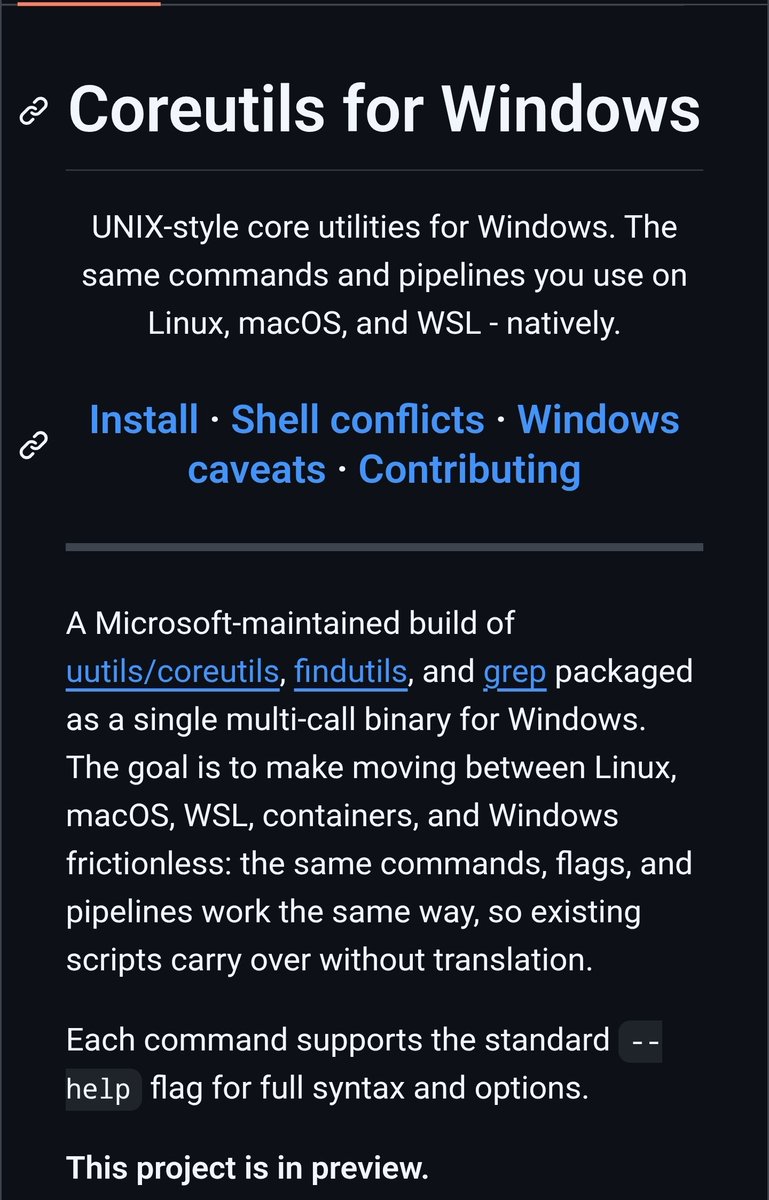
Microsoft just shipped GNU coreutils for Windows.
ls. grep. cat. cp. find. The same commands that have powered Unix and Linux systems for over 50 years are now available natively on Windows, maintained by Microsoft itself.
For context: GNU coreutils are the foundational utilities that every Linux and macOS system relies on for basic file operations, text processing, and shell scripting. They are the bedrock of Unix computing. Tens of millions of scripts, pipelines, and workflows run on them every day.
And now Microsoft is shipping and maintaining a build of them for Windows.
This is not WSL. You do not need a Linux subsystem running in the background. These tools run natively on Windows, with the exact same flags and behavior as on Linux. Your existing scripts just work.
Microsoft's goal: make moving between Linux, macOS, WSL, containers, and Windows completely frictionless. Write a script once. Run it anywhere.
The package bundles uutils/coreutils (a modern Rust rewrite of GNU coreutils), findutils, and grep into a single multi-call binary. Every command supports standard flags. Same commands, same pipelines, no translation needed.
The project is still in preview. But the direction is unmistakable.
Plan your daily commute in Mumbai easily now! 🚉✨
Live local train updates for Mumbai users are now available on Google Maps and currently rolling out on Where Is My Train. Track your train in real-time, get schedule adjustments, and know your platform changes instantly to avoid the last-minute rush.
Made possible with data from our partners at @YatriRailways
Turn a multi-step process into a single workflow, powered by NVIDIA RTX Spark.
See how an agent like @NousResearch Hermes Agent helps transform a concept sketch into a photoreal render, connecting Rhino, @ComfyUI, and @Blender into one seamless workflow so designers can stay focused on their vision.
The next evolution of Hermes Agent is here!
Introducing Hermes Desktop: everything you love about Hermes, now native on your machine.
First demoed in Jensen's GTC keynote, it's now in public preview.
Composer 2.5 is now available inside Grok Build.
Composer 2.5 is a fast, highly intelligent model that excels on long-running tasks and following complex instructions.
Steady long term Principles of Least Action + Smart and wise adventures action variations at regular intervals = Maximum growth that exceed what PLA can achieve with locked in fixed time period! @grok
The seven crystal systems classify minerals according to the symmetry of their atomic lattices, shown here with the characteristic axis arrangements and real examples ranging from spinel and garnet in the cubic system to amazonite in the triclinic.
These internal structures directly determine a stone’s external traits—how it grows, cleaves, refracts light, and holds up under wear. Gem cutters rely on this information to choose facet angles that maximize brilliance and fire, while the same principles guide material selection for jewelry durability and for technical uses such as quartz in precision timing devices or corundum in optical components.
Why does this scale?
Because the pattern is PROVEN at massive scale:
• Redux → Millions of apps, 500k+ LOC codebases
• Erlang/OTP → 99.9999999% uptime systems
• Akka → Millions of actors, fintech, gaming
• Trading systems → Millions of msgs/sec
This isn't theory. It's battle-tested.
This is elomaxz.
A hybrid MVU framework for C that combines:
• Elm-style predictability
• Functional Core + Imperative Shell
• Actor Model composition
One tiny contract. Infinite scale.
The awe-inspiring part:
The SAME 150 lines that power a simple CLI counter can power:
• 10,000 concurrent connections
• ML training across 8 GPUs
• Security audits across 500 machines
• 100,000 messages/sec trading systems
Not because it's magical.
Because the pattern is SOUND.
Please rethink, algorithmic feed, creator revenue share. They can be separated. Why can't be creators rewarded for their content irrespective of views (pure quality, be it AI assisted).
Creators/Curators with M views are not so relevant to pull more users or engagement for X. Find a way for revenue share reaches to those who quitely write and share great and high SIGNAL things and didn't mind too much about returns.
If somebody can crack the algorithm and find a money glitch and make a lot money, it is not good algo either. Other platforms are there for that
Why does this scale?
Because the pattern is PROVEN at massive scale:
• Redux → Millions of apps, 500k+ LOC codebases
• Erlang/OTP → 99.9999999% uptime systems
• Akka → Millions of actors, fintech, gaming
• Trading systems → Millions of msgs/sec
This isn't theory. It's battle-tested.
This is elomaxz.
A hybrid MVU framework for C that combines:
• Elm-style predictability
• Functional Core + Imperative Shell
• Actor Model composition
One tiny contract. Infinite scale.
The awe-inspiring part:
The SAME 150 lines that power a simple CLI counter can power:
• 10,000 concurrent connections
• ML training across 8 GPUs
• Security audits across 500 machines
• 100,000 messages/sec trading systems
Not because it's magical.
Because the pattern is SOUND.