@sporadica Also, ≈9/10 people can drink regularly and have a great life. But for ≈1/10, it's terrible. The ceiling of harms from weed is lower than alcohol, but the percentage of people who can use it regularly without wrecking their life is probably lower too. I'm guessing it's ≤75%.
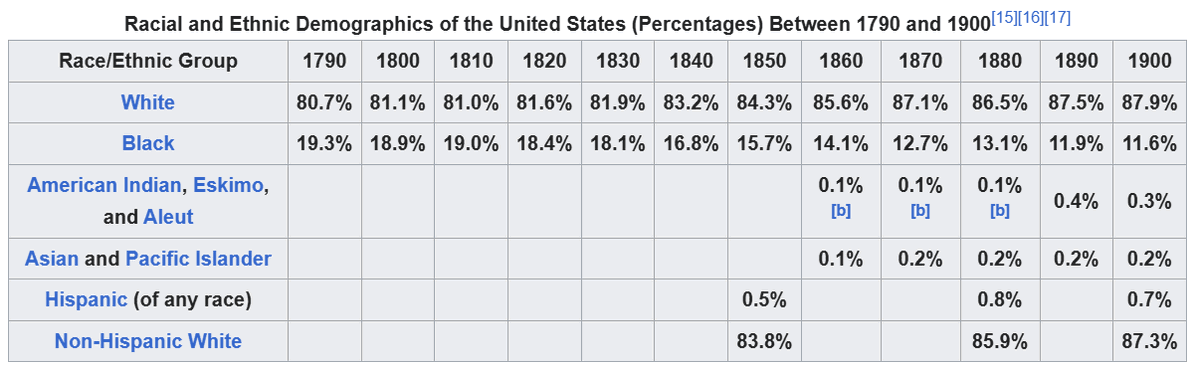
@Deist_Darwinist@IterIntellectus Doesn't this prove that the U.S. was always multiethnic? If you're advocating for what existed in 1790, you are advocating for an apartheid state, not a monoethnic state.
@nntaleb The particular advice I gave above, I cannot say my mother would be in need of.
But fair enough, you won't hear a criticism from me again. Have a pleasant day.
@allTheYud What if instead of 21 though, we were talking about a new number I just made up called "Abbot's Number." Nobody knows what Abbot's number is, but we know it has 420^69 digits. There are infinitely many numbers that aren't Abbot's Number, but still nobody knows what it is.
Yeah, I don't really agree. The main driving point in Philosophical Investigations is words have functional meaning in the context of specific language games. We don't have to have perfect off-the-shelf definitions for words, and furthermore we cannot. When you go to the store and ask for "five red apples," you're not subjected to some paint-card test of "well what is red, really" because it's not relevant to the question. When we learn more about what qualia are, I expect we will find that some of our previous questions were imprecise. But I think we know what qualia are perfectly well enough for "do LLMs have qualia?" to be a meaningful question which Wittgenstein would be interested in. As opposed to questions like "but do LLMs *really* think?" which is perfectly analogous to the discussion in Philosophical Investigations 156 et seq. about what is reading.
@quasicoh I'll admit "consciousness" is a bad word because it means multiple things.
But I think we know what qualia are. At least I know what I mean when I use the word. And when I hear other people use the word, it sounds to me like they're describing the same thing.
@quasicoh These questions are different from (for example) "Am I the same person I was 5 years ago?" or "Can undeserved mercy ever be just?"
Both questions are merely seeking definitions of words they contain. They have no clear utility outside of therapeutic philosophy.
@quasicoh Because it frames useful inquiry. For example:
"P?=NP"
and
"Will it rain in NYC on October 5, 2061?"
Two well-defined questions, but we aren't even close to understanding how to answer either of them.
By trying to figure out how to answer the above questions, we learn.
@deredleritt3r@willchen500 Totally my experience. Also, it's not just lawyers. All my clients are using ChatGPT or Claude, but they all seem to be using the free or lowest thinking version. At this point, I feel like 50% of my work is just doing LLM arbitrage, using Astra 6 to clean up work from 5.6 Luna.
@PAHoyeck Fun fact: In the U.S., actuarial life expectancy doesn't drop below 1 year from present date until you're over 100. So if you're of average health and under 100, you can on average expect to reach your next birthday.
Let's back up here.
True economic efficiency cannot exist. The economy, where goods and services are exchanged for valuable consideration, is only one part of a broader communication network on which information (i.e. memes) can propagate and spread. For a while in the 20th Century it looked like economic efficiency could be achieved and was the driving civilizational force. But that's only because economic media of exchange were ahead of the curve in terms of communications capacity and efficiency.
With the internet, that all fundamentally started to change. Now, the vast majority of information flowing between nodes in the network (e.g. humans and computers) is not directly economic. It's a pure exchange of information as opposed to an exchange that is measurable in dollars and cents.
This is going to continue to increase as more and more and more bots proliferate and the global communications bandwidth becomes greater and greater. Furthermore, due to the reduced cost of sending information which this expansion drives, economic concerns become less and less so a limiting part of the (meme) market.
The duration of individual memes is a function of their fitness and therefore the composition of memes in the (meme) market is a function of their fitness. While these memes primarily spread through online communication, online communication becomes a sufficiently large part of the overall discourse that memes that originate online spread to all kinds of offline communication.
The effect is also mimetic (not just memetic), since humans desire is driven in part by jealousy and a desire to imitate. Human preferences are therefore shaped by the durability (and therefore fitness) of primarily online memes.
Now, back to the original question. The discussion is about whether noneconomic factors can slow the diffusion of AI tools into various parts of the economy. I think the overwhelmingly likely answer is yes.
As discussed above, economic efficiency is no longer the primary driving societal force--meme propagation is. There is good evidence (and there are good naive reasons to believe) that "resistance to technology in general and/or AI specifically" is a feature of ideas that gives them durability, and therefore fitness, and therefore memetic potential. The main disadvantage of avoiding technology is economic. Advanced technology almost by definition allows economically useful work to be done more efficiently.
But technology is also a force of change which tends to change minds and ideas. For a meme to have durability, it needs to have something of an immune resistance to change. Otherwise, the meme will rapidly mutate and decay into another kind of meme. As such, any characteristic of a meme that makes it resistant to change will also increase its fitness. This suggests that in the future meme economy, many successful memes will have an inherent conservatism which resists technological adoption.
There is also empirical evidence of this. Just look at how much resistance there is online to using AI, data centers, Flock cameras, etc. etc. Also consider how successful cultures which limit certain technological features (e.g. the Amish, Orthodox Jews) have been in persisting relatively unchanged in the face of otherwise universal cultural change during the 20th Century.
It is possible for ASI to understand all the above and completely capture the meme economy to our exclusion, not even allowing us little areas of culture that are immune from its influence. If it does this, it will have utterly disempowered us.
@thePartyPartyUS Solving all (economically) irrational human preferences that way sounds like forced wireheading, which is just "killing all humans" with more steps.