(7/7) We wish to thank the thousands of citizen scientists and participants — recruited in-person and online at https://t.co/JeXwLUkI0n — whose efforts enabled the multiple replications and large samples that give solidity to these findings.
"Face recognition's practical relevance: Social bonds, not social butterflies" 📢New paper from our former PhD student @lauramengfors & a great team including @jeremywilmer, @drmeenie, @gillesegignac,
@lauragermine, @linjef
https://t.co/N3WzJ5n8kh
🧵(1/7)👇
(6/7) Our discoveries underscore the value of good face recognition while suggesting likely struggles associated with poor face recognition. This insight helps us to better understand and support those with varying abilities.
Long COVID, often reported to cause Brain Fog, may also cause #prosopagnosia#faceblindness, say researchers at Dartmouth College USA. Individuals affected can struggle to recognise even close friends and family https://t.co/16Jx2LmEET
These neural responses were observed in the absence of explicit instructions to attend to facial trustworthiness.
Proud supervisors & collaborators are @C_AMSutherland @DrMeenie @DerekSwe@linjef & Scott Gwinn.
@UWApsych
Free download latest paper from @PersonPercept student Saba Siddique’s PhD. Using FPVS we found that 8-9 year old children show reliable neural responses to variations in facial trustworthiness that didn’t differ in strength from adult responses.
https://t.co/ORO4YvJ5my
In a repeated economic game, children first relied on partners' facial trustworthiness to make decisions. But by the end of the game, they had overcome this bias and switched to relying on partners' previous behavior.
https://t.co/tPe58L8Ydf
DEADLINE EXTENDED
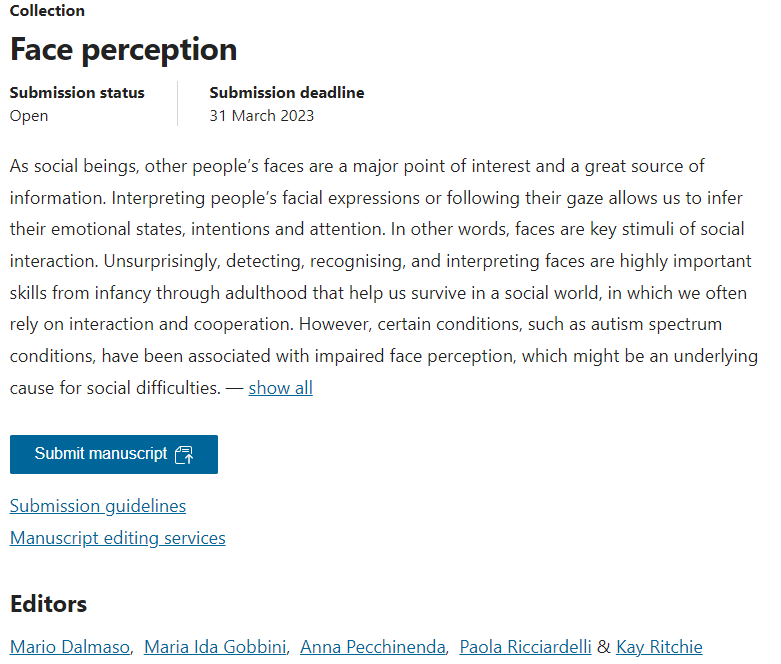
📢 Scientific Reports is seeking submissions for a special issue on FACE PERCEPTION 🙂🙃😆🙄🤩😬
📅 NEW Deadline: 31 March 2023
More info ⬇️ ...please RT
https://t.co/KY984FhEGQ
@SciReports
New paper: How quickly do we learn new faces in everyday life? @MilaPopova8 and I think about 10 minutes of real-life interaction are sufficient. @CORTEXjournal@DurhamPsych@DROdurham
https://t.co/1FwRKiNngL
Check out our newest paper on face-blindness.
Lots of research has focused on finding one explanation for why people can’t recognise faces, but we think there are (at least) two! A 🧵… (1/8)
https://t.co/erCfAseEgw