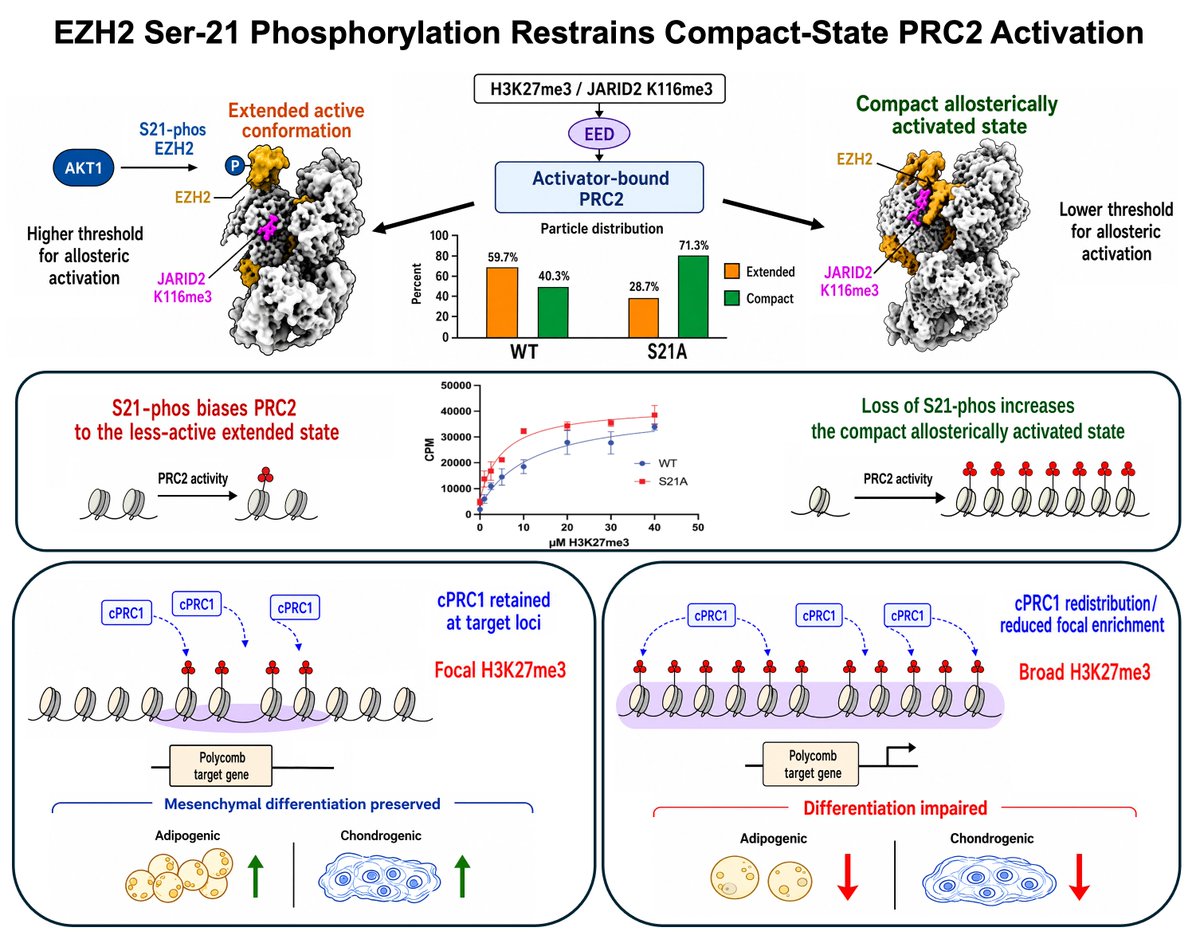
@vignesh_k757 Allosteric activation of PRC2 is coupled to adoption of the compact state. Our new bioRxiv manuscript shows that EZH2 S21-phos, adjacent to the SANT1 domain, restrains this conformational transition and limits activation. @vignesh_k757 & Ben Garcia lab https://t.co/ZF5gOGI3x0
Preprint alert!
We are very excited to share our new manuscript on Bohring-Opitz syndrome, a devastating rare monogenic disorder driven by variants in ASXL1.
This project was led by PhD student @Emma_JDoyle, one of the OG Conway lab members👏. 1/6
https://t.co/RifZXBqiKS
Independent of sequence, disordered regions promote the stable chromatin occupancy required for pioneer-factor activity @ScienceAdvances
https://t.co/a82N4qcoLw
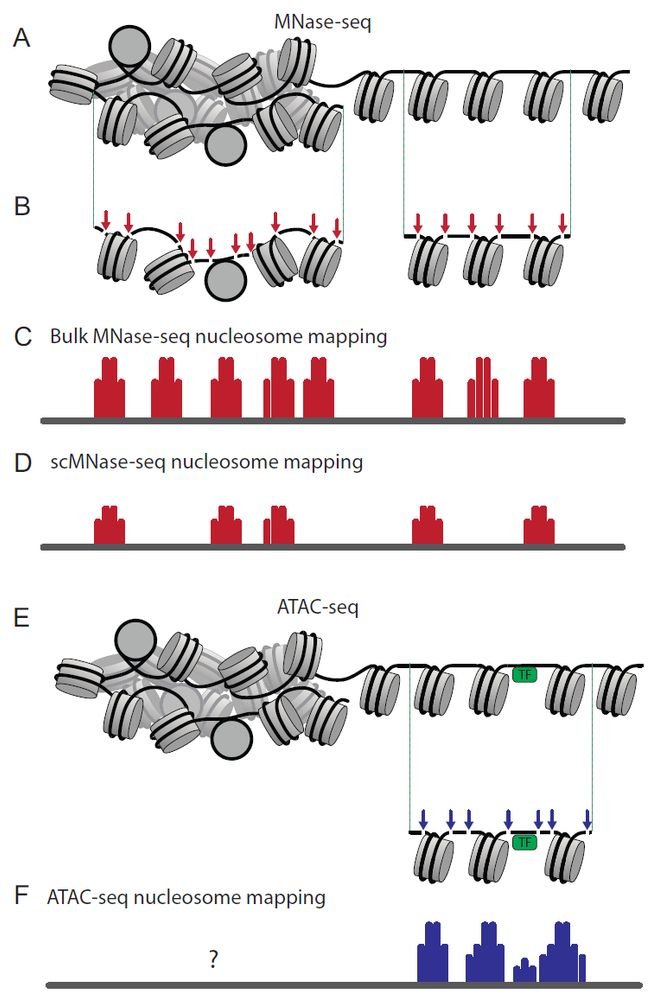
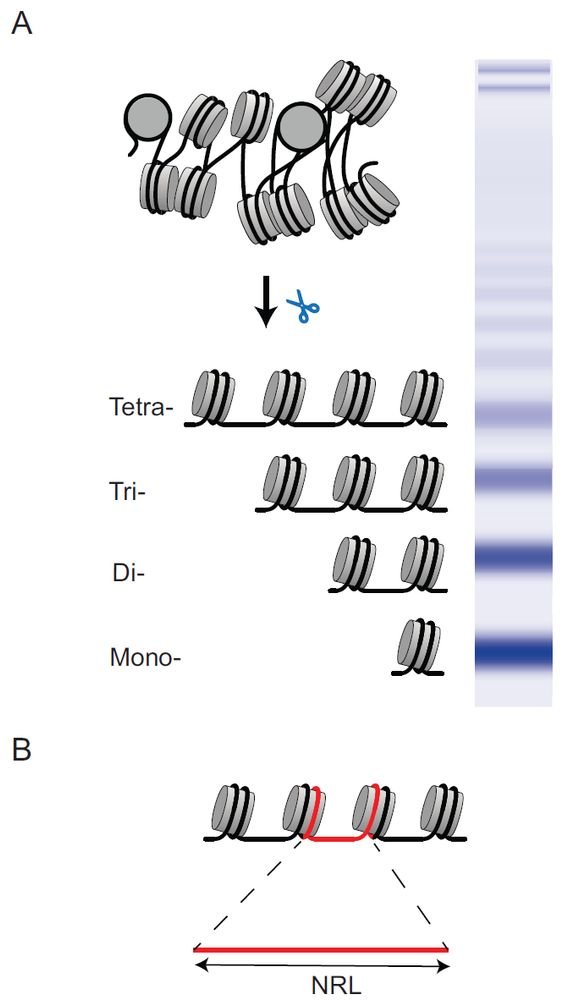
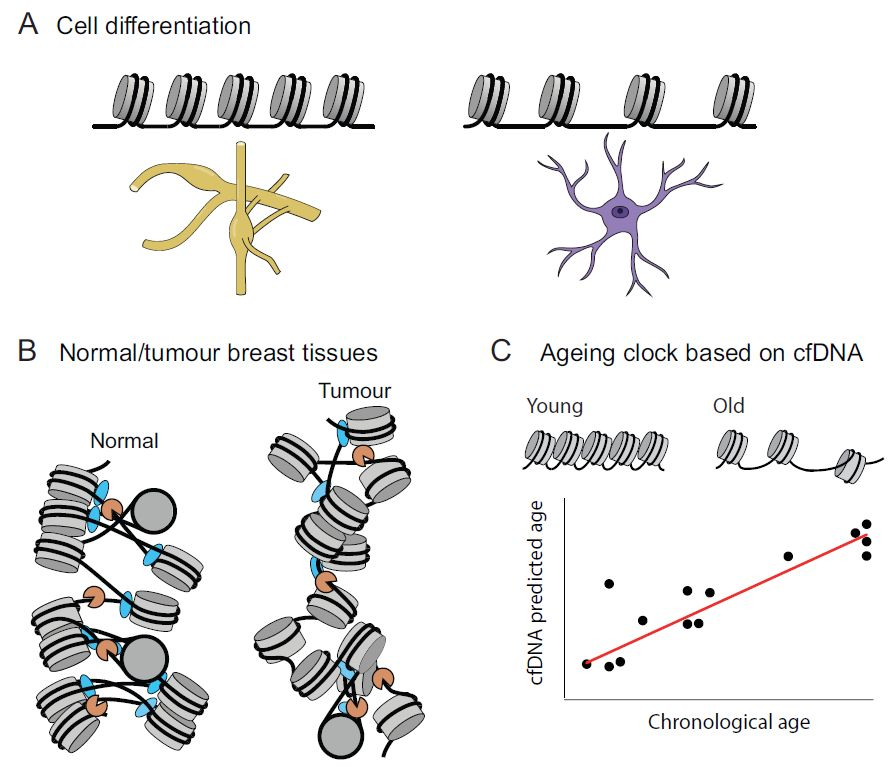
Nucleosome aficionados! Our new review "Nucleosome spacing across cell types, diseases, and ages" is out in NAR: https://t.co/Z1TgEYxBH8
A huge effort to pull together what we’ve learned about nucleosome spacing in many systems. Enjoy!
#nucleosomics#nucleosome#chromatin#cfDNA
Excited to share that our preprint 'RNA reinforces condensate nucleation on chromatin to amplify oncogenic transcription' is now online @MolecularCell https://t.co/3EHJdic0q4 @PennMedCSO@PennCancer@PennEpiInst
🔊 Check out the latest paper titled 𝘚𝘌𝘛𝘋𝟤 𝘮𝘦𝘵𝘩𝘺𝘭𝘵𝘳𝘢𝘯𝘴𝘧𝘦𝘳𝘢𝘴𝘦 𝘢𝘤𝘵𝘪𝘷𝘪𝘵𝘺 𝘱𝘳𝘰𝘮𝘰𝘵𝘦𝘴 𝘤𝘰𝘳𝘳𝘦𝘤𝘵 𝘵𝘳𝘢𝘯𝘴𝘤𝘳𝘪𝘱𝘵𝘪𝘰𝘯 𝘪𝘯𝘪𝘵𝘪𝘢𝘵𝘪𝘰𝘯 𝘢𝘯𝘥 𝘵𝘦𝘳𝘮𝘪𝘯𝘢𝘵𝘪𝘰𝘯, just published in the EMBO Reports @SpringerNature!
📲 https://t.co/pEMpkXtnXy
👩🏻🔬👨🏻🔬 The publication was authored by researchers from the GLaboratory of Genome Regulation (@STOPlabPI) and the Laboratory of Developmental Epigenetics, CAT AMU: Magda Kopczyńska, Agata Stępień, Michał Gdula, and Kinga Kamieniarz-Gdula. 👩🏻🔬👨🏻🔬The remaining authors are Chihiro Nakayama and Prof. Takayuki Nojima from @KyushuUniv_EN in Japan.
@vignesh_k757 Allosteric activation of PRC2 is coupled to adoption of the compact state. Our new bioRxiv manuscript shows that EZH2 S21-phos, adjacent to the SANT1 domain, restrains this conformational transition and limits activation. @vignesh_k757 & Ben Garcia lab https://t.co/ZF5gOGI3x0
@vignesh_k757 Allosteric activation of PRC2 is coupled to adoption of the compact state. Our new bioRxiv manuscript shows that EZH2 S21-phos, adjacent to the SANT1 domain, restrains this conformational transition and limits activation. @vignesh_k757 & Ben Garcia lab https://t.co/ZF5gOGI3x0
How do cells tune PRC2 allostery? We find EZH2 Ser21-phos restrains PRC2 adoption of the compact active state. Loss of this restraint promotes H3K27me3, redistributes cPRC1, and impairs differentiation. New bioRxiv with @vignesh_k757 & Ben Garcia lab! https://t.co/ZF5gOGI3x0
In a genome not so far away, the most elegant design in the galaxy was already wrapped into ~147 base pairs. #HappyNucleosomeDay, May-The-Fourth Be With You.
Excited to share our structural insights into how microtubules differentially guide phosphorylation of kinetochore-microtubule regulators, Ndc80 and MCAK, for chromosome segregation. Heroic efforts by Yiming Niu with a fun collaboration with DeLuca lab!
https://t.co/bdQftOqQ1B
Our latest research is now out in @NatureCellBio https://t.co/I3qN9dMG7o
We show that nonsense-mediated mRNA decay (NMD) pathway safeguards #telomere integrity in pluripotent #stemcells
Our linker histone H1 paper is out @ScienceAdvances: https://t.co/fGZsmvRPWK
@MasaAShimazoe et al. reveal that H1 acts as a liquid-like "glue" to organize chromatin in living cells. 🎉 Fantastic collab with @rcollepardo, @janhuemar, Charlie Phillips and others—huge thanks! 🙌 ½
How to make a heterochromatin by major satellite repeats transcripts?
Congrat @AleciaYHLO and Thomas Jenuwein lab for the work.
https://t.co/VQQzPSKUPZ
Epigenetics Update - Accessory subunits of PRC2 mimic H3K27me3 to restrict the spread of Polycomb domains https://t.co/doyD9dy7Vt
Edwina McGlinn & Chen Davidovich in Mol Cell
#Epigenetics#PRC2#H3K27me3
---
Perfect for cancer, immunology, and aging; https://t.co/WmSYDGWPJD
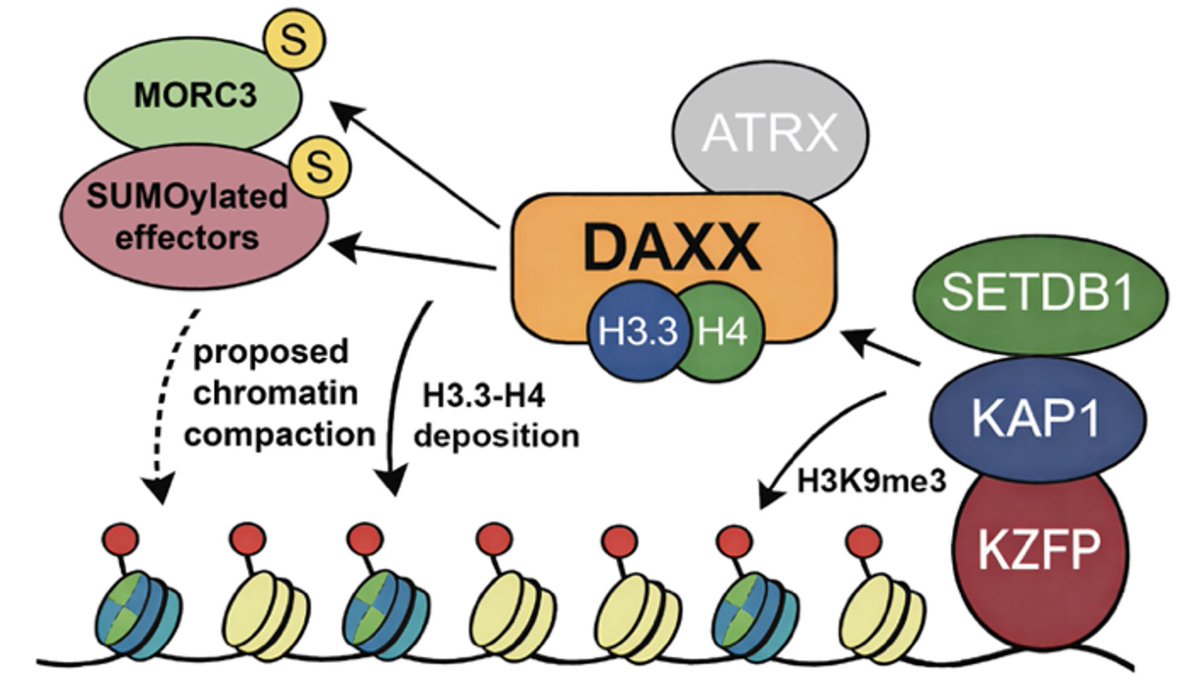
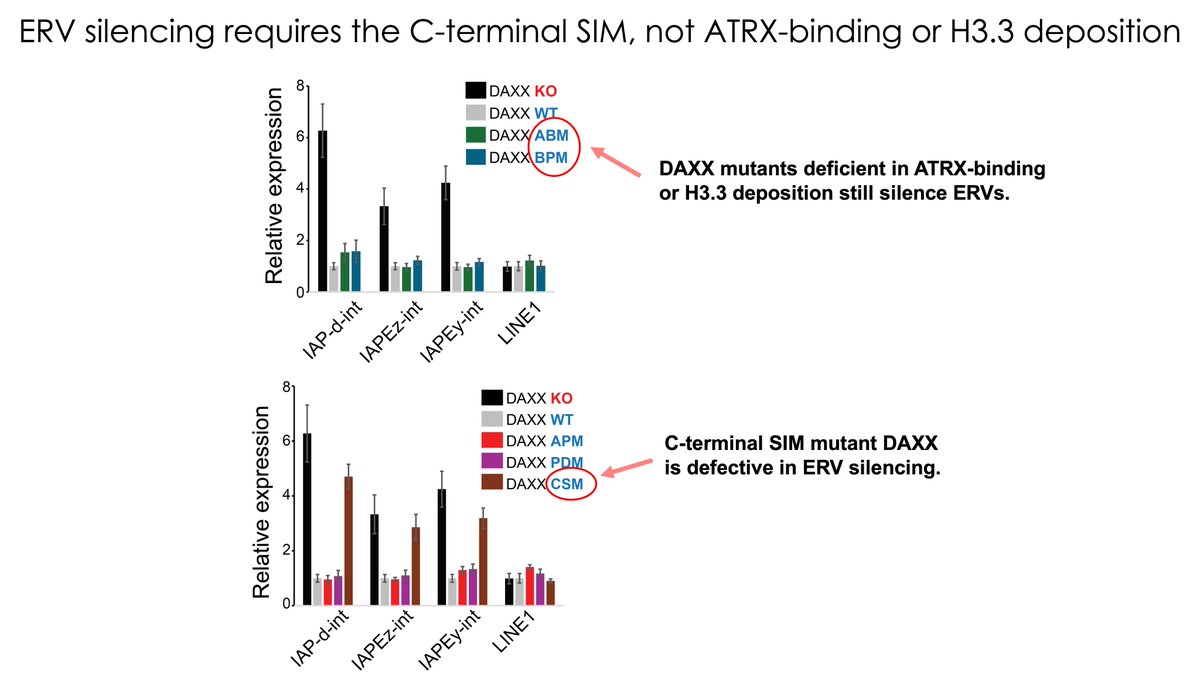
These separation-of-function mutants show that H3.3 deposition can be uncoupled from ERV silencing. This supports our finding that H3.3 deposition at ERVs is dispensable for repression. Instead, repression depends on the C-terminal SIM and interaction with SUMOylated effectors.
New preprint from our lab! An H3.3 knockout does two things at once: it removes H3.3 from chromatin and destabilizes DAXX. We disentangle those functions and find that DAXX-mediated H3.3 deposition can be uncoupled from ERV silencing.
https://t.co/VvCD7CWmja
Which DAXX functions are required for ERV silencing? Mutants defective in ATRX binding or H3.3 deposition restore ERV repression. By contrast, deletion of the SIM abolishes silencing. Thus, ERV repression requires the C-terminal SIM, but not ATRX binding or H3.3 deposition.