Continuous glucose monitoring versus self-monitoring of blood glucose in individuals with type 2 diabetes: a randomised, multicentre, open-label, superiority trial https://t.co/pCiuztDr9G
#CGM#T2D#OpenAccess#ADA2026
Great to see NHS England scaling Microsoft 365 Copilot to more than 500,000 staff.
In early trials, staff saved an average of 43 minutes per day, helping put more time back into what matters most, caring for patients. https://t.co/Frm9SA5eoo
Nanotube Sensor Provides Chemical Imaging for Earlier Detection of Bladder Cancer Recurrence
#Nanotubesensors combined with a rotating optical imaging device provides 3D chemical imaging to identify #cancerbiomarkers within tissue
@MIT#bladdercancer
https://t.co/VPqFEFjeXy
How do some skills become second nature? MIT researchers are uncovering how the brain turns repeated actions into automatic behavior, offering new insight into learning, habit formation, and performance. https://t.co/oyCKDXx39n
Can we measure Parkinson's disease progression years before diagnosis? An ‘alpha-synucleinopathy’ is a brain disease linked to abnormal accumulation of the protein alpha-synuclein and includes Parkinson's disease, dementia w/ Lewy bodies and multiple system atrophy. Monica Roascio and colleagues describe in a new paper in Brain how clinical changes in REM sleep behavior disorder (RBD) may be tracked years before the emergence of overt Parkinson's disease or dementia.
Key points:
- Using longitudinal data from 766 individuals w/ isolated REM sleep behavior disorder, the authors developed a model that tracks disease progression over time rather than relying on a single conversion event.
- The model identified three markers reflecting earlier or later onset of progression, faster or slower progression, and whether motor or cognitive symptoms emerge first.
- These progression markers were linked to established dopamine imaging biomarkers and to EEG measures of brain network dysfunction.
My take: This study tackles one of the biggest challenges in neurodegeneration. We need better ways to measure progression before a person develops obvious Parkinson's disease or dementia. The traditional approach of waiting for ‘phenoconversion’ may miss many years of meaningful biological and clinical change. Continuous progression markers could ultimately improve clinical trials and help us identify who is worsening and when.
Here are 5 points that resonated w/ me:
1- REM sleep behavior disorder remains one of the strongest known risk states for future Parkinson's disease and related disorders.
2- Motor changes appeared to worsen approximately 35% faster than cognitive changes in this cohort.
3- Clinical progression could be detected many years before traditional diagnostic milestones were reached.
4- Abnormal dopamine transporter imaging and abnormal EEG synchronization were linked to earlier and faster disease progression.
5- The future of disease-modifying trials may depend on continuous progression markers rather than waiting for a binary diagnosis of Parkinson's disease or dementia.
https://t.co/9fGVBXMirL
New AI model analyzes ECGs to predict 10-year stroke risk—on par with clinical scores. 🫀🧠 Studied in 200K+ patients, it spots subtle P-wave signals linked to stroke. Scalable, efficient, & could transform stroke prevention. #AI#Cardiology#Stroke
👉 https://t.co/fm0jeOnOnC
Scientists just created a wearable pacemaker that controls the heart with ultrasound.
BIG BREAKTHROUGH:
Researchers at MIT developed a Non-Invasive Ultrasound Pacemaker (NUP) that can regulate heartbeats without implanted wires or electrodes.
The system uses a 2.5 cm × 2.5 cm wearable ultrasound patch placed on the chest.
It is based on sonogenetics, a technique that uses sound waves to remotely control genetically engineered cells inside the body.
The team engineered heart muscle cells to express MscL-G22S, an ultrasound-sensitive mechanosensitive ion channel.
When ultrasound reaches these cells, the channels open, allowing calcium ions to enter and trigger a heartbeat.
Ultrasound → MscL-G22S activation → Calcium influx → Heartbeat
The researchers successfully paced engineered human heart cells and restored normal heart rhythms in rats.
The system achieved less than 1 mm targeting precision and pacing frequencies up to 9 Hz (540 beats per minute).
Even more impressive, it maintained a favorable safety profile during 8 months of animal testing.
The team also demonstrated the approach in porcine (pig) hearts, suggesting potential for future human-scale applications.
This study is one of the strongest demonstrations yet that wearable ultrasound technology can noninvasively control deep organs.
12. The "Older Than" Mass Purge
The Situation: You log in and see 85,000 unread emails spanning back to 2011. You are constantly getting warnings that your "Google Storage is 98% Full," practically extorting you into paying a monthly fee for Google One. This massive, rotting archive confuses Google’s categorization algorithms and bogs down your search.
The Mechanics: Spammers rely on digital hoarders. They know that if they can just slip into your inbox, you'll likely never delete the message, allowing their embedded trackers to remain active. Furthermore, scrolling through thousands of pages of emails to delete them 50 at a time is mathematically impossible and soul-crushing.
The Fix: Use advanced search operators to ruthlessly and instantly purge the past. Type older_than:2y is:unread category:promotions into the search bar and hit enter. Check the "Select All" box at the top left. A tiny blue text link will appear saying "Select all conversations that match this search." Click it. Hit Delete. You just dumped 40,000 useless marketing emails in three clicks and freed up gigabytes of space.
Saurabh Kulkarni, PhD, studies centrioles and cilia — tiny structures found in nearly every cell. When they malfunction, rare and often devastating diseases can result.
At @UVA, his lab is uncovering the science behind these conditions while helping families find answers. 🔬
Veracyte Launches Test Identifying Breast Cancer Patients Who Don't Need Chemo
@Veracyte launches its Prosigna Breast Risk of Recurrence test, a #genomictest that helps determine whether early‑stage HR+ #breastcancer patients need #chemo@PhilFebboMD_CMO
https://t.co/dDp1YN8bPG
The study cited in the article that I considered a wake-up call found a 13-fold risk of cardiac mortality with 1 inflamed artery, which rose to nearly 30-fold when all 3 arteries were inflamed, as determined by AI of non-invasive CT angio imaging
https://t.co/pLTvkkwlvA
GLP-1 drugs for people with both obesity and autoimmune diseases. The drugs were linked to reduced mortality, stroke, pulmonary embolism, and emergency room visits. From a new propensity matched analysis of 13,204 GLP-1 drug users and 13,204 controls
https://t.co/2ik57mwRW0
Researchers show that a type of #AI known as a large language model often outperformed physicians at diagnosing complex and potentially life-threatening conditions, including decreased blood flow to the heart, even in the fast-moving stages of real ER care when information is limited.
In early ER cases, the model identified the correct or a very close diagnosis in about 67% of cases, compared with roughly 50% to 55% for physicians. And the technology is only getting better.
Learn more: https://t.co/ke7CsHcdUq
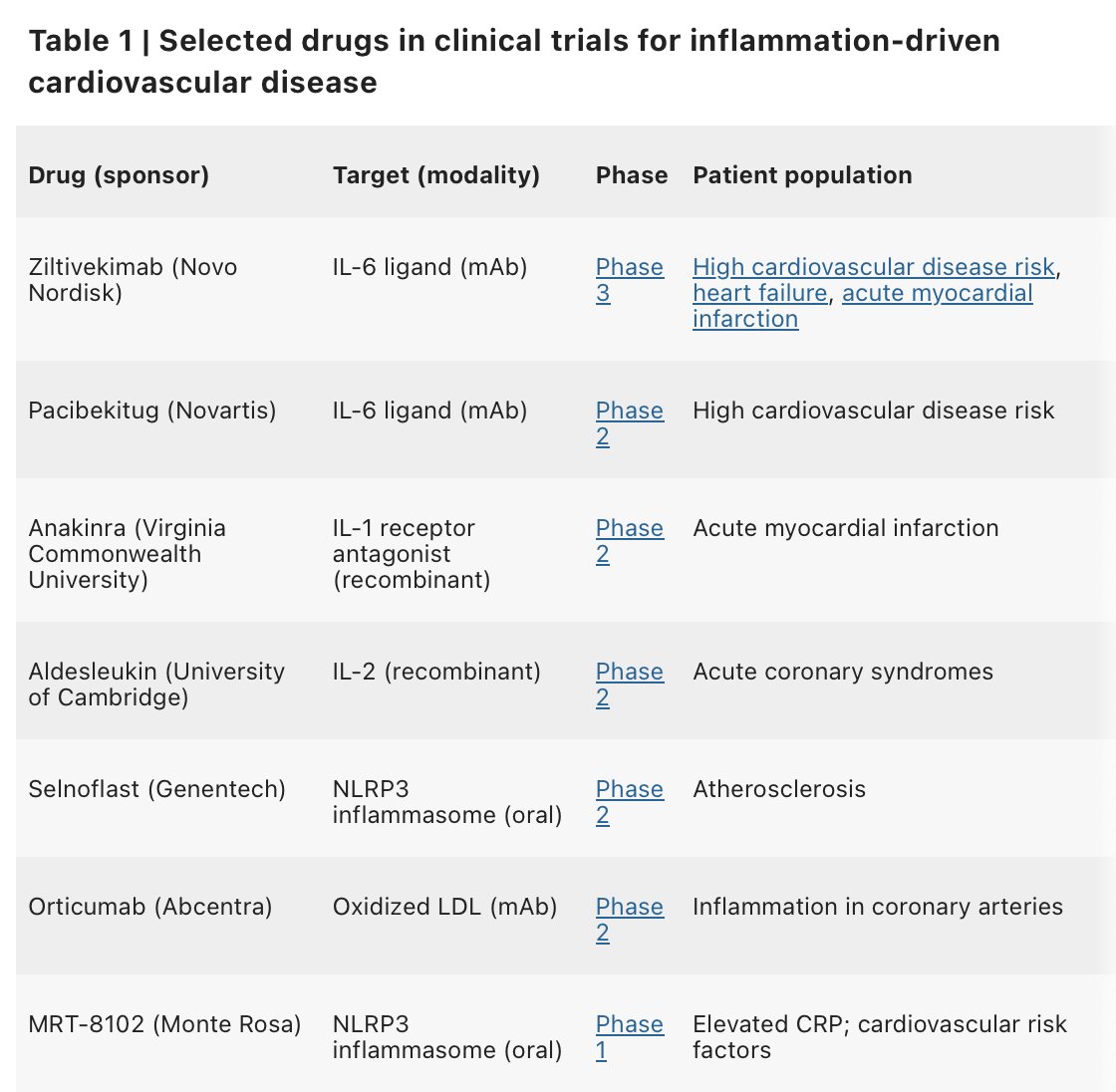
The next frontier for prevention of heart and vascular disease isn't targeting lipids. It's about blocking inflammation. These are some of the ongoing clinical trials @NatureMedicine
https://t.co/DSLMoPFqs7
Every year, about 85,000 Americans are diagnosed with bladder cancer. While treatment is often successful, bladder cancer has one of the highest rates of recurrence of any cancer. MIT researchers have now developed a new way to regularly monitor those patients, which could enable regrowing tumors to be detected much earlier. https://t.co/hneszwbpvj
New Anthropic Science Blog: Making Claude a chemist.
To manipulate a molecule, chemists first need to understand its structure. Their main tool is NMR spectroscopy.
We found Opus 4.7 matches—and on some tasks beats—dedicated NMR software. Read more: https://t.co/1jUvz7wdhV