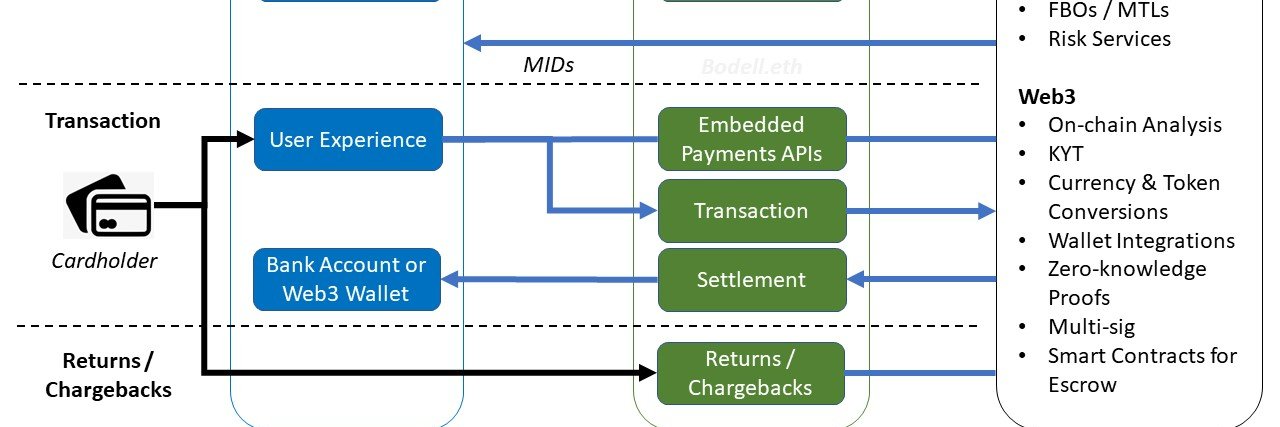
Wrote a little something on crypto's biggest payments gap today:
‘The Next Stripe’: Integrating Web3 with the credit card ecosystem https://t.co/nVioK9wQCY
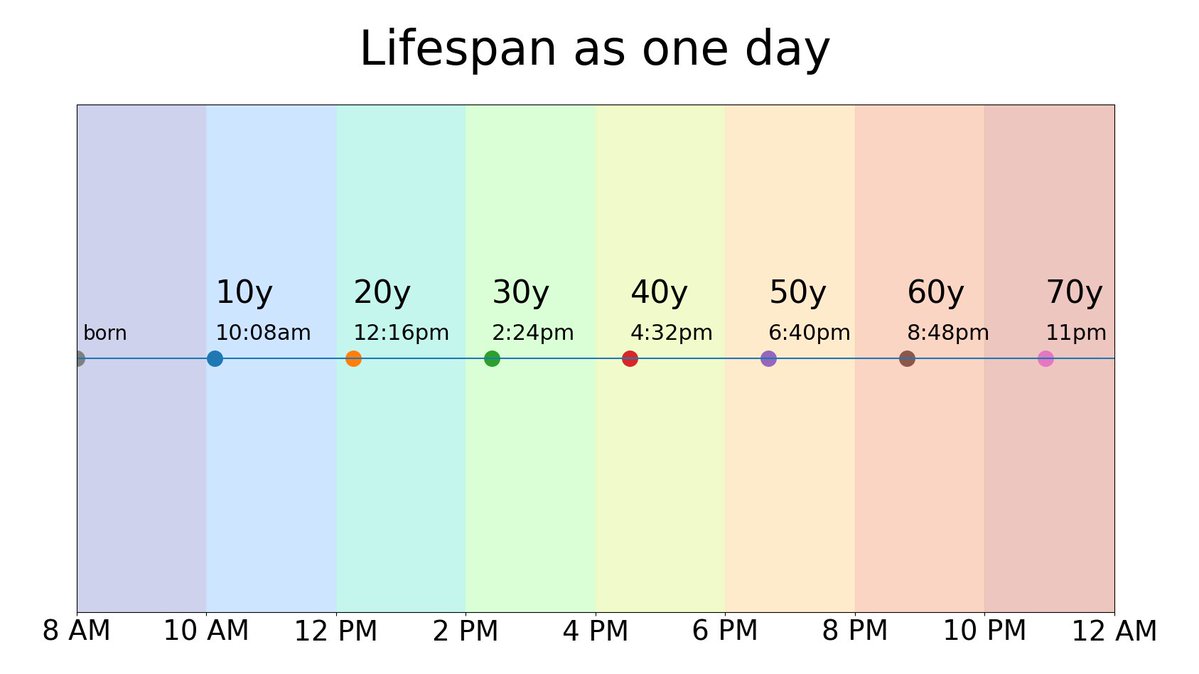
I was driving home from the store today and imagining life remapped to a single day.
Both my parents are gone now and I've been reflecting more on mortality. It feels so unreal and intangible. It's 4:30 pm for me, I still have time left but it's finite. It all goes by so fast
I stole this idea and now use it with every single employee.
It’s the best illustration I’ve seen of teaching someone to be high agency.
It says there are 5 levels of work:
Level 1: “There is a problem.”
Level 2: “There is a problem, and I’ve found some causes.”
Level 3: “Here’s the problem, here are some possible causes, and here are some possible solutions.”
Level 4: “Here’s the problem, here’s what I think caused it, here are some possible solutions, and here’s the one I think we should pick.”
Level 5: “I identified a problem, figured out what caused it, researched how to fix it, and I fixed it. Just wanted to keep you in the loop.”
Using this framework, here’s what I say to every new employee…
You will live at Level 4 from Day 1 and as we build trust you will rise to Level 5.
Being high agency doesn’t just mean tackling problems in this way. It means your entire way of working should be oriented to being a Level 4+ employee.
Plz feel free to steal it as well.
And ty @stephsmithio for the framework!
The confounding factor is that virtually every big company is overstaffed by 2-4x and has been for decades. AI is the catalyst/excuse to finally fix that. Of course nobody wants to say this out loud.
A few months ago I bought contracts that would be Khamenei out of office by April 1st.
This morning, Kalshi changed the rules to exclude death as a possible outcome.
lol, lesson learned - have withdrawn everything from Kalshi and will never use them again.
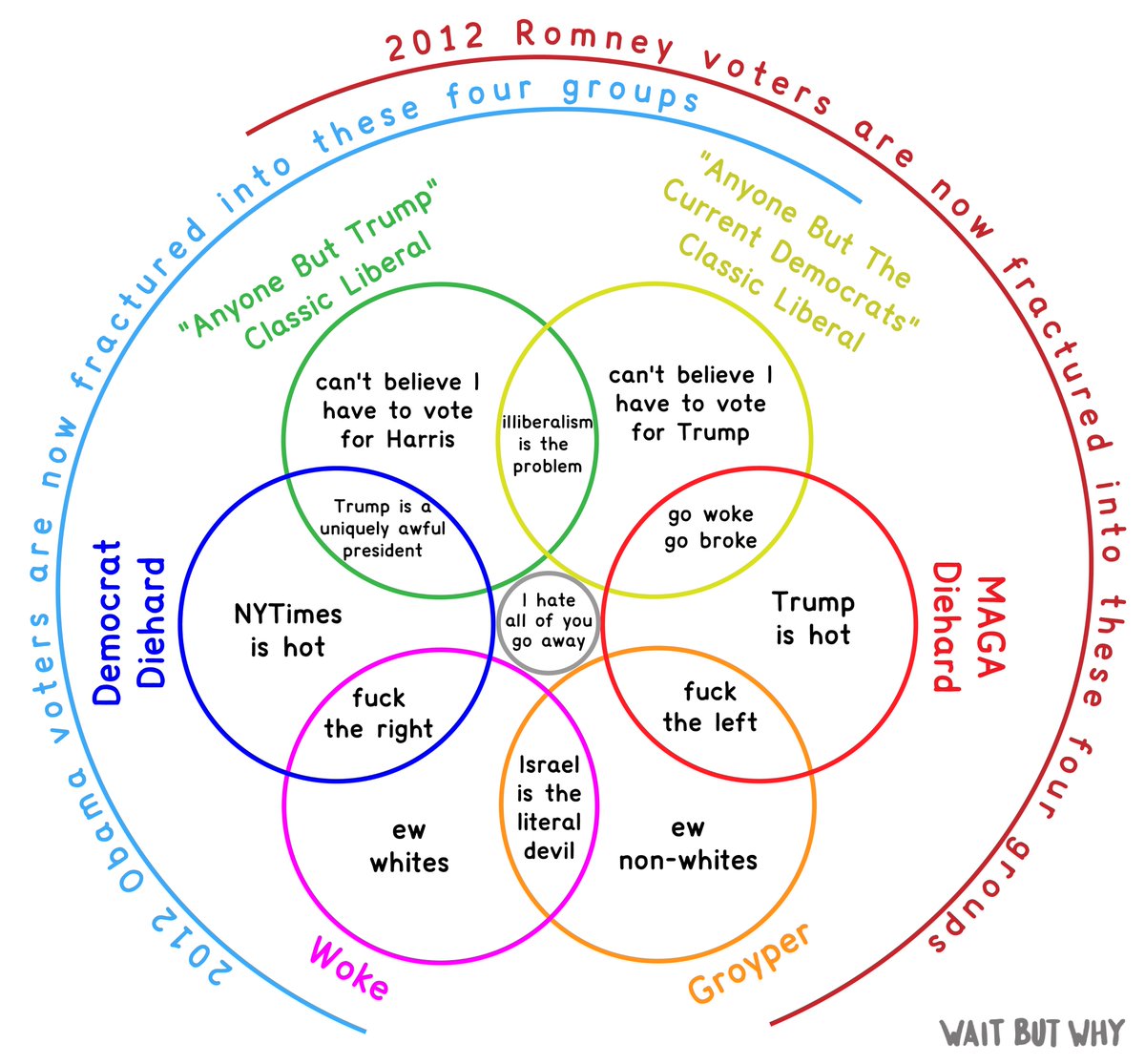
America’s political landscape is more complicated than it used to be. Here’s my attempt to depict what I see as the seven broad camps today. Most people I know fall pretty cleanly into one of these circles (each of which has some common ground with the two adjacent circles).
Some additional points:
- The top two circles (green/yellow) are concerned first and foremost with the rise of illiberalism—disregard for the constitution, cancel culture, mob behavior, political violence. They see liberal vs illiberal as more critical right now than left vs right. In 2020, they agreed that wokeness was bad but today they’re divided on whether Trump or Harris/Biden are the lesser of two evils.
- For the middle two circles (blue/red), left vs right is the main thing. They’re not illiberal themselves but tend to focus on illiberalism from the other side while ignoring or condoning illiberalism from their own team. Both skew older and are the main consumers of traditional media, whether it be cable news or newspapers.
- The two lower circles (pink/orange) share a strong sense of grievance, place utmost importance on identity, tend to view identity groups (race, religion, sex, etc.) as monoliths, and are prone to believing conspiracy theories that fit with their worldview. Both skew younger, with woke skewing feminine and upper class and groyper skewing masculine and lower class. Both use revolutionary rhetoric, seeing the establishment as rotten to the core, and readily employ illiberal tactics under the belief that desperate times call for desperate measures.
Thoughts?
Canonical AI Agent Coding Use (What I've Learned so Far)
Everyone has their own agent guide. I generally like reading other people's. I will try and provide mine succinctly
The loop that works:
Ideate → Design → Plan → Execute → Test → Use → Optimize Back End / Performance → Refactor → Track / Analyze → Return to ideate
Concretely:
1) Write a long product document that incorporates all your features and desired functionality
2) Go into Claude and ask it to split it into screens. Each screen should have a user story (I am a person logging into this app and I need to create a wallet)
3) Once user stories are done for each screen, create UX mocks for every single screen in Claude (it's fast and more responsive)
4) When a UX mock looks like shit use Gemini Pro to generate an image that would look better and feed back into Claude
5) Create a milestones folder
6) Take the output of #1 (your product doc) and all your user stories – feed that into Claude and make a normalized output (your project plan)
7) Instruct Claude or Codex to make a series of milestones folders. This will often be like 10-15 milestones
8) The milestones should explicitly link to your project_plan (alternately called a burndown list). The agents should understand that the project plan is always updated after a milestone is completed
9) Explicitly map milestones to appropriate UX elements. Instruct the agent to reference JSX or HTML/CSS designs and not to redo them unless necessary (you already did all that UX mocking)
10) Milestones have a https://t.co/eFkg5pFgoG, a completion_report.md, a code_review.md
11) Make sure your first milestones are actual app login so you're working against a live version of the app at all times
12) Each code review should identify security problems and P0s and be separate from implementation. Code reviews are actioned -- after you have tested a feature to make sure it basically works you pass it to make sure it's secure
13) After you implement all your P0 and P1 fixes you need to make sure and test your app (or figure out some way to have Claude Cowork do this for you. I've found this is not really a thing yet but some others have had success with it)
14) Periodically refactor (find long files, poor code design etc and refactor to be readable and maintainable). A good tell that you need to refactor is that there are 2000 line monster functions
15) Use your app repeatedly in new contexts. Start with fresh machines. Make sure to have deployment logic (local docker → staging fly → prod fly). Different apps have different deployment phases
16) Chances are at this point you have some kind of back end architecture. Databases of users etc. Once your app is kind of a thing and is running this is when you should do back end design. This is counterintuitive. Some chads will just do all of this up front with a perfect spec doc. For back end design tell the agent to be minimalist (use Postgres extensively, less managed services where possible, prefer open source). These agents love proposing overkill solutions and this pattern will only get worse as the agents are monetized via advertising to propose premium db solutions etc
17) Get your back end in order, re-test whole app
18) Do a full refactor after proper back end is up (this normally would be super expensive in terms of dev time). This means "make it extremely maintainable". have the agent define what the proper refactor would entail
19) When doing things like massive refactors encourage the agent to create a burn down list as they are context hogs
20) In Claude Code extensively use "planning mode" if you must use Claude Code. I prefer using Codex. Claude code is better for making documentation.
21) This is the right point to add tracking tooling. That could be uptime metrics, user tracking, prompt tracking (langfuse), Google Analytics etc. Tracking lets you know what is working and what is not working
22) Python based tests. Make sure that you can interact with different parts of your app using python scripts (get this set of users and tell which 10 are most active). etc. This stress tests your back end / makes sure it lines up with common sense
23) do your docs. make the docs not too wordy so they dont blow out LLM context
In terms of meta programming you need to impart some version of this process to https://t.co/g1Z7VtYYXl and https://t.co/GvybLnHPD5 (for Codex). Have it write what a good code review would be in the context of your repo.
Simple flow is: always have plan → milestones link to plan → milestones require code review → get milestone done → periodically refactor → track → alter plan
I am not yet at the point where I have orchestrators. Trying to get there. I am finally at the point where I'm building custom tooling which means that the labs will launch the exact tooling I'm building in 2-3 weeks. Whatever, AI is the jam.
🚨 Here is the full 42 minutes of my crew and I exposing Minnesota fraud, this might be my most important work yet. We uncovered over $110,000,000 in ONE day. Like it and share it around like wildfire! Its time to hold these corrupt politicians and fraudsters accountable
We ALL work way too hard and pay too much in taxes for this to be happening, the fraud must be stopped.
Six days ago, the media celebrated a significant milestone: Spain’s national grid operated entirely on renewable energy for the first time during a weekday.
At 12:35 pm today local time, the lights went out across Spain and Portugal, and parts of France. Although power was quickly restored in France, it could take a week to fully restore power in Spain and Portugal.
In an instant, the electric hum of modern life — trains, hospitals, airports, phones, traffic lights, cash registers — fell silent. Tens of millions of people instantly plunged into chaos, confusion, and darkness. People got stuck in elevators. Subways stopped between stations. Gas stations couldn’t pump fuel. Grocery stores couldn’t process payments. Air traffic controllers scrambled as systems failed and planes were diverted. In hospitals, backup generators sputtered on, but in many cases could not meet full demand.
It was one of the largest peacetime blackouts Europe has ever seen. And it was not random. It was not an unforeseeable event. It was the exact failure that many of ushave been, repeatedly, warning lawmakers about for years — warnings that Europe’s political leaders systematically chose to ignore.
While Portugal’s grid operator REN initially blamed the mass blackout on “extreme temperature variations” and a “rare atmospheric phenomenon,” and while some media repeated that framing, the reality is more serious. Weather may have triggered the event, but it was not the cause of the system’s collapse.
Spain’s national grid operator, Red Eléctrica, revealed that the immediate cause of the blackout was a “very strong oscillation in the electrical network” that forced Spain’s grid to disconnect from the broader European system, leading to the collapse of the Iberian Peninsula’s power supply at 12:38 p.m.
“No one has ever attempted a black start on a grid that relies so heavily on renewables as Iberia,” noted @JKempEnergy . “The limited number of thermal generators will make it more challenging to re-establish momentum and frequency control.”
In a traditional power grid dominated by heavy spinning machines — coal plants, gas turbines, nuclear reactors — small disturbances, even from severe weather, are absorbed and smoothed out by the sheer physical inertia of the system. The heavy rotating mass of the generators acts like a shock absorber, resisting rapid changes in frequency and stabilizing the grid.
But in an electricity system dominated by solar panels, wind turbines, and inverters, there is almost no physical inertia. Solar panels produce no mechanical rotation. Most modern wind turbines are electronically decoupled from the grid and provide little stabilizing force. Inverter-based systems, which dominate modern renewable energy grids, are precise but delicate. They follow the frequency of the grid rather than resisting sudden changes....
Please subscribe now to support Public's award-winning investigative reporting and to read the rest of the article!
https://t.co/TiQF1P6Otf
The American dream is alive and well (selling your services business to an overcapitalized PE roll up fund run by a 26 year old with an MBA for 7x earnings, traveling the world until your 3 year non-compete runs out, and then building the exact same business over again with an initial investment of $10k)
I asked chatgpt's new image model to script and generate a series of comics starring itself as the main character. The results genuinely gave me chills.
I'll post them all in a thread below.