It's yet another example of what historian David Brock calls "wishful worries" - things people worry and talk about because it is more enjoyable than facing and addressing the actually existing problems all around us.
I posted on the new White House OSTP report, Science: A New Golden Age by Kratsios.
An unusual and ambitious report, with a surprise focus on the linear model of innovation. We should use this to push for a better science policy culture, but see challenges.
https://t.co/so8yX9NjPh
I’ve argued that the Civil Service’s problems are best framed as structural + cultural, rather than about individuals.
Cultures are made up of norms that are sustained by language and behaviours.
So what norms does the CS need to tackle to be more effective?
A first stab 🧵
A pioneering study that uncovers the dynamic history of prediction in science and engineering over four centuries.
Ann Johnson & Johannes Lenhard's "Cultures of Prediction" is available now (in a free #openaccess edition, too!) 👉 https://t.co/j0jPpgtAcq
Public trust in science is more important than ever. But what happens when scientists openly share their political opinions on social media?
Our updated paper with @EleAla & Francesco Capozza shows how academics’ political expression affects their credibility.
Let me take you back for a moment to 2018.
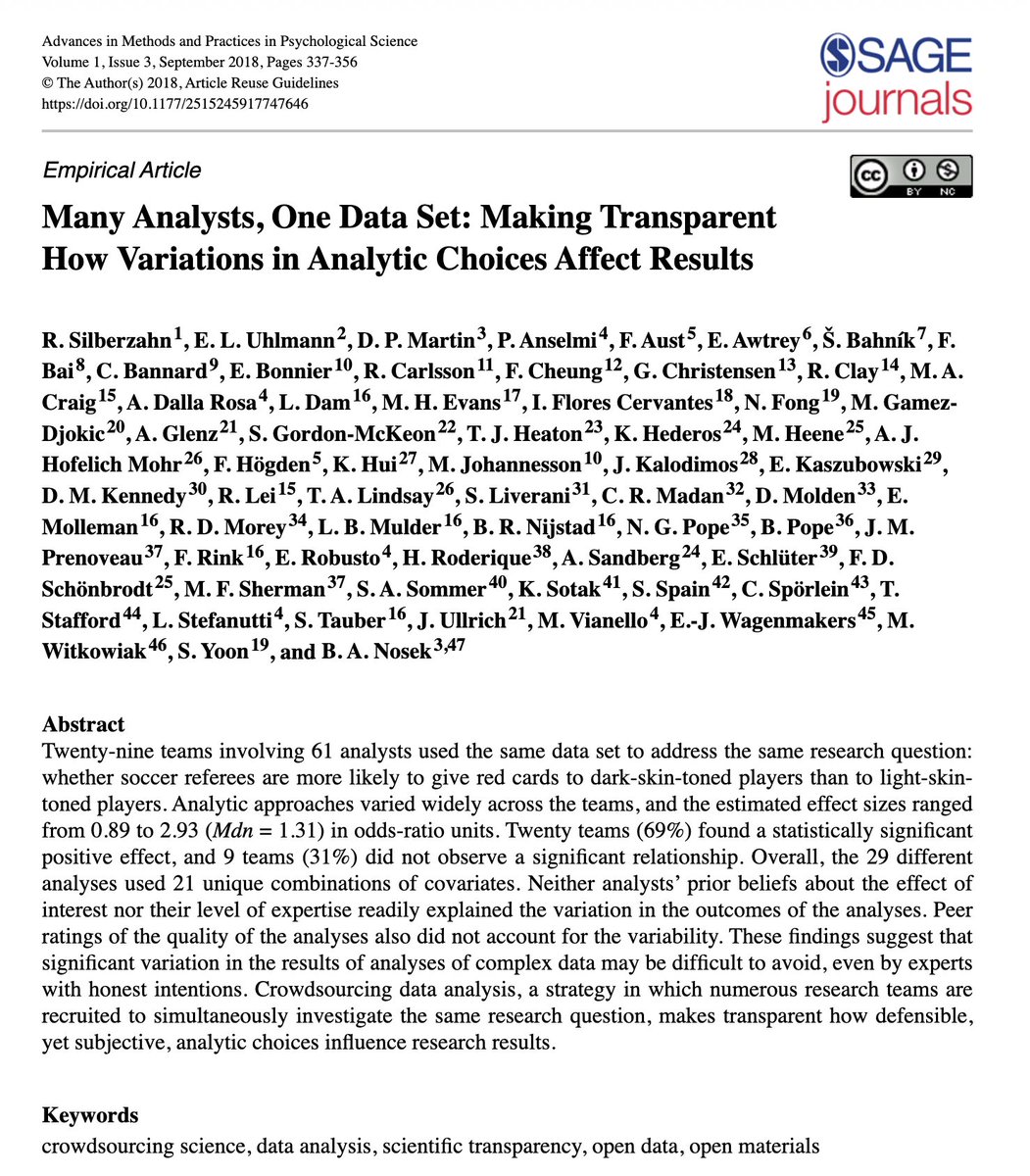
A team of powerhouse psychologists have just published a (seemingly) groundbreaking article.
The premise of the article was simple--give multiple research teams the same research question with the same dataset.
Would teams with the same research question and the same data come to the same conclusions?
The research question was: are soccer referees more likely to give red cards to players with dark skin tone than light skin tone?
The results obtained by the teams differed extensively.
Many concluded from this widely noted exercise that the social sciences are not rigorous enough to provide definitive answers.
This finding was widely shared in the popular press and on social media.
Fast forward a few years: a new (less covered) article comes out and shows that the main reason teams came to different answers was the original research question was unclear.
Teams differed in their interpretation of the research question and therefore used diverse research designs and model specifications.
When you reanalyze the data with a clear research question, a precise definition of the parameter of interest, and theory-guided causal reasoning, results across teams don't vary that much.
From the authors of the new study: "The broad conclusion of our reanalysis is that social science research needs to be more precise in its `estimands' to become credible."
1/ Today, @RenPhil published our first set of playbooks for leveraging philanthropy and innovation to solve important problems, inspired by Christopher Alexander’s work on a “pattern language.” https://t.co/YUXoew43yw
In the wake of the U.S. election, @theNASciences President Marcia McNutt has authored an editorial in @ScienceMagazine stressing the apolitical nature of science and emphasizing that science remains vital to informing #PublicPolicy.
Read: https://t.co/6ycerkrnnL
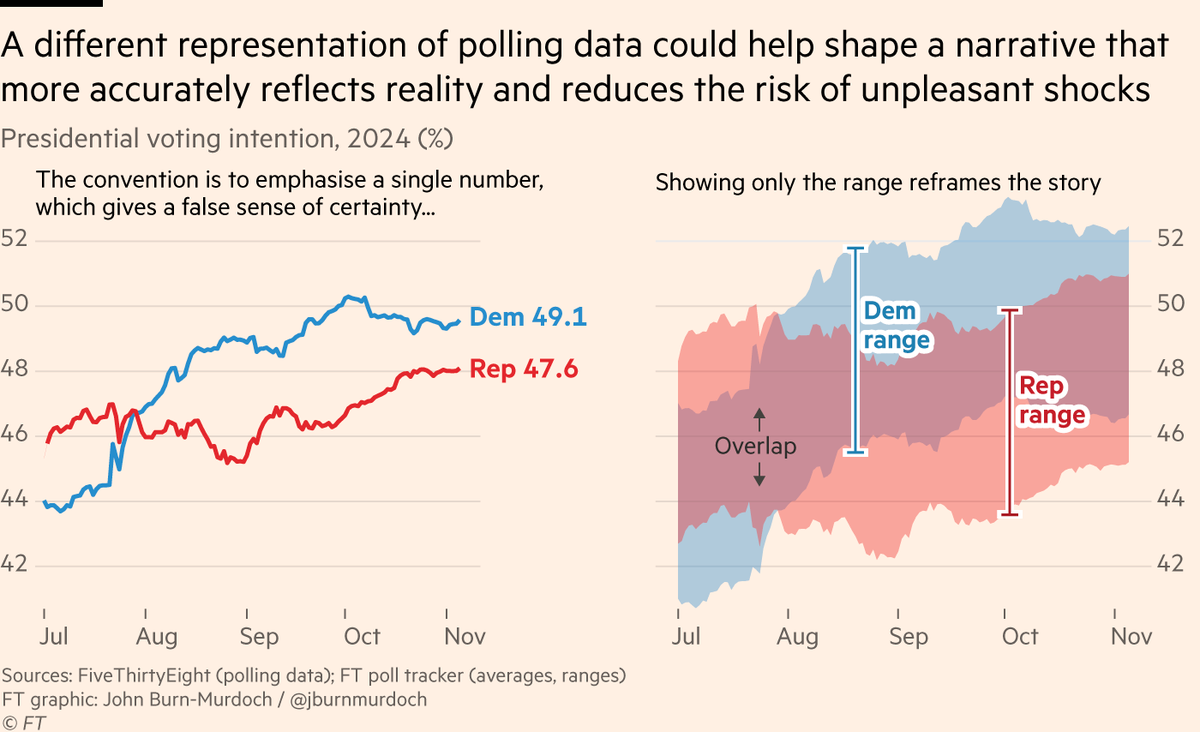
My wish for the next election is that poll trackers look like the one on the right 👉 not the left
This was yet another election where the polling showed it could easily go either way, but most of the charts just showed two nice clean lines, one leading and one trailing. Bad!
I’m holding out hope that @potus@vp @whcos @WHCommsDir@PressSec@AndrewJBates46@NeeraTanden46 tell the American people about this today. It’s 3+ years late, but far better for an administration to publicly recommit to government transparency & accountability than never do so.
Finally, some years of work and engagement have materialised in this encyclopedia of #STS. Many thanks to the + 90 authors who contributed! And what a pleasure it has been to go on that adventure with Alan Irwin - thanks for being such a great colleague, conspirator and friend!
Please circulate: we're hiring a postdoctoral research associate with expertise in philosophy of scientific method and philosophy of causality. Apply here: https://t.co/rl2f8uq89o. A 2nd postdoc job, for someone with expertise in evidence review and research methods, coming soon.
Philosophy & Public Affairs has an impressive editorial line-up!* STS, HPS, phil-sci, and metascience folks should take note. 🔎📚
"The journal welcomes submissions from philosophers, legal scholars, political scientists, economists, and sociologists. It welcomes papers on problems requiring empirical or legal analysis, provided those papers also rigorously defend a normative position."
*Noting the valid concerns of the previous board.
FELLOWSHIPS: Come visit @iphilLUH as a SOCRATES fellow to work on trust, expertise and science with my colleagues from the SOCRATES Team. Here is a CfA for the next round of fellowships; deadline is Nov. 15: https://t.co/83T1xA8d8w
INEM is making funds available for workshops and other initiatives in philosophy/methodology of economics, broadly construed. Please spread the word and consider applying!