President Trump has added more to the national debt than to economic output in his first 17 months in office.
The CBO projects the gap will only widen over the rest of his term.
Back of the envelope for Trump Dividend. 270 million adults in US X $5,000 = $1.35 trillion. The entire discretionary U.S. budget in 2026 is about $1.6 trillion. So an 84% increase in spending, if no other cuts. "That alone should win the midterms," Trump says.
While rhe Constitution does not explicitly mention much now regarded as rights, this is messed up:
"The Constitution doesn’t provide a right to clean drinking water or accurate information from public officials, a divided federal appeals court ruled."
The Constitution doesn’t provide a right to clean drinking water or accurate information from public officials, a divided federal appeals court ruled. https://t.co/a3NSssJJaw
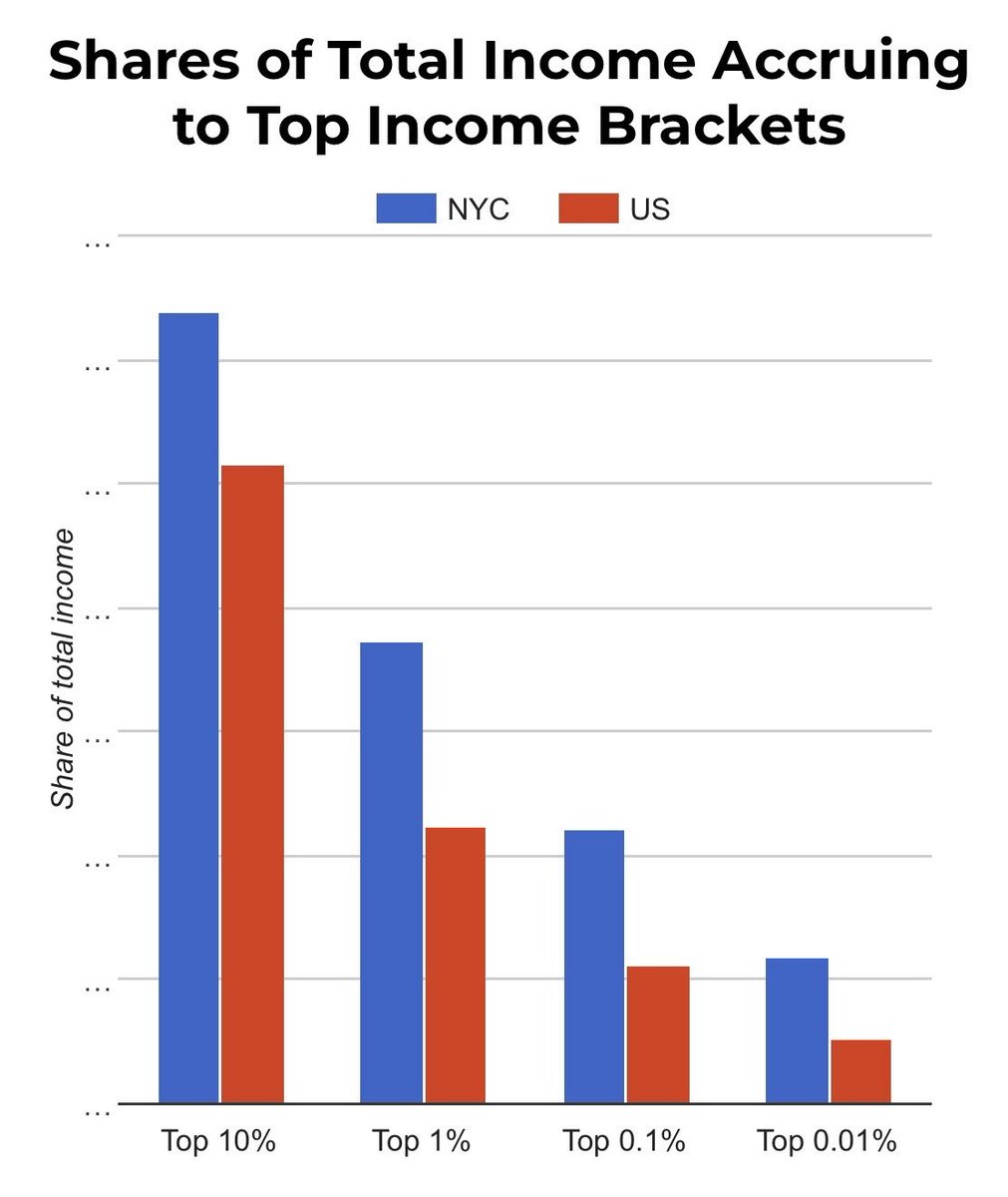
Two-thirds of NYC’s income growth since the pandemic went to the top 1%.
The richest 0.001% — about 50 families — saw their average income soar from $315 million in 2019 to nearly $600 million a year.
It’s time to build a city that works for everyone.
"GDP can tell us how the economy is performing without telling us how Americans are faring. It can tell us how much an economy produces, but not who receives the rewards, whether those gains improve people’s lives, or what is destroyed and what is sacrificed in producing them."
“A single statistic can conceal as much as it reveals,” writes Antara Haldar. “GDP can tell us how the economy is performing without telling us how Americans are faring.”
https://t.co/Wz2WfN95Aa
On Friday, the United Nations General Assembly adopted an African proposal for a new world map, which shows countries’ true size relative to one another.
In favor: 164
Against: 1
Abstentions: 6
We see US counties where at least 20% of people live in poverty. America’s poverty map reflects historical economic geography: plantation slavery across the Black Belt and Mississippi Delta, lost coal jobs in Appalachia, dispossession on Native lands, and low-wage border economies. Some isolated dots are student-heavy college towns and should be ignored. Source: https://t.co/6BWSUyNIHh
"people...either employed or looking for a job has dropped by 1.6 million...largely because of Trump’s immigration restrictions. Unless those policies change, a shrinking workforce will cause slower economic growth and lead to more expensive public debt."
https://t.co/pG8AJjcYFj
High Street, Kirkcaldy. This is where Adam Smith’s mother had her home & where Adam Smith lived as a child & again from 1767 to 1776 & wrote The Wealth of Nations. So for all practical purposes this is the birthplace of economics.
This confirms what I wrote in 2024; in the very rare cases of noncitizen voting, the most common scenario is a lawfully present immigrant wrongfully told they can vote by a local official.
If the 400 number is right, that’s 0.009% of the 2024 vote in NJ; still very rare.
61% of public pessimistic about the state of the economy/future outlook--highest percentage since December 2023, when the country was just emerging from the pandemic-era inflation. Only 25% are optimistic about the economy now and for the future. (Source: https://t.co/YhS01GkswM)
Starting in early 2025, Elon Musk and the Trump administration began terminating USAID's programs and firing its staff — with Musk himself boasting about "feeding it into the woodchipper." One year ago today, USAID was officially dissolved, its remaining programs haphazardly folded into the State Department. Amid all the lies and misinformation that have followed, some facts about what has actually been lost:
• USAID saved more than 3 million lives a year at a cost of less than $10/month per American. That is what was destroyed. On purpose.
• According to Boston University's Global Impact Counter — which tracked deaths attributable to the cuts until it stopped operations in February 2026 — an estimated 781,000 people died preventable deaths in the first year, including 518,000 children.
• Global child mortality (the number of children who die before their fifth birthday) rose in 2025 for the first time in 35+ years — by 200,000 additional deaths.
• USAID's 50-country disease surveillance network — the system that cut outbreak response times from 2 weeks to 48 hours — is gone. We are now watching an unprecedented Ebola outbreak unfold in real time — with the highest first-month caseload and death rate in modern history.
• Programs reaching 93 million women and children were cut 92%. TB programs cut 56%. Water and sanitation cut 86%. Over 2,000 health facilities permanently closed.
• 25 million fewer people received humanitarian assistance in 2025. The overall humanitarian budget was slashed 74% — from $14.1 billion to $3.7 billion.
• 363 million people face acute hunger in 2026. The famine early-warning system that would have seen it coming went dark for five months.
• $1.7 billion in democracy and governance funding (election monitoring, anti-corruption work, support for independent media and civil society) was terminated.
• 360+ independent media outlets lost funding. Hundreds of legal clinics closed.
• Far from saving money, the Trump administration itself has already said the dismantlement will cost taxpayers at least $19.2 billion in cancellation fees, severance, and penalties. That's more than half of USAID's annual budget — spent on destruction and closeout, not support for vulnerable people.
• American farmers, universities, and businesses are among the casualties too. USAID partnered with more than 3,500 U.S. companies and maintained 17 university-based research labs. Its work with U.S.-based contractors and the private sector generated hundreds of thousands of American jobs and multiplied the return on every dollar spent. Those markets and partnerships are gone.
Americans who read for personal interest in 2025 spent 100 minutes on an average day doing so.
Stop by our table at #ALAAC26 to find out more about how Americans spend their time.
The labor share of income fell to 53.7% in Q1 2026, the lowest since the series began in 1947. While GDP grew 1.6% in Q1 2026, productivity rose 2.8%, and corporate profits are at historic highs, workers are netting the lowest earnings since data collection began.