🚨 COACHES 🚨
In this article we explore the negative effect of the thirds of play and game models in football development.
Complete with Differential Learning practices.
Boxed in: How the thirds of play impact creativity in football development
https://t.co/LnpPDlhVZM
@timmparsons They’re all good players in their own ways. The main thing to release some creativity is to set a task, ask them to solve it. If they solve it in the same way, say they can’t solve it in that way any more. See what they do, then change/progress the task and just keep going.
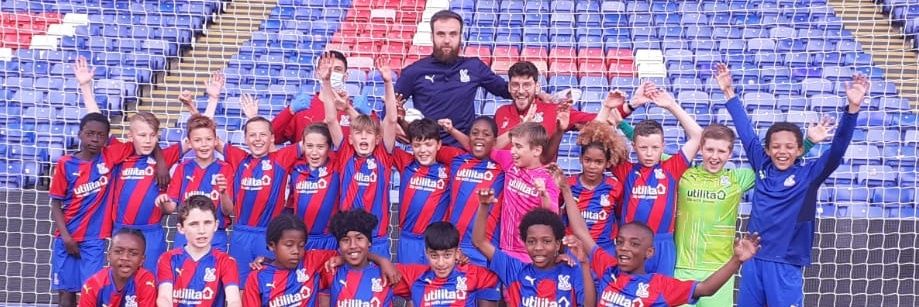
At Palace, South London culture naturally encouraged flair, improvisation and individuality. Practice design had to embrace it.
Brighton was far more structure and authority-led.
Two very different sociocultural environments. Two very different player behaviours over time.
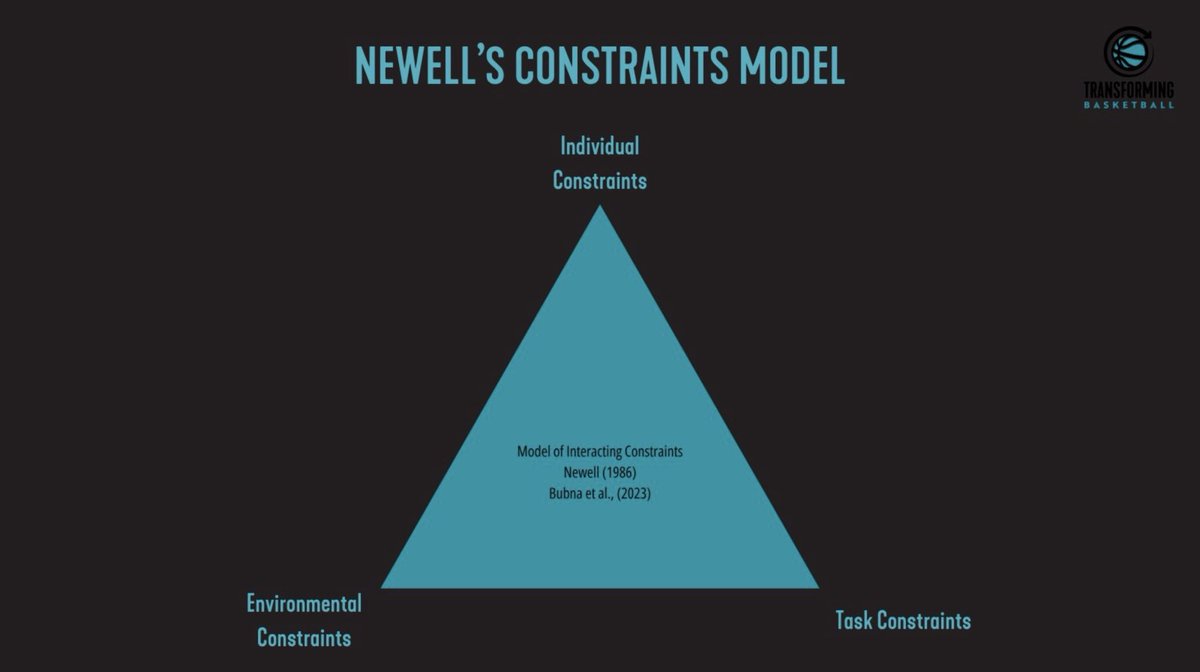
One of the most overlooked ideas in skill acquisition is the impact of sociocultural constraints.
These are the cultural, social, and historical influences that shape how players and coaches behave, learn, and develop skill. Over time, they influence what players value, how they solve problems and even the types of movement solutions they develop.
The interesting thing is that many of these influences can feel “normal” because they are so deeply embedded in the environment.
For example:
• Street basketball often encourages creativity and 1v1 problem-solving
• Brazilian football culture is often associated with flair and improvisation
• Informal backyard games encourage exploration without constant instruction
While designing practice tasks and manipulating constraints effectively are going to be crucial, the effect of sociocultrual constraints is something that I’m thinking about more and more in my sessions.
As coaches, I think there are so important things that we need to ask ourselves.
•What sociocultural constraints are present in the environment you coach in?
•What behaviours and playing styles do they encourage?
•How might they influence how players learn and interact with the environment?
•Are there aspects of the culture that may be helping or limiting development?
@timmparsons The practices didn’t change in terms of the environment, but the tasks and individual constraints changed a lot as the players were so different.
@timmparsons It’s a good question. The lads in South London taught me a lot just by being themselves. Meanwhile, I had to improve a lot as a coach to get any creativity and individuality out of the Brighton boys. So, they both taught me so much, I’m not sure I could choose.
At Palace, South London culture naturally encouraged flair, improvisation and individuality. Practice design had to embrace it.
Brighton was far more structure and authority-led.
Two very different sociocultural environments. Two very different player behaviours over time.
@_ToddBeane@statsbet@JOGOFUNCIONAL1 No-one is trying to deny the influence of Michels/Cruyff.
My point is simply to offer a different lens on modern positional play models.
There can obviously be overlap between positional and relational ideas. I just don’t think they organise the game in the same way.
Great example from @JOGOFUNCIONAL1 showing the difference in relational structure.
No holding positions. Relationships change. Information changes. Decisions emerge.
This is why I argue we need to move beyond the rondo and positional training👇
🔗 (Link in first comment)
Emerging solutions happen less in positional teams due to the predictability of the structure
In relational teams movements are orientated to the ball, moving to it not away from it, play is centered to connections
Players bear the responsibility of interpreting the moment
@_ToddBeane@statsbet@JOGOFUNCIONAL1 Todd.
Respectfully, their ideas still prioritised a positional structure first. Relationist ideas tend to let structure emerge second, from player interaction.
I think it’s important to show coaches different lenses for organising the game. PP is not the only way to view/play.
@_ToddBeane@statsbet@JOGOFUNCIONAL1 Except you couldn’t, in positional play models, players are far less likely to cluster and create these types of combinations. These models depend on maintaining occupation of specific spaces so the ball can progress through predefined lanes.
That is not what is happening here.
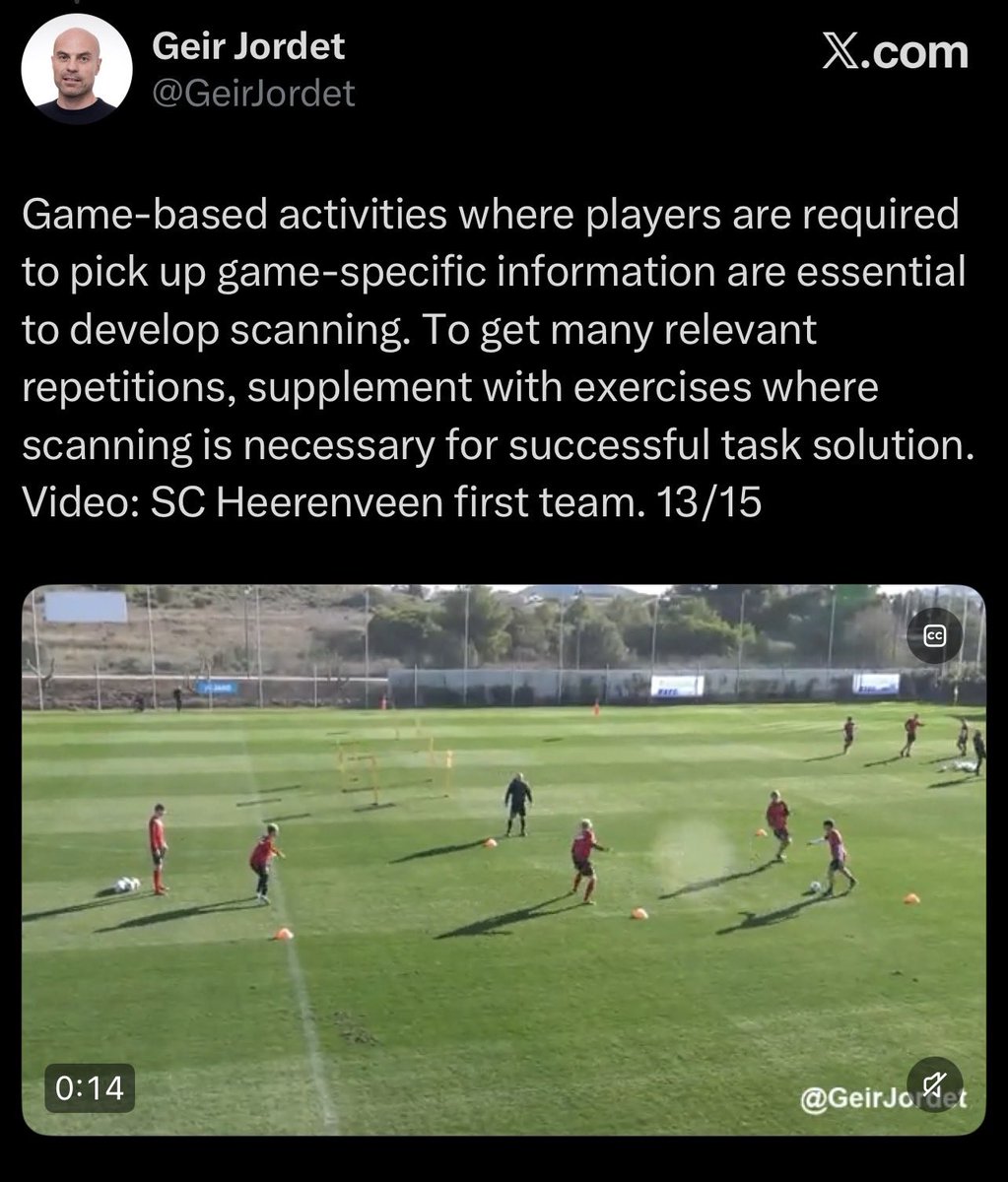
What’s important here isn’t whether players turn their head. It’s whether there’s actually information worth searching for.
Scanning without a meaningful stimulus just becomes a rehearsed movement pattern. What gets lost is the picking up of relevant information to guide action.
Great example from @JOGOFUNCIONAL1 showing the difference in relational structure.
No holding positions. Relationships change. Information changes. Decisions emerge.
This is why I argue we need to move beyond the rondo and positional training👇
🔗 (Link in first comment)
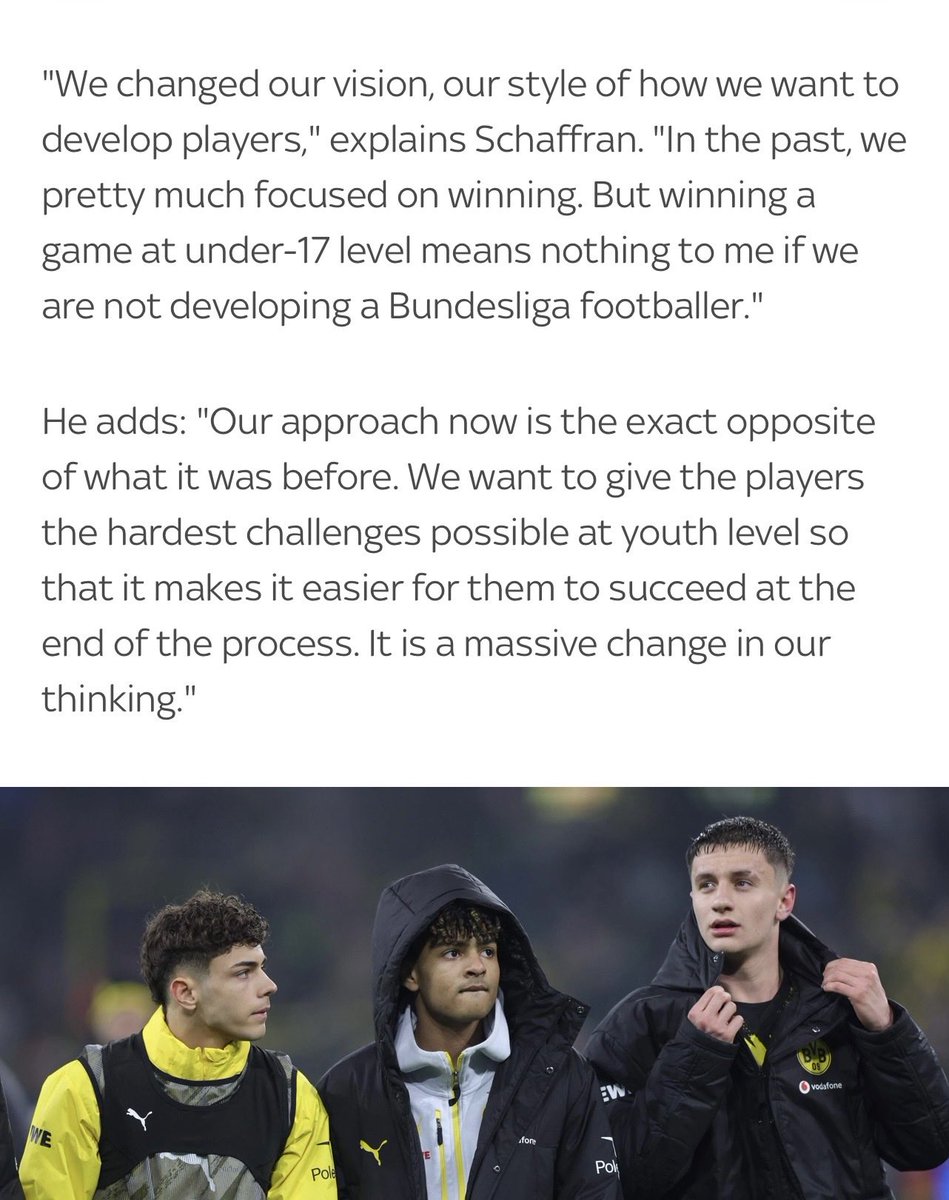
Interesting comments from the Dortmund academy director on youth development.
Questioning whether winning youth trophies is really a marker of success if it doesn’t lead to first-team progression.
It raises a wider question: what is success for us as youth coaches?
Elite football and youth development are not the same thing.
An 11v0 walkthrough may have value for synchronising an elite team around a game model.
It should not become a foundation for how young players learn.
Build context rich environments for our players to interact with.
What’s important here isn’t whether players turn their head. It’s whether there’s actually information worth searching for.
Scanning without a meaningful stimulus just becomes a rehearsed movement pattern. What gets lost is the picking up of relevant information to guide action.
This podcast has a lot of great stuff in it, but suggesting the most representative practice is the best because it’s ‘the most real’ is a fundamental misunderstanding of what RD is for. Minimally representative practice can be still be ecological and support skill development.
This podcast has a lot of great stuff in it, but suggesting the most representative practice is the best because it’s ‘the most real’ is a fundamental misunderstanding of what RD is for. Minimally representative practice can be still be ecological and support skill development.
🎙️ Dr. Dave Collins on the informed art of coaching.
⚖️ Eco design/Cognitive science/Predictive processing
🧠 Shared mental models
📐 Practice design.
A sharp conversation on how coaches can choose the right tool at the right time.
🎧https://t.co/UfNSzUFj81
@DCGreyMattersUK
@KyleUnitas Minimally representative practice simplifies a task while preserving p–a coupling, allowing the athlete to self-organise. Prescribing a movement in advance, reduces the learner’s opportunity to explore solutions that fit their own individual constraints and action capabilities.
@midfield227@Duarterbparaujo@ConstraintsColl There’s no such thing as ‘the right movement’. There are millions of solutions he could have come up with to move through that gap. You’re looking at the problem through your own limited perception.
The problem with this kind of analysis is that it treats football like players are selecting pre-programmed techniques from a toolbox.
But actions in football are not recalled solutions. Solutions emerge from perception, interaction and constantly changing information.
Mainoo,a good technician.
but,here the minimum standard should be a clean left footed touch on the ball followed by immediate right foot-perfect La Croqueta/Iniesta will eliminate all
ideas and flow state is there,but a nice refinement can make him that 'proper midfield baller'