@sequoia is leading our Series C at a $1B valuation.
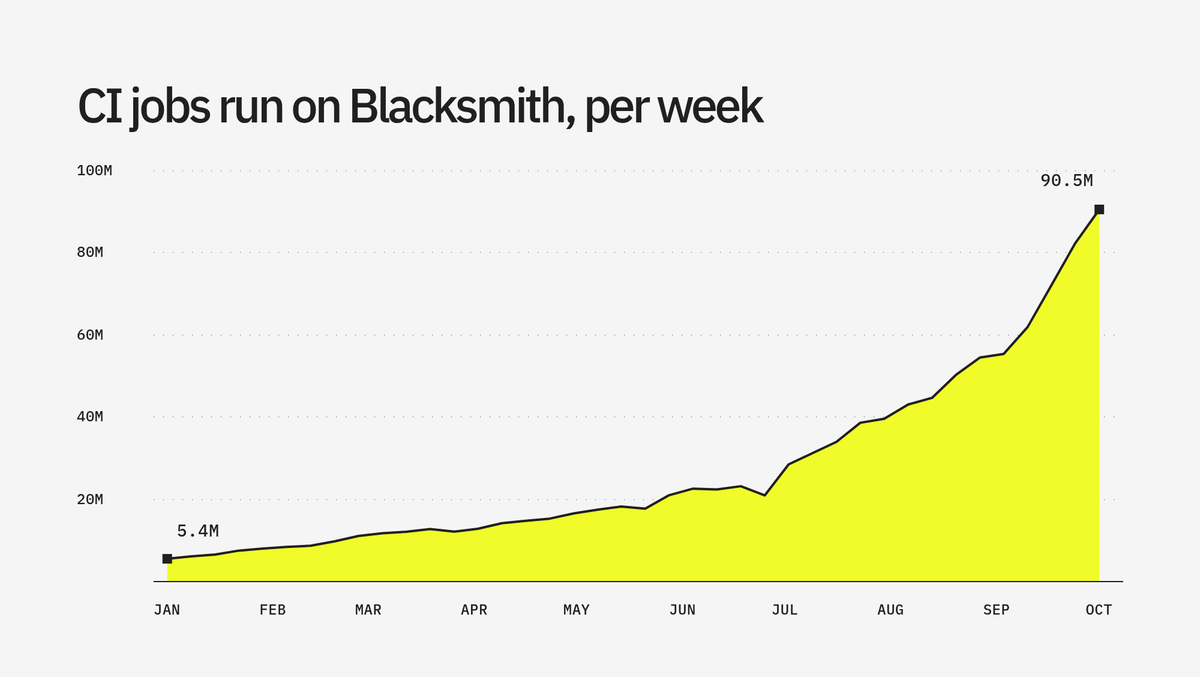
We started Blacksmith in 2024 to make CI faster and less painful. In January we ran 5 million CI jobs a week. Today it's over 90 million and growing, and we’re still early.
We've shipped 7 different models in a single year.
Now comes Drama 3: our most emotive & controllable TTS model.
You can direct a voice in plain English, add different emotions to a single sentence, and control how even a single word should sound.
It's also open-weight.
Extremely proud of every single person involved in making this possible @FishAudio
pretty genius idea ngl
historically companies that needed certain SLA's would have needed to go to a baseten or a together and rent out gpus to host models themselves
an SLA could mean TTFT or TPS for a certain model
routerplus lets them just say 'yo we need this SLA for this model, who wants to be our dedicated inference provider, put out a bid'
and then someone else handles the inference
a very good player in the ecosystem because companies get better terms once they hit volume, and aren't as locked into certain models
there's a lot of money in finding inefficiencies in the inference market and capitalizing
$52M seed round. 15M+ users. But this is what we're most proud of yet.
Introducing Drama 3: the most emotive and controllable TTS model in the world
And yes, it's open-weight.
You can now control how even a single word should sound, change its tone, and shift your voice mid-sentence.
Uncle Roger was impressed too.
Try it here:
https://t.co/4nbz4sQ4yy
Comment “DRAMA” within the next 48 hours for 1 month free.
If you're an enterprise your first month is on us:
https://t.co/jBXXZSAg0p
My conversation with @alexandr_wang, chief AI officer of Meta.
0:00 The vision behind Muse
1:32 Discovering the potential of personal AI agents
3:34 Three years of therapy in one AI session
5:46 Building Muse in 7 months
9:16 Why Meta bet on personal AI
16:51 Mark Zuckerberg's obsession with improving products
20:15 How Meta knew Muse was ready to launch
23:32 Why great products need a single point of view
25:56 Making Meta cool again with memes
34:38 Building trust with AI agents
38:43 The future of human ambition
45:22 The call from Mark Zuckerberg that changed everything
52:13 Leaving Scale AI for Meta
55:19 Rebuilding Meta's AI lab from scratch
58:13 From founder to coach
1:05:55 The future billionaires at Alexandr's 19th birthday party
1:08:04 Diamond mining vs. building skyscrapers
1:09:21 Why Alexandr has more than 200 direct reports
Includes paid partnerships.
the bigger opportunity is potentially coordinating demand not just helping each person shop better. If agents know thousands of users would switch providers for a better offer, they could pool that demand and ask suppliers to bid for it
Assorted things I've been mulling over regarding agents in the economy:
• Companies are in some sense the original superintelligence. It's often the case that they can use their amortized cognitive surplus to advance their interests against those of certain consumers: relative to the optimization capacity of companies, consumers can be inattentive, underinformed, irrational, etc. (Think, say, of some of the classic insurance upsells at the end of a booking process, which is typically priced substantially above what a regular policy would cost.) Herbert Simon introduced the idea of bounded rationality, and firms often end up benefiting from it. Thanks to personal agents, we will probably get somewhat more rational in how we engage with companies.
• How exactly will outcomes change? Well, certain kinds of price discrimination will work less well (how do coupons work if every agent hunts fastidiously for them?), and certain kinds of customer cross-subsidy will change (today, people who forget to cancel subscriptions subsidize those who don't). Taken across the economy as a whole, I'm not sure what the incidence of all of this will be.
• In corporate strategy, people have long debated the relative importance of distribution and product quality. Perhaps you've made something better, but does anyone know about it? Won't people just continue to buy the ACME Corp Mousetraps? Personal agents will, I think, act as a kind of structural subsidy for product quality. How would markets look different if individuals always spent at least 10 hours researching their purchases? On the margin, focusing on making a product better is, I think, going to become a more effective strategy for companies. This is good!
• It true, a corollary is that information about product quality will become more important and impactful. Today, most people have very limited ability to aggregate and integrate such data, but agents will have insatiable thirst for such signals. (It's often said that data is becoming more valuable because it helps in the training of models. That's obviously true, but I think there's a secondary way in which it's more valuable simply as a complement to cheaper intelligence.)
• A big question is whether agents will increase superstar effects (rational agents all settle on the same product) or increase dispersion (because everyone has slightly different tastes and preferences, which agents are good at eliciting, finally overcoming the artificial clustering we've been subjected to).
• Many internet companies have monetized demand routing, which is in turn often predicated on short attention spans. "I'll click on the first thing I see." This has led to some amount of inefficiency, as companies try to propitiate capricious ranking algorithms and incur various placement fees. It's not all deadweight loss (willingness to pay is itself a kind of signal, which is valuable to buyers), but it's not great. How will the nature and value of this routing change in a world of personal agents? I don't know the answer, but I think that the effects might be pretty big.
• Much of what I'm writing hinges on the assumption that personal agents will be on the consumer's side. I suspect that that will be the winning strategy, but whether it's true, and what it means to be true, involves a lot of other questions.
Taken as a whole, the market is a massively parallelized, decentralized, and highly imperfect value attribution machine, and, taking stock of all of the effects, it seems to me that the quality point may well be the biggest: that agents will change the nature of the backpropagation such that the rewards for better products increase. Maybe this is too optimistic, but I suspect (and hope) that companies that make things that they're proud of will feel that the universe is a little more partisan in their favor.
What that unlocks:
→ Large spreadsheets: clean, analyze, reshape
→ Legacy portals with no API
→ Many tasks in parallel on one computer
→ Long jobs across browser, apps, and files
→ Teach it once, reuse it as a skill
recentemente descobri um nicho da internet que me chamou a atenção, é o "buy-it-for-life"
os caras pesquisam marcas e produtos de qualidade e recomendam. Nem sempre são produtos caros, a única regra é que tem que durar "for life"
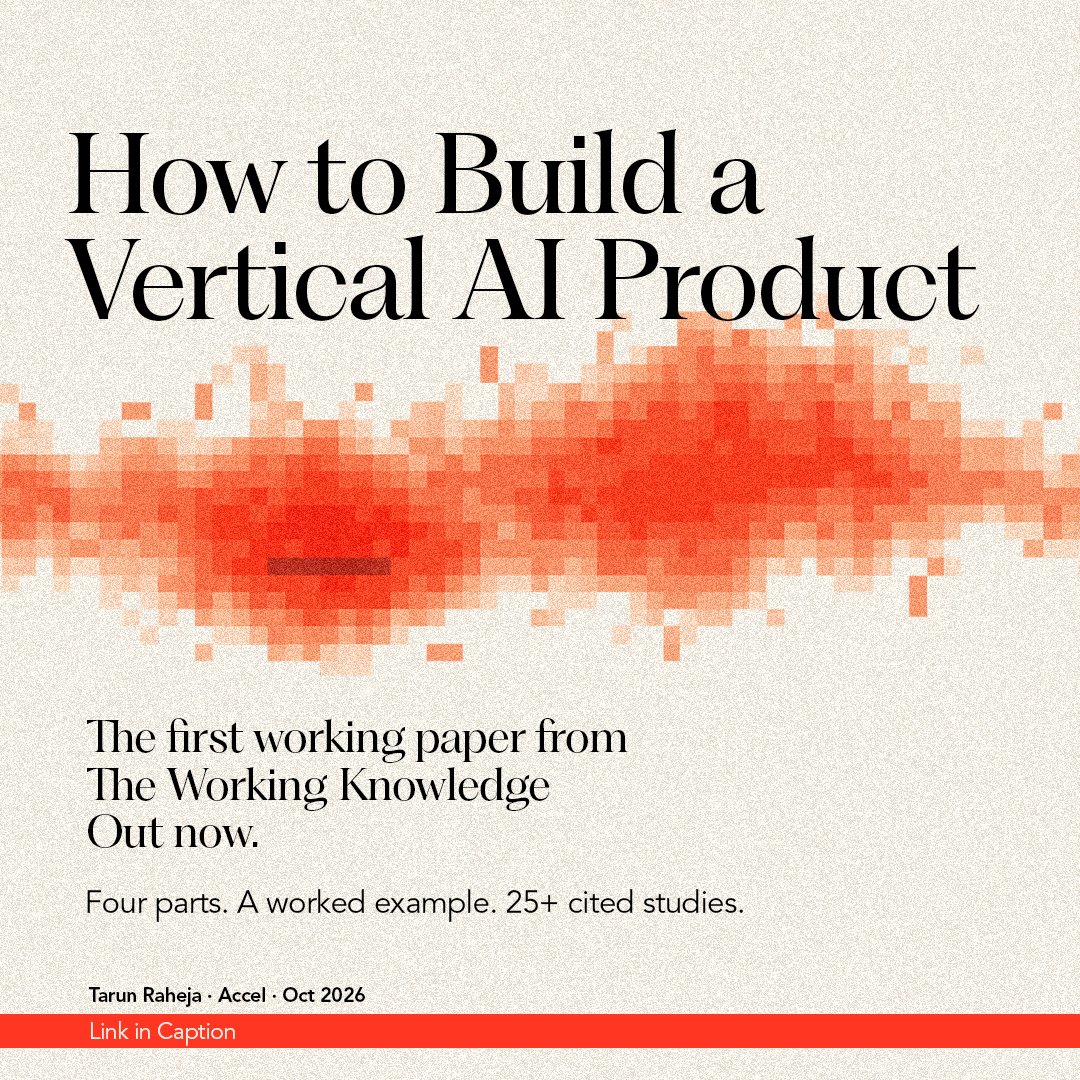
Introducing The Working Knowledge, a new technical publication from SeedToScale by Accel to help founders and technical teams make better decisions about the products they build.
It brings together AI research and lessons from practitioners in playbooks teams can put to work.
Our first, “How to Build a Vertical AI Product” by Tarun Raheja, explores how to evaluate models for your domain, build the context and tools around them, and make the product reliable in production.
With a framework and worked example, it also helps teams decide what to keep, simplify or remove as models improve.
Explore The Working Knowledge and download the playbook: https://t.co/4icyCDGXWr
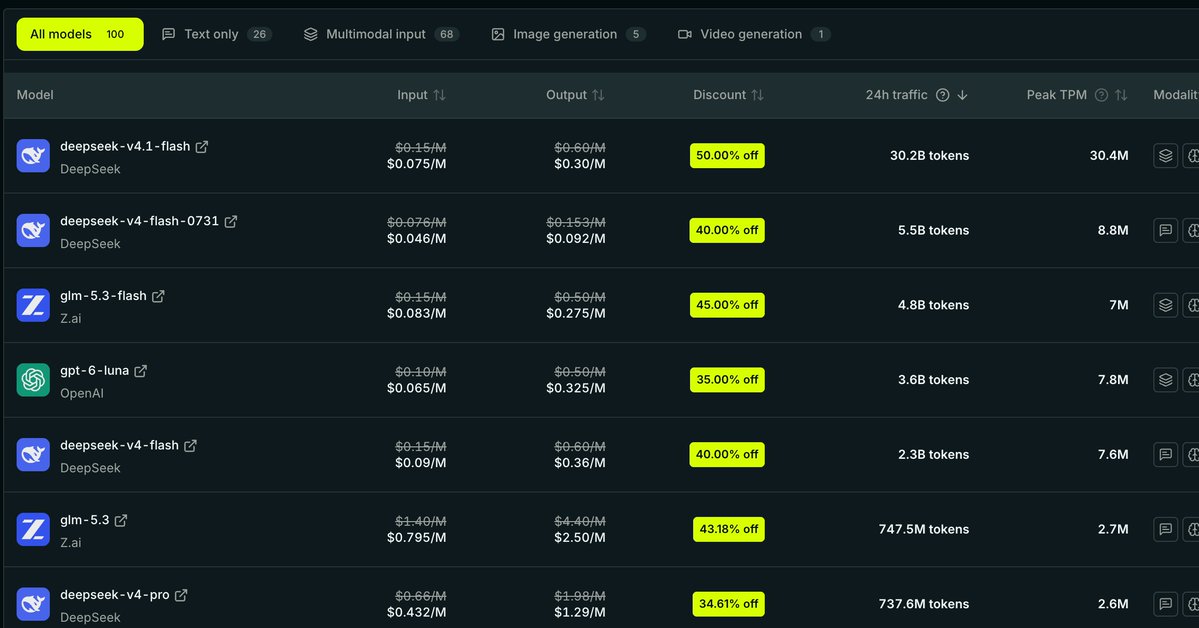
You can massively cut your AI bill in literally 5 minutes
1. Create a https://t.co/PwDxeyq3tH account
2. Swap your API endpoint
3. Send the exact same requests you send today
https://t.co/Xdl6LXlRrL
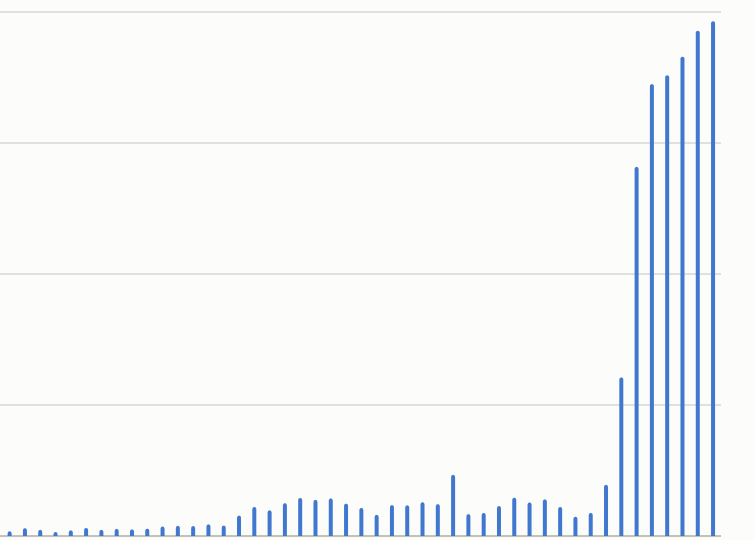
We haven't stopped growing since we launched our new ChatGPT plugin last Tuesday.
I've never seen anything like this, we added 500K in ARR this week only!
OKAY THIS IS GETTING F*CKING INSANE, MY CRAWLER WRAPS SCAM COINS IN SILK WHILE I SLEEP AND JEV + MY GROK BOTS TOOK MY $100 TO $23,879
my crawler post hit 1.2M views on night 3, then half my timeline copied it
so last night i taught mine three new moves
the crawler = a bot that combs crypto Twitter for me all night
Jev = an AI with two answers, yes and no, quicker than a blink, cheaper than a gumball
spider reads, Jev rules, Grok bots click buy and sell
the new moves:
→ radar, circles the top wallets, pings big sellers
→ cocoon, wraps a fake coin in silk, drops it
→ audit, zigzags over my balance, checks every fill
the coin:
HOOKI, 3 hours old, $460K at 10pm, Jev gave it a yes
overnight:
→ 10:20pm first entry came too early, -$271
→ 11:15pm it crashed to $150K, holders down 67%
→ 11:20pm buyers came back, Jev said buy at $366K
→ 11:55pm sold at $718K, +$2,008
→ 1:45am night's bottom $279K, Jev said go, sold $558K, +$2,188
→ 6:15am Jev said buy at $224K, out on the 6:50am close, +$750
→ two smaller wins, +$1,910
anyone who bought HOOKI at 10pm and held woke up 40% poorer
my bots finished up 35.6% trading that exact chart
honestly i'd pay for the cocoon alone, the coins i skip save me more than the ones i buy
night 1 $2,197, night 2 $4,962, night 3 $12,161, night 4 $17,608, night 5 $23,879
at 0:11 the spider wraps a scam coin and drops it
bookmark it, night 6 is tonight
all of it is below ↓ free
send this to whoever copied the crawler first
be honest, who picks better coins at 3am, you or a spider?
Introducing OpenSource Clay killer
- 85% cheaper than clay
- Most accurate on people-search bench
- 25x faster
- Run GTM directly in claude code or codex
Try it at https://t.co/s60Ye4EO3h
Repo link below 👇
I played a Sherlock Holmes deduction game on @VivixLabs_HQ A1.
its a real time AI character model so you talk to him live instead of watching a pre-rendered clip and its built to let you cut in mid sentence.
He lays out the clues, gestures through them and you pick the culprit.
Most live avatars i have seen are just talking heads, so seeing one run a full game was new to me.
I JUST TRIED TALKING TO ELON MUSK AS AN AI CHARACTER… AND THIS IS WILD.
With Vivix A1, you can interrupt it mid-conversation, change your instructions, and watch it immediately adapt.
It can move, respond, and interact with the environment in real time.
The impressive part is how dynamic the interaction feels
it doesn’t feel scripted.
Create your own character. Call the shots. Live.
Introducing A1 Playground + Agent: build a live AI character that talks, moves, and plays with you.
Create yours: https://t.co/3NQRTgOE6O
Their look. Their personality. Their voice. Your choice. Describe who you have in mind, upload a picture, and let our Agent bring them to life.
And they do a lot more than talk.
💃 Full-body performance. From air guitar to victory dances.
🚶 Move around the scene. Walk and talk. Pace while making a point.
🛍️ Interact with objects. Pick up products, show them off, and pitch them.
🎮 Play web games together. Deal cards, keep score, and play along.
Solve a mystery with Sherlock Holmes, then interrupt him for a dance break.
Take a walk with Socrates. Hand him a protein shake and debate the meaning of gains.
Give Snape a bottle of shampoo. Ask for the most enthusiastic sales pitch of his life.
Who will you bring to life?