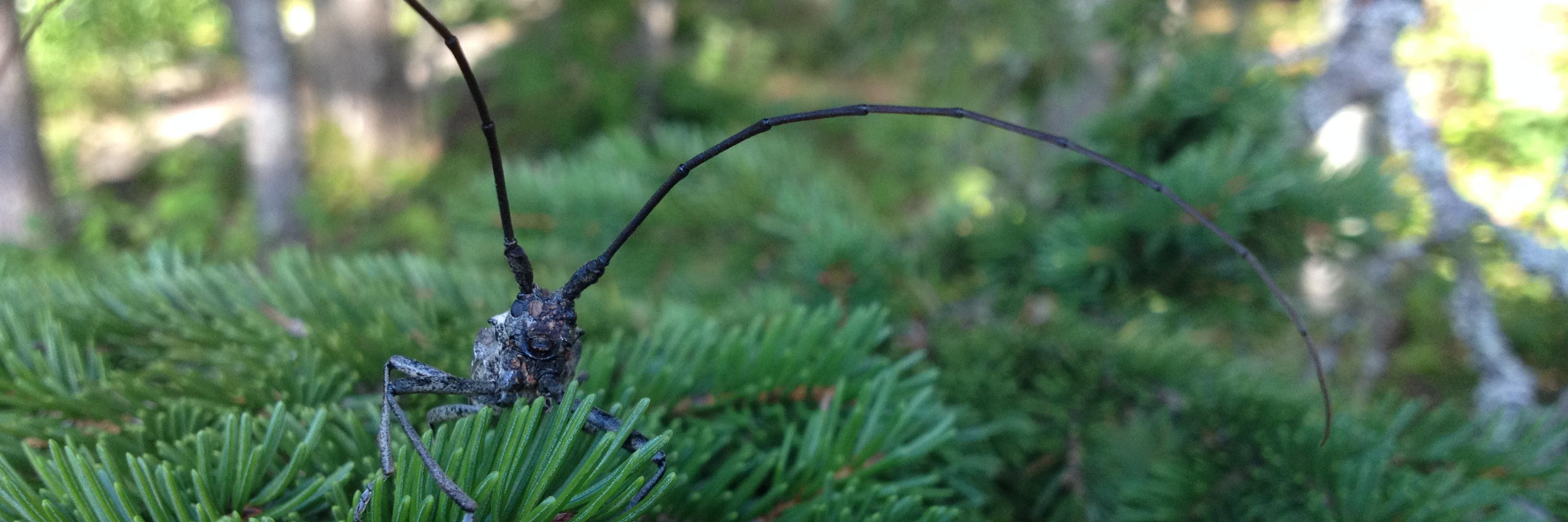
Folks - I'll be at the Botanical Society of America meeting this year presenting on ongoing research from my group studying how natural variation in tree chemistry can be harnessed for conservation of forest ecosystems. Thanks for the invitation @Dowell_VOC Jacob Francis!
@mbeisen If we look at just ROI, study has shown that every $1.00 of NIH funding generates $2.56 in economic activity. This is on top of the medical breakthrough and public health benefits from the investiment. Which other Federal agency can confidently say this?
@JohnStreicher1@mbeisen Absolutely. Like it or not, we live in an attention economy! What captures & holds attention wins. Whether it's 💰 or 🗳. We scientists somehow claim to hate attention mongering as if it's beyond our holier-than-thou selves. But eventually, even within science, this is not true.
Next week we organize our first Workshop on the Management of Terrestrial Gastropods at the @UFIFASCitrusREC in Lake Alfred, FL. You still have time to register on @eventbrite ! #mollusk#workshop
“It’s an escalation of a kind that is unheard of,” said Joan Scott, a historian & member of the academic freedom committee of the AAUP. “Even during the McCarthy period in the United States, this was not done.”
https://t.co/zZDbB0kwnM
For a CS skillset that can't just be replaced by an AI, you have to learn fundamentals. That lets you do tasks that an AI still can't, because your brain is very powerful.
If you're ChatGPT'ing your way through it, you're not building any of those connections for later use.
The story that synthetic nitrogen represents a technological triumph that saved the world from hunger mischaracterizes its industrial origins.
These fertilizers weren't designed for optimal crop nutrition, they emerged from repurposed wartime chemical manufacturing...🧵
No. No. 1000 times No. We don't need to explain the value of science to "the people". Our problem isn't that people don't value of trust science in theory - they love science! It's that they question it's value IN PRACTICE. They question US. To save science we need to show them that they can and should revive their trust in US and OUR INSTITUTIONS to deliver on the promise of science everyone believes in.
Soil microbes don’t just coexist—they communicate
Through quorum sensing, bacteria and fungi synchronize, turning collective actions on or off depending on population density
This hidden system drives nutrient cycling, disease suppression, and drought resilience
How it works:
The claim that graduate students are “free/cheap labor” is not just wrong—it is utterly infuriating. I have to wonder: how many of the people spreading this absurd misinformation have actually trained a PhD student? How many have poured years into mentoring, teaching, and shaping the next generation of scientists? Because if they had, they would know—without a doubt—that this narrative is a complete and utter lie.
Without NIH funds to run research labs at academic institutions, as a country we cannot train PhD students. No physician scientists. No undergraduates get experience in labs. Nothing.
Industry does none of these things.
Other countries will have to take the lead.
Very cool oviposition photos and experiment from @apsciencebydan! Finding adult wasps, demonstrating which host and tissue they oviposit on, and then observing those tissues for gall growth is one of the most accessible and high-value methods!
https://t.co/OxMvxo18bw
I’m on the market! 🎉
What do I do?
-I develop research questions and applied biotechnology to understand and disrupt insect symbioses.
-I coordinate international teams to tackle interdisciplinary global challenges.
-I train mycologists, entomologists and insect pathologists.
As I watch the horrors of that time fade, and governments rewrite history in favour of those who were cruel and selfish while dismantling the systems that kept innocents safe, I’m seeing less and less benefit of the doubt.
We are pleased to announce our new book: The World of Zero-Inflated Models: Using GLLVM. Zuur and Ieno (2025)
This book explores modern statistical methods for analyzing complex datasets, focusing on multivariate models, mixed-effects models, and latent variable models. GLLVMs integrate GLMs and GLMMs with multivariate analysis techniques, allowing multiple response variables to be modeled within a single framework.
Key topics include count data models with excess zeros and distributions such as Poisson, negative binomial, zero-inflated Poisson, zero-inflated negative binomial, and Tweedie. The book also provides practical guidance on implementing these models in R using the gllvm package.
Designed for researchers, statisticians, and analysts working with multivariate ecological, environmental, or social science data, this book is also a practical resource for R users looking to apply complex statistical models effectively. Each chapter includes detailed R code and case studies, demonstrating how to fit and interpret complex models, diagnose potential issues, and refine model performance. Emphasizing practical solutions, the book helps readers apply these methods to real-world datasets.
I am hiring 2 postdocs to work on parasitic and endosymbiotic fungi associated with Hemiptera insects!
Ideal candidates will have experience working with symbionts, dissecting insects, meta/phylogenomics and confocal/FISH techniques (or some of these). Info below.
Please RT.