I actually have data on this! This is a sample of ~150k people who reported their officially-tested score (and checked against an actual IQ test I gave a smaller sample), and the kink groups that correlate with highest and lowest IQ.
Holy crap -
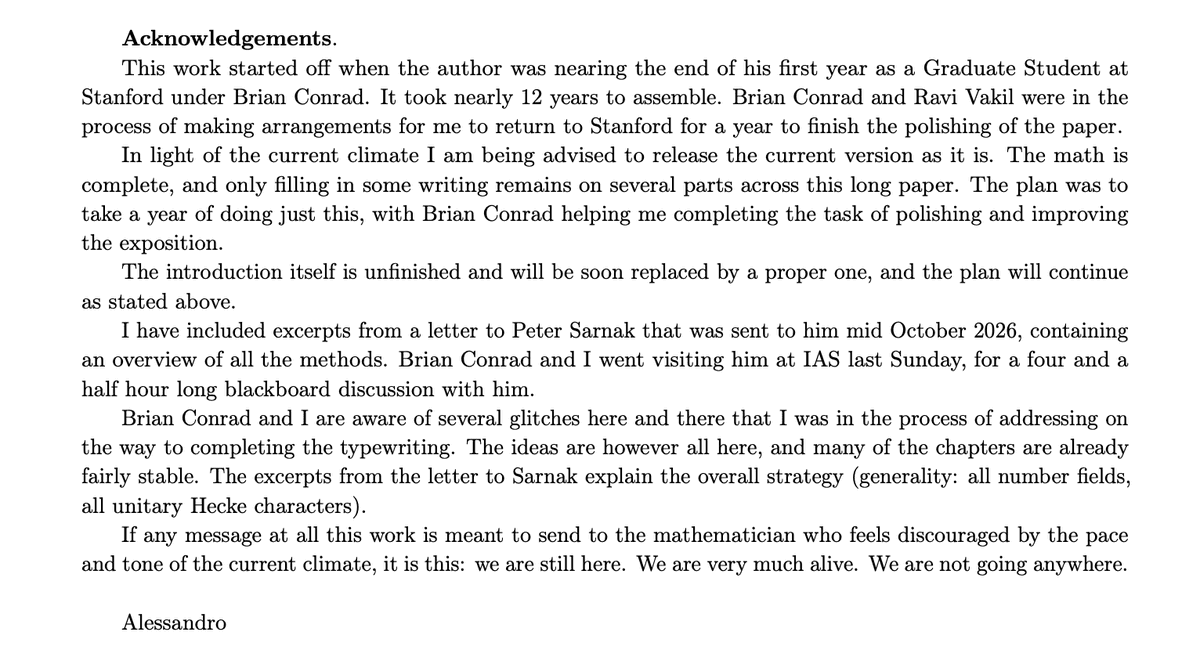
The release of AI assisted Riemann hypothesis solution, forced the hand of Alessandro Masullo to release his own, completely human (no AI) proof he said should have taken another year or so to formally "polish"
Decompiled the stack trace. Way, WAY worse than I could have imagined. On EVERY SINGLE MOUSE MOVEMENT, macOS asks whether the Writing Tools button should be hidden or not. To check, it copies the whole selection over asks if it has >= 8 words. Most of the time this is fine, but:
(a) if you Cmd+a to copy the contents, you are copying THE ENTIRE DOCUMENT OVER, just to check if it has >= 8 words
(b) its copy routines MUCH more expensive when there is a bunch of formatting like syntax highlighting.
EVERY mouse movement. The ENTIRE document. So this locks up the entire tab.
Stack trace in next tweet.
In my ongoing quest to find the limits of Opus 5.5, I directed it to audit my old scientific field, theoretical astrophysics. We indexed about 150,000 papers, audited 50,000 for issues, and did progressively more thorough checks on thousands more. We found nearly 1000 major errors that got cited many times, most are still uncorrected. This survey enabled me to estimate the efficacy of peer review for correcting errors (not very good) and to identify dozens of open questions that anyone with spare Claude Max tokens could answer today (.md context files included).
Bottom line: AI can speed up quantitative science by >1000x with no further model improvement required. But I'm seeing no evidence of this being pushed within universities, only academics complaining about labs dropping math proofs.
Among my fellow reformed academic high agency founders, however, several are speed running entire disciplines.
This survey has implications for how science will be run in the very near future. Hint: Academic publishing is dead. It was already a very stupid way to record and promulgate knowledge, and had been so for decades, even before all that publicly funded knowledge was locked behind paywall cartels. Now AIs can generate thousands of novel, correct papers per day, it is no longer meaningful for humans to consider a research paper a "unit of science" or to even bother much with the 99.9% of science which, up to this point, was necessary drudgery. Time to discover something like General Relativity or Evolution every week. LFG!!
Enjoy: https://t.co/BhRxKVvbim
@Frenchtrader7@thejailbreakhub@i0n1c has a history of finding exploits, proving he can jailbreak, and then performing “responsible disclosure” to Apple and never releasing anything for the jailbreak community. For more than a decade.
Im going to say something that will probably piss people off. I dont see any moral issues with copyright infringement on an internal mockup. Mockup containing the copyright infringement were released it would be subject to legal action. Refusing to provide the mockup is a moral stance a company can take. Sabotaging other efforts for that mockup seems a bit excessive, and may violate federal CFAA.
@etscrivner Microsoft engineers have been screaming about this from the rooftops for the past 5 years but leadership didn’t care.
Microsoft engineers are the lowest paid big tech engineers in the entire industry. And STILL Satya finds excuses to have mass layoffs every year
I joined Microsoft in the 2013–14 timeframe and was immediately struck by the quiet competence that ran through the place. Engineers, security people (including the physical security team), lawyers, developers, and others were simply very good at what they did. In many niche areas, the person sitting in the role was, quite literally, “the” person in the industry for that domain.
Incident and outage calls reflected the same culture. They were calm, quiet, and professional. I still remember jumping onto a Saturday outage bridge and listening to a group of relatively junior engineers work methodically through their runbooks. When they reached the end of the procedures without a resolution, they pivoted without drama into deep technical troubleshooting well beyond the documented steps.
Security incidents were handled the same way. A call might bring 50 people together, yet an L63 or L64 incident manager would run it with clarity—walking through what was known, identifying the gaps, and tasking items across the company.
There were roughly three kinds of people who made this work. Junior college hires were often brilliant, highly motivated, and full of energy. Mid-career people, many with kids and living on the Eastside in places like Sammamish, served as the steady anchors of their teams—engineers, PMs, and others with a decade or more of experience who were simply good at their jobs. Then there were the longer-tenured employees, some with 30 years at the company. Microsoft valued that longevity. These people knew where systems had come from and what was under the hood; they were respected for what they knew, regardless of level, and were regularly pulled into meetings with senior leaders to walk through hard problems.
Even senior leadership operated in the same spirit. I once got a weekend call from a very well-known Microsoft VP. He was direct and courteous: “Is this X? I’m going through this issue and see that you own a document I’d like to read. Can you give me access? Thanks for the help on a weekend—I really appreciate it.”
Around 2020, that culture began to change, and I left not long afterward. I watched the company part ways with many of the people who had solved some of its most significant problems over the previous 20 years. A large number of my former peers and colleagues left as well. It is no longer the company it once was.
I regret to inform you all that we have found our first long false positive from 2006
it's a poem where the same 6 words are repeated four thousand times