Blockchain and Crypto. Sharing thoughts and insights on blockchain technology and cryptocurrencies, focusing on ideas I believe deserve wider attention.
The confidential shard is the main reason the market is paying attention to NEAR again.
It lets a trading desk move size without other desks seeing it. A startup run payroll on a public chain without leaking salaries. A DeFi vault publish its NAV while keeping the strategy hidden. An AI agent run prompts that never reach the model provider in plaintext.
Or at the consumer level: you can pay for coffee without the cafe pulling up every transaction you've ever made, and without whoever was watching your wallet learning where you eat lunch.
All on one chain. Same wallet. Public verification still intact when you want it.
Let me walk through how the mechanism works and why nobody else has shipped this.
The shard is operated by a decentralized set of independent permissioned validators, but the execution runs inside encrypted hardware enclaves (TEEs). Validators process transactions as if they were running normal code, except they have no visibility into the data being processed. Nothing about the transaction makes it onto the public ledger. Not balances. Not order details. Not the address on the other side. A TEE-based bridge handles transfers between the private shard and NEAR mainnet.
You still need to see your own balance somehow. That's what viewing keys are for. A private key the account holder keeps locally, used to decrypt their own state. Indexers can't read it, block explorers can't read it, and even the validators that just processed the transaction can't read it.
The UX is a switch. Open near-dot-com, flip from your Main Account to your Confidential Account, move funds in. Send or swap from there. When you want it back on the public side, unshield. No ZK ceremony, no state sync, no separate wallet.
Cross-chain isn't broken. Last week Alex Shevchenko sent 0.1 ETH from his NEAR account directly to the Ethereum Foundation. The EF received the ETH on Ethereum. No chain recorded who sent it. He said it felt like sending money in Revolut.
For institutions there's a second piece. Optional selective disclosure. The validators don't see anything, but the account holder can hand a viewing key to an auditor. Compliance without broadcasting to the public chain. That has been the missing piece blocking serious money from entering DeFi.
Privacy on a public blockchain used to mean leaving it. NEAR made it a switch on the account you already have.
my favorite way to use crypto as my bank recently:
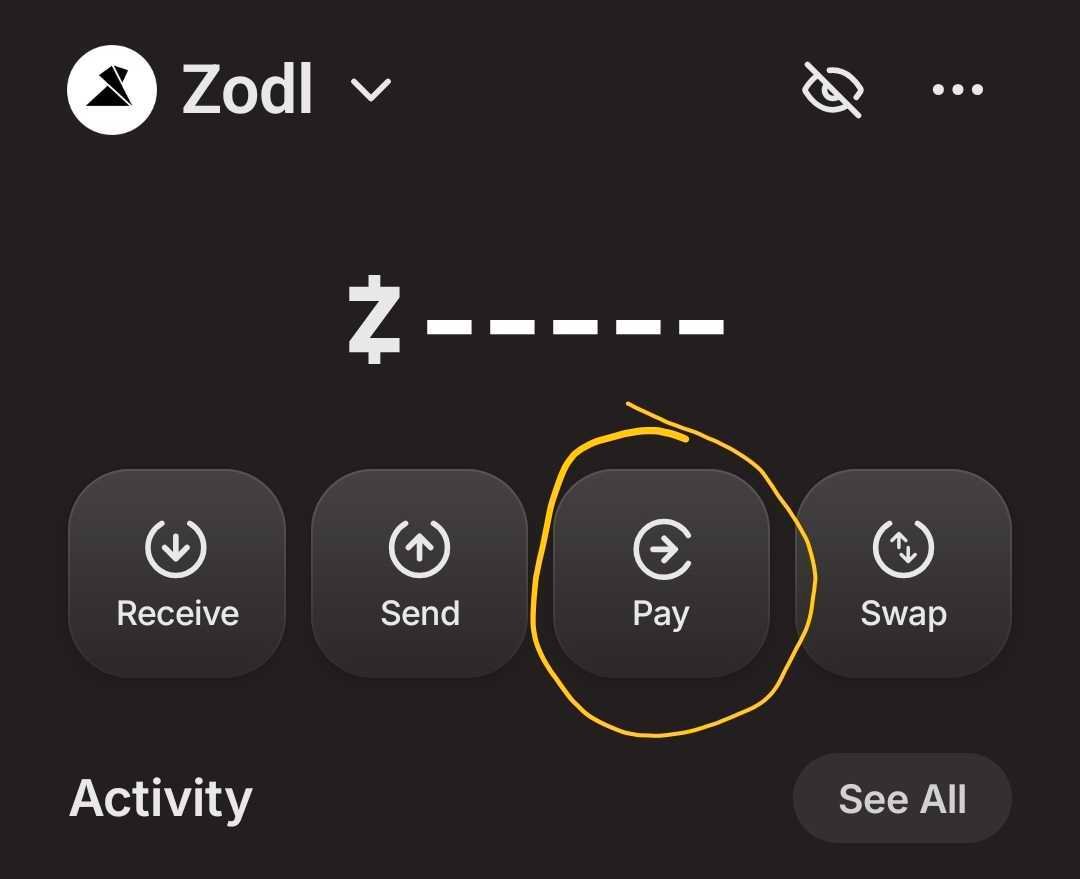
i) shield zec in @zodl_app
ii) use crosspay (uses near intents) to do txns in stables on Solana when needed
a private swiss vault you can spend from
zcash x near x solana, the dream team
I just got back from SF and I FEEL INSPIRED.
I spent 5 days with frontier AI model teams, AI startup founders, and 3 billionaires.
My takeaways:
1. I had lunch with 3 billionaires. All of them are buying SaaS companies and rebuilding them agent-first. They were deeply inspired by Bending Spoons and Ryan Cohen's eBay deal. Buy the company, cut the headcount, rebuild the tech, add agents, add features, make more valuable experience, raise prices.
2. The frontier model companies are hungry for usage data from the field. They can see API calls and token counts. They can't see the actual workflows. If you're deep in a niche using these models in ways the model companies haven't seen, that understanding is incredibly valuable. Usage intelligence is the new alpha.
3. Consumer AI is massively underbuilt. Every billboard in SF is either B2B inference infrastructure or vertical agent companies. The entire city is optimized for enterprise. Meanwhile you have companies like Cal AI doing $50M ARR in 18 months as a consumer app. I met with a cool few teams doing consumer AI (@paulscherer / @ekuyda)
4. MCP came up in literally every conversation. The companies exposing their product as MCP endpoints are getting pulled into deals they never pitched for. The ones that aren't are becoming invisible to agents. This is the new SEO. If agents can't find you, you don't exist. Building products for agents is the new zeitgeist in general.
5. Not uncommon for hot seed rounds to be $25-50 million valuations. I saw a Series A at $450 million
6. If I had a dollar every time someone mentioned "forward-deployed engineer" this trip I could have funded a seed round. It's the hottest role in SF right now. The person who sits between the agent and the customer, making sure everything actually works.
7. The mood around open source shifted. A year ago it felt like open source was chasing the frontier models. Now founders are telling me Gemma and DeepSeek are good enough for 80% of what they need at a fraction of the cost. The "which model do you use" conversation is being replaced by "which model for which task." Model loyalty kinda feels dead.
8. Voice agents came up more than I expected. Multiple founders told me voice is the interface for the next billion users. The billion people who will never type a prompt will absolutely talk to one.
9. The Obsidian community in SF is weirdly intense. Multiple founders showed me their vaults unprompted. Like showing someone your home gym. It's a flex now. The quality of your knowledge base (second brain?) is becoming a status symbol among builders.
10. Maybe it was just the people I met but the age of the founders is shifting. I met more founders over 40 this trip than any trip before and more founders under age 21 than ever before. Founders getting older and younger at the same time.
11. I spoke to a lot of fast-growing startups, VCs and frontier models who are hiring content creators right now.
12. The restaurant scene in SF is actually better than it's been in years. Founders are going out more. Alcohol is out, not surprisingly.
13. SF doesn't feel like the only place anymore. We all have access to the same frontier models. We all read the same X feed. A founder in NYC or Lagos is calling the same APIs as a founder in SoMa. So in the past it felt like SF was always lightyears ahead, doesn't feel that way anymore. It's okay not to live in SF and have BIG DREAMS.
14. The coworking spaces in SF are half empty but the coffee shops are packed. People want to be around people. I had a few startup ideas here....
15. Walking around the Mission I noticed something: the street-level businesses, the taquerias, the barbershops, the laundromats, none of them use any AI at all.
16. I heard the phrase "agent debt" for the first time. Like technical debt but for agents. When you hack together an agent workflow fast and never clean it up, the system prompts conflict, the memory gets polluted, the tools overlap. 6 months later the agent is doing weird things and nobody knows why lol.
17. Met a few people who carry two phones now. One for personal. One that's basically an agent terminal running Telegram or iMessage connections to their agent fleet.
It's always amazing to get that dose of inspiration in SF. I FEEL INSPIRED.
But I'm so happy to be back home, locked in and building.
We're 12-18 months into a shift that will take 15 years to play out. The urgency in every conversation was real.
What an incredible time to be building.
Zcash has the strongest investment thesis in crypto.
It is the pinnacle of the cypherpunk vision: encrypted money at planetary scale, soon resilient even against quantum attacks.
No other asset is as philosophically and technologically ambitious as Zcash.
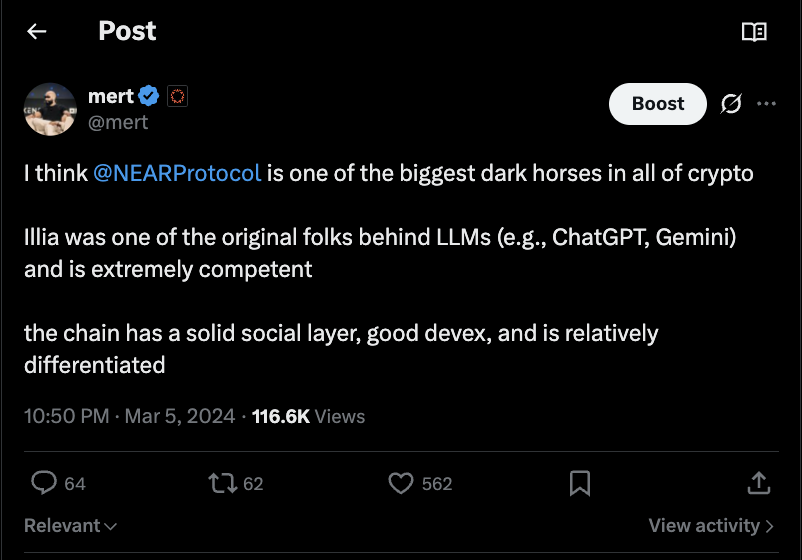
I'm not directly involved with near unlike zec & sol, but I've been consistent that it's obviously underrated given what it can do for a while
so it's satisfying to see a vibe shift around it
if they nail their gtm, decrease distractions, and increase focus, this could be fun
The CLARITY Act has now passed out of the Senate Banking Committee with bipartisan backing and moves to a full Senate vote - a historic moment for crypto entrepreneurs and American consumers.
Crypto is not a red or blue issue. It is about whether the next generation of financial and internet infrastructure gets built in the United States.
Thank you to @SenatorTimScott and @SenLummis for your leadership on the committee, to @BankingGOP, @Sen_Alsobrooks, and @RubenGallego for their support, and to all of the staff who have worked tirelessly to get to this point.
It’s time to pass CLARITY.
This is it.
Everything learned spending millions on longevity.
From: Your Immortal Unc and Auntie.
To: Our Immortal nieces and nephews.
0. Sleep is the world's most powerful drug.
1. Be in your bed for 8 hours
2. Same bedtime every night, any time before midnight
3. Don’t eat right before bed
4. Calm foods for dinner
5. No screens 1 hour before bed
6. Avoid added sugar (be aware it’s in everything)
7. Avoid all things in an American convenience store
8. Avoid fried foods
9. Shoes off at the door
10. Eat whole foods, particularly veggies fruits nuts legumes berries
11. Walk a little after meals or air squats
12. Get your heart rate high routinely
13. Lift heavy things
14. Stretch daily
15. Water pik, floss, brush, tongue scrape, morning and night
16. Make an effort to drink water
17. Get sunlight when you wake up (UV is low)
18. Protect skin in midday sun
19. Stand up straight
20. See at least one friend once a week
21. Avoid plastic where you can (in all things)
22. Circulate air in rooms
23. When stressed, breathe, learn to calm your body
24. Go to the dentist
25. Avoid sitting for long times
26. Protect your hearing, the world is too loud
27. Alcohol is bad for you
28. Finish coffee before noon
29. Avoid bright lights after sunset
30. If obese, look into a GLP
31. Sleep in a cold room
32. Texting while driving is dangerous
33. Turn off all notifications
34. Limit social media use
35. Don’t smoke anything
36. If you struggle to sleep, read a physical book before bed
37. 1 hour before bed have a calm wind down routine: bath, read, light walk, listen to music
38. The body is a clock and loves routine. Have a daily morning and evening schedule.
39. Avoid long distance travel where you can
40. Baby steps first: incorporate new things slowly
41. Do less… most things don’t work.
Bonus points if you get your blood checked.
Start here, it will change your life.
Arthur Hayes (@CryptoHayes) dropping strong conviction on $NEAR in his latest substack article.
“My next essay will explain our thesis on why the privacy narrative combined with NEAR Intents will create a positive cash flow situation for the protocol."
The pieces are coming together. Here are 28 reasons why 2026 belongs to NEAR ⬇️
Your agent, your model. Switch between Claude, GPT, Gemini and more inside IronClaw with one click & run them securely.
Swap @IronClawAI Model providers in seconds.
Watch the tutorial below ↓
$ZEC is up 50% on the week. people are calling it noise, it's not.
CLARITY Act markup hits the senate banking committee may 14. first real US crypto market structure bill to actually move in years. once tokens get clean rules, the assets that've been sitting in the regulatory grey zone forever, like privacy coins, get a shot at being touchable again. ZEC is the most leveraged play on that thesis. that's why it's bid.
but the trade isn't ZEC.
ZEC by itself is annoying to use. shielded wallet, cold UX, basically zero DeFi. fine for hodling. useless for anything else.
ZEC on NEAR Intents is the version that actually works. swap it for BTC, SOL, ETH, USDC at near-zero fees, no shielded wallet drama. it stops being a museum coin and starts being a real liquid asset.
NEAR Intents already runs:
- $45M/day
- $1.7B last 30 days
- $18B all time
no token. no farm. no incentives. just product.
if CLARITY moves and the privacy trade keeps going, ZEC pumps once. the rails it pumps on keep the volume forever.
current $NEAR mcap: ~$2B, fully circulating. current AI agent meme mcaps: way more, with no product. current pricing of NEAR being THE privacy DeFi rails: zero.
idk how you don't take this trade.
amazon launched agentcore payments on may 8 routing AI agent transactions through x402 in USDC on base. 161k monthly active agents, up 669% month over month, $100m+ in Q1 volume. the part that matters for positioning: chainlink's payment abstraction layer converts enterprise fiat payments into LINK and deposits them into the chainlink reserve automatically. every dollar an AI agent spends through x402 creates programmatic LINK accumulation. chainlink already pulling $39.64m in annual oracle fees. now there's a second structural demand vector scaling with agent commerce volume that has amazon, mastercard, and coinbase backing it through the linux foundation. LINK has a treasury accumulation mechanism disguised as payments infrastructure.
foundry digital just made zcash the second asset they've ever supported after bitcoin. captured 30% of ZEC hashrate in their first month. this happened the same week mining emissions dropped 70% from the halving while 31% of total supply sits locked in shielded pools, up 304% YoY. ansem bought at $5 and told you about it at $600. why are they confessing? they aren't confessing, they're bragging. the supply squeeze math is straightforward: 70% less new issuance, a third of float privacy-locked and growing, and bitcoin's largest mining infrastructure operator just validated the network. $924m in open interest and $5.6b in daily perp volume. this is not a shitter rotation. foundry doesn't mine shitters.
many people dont know this
zcash was the first ever zk snark system on the planet (which is crazy lore), and so zk tech was very early and hard to work with
zcash only started becoming viable ~2 years ago
after grinding for years, the tech finally advanced to have better performance and fewer compromises, while others took shortcuts
then @zodl_app came along and started building on top of it to show what's possible
now, we're in a state where we have the strongest cryptographic guarantees through a decade of rigorous engineering, tons of upcoming performance and UX upgrades, and quantum recoverability within the month
the show is just beginning
zcash generated $28.2m in chain fees over the measurement period. ahead of solana ($15.8m) and ethereum ($13.8m). ZEC perpetual volume on hyperliquid exceeded SOL on may 1st. foundry captured 30% of network hashrate within 30 days of launching their ZEC pool. 59.3% of transactions now shielded, all-time high. shielded pool volume up 304% year over year. FCMP++ 2nd testnet goes live may 6th, expanding the anonymity set from 16 outputs to 100 million. the optional privacy model survived every major exchange delisting wave that killed monero's CEX liquidity. robinhood, thorchain, and bulktrade all added ZEC access in the last two weeks. $25m ZODL raise closed. this is a protocol generating more fee revenue than the two largest smart contract platforms while trading at a fraction of their market cap.
What NEAR shipped last month:
✦ NEAR Intents crossed $17B+ in all-time volume and 23M+ total swaps.
✦ XAU₮ (@tethergold) went live on NEAR Intents. ✦ IronClaw released versions v0.26 and v0.27, upgrading agent self-improvement and security ✦ NEAR AI and @joinabound partnered to deploy cross-border payment IronClaw agents ✦ @sigmaswgroup and NEAR AI partnered to deploy confidential inference for enterprises ✦ @oisy wallet integrated NEAR Intents ✦ NEAR Intents began powering cross-chain swaps inside @matchametaxyx ✦ NEAR Intents now powers deposits from any chain into @trycallshot ✦ NEAR intents went live in @reydotxyz ✦ Co-Founder @ilblackdragon presented at the @Kryptoplanet_ IronClaw meetup in Seoul and Buidl Asia ✦ NEAR Legion began hosting IronClaw Agentic Workshops ✦ @DefiLlama introduced a comprehensive NEAR ecosystem dashboard ✦ IronClaw got its own X account (@IronClawAI)
And much more.