I’ve started a new company with @philhchen!
Phil built frontier LLMs across research & engineering at OpenAI, DeepMind, and Scale.
I was shipping AI experiments at Ramp Labs.
We've been heads down building personalized AI coworkers for every business.
We’re growing our team of researchers, designers, and IMO gold medalists. Reach out if you're interested!
1/ Concrete x Jet
We’re excited to announce that we have acquired @JetProtocol to build the most robust full-stack DeFi experience.
Jet was an early money market in the Solana ecosystem and this acquisition accelerates our expansion beyond the EVM.
two unread emails:
- from HR: please fill out our anonymous survey
- from Boss: don't forget about the survey, HR said you are the last one from our team
@VCBrags For every blind faith check a VC writes there are 50 blind faith LPs whose returns are slowly eroded by a “management” fee schedule. The startup needs to decide how to allocate the capital—a lot more challenging to do correctly than do make that initial pick imo.
. @nivi shares the story of how AngelList got started.
“If people are massively frustrated by your product, I think that’s just a great sign of success – an indicator of how much they need it.”
Full story and more insights in this Airchat channel: https://t.co/lhk2HLdUtA
BREAKING: US Supreme Court effectively outlaws landing pages that look like Linear.
The court, which has a 6-3 conservative majority, has found that continuing to copy Linear's style is "too trendy" and has deemed the practice unconstitutional.
The justices expressed concern that designers are being directly asked to design landing pages to look like Linear — or even worse, shown other SaaS companies that copied Linear, as reference.
"It does seem to me to be curious that designers are coming into these projects with great creative ideas, but the output ends up looking exactly like Linear. While it is difficult to prove what went wrong, it is clear that a direct violation of the constitutionally protected creative process is being violated." Chief Justice John Roberts said.
BLOOMBERG ARTICLE ON SYSTEMIC RISK FROM PODS
Some interesting points in this Bloomberg article on multi-manager funds.
A couple points stood out to me, and there were a couple points I would add. What stood out:
1) PODS ARE BIG. 30% of HF GMV per GS report (does anyone have this GS report that can share? If so please e-mail me brett@fundamentedge . com). The mindset I was taught coming up on the buy-side was that unlevered long only funds were the incremental price setter in markets, i.e. "who we are selling stock to" when we are right, or "what gets Fidelity to buy 10% of this company". Market structure has clearly shifted over the last decade and now the incremental price setters are indexers and levered pods. This evolution has implications for both alpha capture and, more importantly, risk management. As students of LTCM and Mandelbrot know, the bell curve distribution does not accurately capture the prevalence of left tail events (particularly when leverage is present). While I'm not in the peak pod camp (the simple Sharpe math of additive P&L with sum of squares risk combined with shared infrastructure & resources and the benefits of responsible leverage, delivering 8-12%+ uncorrelated alpha-focused P&L are just too powerful for the biz model to go away), I feel like it is almost certain that of the 55 pod firm Bloomberg noted that there will be some catastrophic impacts to equity over the next 18-24 months (likely not at the big firms, which I will talk about in a minute)
2) THIS SHIFT CREATES OPPORTUNITY. The article noted Magnetar introducing a short-term strategy to monetize pod kerfuffles. I've written about this on Twitter and spoken to many clients about some ideas on this. In short, the same way Tiger funds obsessed 15 years ago about when Fidelity would buy a stock, today I think it is very important to understand pod positioning - where they are and why they are there. This isn't rocket science. Pod portfolios tend to lean into a somewhat consistent factor profile (long ST Mo and semi-consistent biases in aggregate on SI, excess beta & earning revisions). With this "pod superfactor" lens combined with some approaches on positioning survey & observation as well as other quantitative signals, I don't think it is super complicated to determine a caricatured pod portfolio. Then a simple quintile spread (most vs. least crowded) and some trading volume measures can, I think, give you a dashboard to better manage risk & seek opportunity amongst the pods (I discussed this in some depth in a Beat the Pods thread and continue to apply brain cycles & have had many proactive conversations on this topic with managers).
In general, however, I resonate with Ken & Citadel's pushback on regulation here. While it is possible, I personally would be surprised if one of the Big 4 pods have a catastrophic impact to equity (i.e. over 25%). Why?
1) They all hire (mostly) responsible PMs who risk manage their own portfolios and are trained in cutting left tail events aggressively on a bottom's up basis
2) My sense is most of the Big 4 have locked up capital, i.e. the snowball of LP redemptions is a smaller risk
3) Strong PB relationships. The Big 4 are such key revenue generators on the Street that I would have to believe they get more flexibility from PBs in times of stress, such that a margin call doesn't snow-ball a drawdown by forcing more de-grossing (this is my speculation)
There are a few issues that the article didn't discuss.
1) LIQUIDITY OF THE UNDERLYINGS. With pods now overseeing well over $1tn gross, to me part of the conversation should be focused on the liquidity profile of the underlying securities. The article discusses mostly non-equity trades and my sandbox is equities, so I pulled up the T3M ADV of the S&P 500. The average S&P 500 stock trades about $514m per day, but the MEDIAN trades only $222m (average skewed higher by TSLA/NVDA/AAPL/MSFT). Why is that an important stat to know? Slippage curves (i.e. the price impact from trading) tend to rise exponentially above 3-5% of volume. Try to trade above 10% of volume and you are really jamming the stock. 5% of $22m ADV is only $11m per day (i.e I can only buy or sell $11m a day without meaningfully moving the price). So what? Well, as pod portfolios have grown exponentially in both size and number, the liquidity of the underlyings have not. And, as the article noted, overlap has increased. As a PM, I might think I am being responsible only owning 0.5x an ADV of a stock, but if 20 of my pod PM buddies (including 10 at recent upstarts) who think alike and talk to each other both own half an ADV, the race for the exits can be much more violent than it was even 5-10 years ago. Layer in pod growth in Europe & Asia where liquidity is even thinner.
2) BACK-BOOKS. My sense is that the majority of pods either have some sort of center or back-book or want to have some sort of back-book. Why? Well, it is simple math. If I have a PM who generates $100m of P&L and I pay that PM 20% of his P&L, I keep $80m, he & his team keep $20m. If I back-book the same positions by doubling up his portfolio, I keep 100% of the back-book. Generally PMs have no visibility into this (but they feel it in slippage). Thus, that PM who thinks he is being responsible capping at 0.5x ADV doesn't realize his firm owns more than that via the back-book.
3) CHAIN LEVERAGE. Honestly this is the one that worries me the most and I hear some of these stories and I really scratch my head.
What do I mean by chain leverage?
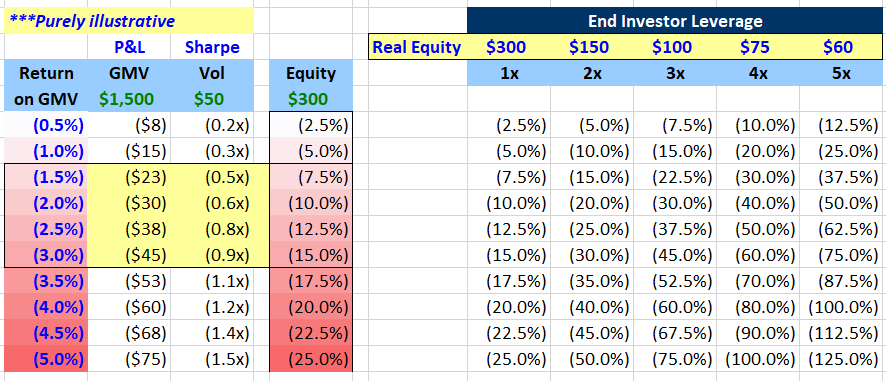
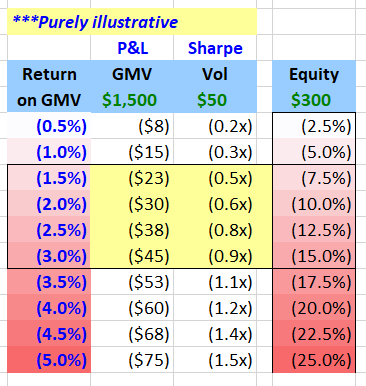
Well, I think it is pretty clearly understood the typical way a pod works. Take $300 of equity, lever it ~5x and turn a 3% return into a 15% return. This has worked on the positive side, but leverage accelerates outcomes on the downside as well.
What worries me more are the stories of LPs levering up THEIR equity checks. So of that $300 I commit to a multi-manager, I may lever up $100m with $200m of borrowing. This just seems insane to me, and a trend I hope does not grow. The chain of leverage effectively means that I am taking $100 of equity that supports $1,500m of gross market value at the underlying portfolio, and a chain of leverage of $1,400. I that instance, a 5% drawdown on the $1,500 book leads to an impairment of 75% on my initial $100 equity. A potential equity vaporization scenario for the levered LP.
Capital quality (i.e. a baseload of internal capital, longer lock-ups and avoiding levered LPs) seems to me like it will be an important thing to consider if we do indeed see systemic pod risk flare-ups. (Again, my sense is the Big 4 stand out very positively on this regard). But something to be aware of.
As always, if you are a fund and want to spitball on some of this, please reach out either via DM or e-mail. I think this will be a fascinating part of the market over the next couple years (leverage, if nothing else, makes things exciting)
https://t.co/GQY6NePa5O
back in PE days
my fellow associate & i used to play a little game
he was a fellow mischief-maker -- i think he's a yoga shaman / snowboard instructor in rural CO nowadays
anyway, our game was called "Hot Cookie"
(1/n)