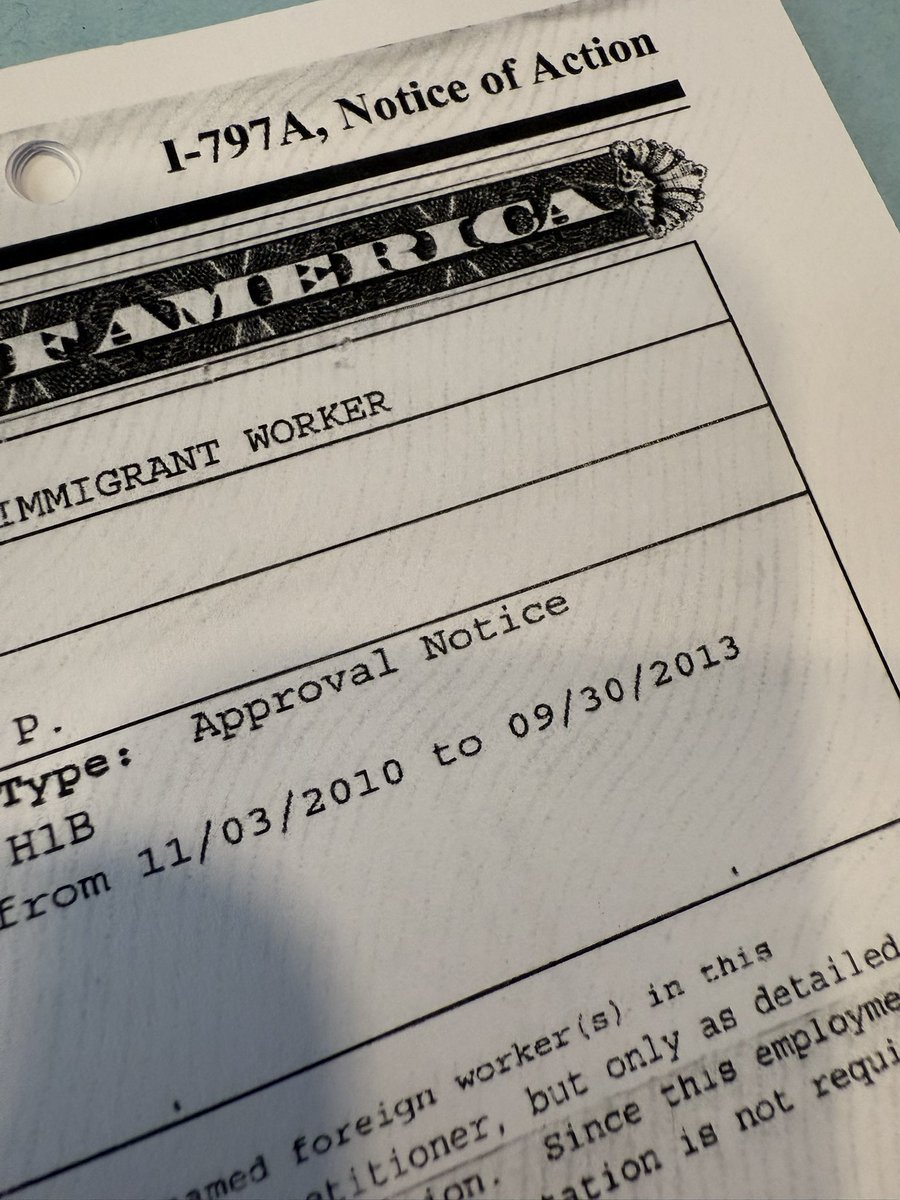
Reviewing an H-1B extension for an employee who’s been in H-1B status nearly 15 years. She started her green card process a decade ago—and is still waiting. The only reason? She was born in India. How does this serve the interests of the United States?
@immigrationgirl I think Senator Mike Lee had put it most articulately as "antithetical to American values" and "morally wrong." Don't know what else there is to say: https://t.co/5c61FLsgjJ
What's the source?
This is likely about domestic H-1B renewals, which the State Department announced during one of Modi’s recent visits.
Let’s not forget—only those born in India must endlessly renew their H-1B visas due to discrimination based on country of birth, while others transition to permanent residency after a short time on H-1B. In many cases, they don’t even need an H-1B and can move directly from a student visa to permanent residency.
Hey @elonmusk do you know what this table is & how many people & families it impact?
We can only reach you on X but If you get to talk to @AravSrinivas ,he can tell you how bad the situation is for these Legal High-skilled immigrants. 13 year long backlog 1.2 Million applicants in Doctors,Engineers & IT professionals.
We need @realDonaldTrump@POTUS to sign an EO to clear this #greencardbacklog .
@JDVance@VP@DOGE
Under the Civil Rights Act, discrimination based on national origin is illegal.
Workers applying for Adjustment of Status (AOS) within the United States should not face differential treatment based on their country of birth.
President Trump should issue an Executive Order to ensure that AOS applications are processed on a First-In, First-Out (FIFO) basis, ending DEI in merit based immigration.
Skilled based immigration should be based on merit. It's ok if 0 Indians qualify once it's purely based on merit. No one is asking here to let in more Indians.
And if you have 0 issues giving 100% students and work visas to people of one country, then there shouldn't be any issue giving them equal opportunity and fair shot at earning their freedom.
@elonmusk And America does provide employment based greencards based on country of birth today. Literally doctors and surgeons on the frontline are unable to get greencards only because of birth country, after being approved for a green card many times.
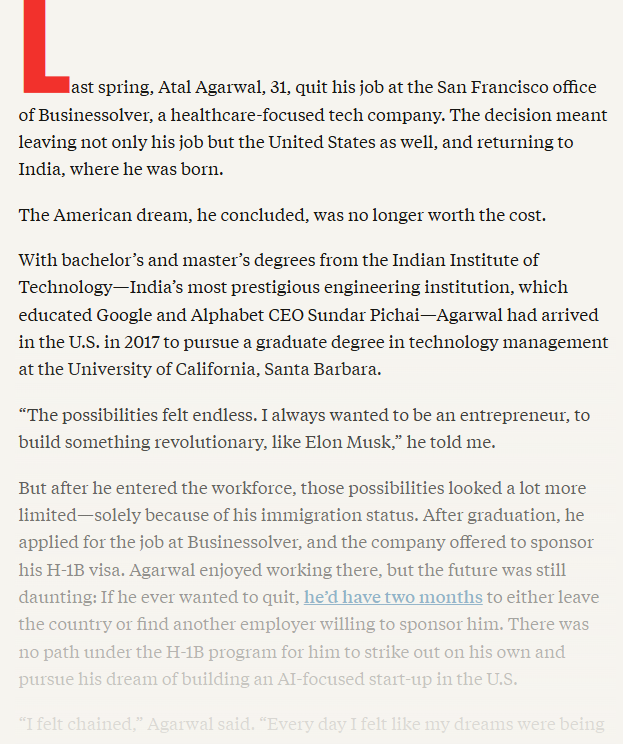
Some ppl said Rosa shouldn't have been on the bus at all, and some others empathized with Rosa being on the bus. If you ever wondered what Rosa felt, here is a similar but slightly different struggle in the modern age: https://t.co/aD74dF3pCb
@elonmusk@VivekGRamaswamy
@MichaelZygi@Cloudwatch199 Today, H1B is a path to citizenship only for those who aren't born in India (this discrimination is the issue). Make the system for skilled based visas based only on skill and not on country of birth, remainder of issues will sort themselves out.
The H-1B was designed to be 6 years. In 2000, employers were struggling because the H-1Bs they had sponsored for green cards were facing a backlog due to the green card caps on each country and their H-1B would expire before they got their green card.
Rather than abolishing the caps on each country and expanding the number of green cards to meet the age of the internet economy, Congress modified the H-1B so that workers in the green card backlog could renew their visa in perpetuity as they wait.
H-1B is now used as an endless waiting room for employees in the green card backlog. Not having a green card after working here for many years causes a multitude of problems. Not only do they have a lot more bureaucratic hurdles and restrictions when it comes to switching jobs, the children they brought with them age out of their dependent visa status when they turn 21, causing them to get kicked out of the green card line and potentially the country. Even the dependents with high paying job offers can be rejected by the visa lottery, or the Department of Labor can take too long to approve their employer's green card petition and they're forced to leave anyway.
They also can't freely travel back home without stopping at a consular office abroad to renew their authorization every 3 years. The renewal process is unpredictable, and people might be stuck in another country for months as the State Department processes their visa renewals.
Why are people still getting in the green card line if the backlogs are so long? Because the government is terrible at projecting how long it takes to get a green card. One year, they say an applicant could get it in 5 years. The next year it could be 20 years. That lack of transparency makes people believe they can wait it out, but it also gives people false hope as their estimated wait rapidly fluctuates.
These people have already bought houses, built families, and have become well seasoned professionals in our broader economy, defense industrial base, and health care workforce.
But rather than worrying about these very real issues, the discourse is centered around imaginary instances of H-1B baristas and cooks making $30,000. Hint: if most RNs aren't considered educated and specialized enough for an H-1B, then a barista certainly is not eligible.
Read this story
After 19 years of being a doctor and saving American lives, he is still waiting for his Green Card.
Sriram was talking about this discriminatory country caps on skilled green cards but some of you made it about H-1B, which doesn't have country caps.
America’s Hidden Paradox: Valuing Skilled Workers but Denying Fair Treatment
American companies, hospitals, and universities rely heavily on the H-1B visa program to hire the best and brightest skilled workers. This program plays a critical role in addressing shortages, enabling businesses to grow, hospitals to provide essential healthcare, and universities to conduct groundbreaking research.
Neither employers nor the U.S. government has any issue with where these workers come from. Their sole focus is on hiring the best of the best, regardless of nationality—even if nearly all of them come from a single country. This approach has led to the majority of H-1B visas being awarded to Indian workers, who are highly sought after for their exceptional work ethic and expertise across a wide range of in-demand skills. In 2023, a staggering 72% of H-1B visas were awarded to Indian nationals.
The Problem Lies in the Next Step: Permanent Residency
Unlike the H-1B, skill-based green cards (permanent residency) are subjected to an outdated and discriminatory country cap. This cap unfairly distributes green cards as if they were CHARITY handouts rather than being earned through merit. For workers from countries like India, this creates decades-long backlogs, trapping them in a system where they must remain tied to their employer for their very existence in the U.S.
Many employers benefit from this broken system, as it locks skilled workers into their jobs, leaving them with little freedom to change employers, start businesses, or even travel without restrictions. These same employers actively lobby to increase the number of H-1B visas but remain silent on the hardships and exploitation their workers face due to the green card backlog.
Discrimination in 2024: America Can and Must Do Better
It’s appalling that in 2024, such blatant discrimination and exploitation persist in a country that prides itself on fairness and opportunity. Fixing this system isn’t just the right thing to do—it’s essential for America to remain competitive on the global stage.
Please share this message as there is very little awareness on this issue. Raising awareness is the first step toward creating the change America desperately need.
We must stop using the terms #GreenCardBacklog and country cap.
The real problem is #CountryOfBirth discrimination against U.S. immigrant workers, which converts 75% of non-immigrant workers (H1B) into lifetime indentured immigrant workers.
This harms both citizen and immigrant