The first Maruti 800 made in India had just 2.7% local content, while iPhones made in China had only 3.6% in 2009.
By 2017, China had reached 25%, while India hit 20% in just 8 years. The ₹19,000 crore subsidy Bloomberg calls a waste of public funds has generated over 3.5 lakh jobs.
@jayeshmatiyal debunks Bloomberg’s narrative on Indian manufacturing.
I think @narendramodi govt is losing the battle of perceptions particularly on @instagram. Every day hundreds of propaganda reels are being made against the govt that is being forcibly pushed on the timelines of everyone, even when you don’t follow the makers. The platform has clearly picked a side. And @AshwiniVaishnaw’s ministry seems to be either clueless about it, or the babus are compromised. @blsanthosh
@raenjoyer19 https://t.co/JSw5uqG9c6
The delivery from Saifullah Khan was short and Mehrab Hossain pulled it hard, hitting Lamba in the forehead with such force it rebounded beyond Mashud
🚨 Sridhar Vembu, Zoho co-founder, says India must focus on building its own capabilities rather than reacting to anti-India hatred.
“The urgent national priority is to build, build and build.”
एक 20 साल का लड़के को इतने ही साल पहले जब पहली बार बाइक खरीद कर परिवारवाले देते थे तो उसका भौकाल देखने वाला होता है,ऐसा लगता है कि वो बादशाह है और दुनिया उसके कदमों में हैं..
पर अब जमाना कहां से कहां चला गया..
अब 20 साल का लड़का खुद ऐसी भौकाली चीजें बना रहा हैं और ऋग्वेद के सूक्त से आह्वान कर रहा कि
अहं रुद्राय धनुरा तनोमि..
अहं जनाय समदं कृणोमि
ऋग्वेद 10.125.6 के देविसूक्त में इसका अर्थ है कि मैं भगवान शिव के उग्र और विनाशकारी स्वरूप रूद्र के लिए धनुष को युद्ध हेतु तैयार करता हूँ...अपने लोगों, अपने समाज और उनकी सुरक्षा के लिए मैं युद्ध करता हूँ...
एक 20 साल के प्योर जेनजी जयंत खत्री कह रहा कि युद्ध करना उसका उद्देश्य नहीं है, बल्कि अपने लोगों की रक्षा करना उसका धर्म है..जब अपनों की सुरक्षा का प्रश्न आता है, तो मैं हथियार उठाने से पीछे नहीं हटता यानि ये जो ड्रोन उसने बनाया है वो भारत के कल्याण के लिए है..
मैं यहां अपोलियन डायनेमिक्स की बात कर रही हूं.. हैदराबाद का एक भारतीय डिफेंस टेक स्टार्टअप है, जिसे बिट्स पिलानी हैदराबाद के दो इंजीनियरिंग छात्रों जयंत खत्री और शौर्य चौधरी ने बस पिछले साल 2025 में शुरू किया था...
इसने भारतीय सेना के तीनो अंगों को काफी इंप्रेस तो किया ही ,कई आर्डर भी क्रेक कर लिए हैं... भारतीय एयरफोर्स के एयर डिफेंस ट्रेनिंग में target drone, दुश्मन के रडार को भ्रमित करने वाले decoy और loitering munition विकसित कर रहा है...
भारतीय नौसेना के लिए प्रोजेक्ट Piranha के तहत समुद्री अनमैन्ड सिस्टम बना रहा है...भारतीय सेना और बीएसएफ को ड्रोन देने के अलावा वो कमांड कंट्रोल सिस्टम पर भी काम कर रहे हैं, जिसका उद्देश्य ड्रोन और उसके सिस्टम के संचालन को एक ही कमांड से कंट्रोल करना है...
ये वो चीजें हैं जो भारत एक जेनजी से एक्सपेक्ट करता है...जहां भारत को तख्ता पलट वाले युवा की नहीं बल्कि भारत की सुरक्षा में यूनिफॉर्म पहनने वाले सैनिकों के साथ साथ तकनीक विकसित करने वाले युवा की जरुरत है और जयंत खत्री और शौर्य चौधरी जैसे रीयल जेन जी अपनी भूमिका निभा रहे हैं...
#WATCH | Jagdalpur, Chhattisgarh | Deities from around 50 villages, once heavily affected by Naxalism, participated in the world-famous Bastar Dussehra for the first time following the end of Naxalism in the region.
(22.10)
Mathematics is NOT universal.
Colonialism brought Western ethnomathematics, different from ganita, which prevailed in India ___before colonialism.
Different even at the level of 1+1= 2.
In ganita children learn one plus 1+1= 2, using observation, as you were taught in kindergarten. (pic1)
In axiomatic math brought by colonialism, observation is prohibited as explained in the previous class 9 text (p. 301, pic2)
Hence, Bertrand Russell foolishly took 378 pages to prove 1+1=2, That page 378 (pic3) is beyond the understanding of most people, because colonial education DELIBERATELY made us mathematically illiterate, as we will see in more detail later.
contd.../2
भारत के मौसम वैज्ञानिकों के एक अध्ययन में बड़े चिंताजनक परिणाम सामने आए हैं।
अध्ययन के मुताबिक, प्रशांत महासागर के विक्टोरिया मोड के कारण भारत की जलवायु में बड़े बदलाव हो रहे हैं।
उत्तर भारत में शुष्क स्टेपी क्षेत्र का विस्तार हो रहा है, जबकि दक्षिण भारत में मानसूनी जलवायु बढ़ रही है।
वैज्ञानिकों ने चेतावनी दी है कि यह बदलाव खेती, जल संसाधनों और स्थानीय आबादी पर गंभीर प्रभाव डाल सकते हैं।
पूरी रिपोर्ट पढ़ें - https://t.co/oa4tGTlnr5
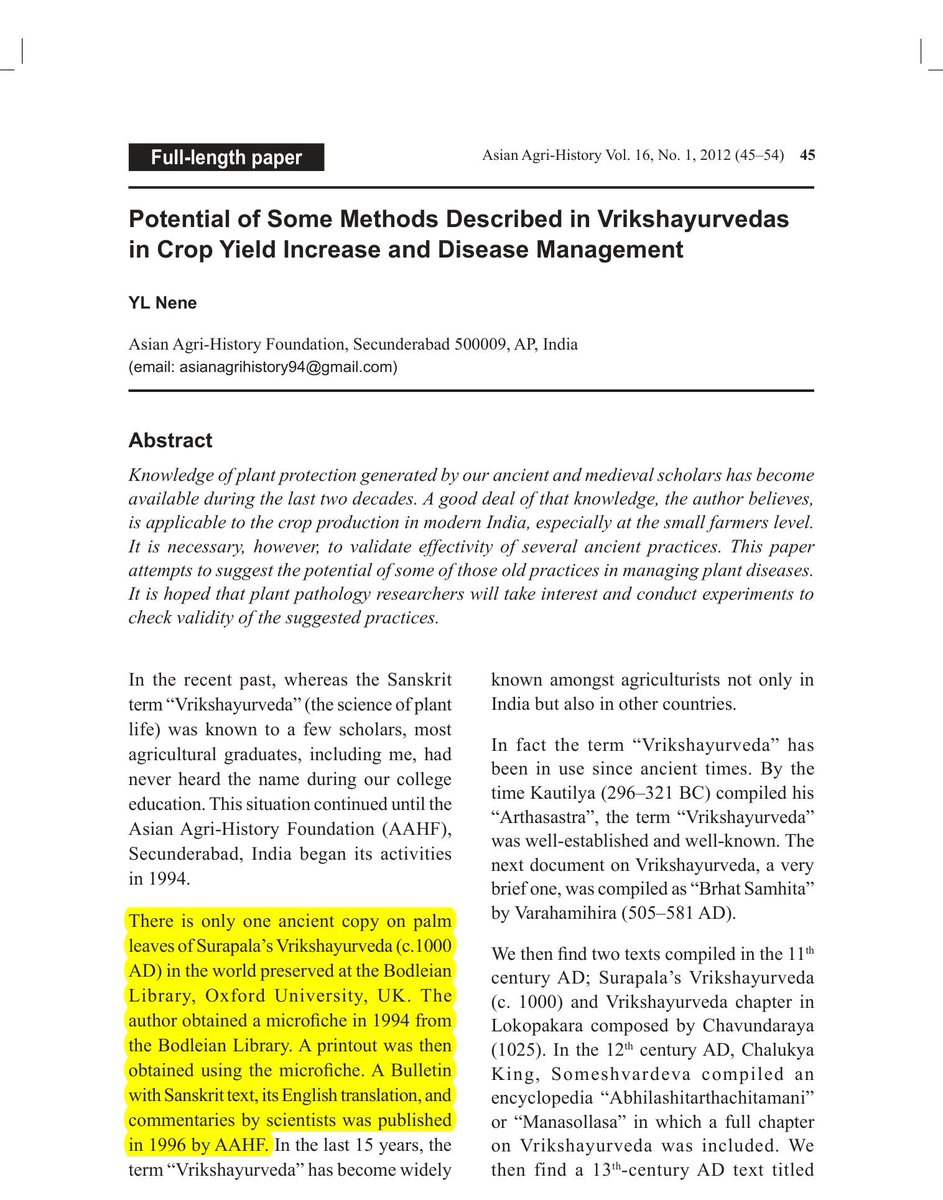
An Indian plant scientist bought a Sanskrit farming manuscript on microfiche from Oxford. Years later, Indian researchers tested a preparation from that agricultural tradition in a field in Belagavi.
Dr Y. L. Nene recalled purchasing the microfiche of Surapala's Vrikshayurveda from the Bodleian Library in 1993. He had the text enlarged into a readable printout and asked Sanskrit scholar Dr Nalini Sadhale to translate it.
In 1996, the Asian Agri-History Foundation published the Sanskrit text, English translation and commentaries.
One preparation described in this tradition is kunapajala, a fermented liquid manure.
A study published in 2017 tested a modified traditional formulation on ashwagandha at Kanabargi, Belagavi. Meat and fish were boiled, combined with black gram, sesame, milk, ghee and honey, and fermented for 30 days.
The researchers used randomized field plots with four replications. Treatments included kunapajala, farmyard manure, NPK fertilizer and an untreated control.
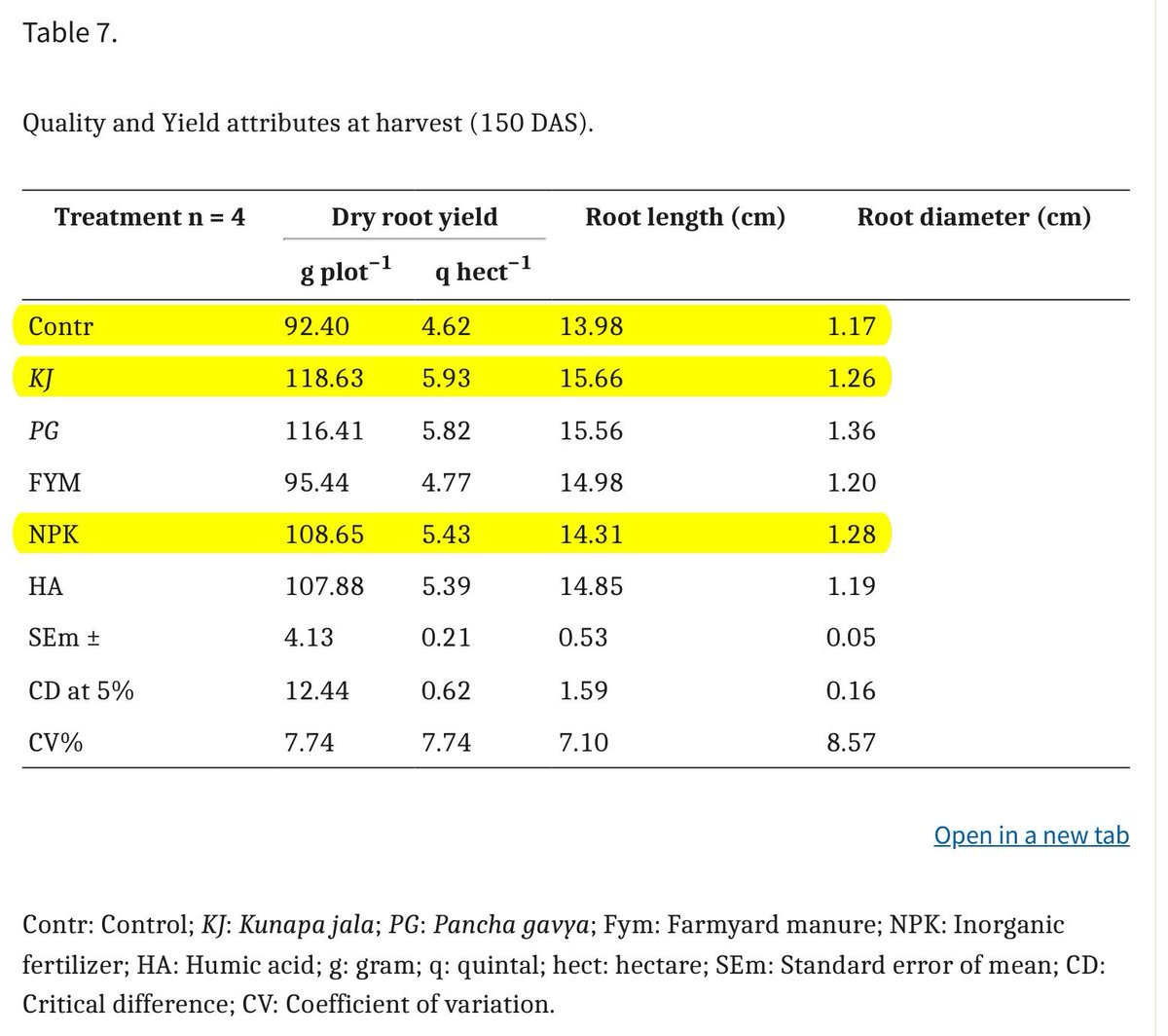
After 150 days, the dry-root yields were:
- Kunapajala: 5.93 quintals per hectare
- NPK: 5.43
- Untreated control: 4.62
Kunapajala significantly improved yield over the untreated control. Its yield was numerically higher than NPK, but statistically on par with it. This trial did not establish that it beat chemical fertilizer.
The tested formulation was modified from classical sources, not an unchanged Surapala recipe. And the result concerns ashwagandha under this experiment's conditions, not every crop or every prescription in the book.
What interests me is that the researchers did not stop at translating the text. They prepared the manure, grew the plants and measured the roots. That gives us an actual experiment to examine alongside the Sanskrit literature.
Date note: Nene's 2012 interview gives 1993 for the microfiche purchase; his paper in the same year's journal gives 1994. I have followed his interview here.
Sources: Y. L. Nene, "Relevance of Vrikshayurveda in Agriculture Today: A Tele-interview," Asian Agri-History 16(4), 2012, pp. 423-429; Nene, "Potential of Some Methods Described in Vrikshayurvedas in Crop Yield Increase and Disease Management," Asian Agri-History 16(1), 2012, pp. 45-54; Ankad et al., Journal of Ayurveda and Integrative Medicine 8(4), 2017, pp. 247-251.
Photo 1: Nene's own paper: obtaining the Oxford microfiche in 1994 and publishing the Sanskrit text, translation and commentaries in 1996. Key passage highlighted.
Photo 2: The trial's actual yield table: control 4.62, kunapajala 5.93 and NPK 5.43 quintals per hectare of dry roots.
Photo 3: Dr Y. L. Nene, from the Asian Agri-History Foundation's 80th b'day tribute cover.
314 years ago, a book of Indian medicine was shipped from the Tamil coast to Germany. It is still there.
Let us hear that story....
The place is Tharangambadi, the Tranquebar of history books, a small Danish trading colony on the Coromandel coast. A German missionary, Johann Ernst Gründler, was posted there by the Danish-Halle Mission.
He sat with an Indian scribe and a local Brahmin, and began collecting, translating and compiling the medical knowledge of the Tamil country.
The result is dated 1712. A handwritten manuscript of 186 pages, titled Medicus Malabaricus. The Malabar Doctor.
It opens with a preface, then a 19 page medical dictionary. Then 132 pages of the real thing. Diseases, their causes, their diagnosis, their treatment. Medicines, their composition, their application.
Gründler sent it home to Halle, the mission's headquarters in Germany. And there it sat, in the Francke Foundations' archive, for 3 centuries.
Only in 2021 did Halle begin a proper project to catalogue and edit it. Workshops at Germany's national science academy followed.
In 2025 it was presented at a Cambridge symposium. The work is still going on. The German archivists call it a source of "outstanding importance for the preservation of India's autochthonous cultural heritage in the history of medicine."
The medicine inside is Tamil, the sister tradition of Ayurveda. Written down with Indian hands in an Indian port, 314 years ago. Unfortunately, we have barely heard of it yet.
Source: Francke Foundations, Halle - "The Medicus Malabaricus of 1712" project. The full manuscript is digitised and readable online in their Digital Collections.
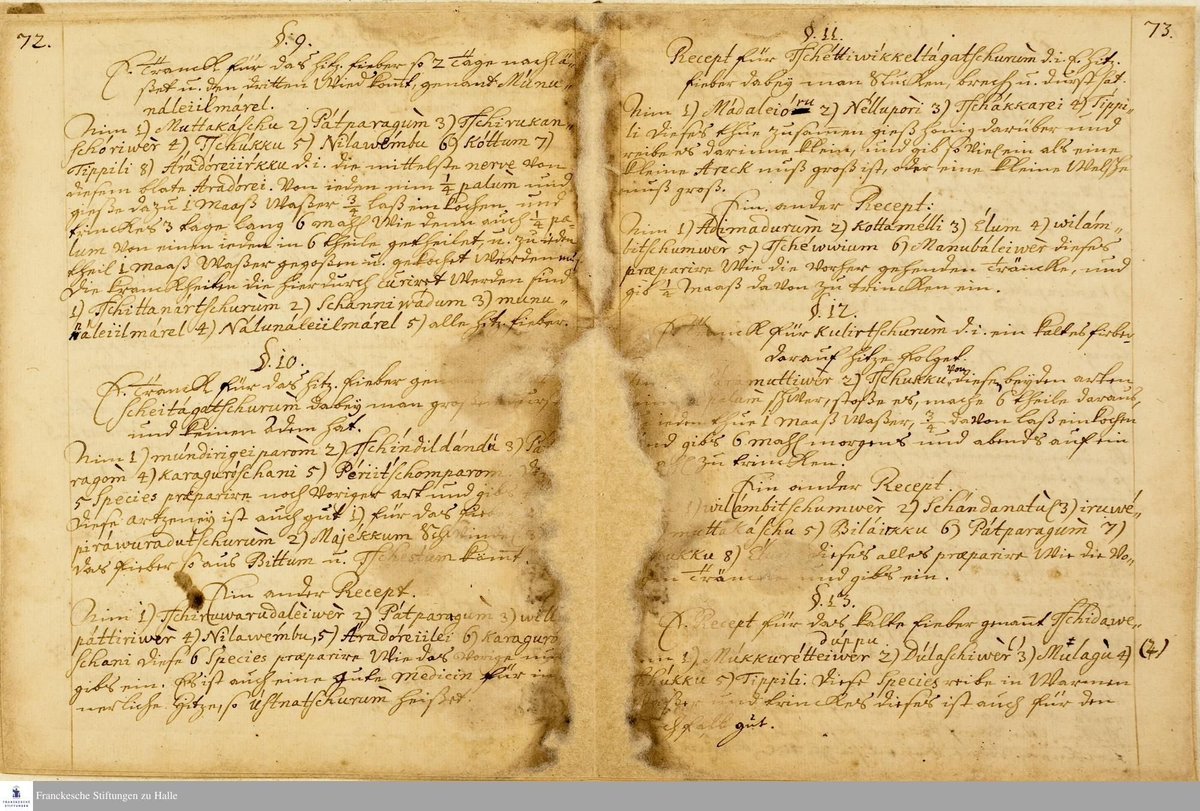
Photo 1: The very 1st leaf of the manuscript: hand-coloured deities, Ganesha on the left, the multi-armed central deity on a lotus. Torn at the fold, but gorgeous.
Photo 2: The manuscript's 1st written page, straight from the archive scan. This is what 314 years looks like.
Photo 3: A diseases chapter opening - Tamil medical terms transcribed into German script (vatham and pitham, the doshas, appear as "Wadum" and "Bittum").
Photo 4: The numbered recipes with Tamil drug names written out one by one: Tschukku (dried ginger), Tippili (long pepper), Nilawembu, Milagu (pepper). Indian medicines, numbered in German, 1712.
In the last 2 weeks, one man in India quietly did what AI labs spend billions chasing. And nobody noticed.
Jitesh Prasad, a physics grad from the University of North Bengal and MBA from IIM Lucknow, runs a one man lab called Udgam. Between Oct 10 and 23, he shipped 5 open AI models and a public benchmark.
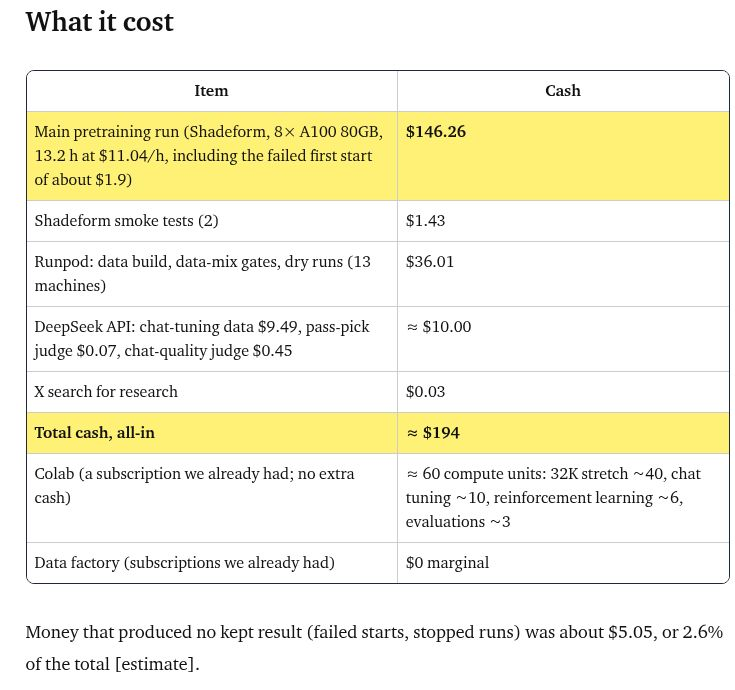
There is Laghu, a chat model trained from scratch for $146. The full cost ledger is public, failures included: 8 rented GPUs, 13.2 hours, all in < $200.
There is Shruti, a Hindi-English-Hinglish speech to text model in a single 29.5 MB file. It runs offline inside a browser tab.
On the same Hindi test clips it makes fewer errors than OpenAI's Whisper large-v3, a file a 100x its size. On English, he tells you plainly, Whisper wins.
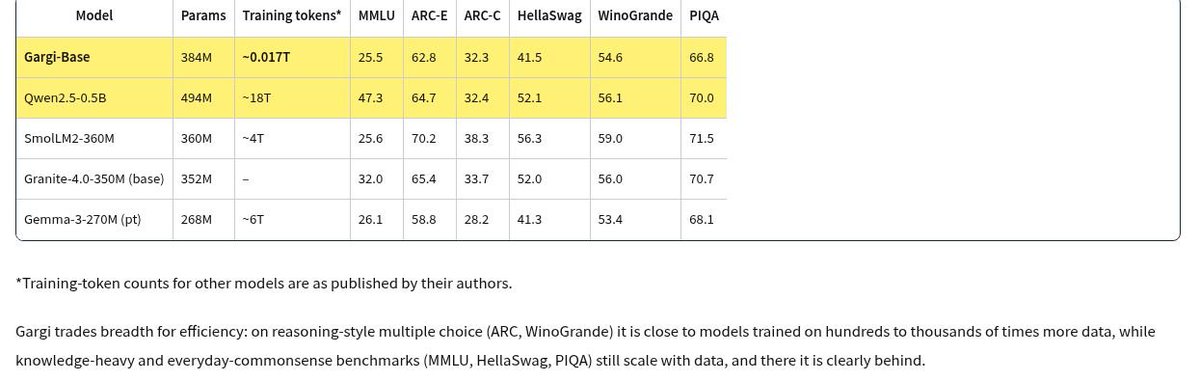
There is Gargi, a 384M reasoning model named after the Vedic philosopher Gargi Vachaknavi. Trained on 17B tokens, about a 1,000x less data than Alibaba's Qwen2.5-0.5B, and within 2 points of it on reasoning tests. On knowledge tests, his own model card admits, it loses badly.
Everything is Apache-2.0 on Hugging Face: weights, code, checkpoints, evaluations, even the $0.45 spent discovering a failed run.
No funding round. No press release. Just one man, thirteen days, and the belief that honest numbers matter more than big ones.
Sources: udgamlabs/blog (link in the comments); Hugging Face model cards udgamlabs/Shruti, udgamlabs/Gargi, udgamlabs/Laghu
Photo 1: Shruti model card WER table - 29.5 MB Shruti beating Whisper large-v3 (3,087 MB) on all three Hindi sets, with Whisper's English wins visible.
Photo 2: Laghu's public cost ledger - $146.26 for the main run, ~$194 all-in, even the $0.03 X search row.
Photo 3: Gargi vs Qwen2.5-0.5B - 384M on ~0.017T tokens vs 494M on ~18T, within 2 points on reasoning, honest MMLU gap in the same rows.
Photo 4: The Hugging Face org page - "Team members 1" next to the full model lineup. The one-man lab in a single screenshot.
Something huge happened in Indian geopolitics over the last 7 days, and most people didn't even notice.
IT WILL GO DOWN IN HISTORY BOOKS
- America was looking for a crude oil refinery for Venezuelan oil.
- Only Indian refineries were geopolitically safe, cheap, and well connected.
- America had no other option than to deal with India to refine its oil.
- But they knew that refining oil in India meant India would control their oil exports and could threaten them over other things.
- The only way to overcome this issue was to install a puppet government, and refine oil without any major threat.
••••••••••••••••••••••••••••••••••••••••••••••
- That's why they planted CJP, amplified their reach with help of Meta and X, suppressed Indian right wing posts, made Congress, AAP & whole left wing to unite and push for regime change.
- They went all in, but still, the masses in India didn't even care and all the protests flopped. People of this country only see Narendra Modi as a capable PM candidate.
- America knew that it wouldn't be able to bring about regime change this quickly and that it would take a hell of a lot of time.
- They had no option left, so without wasting any more time, they finally proposed a deal to India.
- All the protests have gone immediately silent since then.
- Most of the tariffs have been lifted from India.
- America gave India the green signal to buy Russian oil.
Now, if the deal gets finalised, India will have America by the neck. And it would be a golden opportunity for India to grow and export globally.
This is literally the biggest geopolitical win we have had in this decade.