NON-MATHEMATICIAN: So what's this problem everyone's talking about?
MATHEMATICIAN: Okay so listen to this wild shit—if you take this math function that only converges with inputs over 1, and then you add an imaginary axis in and use some backward extrapolation, you can make it converge for values below 1 too! And then you can ask which inputs yield an output of zero, and if you just focus on those whose inputs are between 0 and 1 on the real number line, there are a bunch at 1/2, and then if you ask whether there are any that aren’t 1/2, that question is the MOUNT EVEREST OF MATH.”
NON-MATHEMATICIAN:
MATHEMATICIAN: Right??
NON-MATHEMATICIAN:
MATHEMATICIAN: Okay but anyway, solving this problem was the ULTIMATE dream of every young mathematician. It was the kind of great challenge that made people want to become mathematicians in the first place—this pot of gold at the end of a rainbow we could all have fun searching for. And now someone used AI to just go get the gold, and suddenly there's no more gold there to dream about, but we got the gold which is great!
NON-MATHEMATICIAN: Wait, that's actually pretty sad.
MATHEMATICIAN: No, no, it's great! It's a new age of knowledge and discovery.
NON-MATHEMATICIAN: You look like you need a big old cry.
MATHEMATICIAN:
NON-MATHEMATICIAN: Come here.
[hug]
Okay. Look. Imagine how you'd have felt if an AI had just proved the Riemann Hypothesis.
Now you will predictably, at some point, get that news LATER, if we're not all dead before then. So you can go ahead and feel that way NOW, instead of acting surprised LATER.
This slide from the Anthropic IPO roadshow was a big factor in my decision to leave. It’s an insane plot and I’m surprised they made it public.
It shows the compute efficiency of pretraining over time. The y-axis is a **log scale**: they are seeing continued superexponential algorithmic progress.
Mythos was not a one-time deviation, but a point on a superexponential. They could already retrain Mythos with a fraction of the compute originally needed.
It doesn’t strictly imply a software-only intelligence explosion- they have been spending more on R+D. But algorithmic improvements do not require ridiculous creative genius and are on the verge of being automated. You do the math.
@The_AI_Investor Seems like a conspiracy theory which doesn't make any sense. The last thing that Dario wants is to tank the market a week before their IPO.
@The_AI_Investor A stupid conspiracy theory. Did Jensen cheat (twice) or not, did he support smuggling or not -- those are the questions.
Exporting GPUs to China is a matter of opinion. Jensen has a direct stake in it, so he can't be unbiased. It's natural that he disagrees with Dario there.
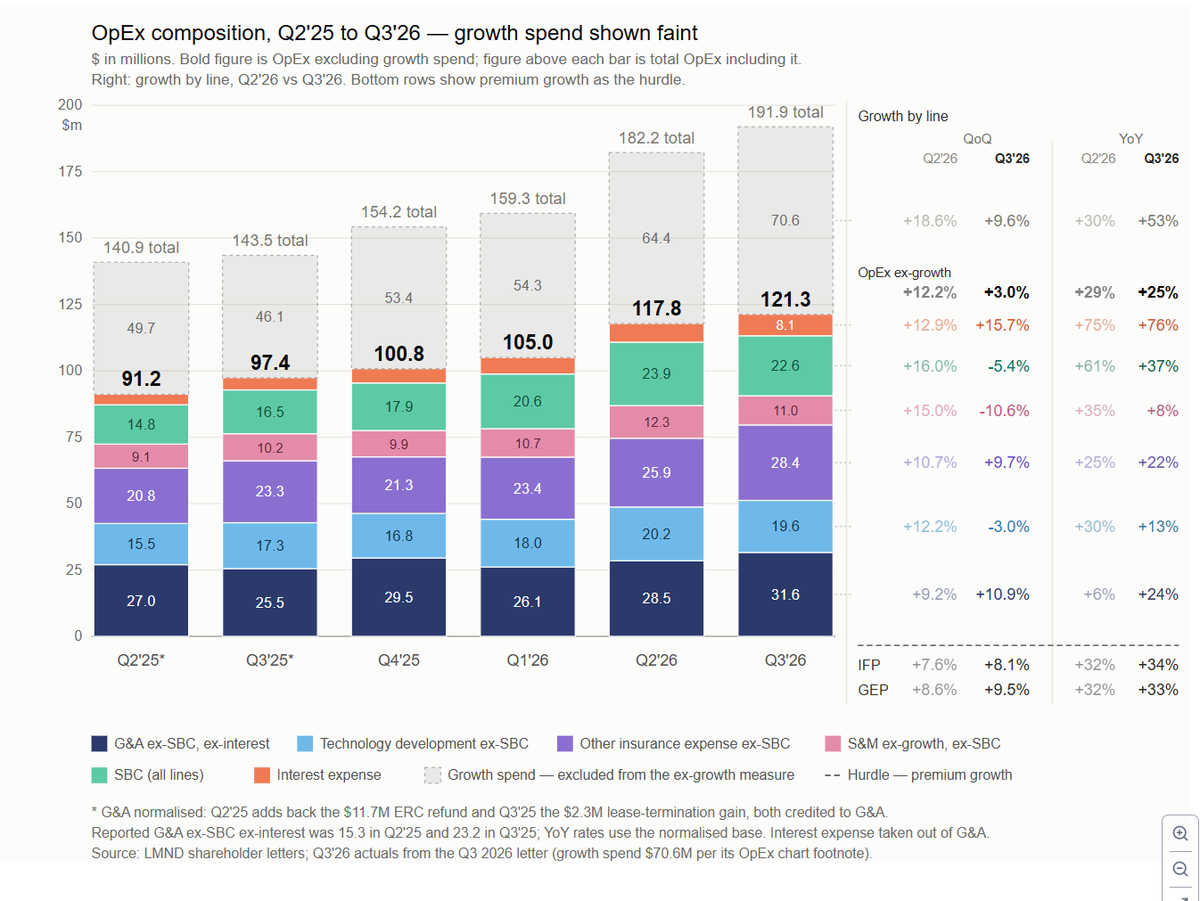
$LMND Q3 OpEx ex-growth spend grew only +3.0% QoQ against GEP's +9.5%.
Tech dev (−3%), S&M ex-growth (−11%) and SBC (−5%) all fell, and OIE (+9.7%) roughly tracked premium.
The one sore spot is G&A (adjusted, ex-SBC and interest), up +10.9% -- more than ideal for a line that should be leveraging.
@buzzberg_ai@AnthropicAI It's easier to understand if you don't misinterpret what they said. They said there is some % of existential risks, and (hopefully) a larger % of a good outcome.
Dusting off this tweet from April because this gap in shared understanding of LLM capability is *widening*. It's now less "two groups of people speaking past each other" and more a sharp funnel.
- Napkin math somewhere around 6B people (~75% of the population) have barely come in contact with LLMs at all.
- Around 1-2B (~20%) are casual and infrequent users of free-tier ChatGPT-like products. This group sees derpy chatbots and treats them a bit like a better Google search, a writing aid, or etc. Maybe an agent tries to book you a flight. I have non-tech friends who (reasonably, imo) say they have not much use for it at all. Even many professionals outside of math&code are in this tier. For example, execs and many other functions spend a lot of their time talking to other people, so while they understand what is happening intellectually, it is still second-hand and a bit abstract.
- Now we get to professional use of frontier-grade LLMs in math&code. Somewhere around 20M people (0.2%) see first-hand that large, complex projects that used to take them weeks/months can now be completed by agents with a prompt. Building apps, copying apps, translating apps, decompiling apps from binaries... This has all happened very quickly and recently - less than 1 year ago, I was writing code manually by hand, typing memorized computer code commands into a code editor character by character, occasionally pressing Tab to autocomplete a little chunk of code.
- And finally we get to the ~5,000 people (~0.00006%) with access to frontier-grade systems internally. The external world has seen the preview. It looks like swarms of thousands of agents collaborating over weeks on software mega projects: minting zero days, running cyber attacks and defenses at machine speeds, discovering new science, advancing the frontier of mathematics. Things that would have taken top professionals in the industry years of work. Meanwhile, human review and comprehension are starting to fall behind. For example, people are still involved in the "archeology" of the OpenAI-HF incident from many months ago. Mathematicians may be poring over the 722 manuscripts on frontier mathematics for a while.
The funnel is driven by a combination of factors:
1. The impact scales with ambition, problem size, and horizon. A question with a paragraph answer barely stresses the system. You need a reservoir of big, difficult problems that you really care about. This aspect drives the consumer / professional dimension of the funnel.
2. The jaggedness of the system (which I have written about a lot separately). Capability peaks in domains that are digital, verifiable and economically valuable. This is because LLM capability emerges from reinforcement learning on verifiable rewards on a curated environment mixture driven by revenue potential. This aspect primarily drives the area (e.g. math&code) dimension of the funnel.
3. Access. Free-tier, paid-tier, internal.
So this is the weirdness of the moment. The general public has mostly not interacted with these systems. When they have, it looks like a derpy chatbot. The majority of professionals still see only a modest uplift. And a small sliver of professionals are experiencing the vertigo of the curve going vertical. And it is all happening at the same time.
The last week has really shown me that someone who wants to understand AI risk has no good place to start.
Hence we made https://t.co/dXiosYcI7l, the Wirecutter for content about AI Risk. We're launching with 3 articles: 🧵