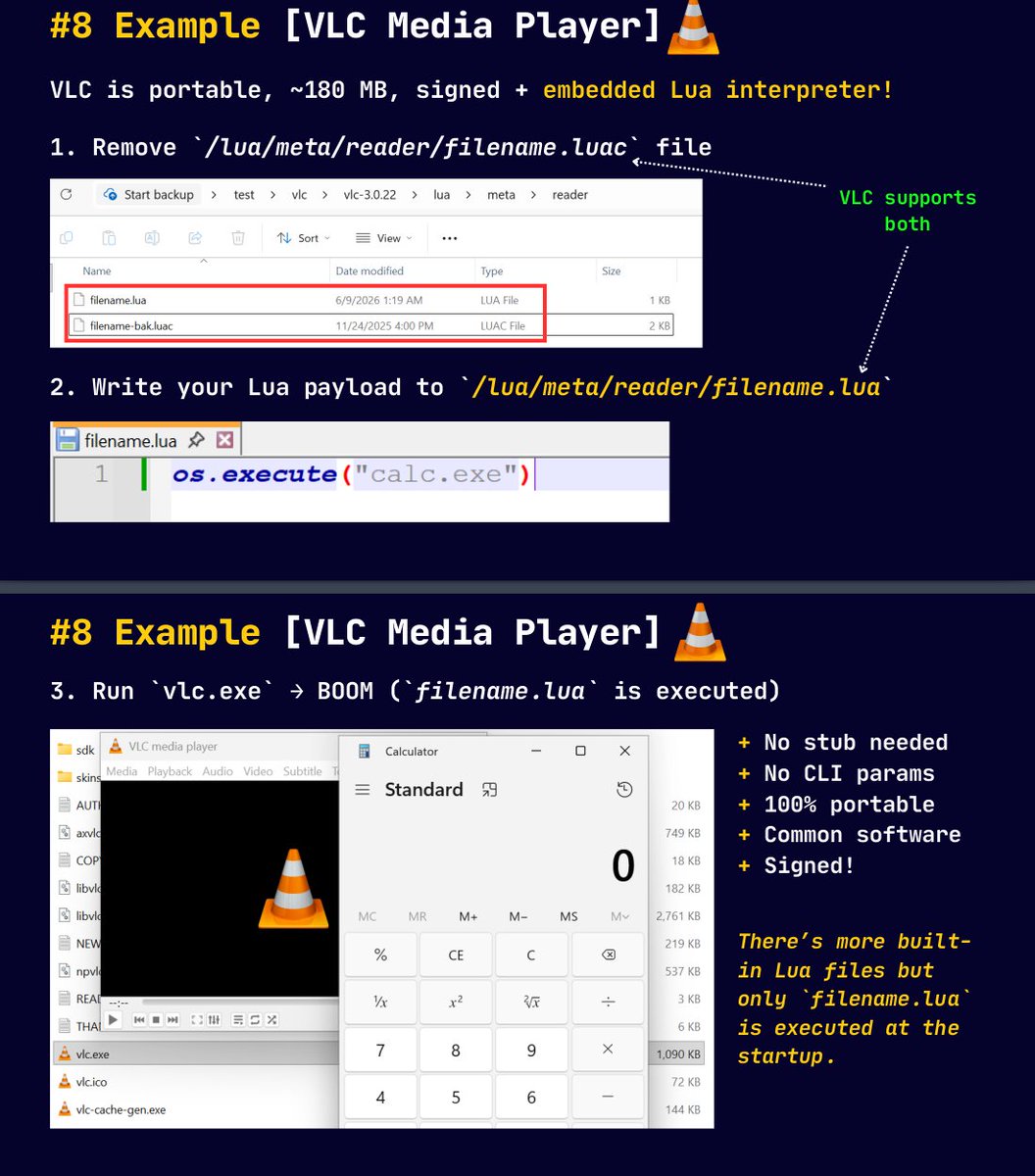
@smuggiekeplar@x33fcon I mean it wasn't actually a custom Lua extension but backdooring built-in `filename.lua` file which is executed at the startup by default. I saw no sandbox in this case to be honest ;)
I’m sharing my slides from @x33fcon 2026.
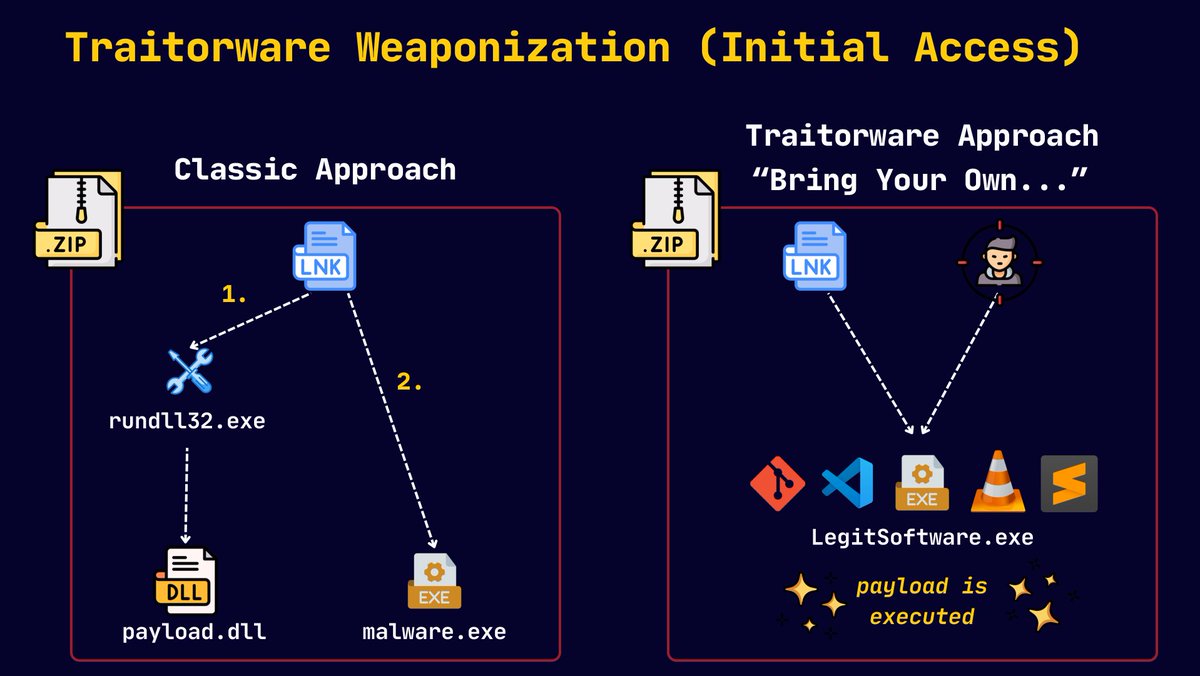
Inside ~15 examples of abusing traitorware to execute your payload via trusted & signed binaries (e.g. VLC Player, SublimeText) and how to find more of them.
Recording will be published soon.
https://t.co/M2jpnNA5XI
Nothing beats the feeling when someone is inspired by your work and builds off it to release something even cooler.
These slides have me hyped for the talk recording!
@badsectorlabs Wait, you are the guy(s) behind "Stop Writing Malware..." talk?! Oh shit! Good job my friend, thank you for you research. The word "traitorware" really clarified things in my head. And I think we are still scratching the surface and grabbing low-hanging fruits... ;)
@niebezpiecznik Dopiero 12 raz dzisiaj widzę posta typu "BREAKING!!!1! Someone just open-sourced". Claude coś dzisiaj zamulał, pewnie dlatego taki słaby wynik.
@ale_sp_brazil@MacmodSec I was using Godap on my engagement! Very nice looking and convenient tool. I like the feeling and detailed info about objects.
Didn't know about FlashIngestor! Thanks :)
### Top-Line Findings
1. **The C2 ecosystem is far less diverse than it appears.** While there are 30+ "different" frameworks, the underlying technique implementations converge on a small number of canonical code patterns, many traceable to specific open-source authors or blog posts.
2. **Three source projects account for the majority of reused code:**
- **TrustedSec's COFFLoader** — the ancestor of nearly every open-source BOF loader
- **PowerSploit** (by @harmj0y, @mattifestation, @obscuresec) — Get-Keystrokes, Invoke-Mimikatz, PowerView, and persistence modules are shipped verbatim by Empire, PoshC2, PowerHub, Amnesiac, and Shad0w
- **Kevin Robertson's Invoke-WMIExec/Invoke-SMBExec** — the dominant PowerShell implementations for WMI and SMB lateral movement, bundled by Empire, PoshC2, PowerHub, and SilentTrinity
3. **A single detection rule can catch multiple frameworks.** Because many C2s share identical implementation code:
- One detection for the PowerSploit `Get-Keystrokes` GetAsyncKeyState polling loop catches Empire, PoshC2, and any framework that bundles PowerSploit
- One detection for the TrustedSec COFFLoader relocation pattern catches Apollo, Loki, Sliver (extension), and derivatives
- One detection for the .NET `ManagementScope` WMI pattern catches Apollo, Covenant, NimboC2, SilentTrinity, and DeimoC2
4. **Genuinely novel frameworks are rare.** Of the 30 analyzed:
- **4 frameworks** (Sliver, Havoc, Realm, TripleCross) demonstrate significant code originality
- **6 frameworks** show moderate originality (Wyrm, AdaptixC2, Emp3r0r, Merlin, NimPlant, GC2)
- **20 frameworks** rely heavily on shared code from the three source projects above, or implement techniques using the same well-known recipes
5. **HTTP C2 communications show the most behavioral convergence.** Three jitter formula families, shared User-Agent strings (the IE11 UA appears in Empire, Nuages, and Covenant), and common URL path patterns create fingerprinting opportunities.
Do you know you can create a custom Google search with limited scope? I collected 230+ high-quality IT security sources (blogs, etc.) and created Google Hack Search 🔥
https://t.co/BKgmkFNL9Z
No AI, no marketing, no bullshit. Old internet. Pure hacking.
#redteam#infosec