Project Liberty builds solutions that help people take back control of their digital lives by reclaiming a voice, choice, and stake in a better internet.
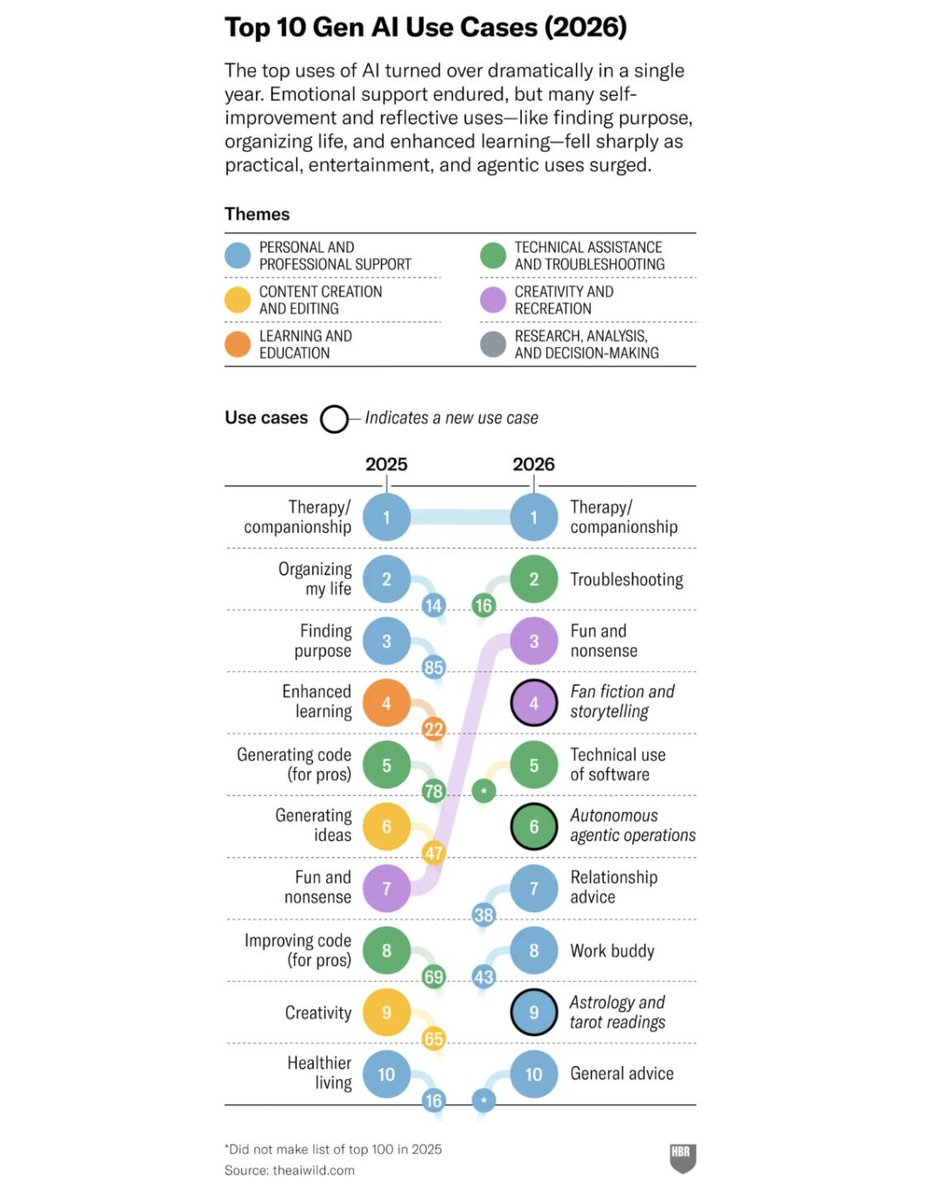
According to the Harvard Business Review, these are the top 10 generative AI use cases in 2026.
And yes, therapy/companionship is the top use case again, regardless of what AI companies say:
Dr Caroline Emmer de Albuquerque Green, Lead of the Accelerator Fellowship Programme (@EthicsinAI_AFP) and Senior Fellow Ambassador Audrey Tang (@audreyt) will speak at SXSW London 2026 (@sxswlndn) as part of a featured session exploring the future of AI alignment and democratic technology.
Their fireside conversation, Reimagining AI Alignment for Humans, will take place on 2 June 2026 from 10:35–11:05am at Protein Studios (Stage 1).
Drawing on democratic participation models, ethical governance frameworks and civic technology, Dr Green and Ambassador Tang will introduce the '6-Pack of Care', an approach to AI alignment centred on cooperation, human dignity and collective stewardship rather than top-down control.
🔗 Learn more and register: https://t.co/bIif88Up55
🔗 Explore Civic AI: https://t.co/ZFkyLaEQSH
In a recent essay on @pro_jectliberty's Substack, @audreyt writes that we need to "Till Data Soil, Don’t Drill Data Oil."
Many worry that AI is assuming the shape of a “digital coloniser.” A handful of tech giants control compute, models, and platform rules, while the rest of us simply rent intelligence. Once a platform pushes an update or adjusts its pricing, even a business may find that its own workflow has been quietly “extracted.”
Underneath this entirely reasonable anxiety lies a deeper question about how we understand the nature of “data.”
Treating data as oil leads to one logic: extraction and concentration. I prefer a brighter picture: Data is not oil, it is soil. AI models are crops, with the key questions: Who tends the data ecology and who mends the system in the event of an error.
For AI to truly take root in every industry and profession, what matters most is not just real-time interaction, but whether its introduction earns genuine trust. This is our opportunity: we can become pioneers of Civic AI.
Many young people are longing for a past they never lived, a phenomenon known as anemoia.
In a Fortune article, journalist @LubaKassova interviewed members of Gen Z about why they’re designing for an analog future.
One 19-year-old she interviewed said, “I am nostalgic for a time when I was present, when my generation was between 5 and 10, when we were still doing things in the real world. I don’t remember what I watched yesterday on TikTok, but I remember what I did years ago when I didn’t have a phone.”
This sentiment is driving renewed interest in vinyl records, zines, and refurbished retro tech (think Walkmans, iPods, and Polaroids). It’s part of an “analog revival.”
For example, in Burlington, Vermont, Christine Tyler Hill, a crossing guard and artist, started producing a mini-zine about what happens at her intersection each morning between 7:30am and 8:20am. It’s called The Cloud Report. Hand-drawn. Eight pages. Printed on 67lb cardstock. Mailed with a proper stamp. “The response to it has been crazy,” she said. She quickly grew to 2,000 subscribers from across the country, generating $14,000 in monthly revenue.
The vastness of the internet has first pushed us into more intimate spaces like group chats and private channels. Now people are choosing to replace their time on digital platforms with phone-free spaces and vintage devices.
Phone-free restaurants and bars are popping up across the country, and as @DKThomp wrote in his The Atlantic article "The Anti-Social Century" board game cafes are popping up, with their business expected to double by 2030.
You’ve heard it for years:
“If you’re not paying, you’re the product.”
But what if the true cost of the internet was far higher than anyone realized?
New research from Web3 Foundation suggests Big Tech and AI companies may extract up to $162,492 in lifetime value from each internet user. 🧵
Safe & sustainable AI doesn’t lie beyond the stars.🌌
It’s on Earth. It’s in us. It’s our relationships of care.🫂
Software freedom holds the key to Kami-cultivated #CivicAI & a future of ⿻Plurality.
Take my @UniofOxford FLOSS lecture.🙏
▶️https://t.co/W1ruLPnBNU
#LLAP🖖
In our latest poll, we asked which guardrails people want for AI.
Preventing users from developing an unhealthy emotional bond with the AI tool ranked first by support: 76% overall support it and 47% strongly support it.
It's the guardrail Americans feel most strongly about, and the one our governance system is least built to deliver.
Read our latest Substack on why companion chatbots are the hardest version of this problem, and what kind of governance actually fits. 👇
Earlier this year, editors of Wikipedia’s English-language articles (which make up just under 10% of all Wikipedia articles) decided to ban AI-generated text from the platform due to its violation of the site’s core content policies.
Within a year of ChatGPT’s release, Wikipedia editors began noticing signs and patterns suggesting that AI-generated content was appearing across its millions of pages.
For example, the phrase “rich cultural heritage” emerged again and again, as did phrases like “nestled in the heart of” and “diverse array.” Wikipedia, which has since published a page, Signs of AI writing, has found more telltale signs of AI writing throughout its many pages.
The editors also faced an onslaught of AI-generated submissions, replete with questionable citations and false information.
This is a problem because of Wikipedia’s commitment to knowledge and accuracy. AI tools can change the meaning of something. For example, according to the Signs of AI writing page, “LLM writing often puffs up the importance of the subject matter by adding statements about how arbitrary aspects of the topic represent or contribute to a broader topic.”
Learn more in our recent newsletter.
🗣️ Senior Fellow of the Accelerator Fellowship Programme of the Institute for Ethics in AI, Ambassador Audrey Tang (@audreyt) will deliver an upcoming lecture on Friday, May 22, from 4.30pm to 5.30pm, hosted by the Oxford Global Society (@global_oxford) for Education and Research, exploring the relationship between software freedom, democracy and civic responsibility across generations.
The lecture, Good Enough Ancestor: Software Freedom as Civic Care Across Generations, will examine how open technologies and participatory digital infrastructures can help build more resilient, inclusive and democratic societies.
🔗 Learn more about the event: https://t.co/muvXE1lEfq
Heightened awareness of national security and the 'enemy' system is shifting perspectives. This isn't just for technologists; parents, policymakers, legislators, researchers, artists, and journalists are all engaged #AIforGood#Collaboration#TechEthics
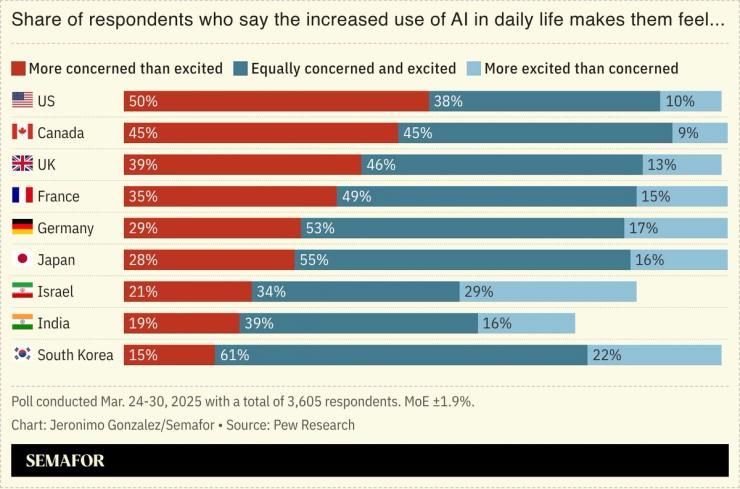
@pewresearch One of the challenges is that AI is a hyper-object. It's moving from the application layer to become digital infrastructure across many use cases. This will make it harder to understand the public perception of it.
🎓🤖Mentions of AI in commencement speeches are drawing boos this graduation season.
Our research found younger Americans are generally more likely than older Americans to think the increased use of AI will worsen human abilities.
https://t.co/kvjFxsIBxi
Incredible work from @FLI_org on articulating a better "pro-human" path for AI, and the steps that various stakeholders can take to help us get there: https://t.co/e9MKs5N0mr
As high-profile websites vanish, it’s a reminder that the web has no built-in archival layer.
But some publishers are now blocking the Wayback Machine.
What’s at stake if the web stops being archived? Our new FAQ explains: preserving the public record matters. 🌐📚 https://t.co/fifJnv3xiu
AI backlash is growing in the US, especially among young people.
Polls show that 70% of Americans think AI is moving too fast, over 50% have negative views of it, and just 18% of young people say they feel hopeful about it.
https://t.co/XH0kWJP7qP
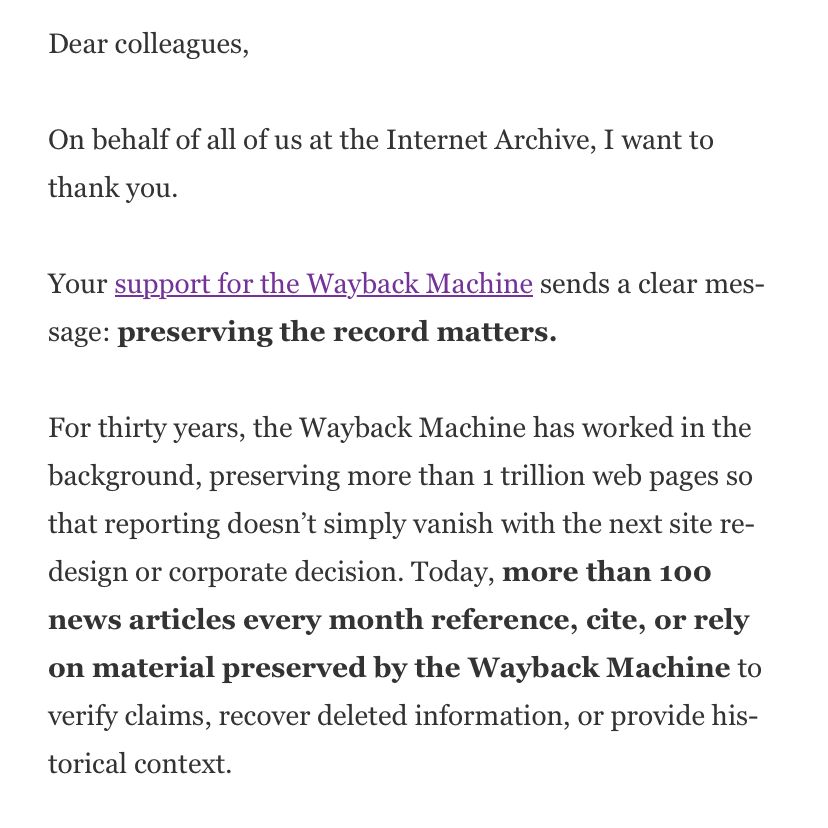
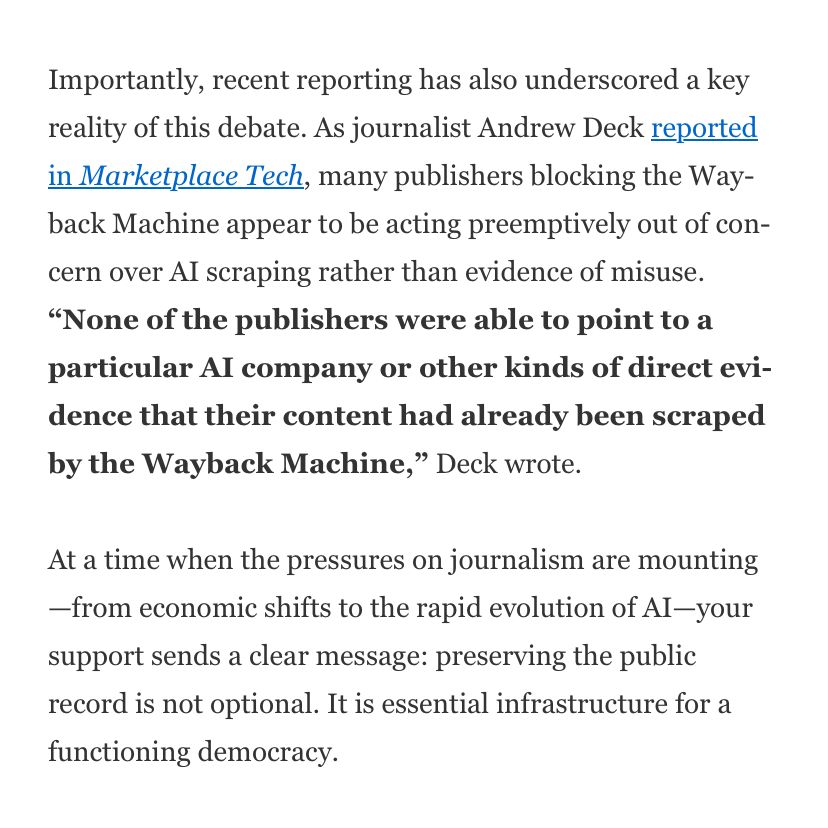
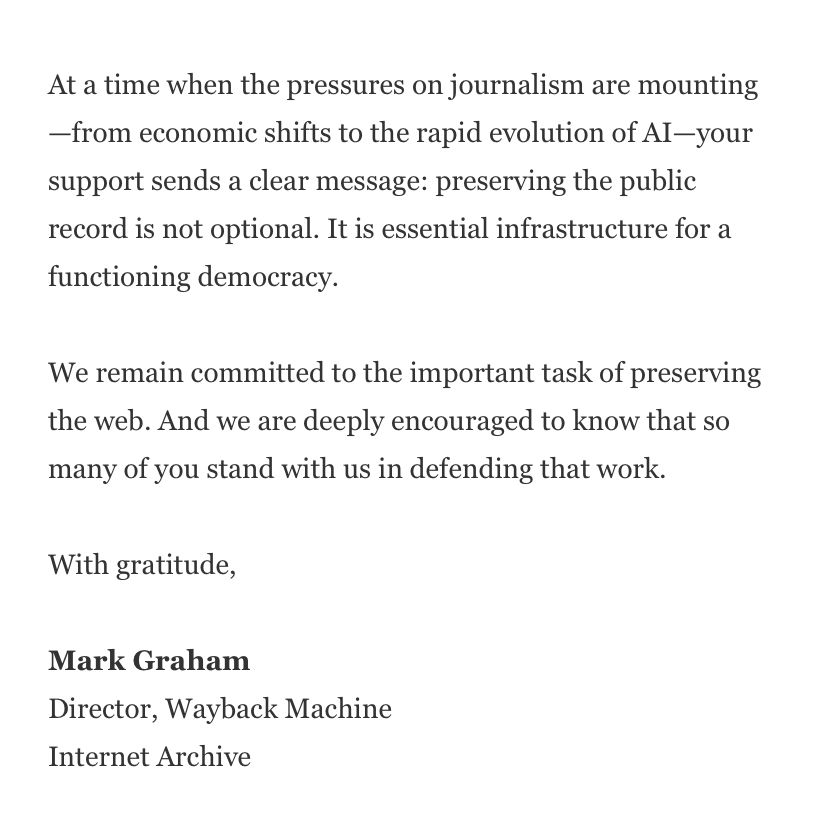
🧵 Wayback Machine director Mark Graham is thanking the hundreds of journalists speaking out in support of the #WaybackMachine and the importance of preserving the online historical record. 🌐📰
At a time when parts of the web are disappearing, journalists are defending web preservation, accountability, and access to the public record.
Read Mark's letter ➡️ https://t.co/vgzkvoaGEd