I completely agree with this take related to the “AI will create viruses that will kill us all” BS. But let me add my few cents, because I am really really angry!
I worked with one of the deadliest viruses in history, HIV, for two decades. I was one of the early scientists to engineer it, and engineered versions of HIV are now helping cancer patients. I understand the immune system that defends us against viruses extremely deeply. I have worked in high security biohazard labs.
I don’t have a PhD in AI, but I have been involved with AI since the early 90s and have been all in on AI for years.
People claiming that you can just make a virus in your garage, use AI to engineer it, and somehow build a virus that will kill everyone don’t know what the hell they are talking about!
Of course bioweapons are extremely dangerous. In fact, viruses and bacteria have killed more humans throughout history than almost anything else. HIV alone killed tens of millions of people, yet today, if you have access to effective medicines and take them properly, HIV is generally no longer a death sentence.
COVID-19 killed millions. Why doesn’t it kill at anything close to the same scale anymore? Not because the virus disappeared. It is still here. We developed collective defenses against it through our immune systems, prior exposure, vaccines, treatments, and better medical care.
And this is exactly the point.
The best way to fight biological threats, whether natural or synthetic, is to use AI to develop vaccines, treatments, antibodies, antivirals, and eventually engineer our immune system to create much stronger defenses against them.
By the way, it is already possible to make synthetic viruses. You don’t need some hypothetical superintelligent AI model to do that. We have had sophisticated molecular biology and genetic engineering for decades.
So how many people have actually died from synthetic viruses compared with natural viruses killing millions every year?
And if someday there really is an AI capable of making some unbelievable “supervirus,” then why the hell wouldn’t that same AI make it even easier to develop defenses against it?
Or cure diseases, for that matter?
Where is this damn superintelligence that has cured a single major disease?!
These AI companies and AI doomers keep talking like, “OMG, AI is going to become so unbelievably powerful that it could kill all of humanity!”
Then why is nobody asking the obvious question?
If your AI is already becoming this godlike, unbelievably powerful intelligence, why hasn’t it cured anything?
I mean ANYTHING.
Where is the cure for cancer?
Where is the cure for Alzheimer’s?
Where is the cure for aging?
Forget those. Where is the vaccine that prevents the common cold?
You are telling me this intelligence will soon be smart enough to engineer some magical virus capable of wiping out 8 billion people, defeating every immune system, every vaccine, every antiviral, every laboratory, every government, and the entire global biomedical community…
…but somehow it still can’t cure one disease?
I call that greatest intellectual dishonesty ever!
At least WE actually know how to cure things and save millions of lives with our supposedly stupid human intelligence compared with this future “superintelligence.”
Humans eradicated smallpox, which killed hundreds of millions of people throughout history.
We turned HIV from a almost certain death sentence into a manageable disease.
We developed vaccines in record time against COVID. If we had the same AI back then, would have saved millions more!
We engineer immune cells to kill cancer.
We developed antibiotics, antivirals, monoclonal antibodies, gene therapies, organ transplantation, and thousands of medicines.
We aren't fast enough but we did all of that with our ordinary human intelligence.
So imagine what actual superintelligence could do for medicine!
And here is the part that really makes me angry.
If you actually have, or are close to having, an AI capable of curing diseases and saving millions of lives, and you are deliberately slowing it down or refusing to make those capabilities available, then we also need to talk about the human cost of THAT decision, which you fearmongering people are going to be responsible for!
More than 150,000 people die every single day around the world.
Every. Single. Day. More than 90% from Cancer, heart disease, infections, aging. How many die because of AI? ZERO!
Talk about the people dying TODAY.
Talk about curing cancer.
Talk about stopping the next pandemic before it starts.
Talk about developing universal vaccines.
Talk about engineering our immune system so viruses become almost irrelevant.
Talk about curing genetic diseases.
Talk about reversing aging.
Talk about saving millions and eventually billions of lives.
Instead, we constantly hear this “AI WILL KILL US ALL!” crap, delivered with absolute certainty and with this smug smile on your faces in front of cameras, as though imagining a science fiction extinction scenarios.
I am actually angry about this. Each one of you causing a delay in AI advance every single day will be personally responsible for those 100 thousands deaths that could have been prevented!
Because if you truly believe intelligence is about to become this powerful, then the greatest question humanity should be asking is NOT:
“How could this intelligence hurt us?”
It should also be:
“WHY THE HELL AREN’T WE USING IT TO SAVE EVERYONE WE CAN?”
And if superintelligence really is coming, then make sure one of the first things we do with it is make humanity biologically damn near impossible to kill.
Uma vez um aluno de doutorado estava fazendo estágio de docência e eu reservei uma aula para ele dar numa disciplina. Me sentei no fundo da sala para assistir e fiquei observado os estudantes de um ângulo diferente do de costume e decidi não interferir. +
A taxi driver in Spain was known for taking patients to the hospital for free. He was picking up a patient one day when doctors and nurses surprised him with a standing ovation plus an envelope of money
There is an ongoing discussion involving Harvard and MIT, two institutions where I spent plenty of time during the past 20 years. I first came to Harvard as a visiting PhD student in 2005, then joined the Kennedy School as a postdoc in 2008, and in 2010 I joined the MIT faculty, where I was until 2019. Personally, I don’t have much to add to the current discussion (eg about DEI, plagiarism, etc.) except some notes on the social context of Cambridge, Massachusetts. Because like all drama, what we are seeing today is unfolding on a social backdrop that may be difficult to understand. After all, I know for a fact that most Americans do not know how society works in and around these institutions. For most, even people from the north and south shores of Massachusetts, Harvard and MIT are mythical places that we hear mentioned in sitcoms and movies. And while the reality is different, it is still interesting. They are a reflection of a segment of society, not only of the United States but of the world, as these institutions are effective at attracting global elites.
I will first start with a few positive notes from the 2000s. I remember vividly being thrown head-first into a tough-love environment. If you brought a half-baked idea to a professor or colleague they would destroy it, and kick you while you are down. You had to learn to change your mind, defend yourself, or go home crying. At that time I hated it, but in hindsight, I’ve come to appreciate it. That’s how I learned to think and write, and also, came to understand that the best you can get as a junior scholar from a senior scholar is unvarnished feedback because the other option is for them to simply ignore you.
You need to keep in mind that academia is a game of social acceptance since all hiring, funding, and publication decisions come from secret peer recommendations. In many institutions, what that leads to is not excellence, but clubbiness. People form implicit support groups with others with whom they agree to approve each other’s work. These challenge-free environments lead to a lot of half-baked work that is usually ignored by the larger academic community. That was not how these institutions were in the mid-2000s. They were tough pressure cookers that did not care about you or your feelings. They cared about whether you really had something important to say, and could figure out how to say it and show it. It was tough, but the focus was on the quality of the work. And that is why their prestige is well deserved. There is a lot of great work and great people in them. Brilliant people pushing themselves and their teams to the limit, and in the process, generating new knowledge, technologies, and scientific leaders.
But there is also an underbelly to this society. A society that is not immune to prestige and its addiction. People always went to these institutions looking for prestige. But over the last few decades, the prestige machine was supercharged with social media, displacing in part the culture of excellence. And this brings me to some of the saddest stories.
I remember a colleague and friend who joined the MIT faculty in the mid-2010s. He came from abroad with his wife who had to quit her job to move there. And he was killing it in academic terms. But still, he was not happy. During a Saturday lunch, he explained to me why. He told me that when they socialized people would turn around and start talking to someone else as soon as his wife told them that she was in between jobs. That behavior was wearing them out. People in Cambridge were not there to make friends. I know this is a cliché, but I remember being told those same exact words by a senior colleague who made a habit of walking past me without acknowledging me every morning after I said hello, even though his office was a few doors away. My friend eventually left Cambridge as well.
I also remember one of the most bizarre parties I’ve ever attended. I don’t know how else to call it other than a well-organized “braggathon.” About 200 people were invited to the house of a person who had made a fortune in finance. After everyone arrived, we were brought to a large library where one of the hosts got the party going. He started calling people, who would respond with their prepared pitches. “Hey Jennifer, I know you are revolutionizing the cancer industry..” and Jennifer would deliver her pitch. “And that reminds me of Brandon, who is doing amazing work on aerospace,” and Brandon would jump into action. That went on for about 2 hours. It is a strange prestige-driven society that is hard to fathom from the outside.
And eventually, you get used to it. Because prestige is a powerful drug, a master of puppets that can take over your life. When you are affiliated to those institutions you get treated like royalty around the world. Saying you are a professor there provides a strong 'in' with the elites of the world. Many people don’t know how to evaluate ideas, so they rely on where these ideas come from. Prestige shapes the world. But there is another side to that coin. The crudest example of prestige addiction is the blighted and chronically addicted, those who at MIT are called lifers. These are people who joined the institute as an undergraduate, and 30 years later, continue doing odd jobs for a big professor because they understand that being low in the ranks of the castle is better than trying to survive outside its walls. They are in some ways, the most loyal members of the institutions, knowing that there is a parade of visitors that will give them for ten minutes the respect they otherwise never get inside.
The north bank of the river Charles is a peculiar place. A place with many stories, that because of this prestige addiction, will never see the light of day. Today I can talk because I have been sober for a few years, after not being granted tenure at MIT (link to this story below). I uprooted my life and moved to Europe during covid, where I have been playing a different game: helping build research institutions instead of climbing them. And I do appreciate my time in Cambridge. It helped me become a better thinker, writer, and scientist. It also opened my eyes to the world. But I know many colleagues who will never share their stories as long as they keep a weak link to these institutions. Quitting the prestige drug is difficult. Still, slowly but surely, the drama will keep on trickling as the cracks in the levy continue to spread. There is certainly a Morning Show-type drama series or movie waiting to be made about Cambridge MA, if only screenwriters were not so focused on New York and California.
https://t.co/pFKlqa5u9S
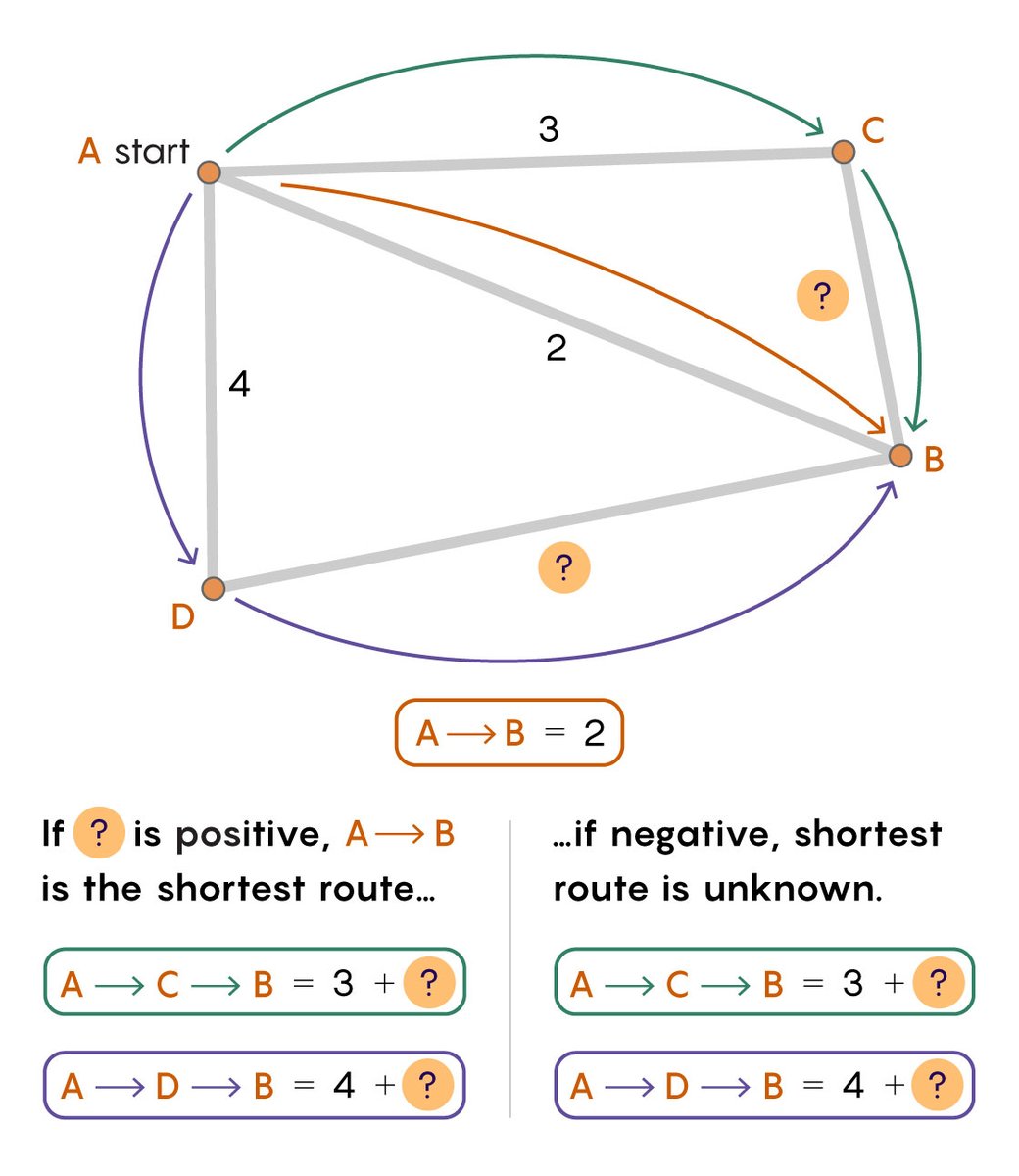
Decades ago, the Dutch computer scientist Edsger Dijkstra developed a greedy algorithm that finds shortest paths between points on a graph with positive weights. But if the weights are negative, the algorithm fumbles. https://t.co/jz9mgELFMl
Daniel entrou na faculdade de Medicina aos 17 anos, em sua cidade natal, no interior do país, num campus recém inaugurado.
Durante o curso, teve que decorar rodapés e picuinhas de prova, mas o que nunca lhe ensinaram foi a raciocinar. Daniel é agora um médico leigo.
Segue o fio
“NO WOMAN SHOULD BE FORCED TO COVER HER HEAD.” 💪
🇧🇷’s Team touches down at the World Cup on a plane paying tribute to Mahsa Amini, the 22-year-old Iranian woman who died in police custody after being arrested for “improperly” wearing her hijab. (1/2)
How to create a mesmerizing (and scary) well in your living room table using the infinity mirror principle.
[what's an infinity mirror: https://t.co/CkuflyCjHa]
[source: https://t.co/IJVbi7lhPP]