“I’m guided by what I’m really outraged about and what I think I can actually try to influence. It may be that I can only influence things one case at a time, but ultimately, the plan is always to try and improve the system.”
May we all pick outrageous causes for change..
@Wharton is now the ONLY top MBA program to have a class on fraud hunting in its curriculum. In Spring, Forensic Analytics is now open to @Wharton MBAs. Guest speakers include individuals who hunt fraud for a living: DOJ/SEC, Short Activists, and Forensic Investigators.
This is a big deal. You will now be able to trade prediction contracts on corporate KPI (earnings, sales etc) both on @Kalshi (CFTC) and @Cboe (SEC). Similar instruments, but different rules and regulators. I don’t see this as sustainable long-term.
SEC announces you can recover from the $48.8 million collected from Nikola. Unfortunately, you'll never recover the over $600 million that Trevor the Fraud skipped out on by buying a pardon. https://t.co/OOE9rFwW3E
When President Donald Trump backed away from threats to strike Iranian power plants on March 23, it sparked a frenzy of buying and selling across oil, equities and other markets. Here's how the investigation went inside the CFTC. https://t.co/dj8bU6LsAs
This is absolutely unparalleled. tldr; Political appointee at CFTC intervenes in the enforcement investigation of oil futures trading before Trump tweets.
Halted on -20% drop. If the stock was tokenized, do the tokens halt trading too? How? Across all crypto exchanges? [Hint: they dont] Brave new world. Buh-bye securities laws.
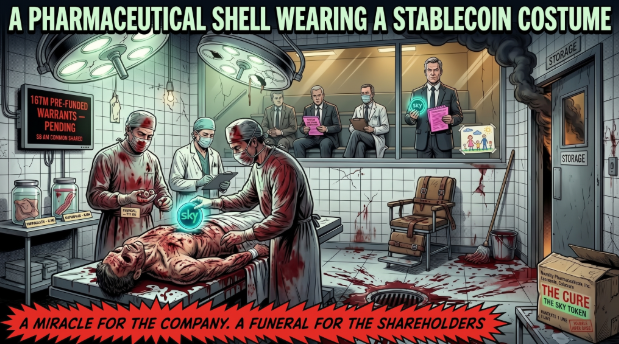
$SDEV's headline is "stablecoin company." It's a fake biotech (NovaBay) whose assets are nearly all one token, SKY.
It "raised" $134M in January, but only $25M was cash. A CEO-linked fund supplied 74% of the tokens, and the CEO signed the deal for both sides, a blatant conflict of interest.
Two funds now hold the majority of the stock, and a pending S-3 would let its investors resell 212.9M shares, 4x what's outstanding.
Its position is $180M... selling it would take nearly 10 days of every buyer and seller combined, and its own filing warns reported volume may be inflated by wash trading.
Fugazi Research considers $SDEV uninvestable at any price above ZERO.
Click for our full report ⬇️
https://t.co/fw2ycLekYU
Companies need to realize that if ppl can get exposure via synthetics, then there is one less reason to buy equity, making it more difficult for public companies to raise money
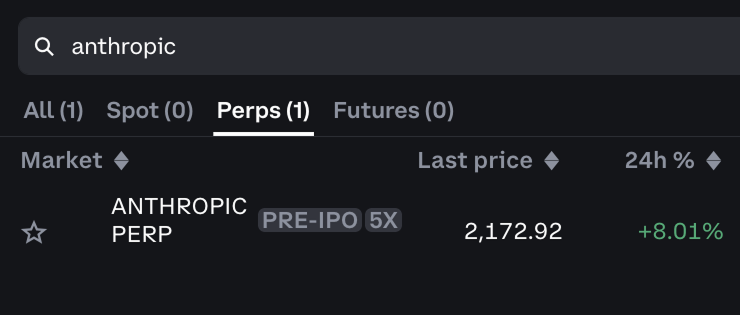
Anthropic has listed for IPO. But you don’t need to wait to trade.
Get exposure to Anthropic any day, any time on Coinbase.
The magic of pre-IPO perps.
What many don’t realize is that $HOOD NEVER offered 4x DTBP before (!!) Now they will. Congrats they caught up to Schwab, IBKR, and virtually everyone else where 4x DTBP has been standard.
New: In late 2024, FBI investigators had enough evidence to launch a sweeping bribery probe that could ensnare top lawmakers, including Sen. Susan Collins. Then Trump was reelected and eviscerated the FBI and DOJ teams handling public corruption probes. https://t.co/oCahGd4lgY
President Donald Trump has promised to give all adult US citizens a $5,000 dividend if Republicans retain control of both houses of Congress.
“It will be called the Trump Dividend,” he says https://t.co/x3BvXQoKvK