Husband & father. Professor & Assoc Dean @bclaw. Nonresident senior fellow @AEI. Telecom/Internet law, Energy, Admin Law.
"An appropriate number of dad jokes."
Justice Antonin Scalia’s now 15-year-old majority opinion in the violent video game case of Brown v. Entertainment Merchants Association stands as a formidable bulwark against the temptations of today’s lawmakers and litigators to erode First Amendment safeguards for new communications technologies.
From @ProfClayCalvert:
https://t.co/uRnOmTwaT9
As an older millennial that was a teenager for these movies, I do not remember anybody saying the prequels sucked at the time.
That was social media revisionism by nerdy edgelords on social media 10 years later.
Episode I is a masterpiece (and Empire is still my favorite)
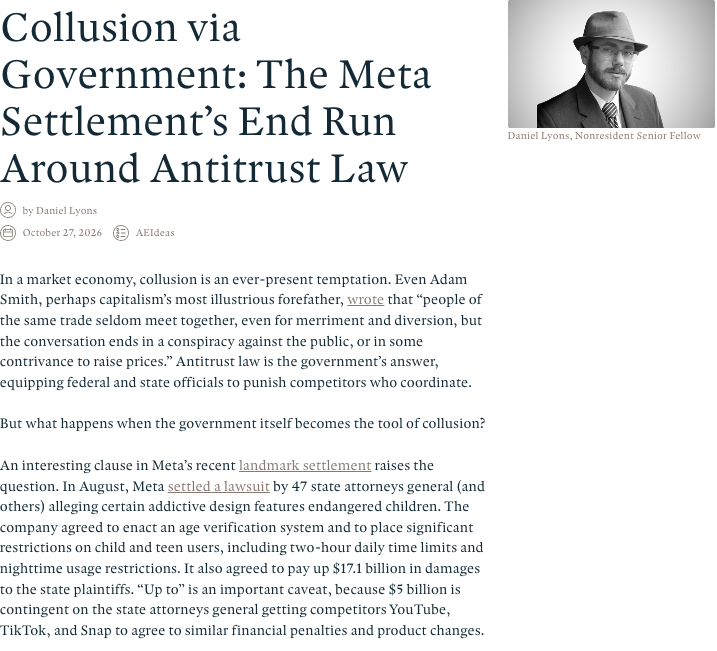
My latest post @AEItech looks at the @Meta settlement's contingent payment: $5B is withheld until states get YouTube/TikTok/Snap to agree to similar terms.
If Meta negotiated this directly w/ competitors, it'd raise antitrust issues. So what if state facilitates collusion? 1/2
“Everyone agrees that *The Prisoner* (1967), the unclassifiable British television show that Criterion recently added to its streaming collection, is an allegory. But of what? If you watched it in 1967, unaware that you’re enjoying a soon-to-be cult classic, a singularity in its medium, you’d probably place it as a spy show. Or perhaps you’d view it as spy-fi, that subgenre of the spy thriller defined mostly by the fact that the spy’s gadgets are all absolutely sick and the film stock has the colors of a childhood dream.” —Phil Christman
https://t.co/wfMn3XFa6p
Five news networks jointly suspended coverage in protest. An antitrust investigation followed.
@RBenSperry in @usatodayopinion on the First Amendment’s protection of editorial choices, including what to cover and publish, and how it applies when networks act together. 🔗⬇️
Every year, thousands of DC residents lose their homes over unpaid rent. Most owe less than $5,000. Going to court is stressful for tenants, expensive for landlords, and slows down the system. We need a better way to resolve rent issues. 🧵⬇️
“In a market economy, collusion is an ever-present temptation. Even Adam Smith, perhaps capitalism’s most illustrious forefather, wrote that “people of the same trade seldom meet together, even for merriment and diversion, but the conversation ends in a conspiracy against the public, or in some contrivance to raise prices.” Antitrust law is the government’s answer, equipping federal and state officials to punish competitors who coordinate.
But what happens when the government itself becomes the tool of collusion?”
Continue reading @ProfDanielLyons's latest:
https://t.co/z7DeNZ6El9
FACT: The annual funding Israel receives from the US amounts to less than one-tenth of 1% of the federal budget. Less than 1/10th of 1%.
FACT: That annual funding would cover only a few hours of federal health care spending. A few hours.
Yet politicians who specialize in scapegoating would have you believe that Israel is responsible for America’s affordability crisis.
Like every form of scapegoating before it, it is a dangerous lie.
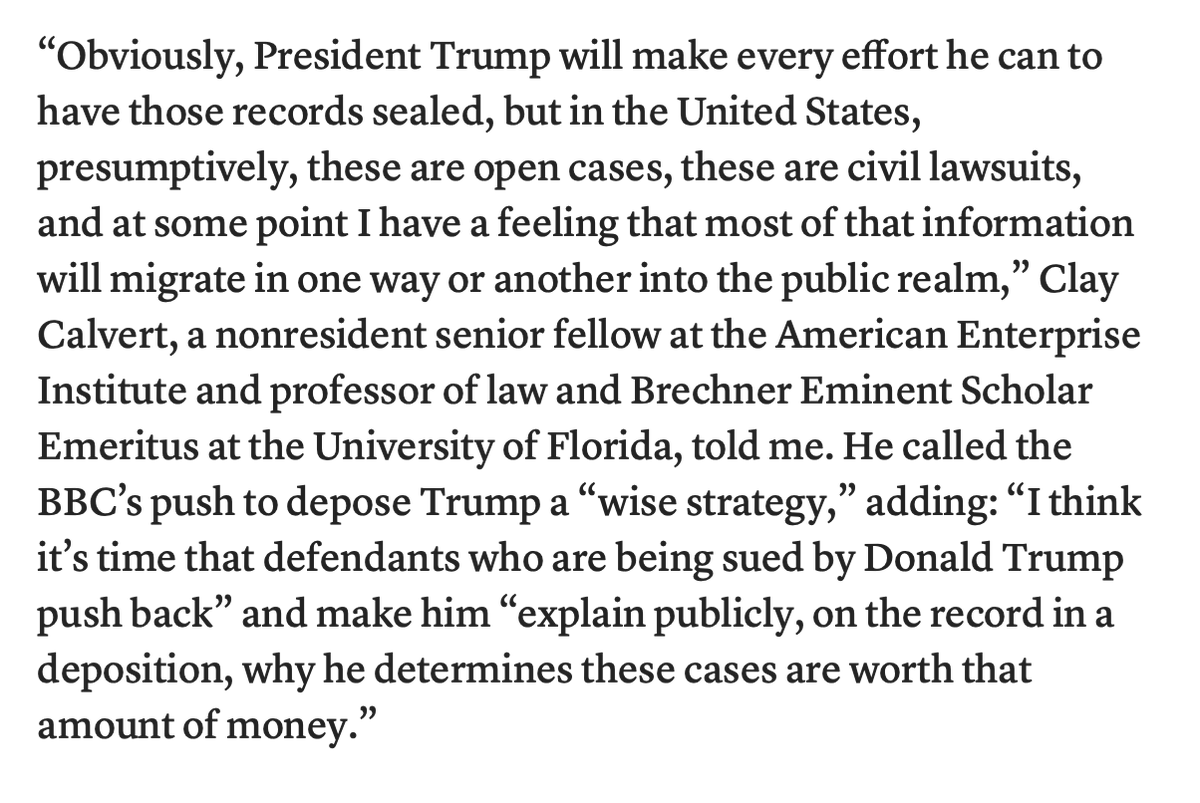
Some thoughts today in @CJR re: Trump sitting for a deposition in his $10 billion lawsuit against the @BBC . . . @AEItech@AEI . . . https://t.co/r1Hi3aWHSt
Striking detail in the big NYT piece on Taiwanese families adjusting to working at the huge new TSMC chip plant in Arizona: their surprise at the lack of rigor in US schools.
01. Start with shorter books and build up your reading stamina. Possibly your ability to focus has been sapped by other media. Luckily, this is a problem with a simple solution. The more you read, the easier reading will become.
02. Carry a book with you. I find it very unsettling when I visit airports and everyone—babies, kids, parents—is glued to a screen. We spend a good chunk of our lives in DMV lines and sitting in diners. You can get a shocking amount of reading done in those spare moments.
03. Read before falling asleep. This is actually where I get most of my reading done. Resolve that for the next hour or however long, you’re not going to look at your phone. There’s something almost hypnotically soothing about reading in silence at the end of a day.
04. Reduce the level of non-book entertainments. This is the main reason most people struggle with reading, because we live in a world of infinite diversions. Harold Bloom said, “There are enormous obstacles to deep reading now. The tyranny of the visual is a frightening thing.”
But once you realize those diversions are the very things keeping you from reading, it becomes easier to prioritize reading as a hobby. Books are both good for the brain (in the same way exercise is good for the body) and more emotionally rewarding than much of what we consume.
05. Keep a reading diary. It can be something as simple as jotting down the titles of every book you complete. Seeing those titles begin to add up is enormous fun, and will motivate you to want to keep reading.
06. Remember that reading is supposed to be fun. There’s a reason books were the chief entertainment for American pioneers and British coal-miners of the nineteenth century. We once had a massively literate working-class, and I believe we could revive a culture of reading for pleasure.
In 1941, a Spaniard walked into the British embassy in Madrid and offered to spy on the Nazis.
The British turned him down.
So he went to the Germans instead, pretended to be a loyal fascist, and got hired as a German spy. His plan was to lie to them for the rest of the war.
It worked better than anyone could have imagined.
His name was Juan Pujol García. Before the war he had tried his hand at running a chicken farm and a movie theater. He had no spy training. What he had was a deep hatred of both fascism and communism after the Spanish Civil War, and an incredible imagination.
The Germans gave him a codename, invisible ink, money, and orders to go to Britain and recruit spies.
He didn't go to Britain.
He went to Lisbon, Portugal, and made everything up.
Using a tourist guidebook, maps, magazines, newsreels, and a British railway timetable from the library, he wrote long, detailed reports about life in England. Military movements. Morale. Ports.
He'd never been there. He made mistakes. He didn't understand British money. He once reported that dockworkers in Glasgow would do anything for a liter of wine.
The Germans loved him anyway.
Then British codebreakers reading German messages noticed something strange. The Germans were hunting for a convoy that didn't exist, based on a report from some agent in Britain they'd never heard of.
The British went looking for this mystery spy. They found Pujol. In 1942 they finally took him on and brought him to London.
Now he had real help. MI5 gave him the codename Garbo, after the actress, because they thought he was the greatest actor in the world.
Together with his British handler, Pujol built a fake spy network for the Germans. It eventually had 27 imaginary agents. Each had a name, a personality, a job, and a backstory. A Welsh nationalist. A Venezuelan student. A Greek sailor. Some of them recruited their own imaginary sub-agents.
When they needed to explain why one agent had gone quiet, they killed him off. They even put a fake obituary in a Liverpool newspaper. The Germans reportedly paid a pension to his widow.
Who also didn't exist.
Then came D-Day.
Hours before the landings, the British let Pujol send a message warning the Germans that the invasion was coming in Normandy. It was timed so it would arrive too late to matter, but it made him look brilliant.
Three days later he sent the most important message of his career. Normandy was a trick, he said. The real invasion was still coming, at Calais, led by a huge army under General Patton.
That army was fake too. But the Germans believed him.
German forces that could have been rushed to Normandy were held back near Calais for weeks, waiting for an attack that never came.
The Germans were so grateful they awarded him the Iron Cross.
A few months later, King George VI made him a Member of the Order of the British Empire.
He's one of the only people known to have been decorated by both sides of the war.
After the war, afraid of revenge from surviving Nazis, he faked his own death from malaria in Africa and disappeared to Venezuela, where he lived quietly running a shop.
For decades the world thought he was dead.
In 1984, a British writer tracked him down. Pujol came back to Normandy for the 40th anniversary of D-Day and met veterans who had landed on the beaches.
Some of them thanked him.