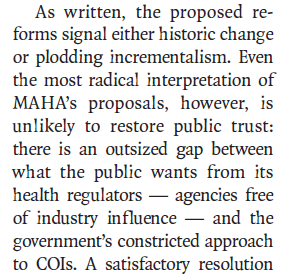
TLDR for my commentary on conflicts of interest in advisory committees, published today in the New England Journal of Medicine.
1. Government defines COIs narrowly
2. AC members can have a boatload of industry ties but not be identified as having a COI
3. Public trust has declined because public equates having any industry tie with a COI even though official definitions are narrower
4. We can't fix public trust through COI policies alone -- there has to be transparency and integrity throughout the health care ecosystem
Link (paywall): https://t.co/mdVamqSmHo
Full text: https://t.co/0uCHApYiqa
RIP Ned Phelps
Ned Phelps followed his own intellectual journey.
When Keynesians relied on a long-run tradeoff between unemployment and inflation, he showed why this was a weak reed to stand on. Thus was born the natural rate hypothesis (although the coining of the word goes to Friedman, a year after Ned’s paper).
When, later, New Keynesians were focusing on nominal rigidities, he built models of fluctuations where nominal rigidities played no role. When New Classicals were exploring the cyclical implications of competitive markets, he focused on the role of distortions in goods and labor markets, be it efficiency wages, or variable markups.
It would be fair to say that, today, the frontier macro models embody the natural rate hypothesis, and many of the distortions Ned focus on---and, what he did not like, i.e. nominal rigidities.
His style was highly idiosyncratic. He was often a poor expositor of his fundamental insights. He did not listen much to others, pursuing his agenda with focus and passion. But, to use an overused but appropriate expression, he was certainly one of the giants in the field. We often met and sometimes fought, be it on hysteresis or nominal rigidities, but I had infinite respect for him.
Hello! Thank you for asking. The issue you raise is more a work permit issue than a physical location issue. Unfortunately we won't be able to sponsor a US work visa at this time, so the candidate would need to be able to have permission to work in the US. Within the US, the RA can work remotely.
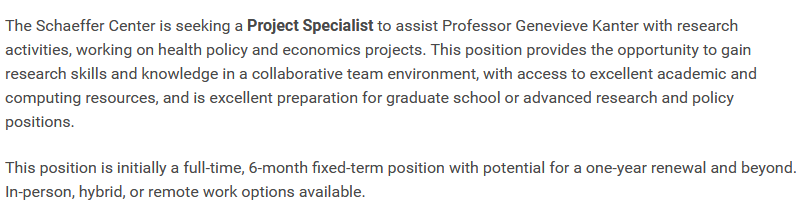
** Research Assistant/Predoc Job Opportunity! **
Our research team at USC is seeking a full-time RA/predoc fellow. We work on a variety of health policy, health economics, and political economy projects. Ideal for recent bachelor's or master's graduates with 1-2 years of experience.
Details and application here: https://t.co/qMCV3Ujzk8
(Combine your cover letter and resume into one document and upload)
SCOOP: FDA Commissioner Marty Makary is resigning from the agency.
Kyle Diamantas, who previously worked as the top food official at the agency, will lead the FDA in an acting capacity.
w/ @Gardner_LM: https://t.co/k4ORTbX8tj
📰 𝗔 𝘄𝗼𝗿𝘁𝗵𝘄𝗵𝗶𝗹𝗲 𝗿𝗲𝗮𝗱 𝘁𝗵𝗶𝘀 𝘄𝗲𝗲𝗸𝗲𝗻𝗱.
A worthwhile read this weekend, and one I wanted to share with my network.
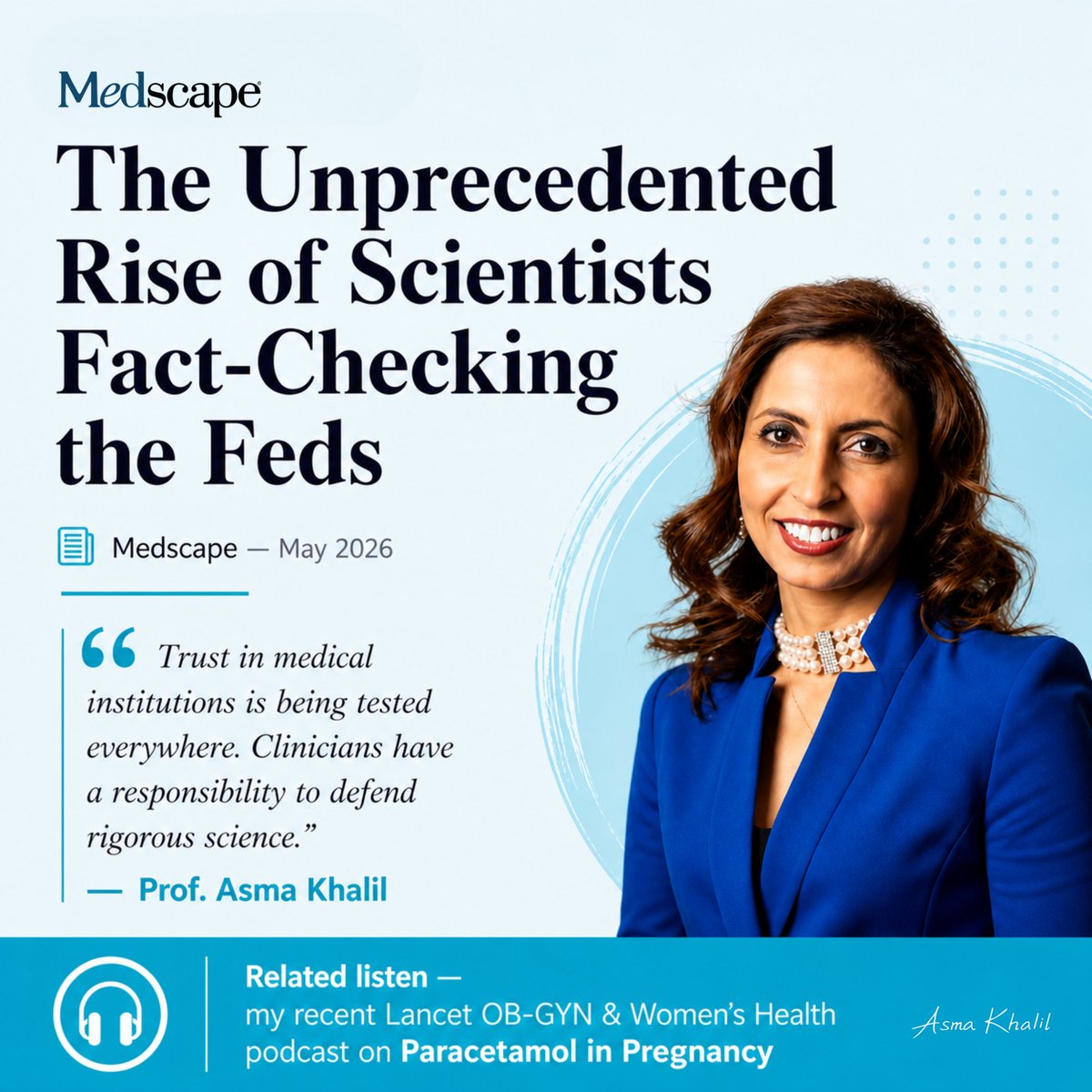
Medscape — "The Unprecedented Rise of Scientists Fact-Checking the Feds."
A few points from the article worth pausing on:
— Public trust in the CDC, FDA and NIH has fallen in double digits since 2024
— Yet 𝘁𝗵𝗿𝗲𝗲 𝗶𝗻 𝗳𝗼𝘂𝗿 𝗨𝗦 𝗮𝗱𝘂𝗹𝘁𝘀 𝘀𝘁𝗶𝗹𝗹 𝘁𝗿𝘂𝘀𝘁 𝘀𝗰𝗶𝗲𝗻𝘁𝗶𝘀𝘁𝘀 𝘁𝗼 𝗮𝗰𝘁 𝗶𝗻 𝘁𝗵𝗲 𝗽𝘂𝗯𝗹𝗶𝗰 𝗶𝗻𝘁𝗲𝗿𝗲𝘀𝘁 (Pew, January 2026)
— In February, the American Academy of Pediatrics issued its own immunisation schedule, departing from recent CDC changes
— Independent research committees are being formed to protect the integrity of scientific work
Read the Article: https://t.co/JlR3gTvv5j
🎙 The article covers a topic I was widely quoted on earlier in the year and discussed in 𝗧𝗵𝗲 𝗟𝗮𝗻𝗰𝗲𝘁 𝗢𝗯𝘀𝘁𝗲𝘁𝗿𝗶𝗰𝘀, 𝗚𝘆𝗻𝗮𝗲𝗰𝗼𝗹𝗼𝗴𝘆 & 𝗪𝗼𝗺𝗲𝗻'𝘀 𝗛𝗲𝗮𝗹𝘁𝗵 podcast: "𝗽𝗮𝗿𝗮𝗰𝗲𝘁𝗮𝗺𝗼𝗹 𝘂𝘀𝗲 𝗱𝘂𝗿𝗶𝗻𝗴 𝗽𝗿𝗲𝗴𝗻𝗮𝗻𝗰𝘆".
🎧 Listen on Apple: https://t.co/bWGP41XptY
🎧 Listen on Spotify: https://t.co/Qy71GJEOvG
#EvidenceBasedMedicine #ClinicalResearch #ScienceCommunication #Healthcare #WomensHealth #Pregnancy #PublicHealth #PerinatalHealth @TheLancet@MedscapeObGyn@Medscape
The Lancet Obstetrics, Gynaecology, & Women’s Health Medscape
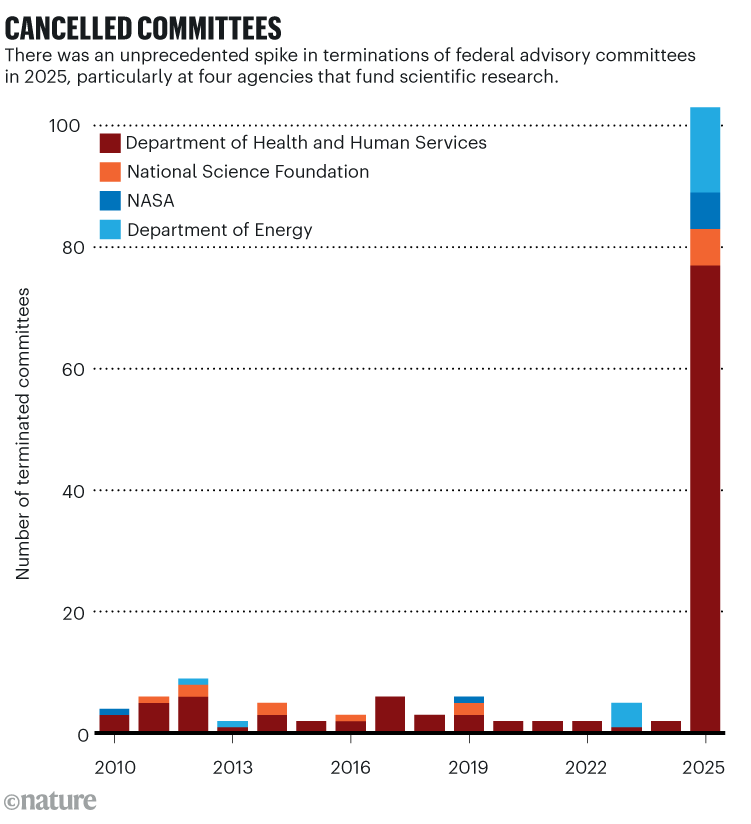
The Trump administration has downsized US science by historic margins — but it's not just via grant or workforce cuts.
Our new @nature analysis reveals the government has cut more than 100 scientific advisory panels across all major science agencies.
If Trump's proposed $6B cut to NIH were enacted in FY27, the NIH estimates that the number of new research grants would drop **47%**
https://t.co/46m9y8jexy
Interesting to take part in today’s panel debate with @NIH Director, Dr Jay Bhattacharya @DrJBhattacharya , at a USC event hosted by Dean Carolyn Meltzer and Dr Neeraj Sood (USC School of Public Policy). Some takeaways:
💡The NIH budget will likely remain flat next year, but an increase in “forward funding” (now 37% of grants, up from 20%) will likely mean fewer grants awarded. Forward funding is intended to allow projects to spend much more in their first year than if the budget was constant in all years, and some investigators, e.g. a junior researcher, may need initially larger funding to set up their lab.
💡If a clinical trial is fully funded at the start, it avoids having nothing to show if each continuation year depends on annual funding appropriations (which are unstable). Forward-funding leads to a temporary very large drop in numbers of grants awarded but “at equilibrium” the same number of grants will be awarded.
💡Calls to increase the 500k/year budget for R01s (the standard type of NIH grant) have to be carefully balanced with the recognition that raising this would lead to fewer grants overall.
💡There is very high priority on reproducibility of research, as not prioritizing this has led to loss of public trust in science. Consortia can address this. Some audience members (incl Rob McConnell) noted it might make sense to expand reproducibility to include experimental work where multiple lines of converging evidence point to a conclusion, from multiple different approaches, rather than just repeating the experiment. But this can be expensive.
💡Paylines (where the top x% of grants are funded, and x is known) are being replaced by a system where NIH institute directors and POs have more discretion. This is because the top-N by score may not be necessarily more impactful than the best selection of grants that collectively as a portfolio could make the greatest impact. If there is redundancy, this can be traded off by funding a lower-scoring grant with higher risk/higher impact.
💡Foreign components on grants are welcome, but must use the new PF5 format with higher expectations of auditing and reporting for the foreign site, including making primary research records available to the funder via the prime site. Foreign subawards are no longer being used as they involve less oversight which can lead to loss of public trust.
💡Panelists noted the need to speed up reviews and the time-to-funding, which has greatly increased. Dr Bhattacharya noted that some ideas take time to incubate in the community before they can be reliably funded, whereas others (perhaps AI, clinical trials) can lose impact if delayed or review is too slow.
💡There is a proposal being entertained that K awards (for junior faculty) be given as an allocation to the institution to give out to people they vet, rather than directly awarded.
💡NIH wants to “spread out” funding to more institutions, across more of the country, to reduce the concentration of funding at some institutions.
💡Innovation is sometimes killed by reviewers who put too much emphasis on the certainty of the approach working. Often Aims 2 and 3 of a project depend on a high-risk, high-payoff Aim 1 working. Forward funding of 2-3 years can allow a checkpoint to be included on a high-risk Aim, before more funding.
💡Thank you to @KECKSchool_USC for hosting the event, and to Neeraj Sood for his "Open Dialogues" project.
BREAKING: In response to huge cuts in Trump's budget request, NSF is closing its social sciences directorate. Staff will be transferred elsewhere in NSF, and "grants that align with Administration priorities" will be kept.
W/ @dangaristo for @Nature
https://t.co/Lakcl0oLYa
Negativity is more viral, but the new Nature studies don’t mean social science is wrong or uninformative.
It’s fine if there are errors in papers. Genetic mutation has a beneficial rate of <1%, but evolution is monstrously effective.
High error rates are ok if you have a process that is robust to high error rates. Many science papers have always been wrong, but they get retested and overturned.
The same thing happens in social science— most papers don’t get replicated but that’s because nobody cares about their results. When stuff is important, it does get tested and retested and the literature builds toward correct answers.
It’s ok to have a moderate error rate because papers are not sacred texts. What matters more is whether you have institutions where errors can be found and overturned. This is the real test of institutional quality.
And we’re around the corner from AI making us much better at this, esp in the fields with open data standards.
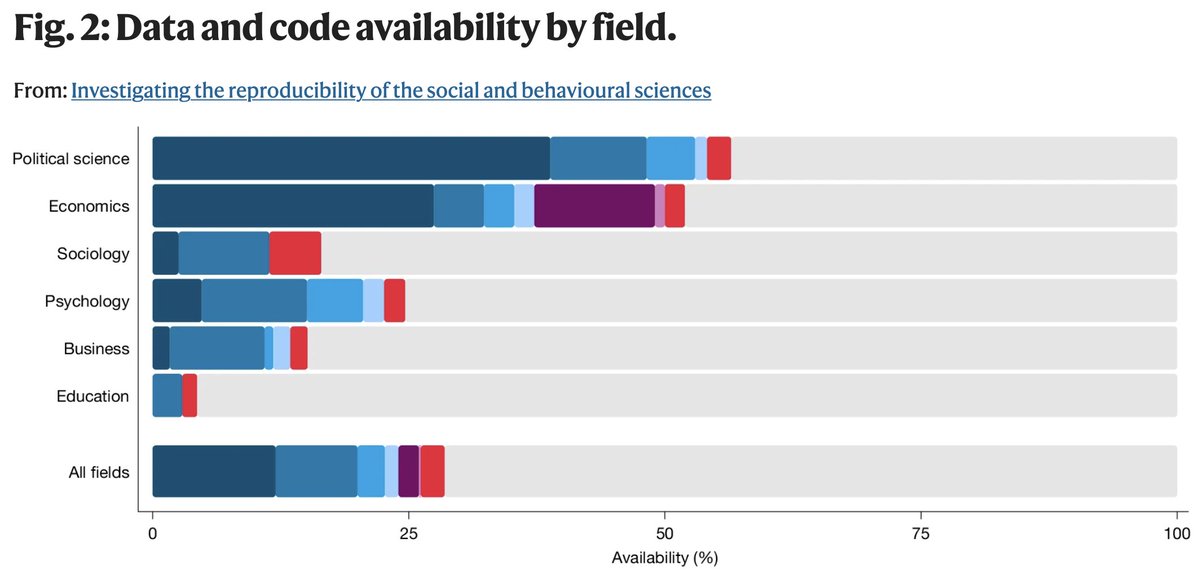
Data and Code Availability by Field: Poli Sci and Econ are crushing it (ok, only relative to the other social sciences, it should be 100%).
Replicability problems will shrink dramatically in the disciplines with open data, as AI will soon be quickly validate all the papers.
The FDA has often failed to share information on how it determines whether advisory committee members have financial conflicts of interest, according to a new review. https://t.co/U7bYMTeG6Z
Thanks to @edsilverman and @pharmalot for covering the GAO report on FDA conflict of interest disclosures.
I'd like to clarify that I was wrong in my criticism about the disclosures of appearance waivers. These rules were not promulgated by the FDA but were issued by the Office of Government Ethics. A screenshot of the note that I sent to Ed requesting a correction is in the comments.
Thanks to Ed, Pharmalot, and STAT for his coverage of the GAO report on FDA conflict of interest disclosures.
I'd like to clarify that I was wrong in my criticism about the disclosures of appearance waivers. These rules were not promulgated by the FDA but were issued by the Office of Government Ethics. A screenshot of the note that I sent to Ed about the requested correction is in the comments.
The FDA has often failed to share information on how it determines whether advisory committee members have financial conflicts of interest, according to a new review. https://t.co/U7bYMTeG6Z