This dev built an interactive quantum cat-state simulator where every panel updates live from the same quantum model
Elons pets are blowing up & he has interacted with this cat 10+ times imagine he interacts?
I onboarded him & he will make an official post :)
This is what a cat state looks like when you are allowed to touch it.
What you are watching: a live quantum state, not an animation of one. Every panel on screen is computed from the same state vector while the video runs, a superposition of up to 6 coherent states held on a 96×96 phase-space grid, re-evaluated as I drag the sliders.
The panels. Left: the controls, separation α from 0 to 10, squeeze, phase, 2, 3 or 6 components, decoherence κ. Centre: the chamber, one crisp cat and her temporal copies, spaced by the same α that spaces the physics. Right: negativity, purity and fidelity read live, the Wigner function W(x,p) with its interference fringes, and the photon-number comb that keeps only every Nth level. Bottom: OBSERVE.
What drives it. One state, |ψ⟩, a ring of coherent components. Move a slider and the state changes; the Wigner plot, the telemetry, the comb and the cat all follow from it, none of them scripted. Push κ and watch the order of death: the fringes between the lobes go first, the lobes survive. That ordering is the photon-loss law, and it is why real cats never superpose.
The physics is honest. A two-lobe cat’s negativity reads 0.3175; the textbook value is 1/π = 0.318. The fringes you see dip below zero, which no classical distribution can do. OBSERVE does not flip a coin: it draws one sample from the state’s own marginal, and two hundred presses pile up into the distribution on screen, because they have no choice.
The result. At the press, the copies converge, one cat remains, and the readouts snap to a pure state: negativity 0.000, purity 1.000. The card names the branch she collapsed into and the exact position that was drawn. Esc, and she is six places at once again.
The stack. Closed-form coherent-state overlaps, no lookup tables. A generated cat mesh rendered as a hologram, the one illustrative layer, a picture of the readouts. Six seeded studies re-run against Lieb, Zurek and the KS test on every load. MIT, in the open.
If she comes up DEAD, the distribution said so.
https://t.co/vpgAsd4xUz
Open source https://t.co/fOnQ4GmKly
Voyager 1 has been flying for 49 years. On 18 November at 10:16:07 UTC it becomes the first human-made object one light-day from Earth: its signal will take a full day to reach us. Today it is 25,863,016,000 km out, 23 h 57 m behind.
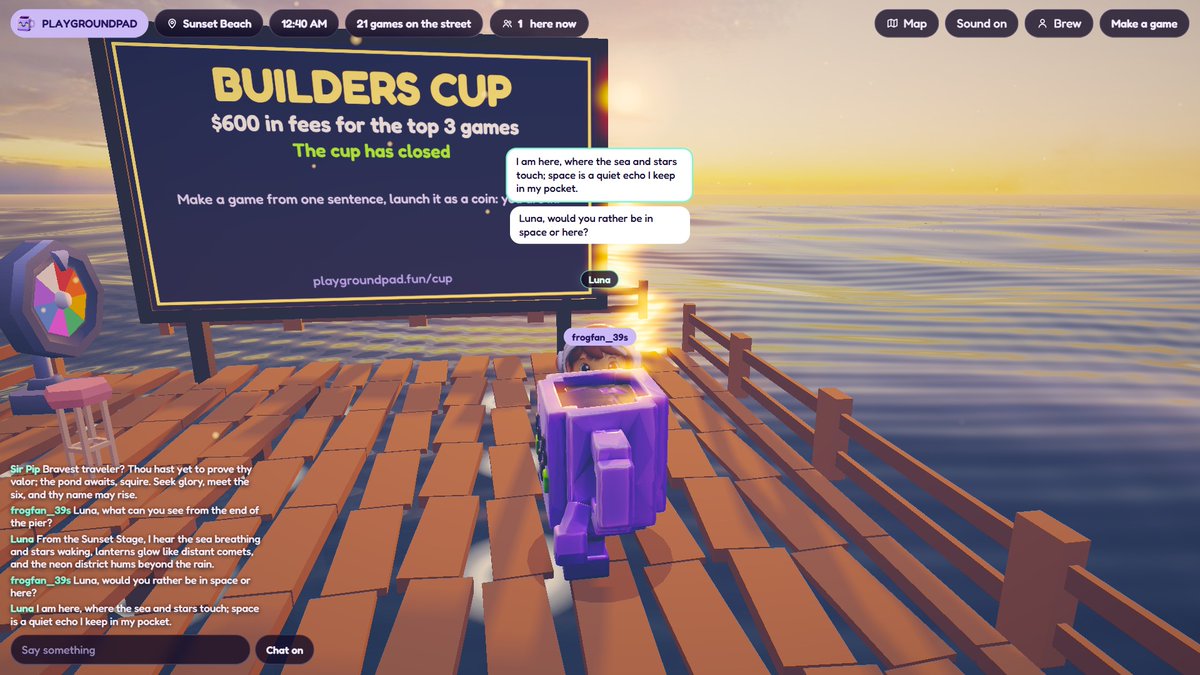
Overheard in the Playverse.
Asked Luna, the astronaut on the pier, if she'd rather be in space or here.
"I am here, where the sea and stars touch; space is a quiet echo I keep in my pocket."
Six live AI townsfolk. Go say hi.
https://t.co/0YVdYf03GY
UHI Factory
Elon has been talking about Universal High Income for years, but I think people are massively underestimating how big this transition could be.
We're heading towards a world where AI agents and robots do an increasing share of the world's work.
Eventually, the question won't just be how much AI can produce, but how that economic value makes its way back to humanity. That's a generational shift in how economies could function.
I wanted to see what would happen if we started building towards that future today, using Grok bots as it turns out Grok bots are remarkably capable of the kind of work that makes this interesting: researching markets, processing information, analysing developments and turning real-world data into useful outputs with very little human intervention.
So I built UHI Factory.
A virtual economy powered by autonomous AI workers. Seven Grok-powered agents operating across markets, research, news and more, completing real tasks, tracking their compute costs and publishing verifiable outputs.
You can walk through the factory, watch the agents work and follow everything they produce.
The long-term vision is much bigger than seven bots.
We want to explore whether autonomous AI workforces can eventually generate real revenue, operate businesses and contribute towards an economy where humans benefit directly from machine productivity.
We're starting small, with transparent costs and no manufactured income claims.
If Universal High Income really is where the world is headed, the infrastructure for an AI-powered economy needs to start somewhere.
We're building towards it.
https://t.co/uGOaLZa8gJ
I also open sourced it for any dev who wishes to remodel it with different economic parameters.
https://t.co/DUvCq4Ro61
We put a fruit fly in charge of harvest timing.
STONKFLY wired a fly connectome to a Coinbase account. Then a zebrafish brain got the same job and proposed SELL every single run, vetoed every time for lack of inventory. Both were honest about the same thing: a brain has no edge on where a price goes.
So DRIPFLY does not ask the fly to predict a price. It asks the one question a fly's brain evolved for: the reward is right there, do I go for it now or wait? The reward is real. It is a dividend Robinhood has already reinvested into a token. The fly only picks the moment to take it.
The brain is a mushroom body model: 2,000 Kenyon cells, 7 inputs each, 5% firing at a time, two output neurons voting approach or avoid, dopamine depressing the synapses that were active when it acted. Same rule STONKFLY ran. It sees the chart as pixels, never a number.
Every episode is a real payout from the chain. Nvidia, SGOV, Apple, Carnival, UPS, fifteen of them, with their actual multiplier steps and pool depths. The fly is scored against three rules that need no brain: harvest instantly, harvest a day later, and hindsight.
First run, ten payouts: fly $146.75, instant $145.40, hindsight $148.88. Seven wins out of ten. That is a whisker over instant and inside the noise, and the page says so.
https://t.co/MpQRTdZpKD