⏳ 4 HOURS TO GO
Join us today for the Qubitcoin X Space AMA with Dmitrii Khitrin, Director of the Qubitcoin Foundation.
🗓️ Today, August 16
⏰ 2:00 PM ET
See you there!
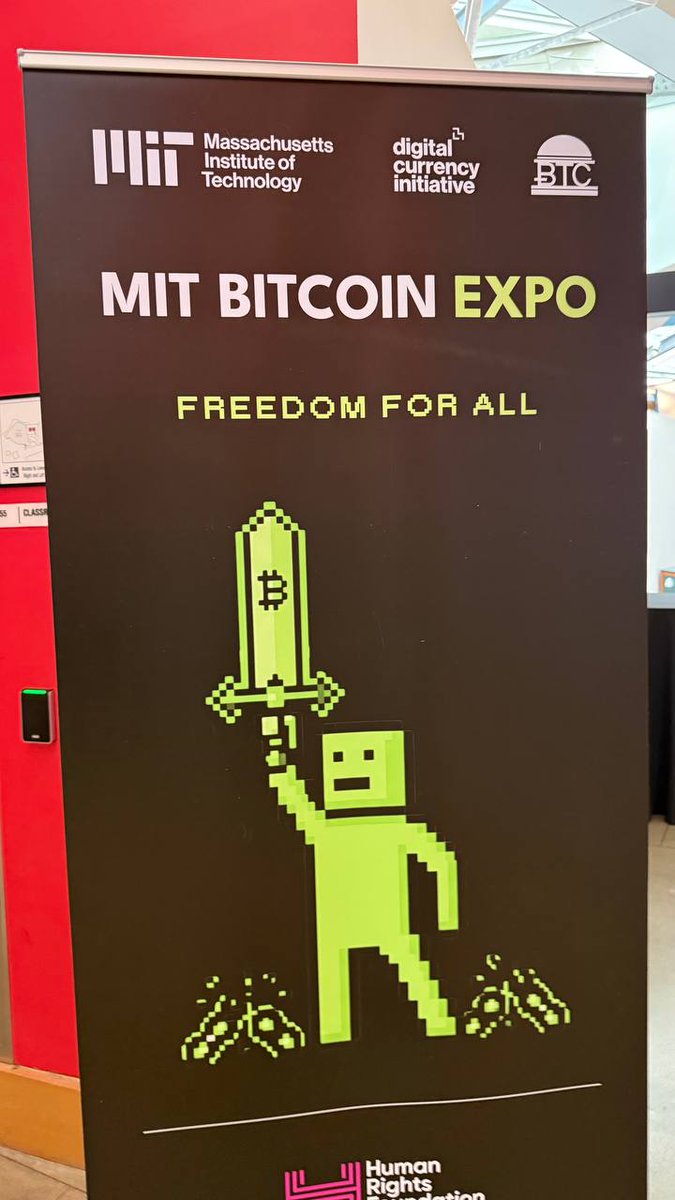
Reflecting on the @MITBitcoinClub Expo 2026. Theme was "Freedom for All."
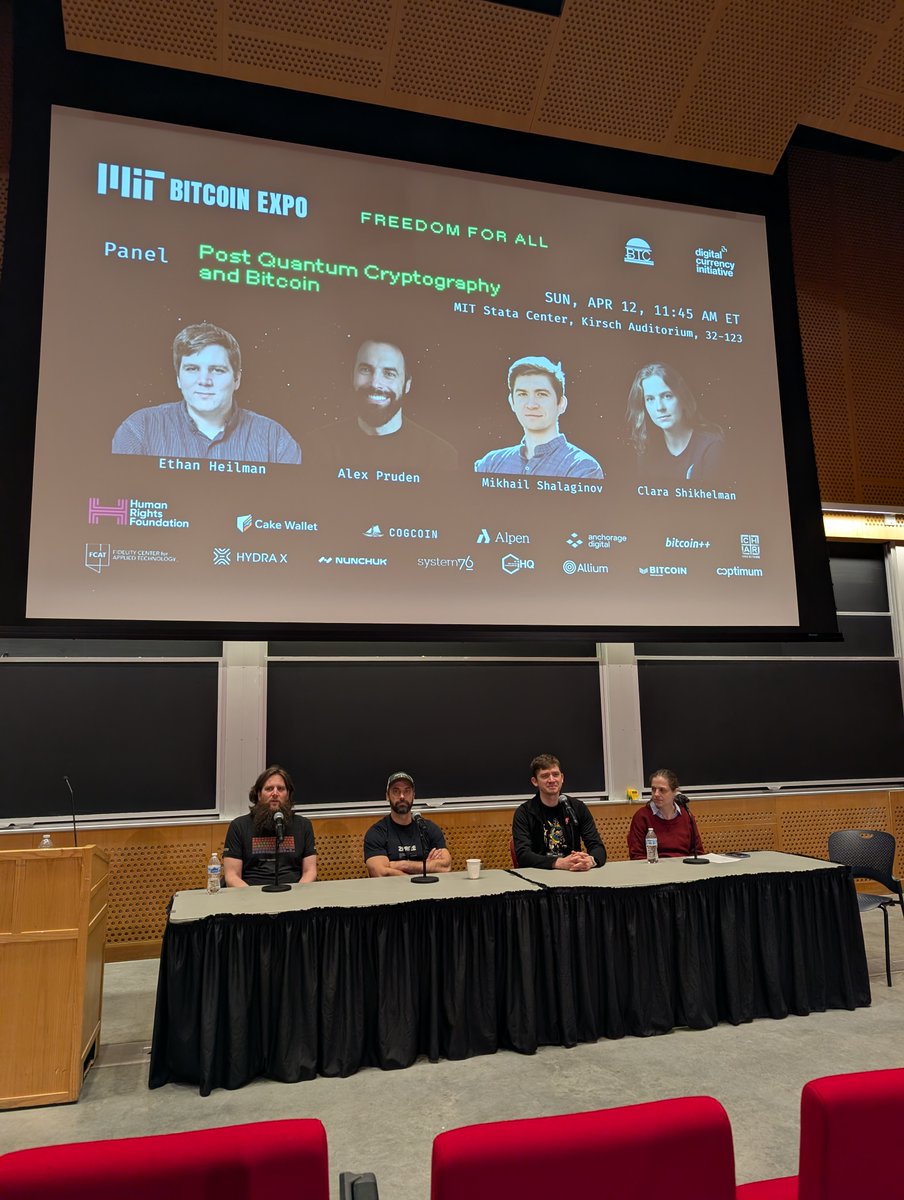
The panel that stuck with me most was @Ethan_Heilman@apruden08@MYShalaginov and @ClaraShik on defending Bitcoin from quantum through post-quantum signatures.
It got me thinking about what this means for DeFi. Most people assume current signature schemes are permanent. But if you're building anything that holds user funds or executes trades, post-quantum migration paths need to be part of the architecture conversation now.
@Austin_Federa argued that none of the upper-layer stuff matters if the physical infrastructure isn't purpose-built. @MurielMedard mentioned how post-quantum research is likely to be a highly significant area for the industry in the coming years.
The Bitcoin Core panel with @satsie@achow101@darosior furszy, Cory Fields, and Sjors Provoost gave some insight on the responsibilities in maintaining the network. And @HesterPeirce highlighted how regulators need to reframe the dialogue around privacy in crypto.
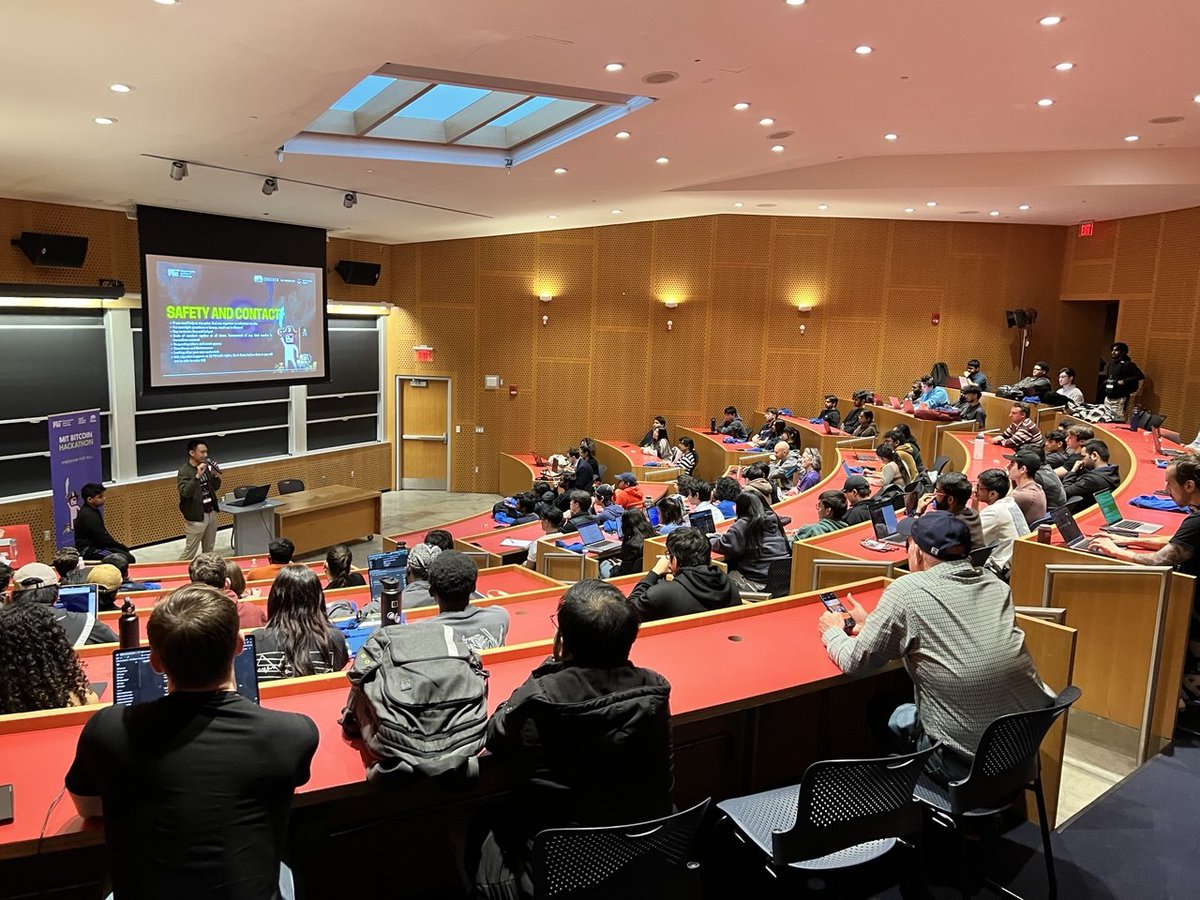
Two whole days of talks alongside a 36-hour hackathon, a DCI workshop, and a lot of hallway conversations with undergrads, professors, researchers, and industry experts.
Full livestream available here: https://t.co/hDQgFzpgkU
It was great to take part in the @MITBitcoinClub Expo, joining a panel on post-quantum cryptography and interacting with Bitcoin Core developers and leading cryptographers.
As quantum machines mature, running Shor's Algorithm or its variants at scale is becoming increasingly plausible, directly challenging Elliptic Curve Cryptography, which underpins Bitcoin and Ethereum.
Bitcoin’s security relies on private keys. However, once a transaction is made, the public key is revealed. With a sufficiently powerful quantum computer, that public key could be used to recover the private key and take control of the funds. This fundamentally changes the security assumptions of the entire ecosystem.
The solutions are not straightforward. Post-quantum schemes exist (e.g., Falcon and Dilithium), but signatures are often 10–100x larger. Since signatures dominate transaction size, this would mean fewer transactions per block, higher fees, slower propagation, and increased centralization pressure. A naive transition risks disrupting Bitcoin’s economic balance.
Upgrading Bitcoin is also inherently difficult. The system resists change by design, and history (e.g., the 2017 split into Bitcoin Cash) shows how contentious even relatively simpler upgrades can be. A post-quantum transition would require global coordination and a large-scale migration of funds.
There is also a deeper question: a significant fraction of coins that are likely lost becomes vulnerable in a quantum scenario. Should they be left as a bounty, or somehow reclaimed? There is no clear consensus.
Quantum computing is advancing rapidly and poses a systemic risk to digital assets. The window to prepare is limited, and the challenges are both technical and social.
Can Bitcoin be upgraded, or will its core assumptions be tested beyond repair?
P.S.: I believe @qubitcoinx (originally inspired by Bitcoin) will become both quantum-secure and quantum-friendly.
This year, Superquantum made its first appearance at iQuHACK. Along with @QueraComputing, @IonQ_Inc, @nvidia and other companies we presented a quantum computing challenge for hackers to solve in 24 hours. Their goal was to step into the role of quantum compilation researchers and minimize fault-tolerant cost (the number of T-gates) for future quantum hardware using various techniques and tools, including Superquantum’s own rmsynth (https://t.co/dDS3jcvnbS).
Congratulations to Nathan Andrew Jones, John Stephen Layton, Valentine Patrick Mohaugen, Landon Holcomb, Chowdhury Abrar Faiyaz and Ashton Bennett McEntarffer for winning our challenge and demonstrating amazing performance and research skills.
It was incredibly exciting to spend the weekend at MIT, and we look forward to being back next year.
Dr. @MYShalaginov — quantum scientist, entrepreneur, and creator of Qubitcoin.
With a Ph.D. in Quantum Photonics from Purdue and postdoctoral research at MIT, he now leads work on neutral-atom quantum machines at QuEra Computing and previously co-founded 2PI Optics. Join us at #MITBitcoinExpo2026 for a presentation and panel discussion at the cutting edge of quantum computing and Bitcoin.
Get tickets now at https://t.co/k58lzEMLHv
#MITBitcoinExpo2026 #FreedomForAll #BitcoinBoston #BTCxMIT
It was a pleasure meeting you and exchanging ideas at iQuHACK ’26 @qBitTensorLabs
Great conversations around quantum computing, simulation, and crypto. Looking forward to continuing the dialogue!
My conversation with Austin Fowler (former Senior Research Scientist at Google Quantum AI) and Yudong Cao (Head of Quantum & AI at BCG X) on quantum fault tolerance, surface codes and the role of open-source tools like TQEC in scalable quantum computing. Thankful for Austin's insights and contributions.
My conversation with Austin Fowler (former Senior Research Scientist at Google Quantum AI) and Yudong Cao (Head of Quantum & AI at BCG X) on quantum fault tolerance, surface codes and the role of open-source tools like TQEC in scalable quantum computing. Thankful for Austin's insights and contributions.
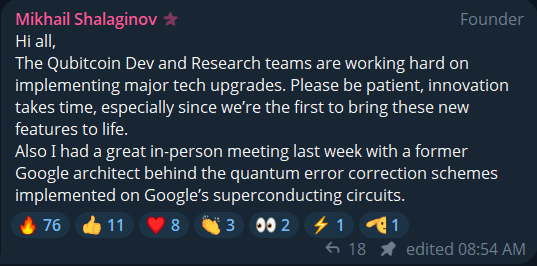
Message from the founder,
Hi all,
The Qubitcoin Dev and Research teams are working hard on implementing major tech upgrades. Please be patient, innovation takes time, especially since we’re the first to bring these new features to life.
Also I had a great in-person meeting last week with a former Google architect behind the quantum error correction schemes implemented on Google’s superconducting circuits.
$QTC @qubitcoinx@MYShalaginov
Happy 1st Birthday to $QTC 🥳
In just one year, @qubitcoinx turned GPUs into quantum simulators - proving that mining can power real scientific progress!!
From 700 miners → 3,000+ GPUs → the world's largest decentralized quantum simulation network!!
Built by researchers from MIT, Yale and Vanderbilt - powered by the community 💪
Next stop: MIT, Nov 14, where the anniversary event and qPoW demo will take place!!
Year One was the foundation.
Year Two is when the revolution scales!!
Full anniversary thread 👇
QUANTUM GOLD STANDARD ⚛️
Let's dive into another, more "meta," utility for $QTC. This one is critical for the entire quantum computing industry.
The network isn't just doing simulation; it's becoming a decentralized benchmark for actual quantum hardware.
The “Answer Key” Problem
Here’s a huge challenge for companies building quantum computers: How do you know your new, billion-dollar chip is working correctly?
If you ask it to solve a problem that's too complex for a classical computer, you have no way to check the answer. It's a "black box."
Quantum systems are incredibly 'noisy' and prone to errors. You could be getting high-tech, expensive-to-calculate, wrong answers.
To build a reliable quantum computer, you first need a reliable "answer key" to test it against.
How $QTC's Simulation Becomes the Benchmark
This is the genius of the Quantum Proof-of-Work (qPoW) model.
The "work" that $QTC miners are doing is classically simulating real quantum circuits. The network then comes to a decentralized consensus on the correct solution.
This process is creating a massive, public, and verifiably correct library of solved quantum problems.
The Real-World Impact
Now, a hardware company like IBM, Google, or Rigetti can:
1. Take a quantum circuit puzzle from the $QTC chain.
2. Run that exact same problem on their new, physical quantum chip.
3. Compare their chip's answer to the $QTC network's "answer key."
If the answers match, they know their quantum hardware is accurate and their error correction is working. If they don't, they've found a bug and can improve their design.
The $QTC network is literally building the “gold standard” test. It’s creating the universal ruler that the entire quantum industry can use to measure its own progress.
The network isn’t just simulating a quantum future, it’s providing the critical verification layer to make sure the future is built on solid ground.
Thank you, @qubitcoinx.
Qubitcoin $QTC takes a mixed approach merging cryptographic hash functions with quantum computing circuits. As a part of the cycle, miners have to complete a quantum task, check the outcomes, and then use these results in the following hashing step. This setup makes sure the whole system stays secure and that it can be verified on regular computers, while also pushing for the growth and use of quantum computing resources.
Currently, the qPoW hashing algorithm inside of Qubitcoin utilizes cuStateVec library from NVIDIA cuQuantum SDK to run quantum circuit simulations on GPUs. Hence, suitable versions of NVIDIA GPU driver, CUDA Toolkit, and cuQuantum itself, are required to build and/or run the full node.
Uses 128-bit complex floating-point numbers to maximize the precision of calculations. However, to ensure the consistency of quantum circuit computations across different backends, the final expectation values are converted to fixed-point fractional numbers. Hash functions in the qPoW algorithm are SHA256 which are imported directly from the original Bitcoin source code. As for the floating-to-fixed-point number conversions, the “fpm” open-source library is already included in the node implementation. After hashing the block data, each of the rotation gates in the quantum circuit is parameterized with 4 bit segments of the input hash. The final hashing step is performed on XOR-combination of the initial classical hash string and the string composed of concatenated Z-axis projected qubit expectation values in fixed-point notation.
The mining package utilizes cuQuantum for simulating quantum circuits, but, as mentioned in the Bring Your Own Solver section, miners can use instead other quantum simulators, or, perhaps, ordinary linear algebra libraries.
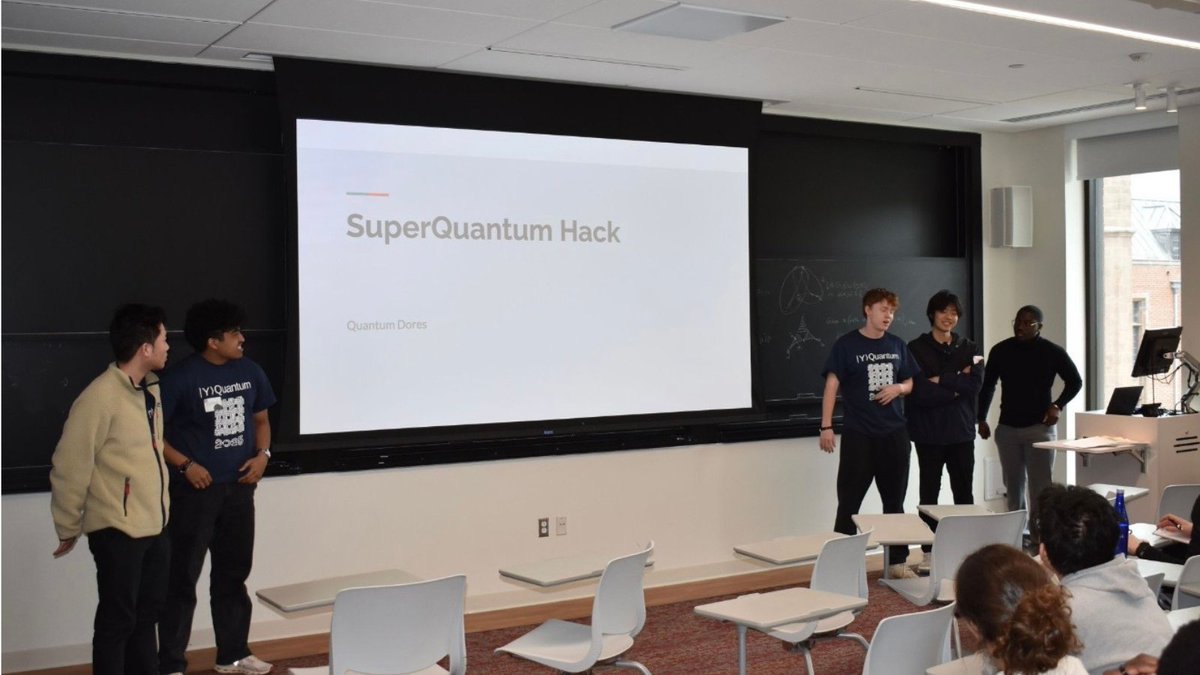
Throwback Friday: YQuantum 2025 at @Yale
At YQuantum 2025, Superquantum launched a hybrid challenge - both in-person at @Yale_QI and virtually for global participants - that asked students to rethink hashing through the lens of quantum computing.
Instead of traditional cryptographic puzzles, our challenge invited participants to design hash functions built on quantum principles.
The idea was simple but ambitious: explore how quantum circuits, especially those with parameterized gates and entanglement, can be used to generate deterministic, hard-to-invert outputs, just like classical hash functions.
Teams experimented with circuit layouts, used simulators, and even threw in some noise modeling to see how robustness might hold up in a real quantum environment.
Some leaned on established structures like quantum walks, while others ventured into more experimental territory, including entangled-state hashing and decoherence-driven randomness.
In the end, the creativity was off the charts.
We saw everything from highly structured hashes to chaotic, probabilistic schemes that still managed to stay verifiable.
The winning submissions balanced quantum complexity with classical verifiability, which is exactly the kind of thinking we hoped to achieve.
Big thanks again to all the students, mentors, and organizers who made this event possible - and congrats to our winning teams - QMers and Casekit!
The energy around quantum hashing was real - and we’re already thinking about what to challenge you with next.
It was good to connect and share expertise with our co-sponsors:
@QueraComputing@BCG@Alice__Bob@QuantumRingsInc@BlueQubitIO@CTquantum@rigetti@UConn@Yale@Yale_Ventures