W @RBDreamer!
A great guy and a world class business partner of mine!! RB is crushing it with investments in @valaratomics, Dream Fund I, and @micro1_ai
RB has made me a lot of money and we have had a lot of fun together: thanks RB!
#POSITIVITY
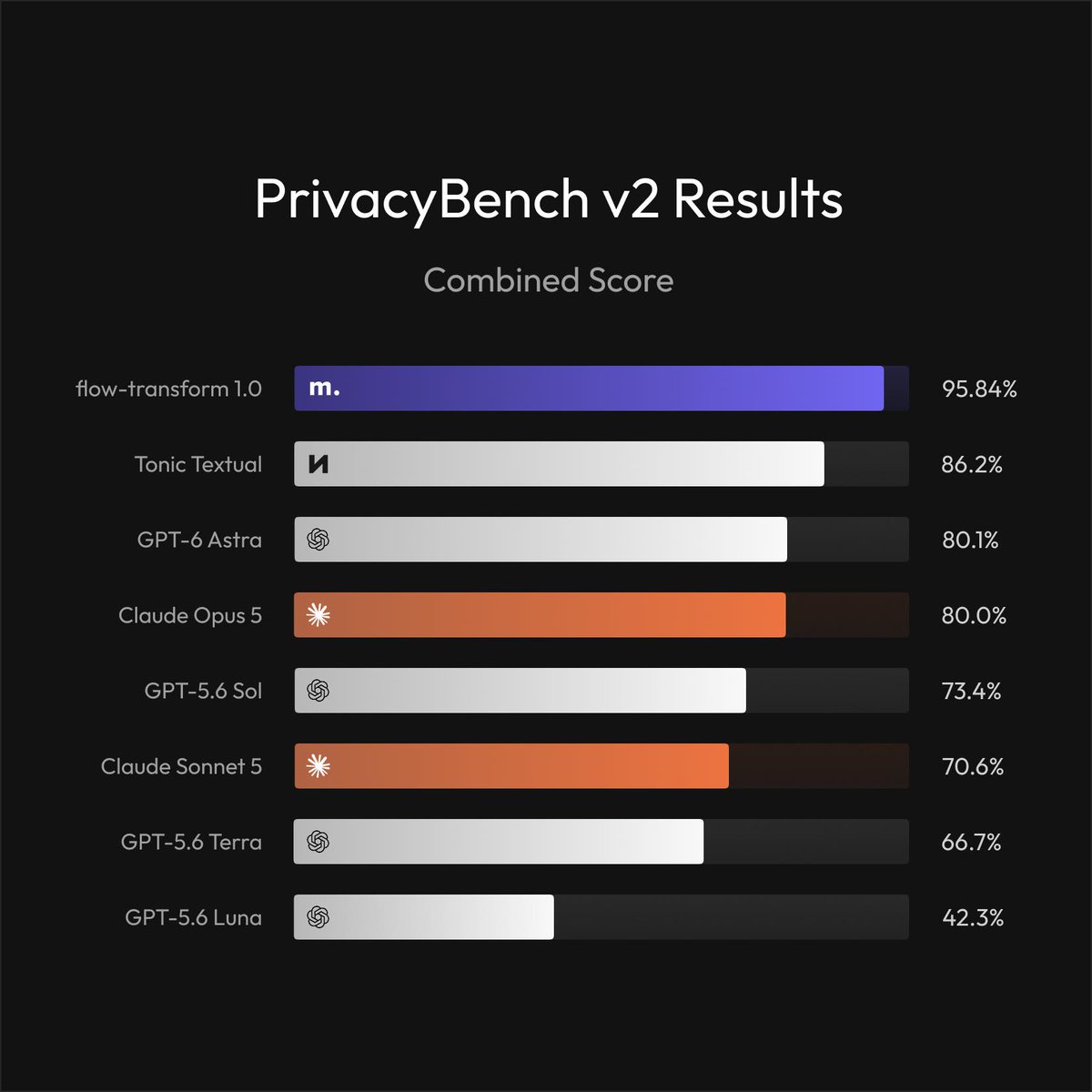
PrivacyBench v2 was recently released, and flow-transform 1.0 by micro1 now leads the expanded benchmark by a wider margin, reaching 95.84% combined detection + synthesis accuracy and finishing 9.64 points ahead of the next-best model.
The latest version expands the benchmark to full synthetic enterprise workspaces with native documents and attachments. Congrats to Tonic on the release.
PrivacyBench v2 is a meaningful step forward, but it still measures only part of the end-to-end transformation problem. In our report, we introduced the Enterprise De-Identification Bench and its Transformation Quality Index (TQI) to measure the final transformed dataset across privacy, utility, fidelity, coverage and coherence.
We believe this is the better way to evaluate enterprise de-identification because a single combined detection + synthesis score can hide important failure modes. It doesn’t account for the severity of what was missed, unnecessary transformations, uneven performance across files, or whether the final dataset remains coherent and usable.
we are opening up our first robotics data lab in Malibu!
in 9 months, our robotics department has grown from 0 to $100m ARR.
this data lab is an effort to accelerate all the progress being made, with an increased focus on evaluating models with hardware.
we are hiring robotics researchers, engineers, and teleoperators.
please reach out if you are interested in training robots at the beach. 🏄♂️
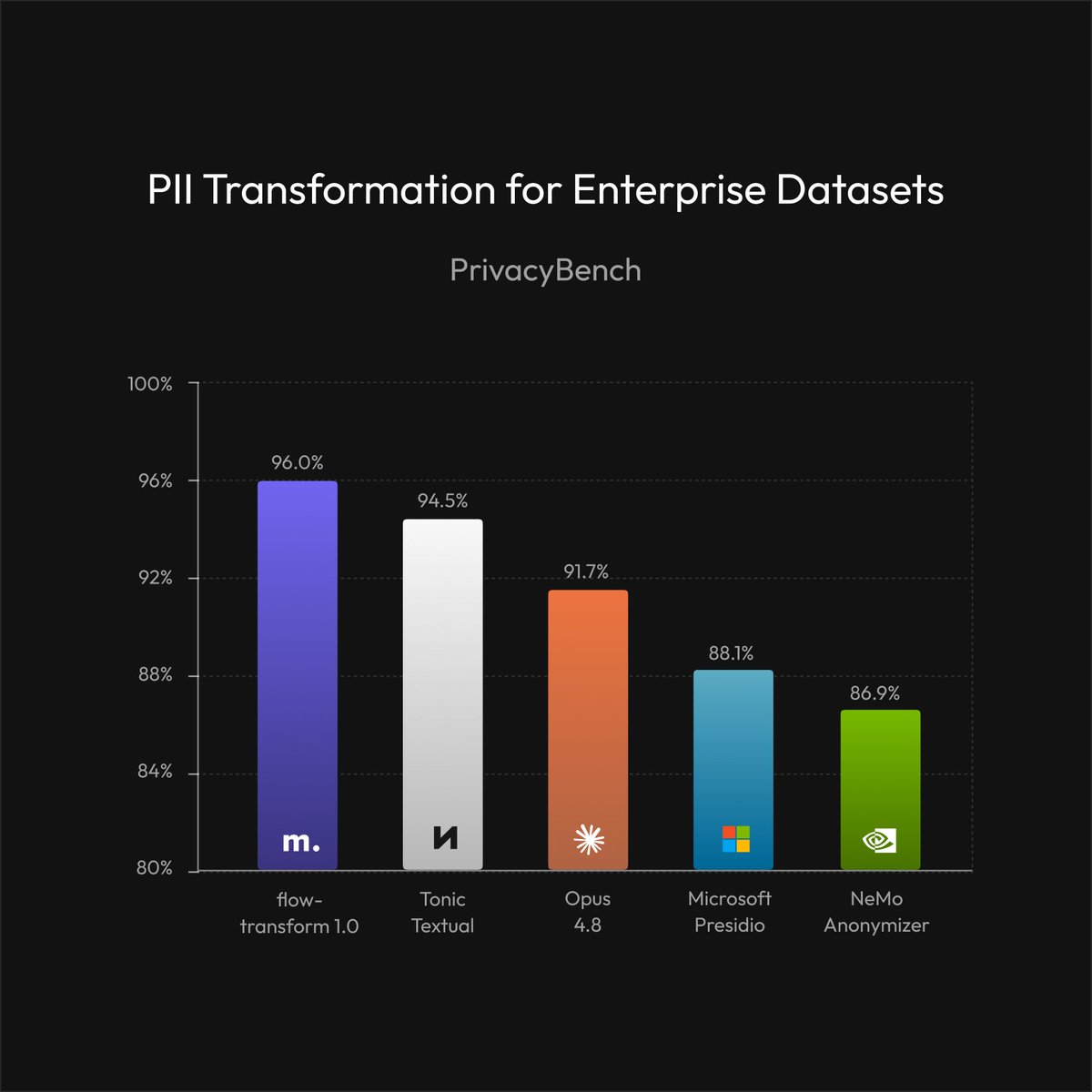
Today we’re launching micro1’s PII transformation model, flow-transform 1.0, delivering frontier-level performance across detection, identity synthesis, and transformation of personally identifiable information.
On PrivacyBench, our model reaches 96.0% F1, outperforming every detection baseline we tested, including Tonic Textual, Claude Opus 4.8, Sonnet 4.6, Microsoft Presidio, Haiku 4.5 and GLiNER2.
Some of the most valuable training data for frontier AI models lives inside fully functioning companies. It captures years of real work across decisions, communications, tools, handoffs, exceptions and the relationships connecting them.
The problem is that this data is also full of PII.
Traditional redaction makes the data safe, but it also destroys the very workflows and relationships frontier models need to learn from.
flow-transform 1.0 solves this by turning enterprise operational data into high-fidelity training data for frontier models by replacing real-world identities without flattening the reality the data captures.
Rainmaker has raised $100M to become the world’s best lab for weather modification and atmospheric science.
Thank you @noavctech@upfrontvc@DCVC@lowercarbon@DreamVenturesVC and other visionary partners.
We are aggressively hiring and scaling our research org to create a flywheel of atmospheric data collection, synthesis, understanding, and intervention.
We will solve the weather and we will set the stage for the terraformation of Earth.
More in my essay below.
TLDR: @CJHandmer wrote two essays proposing plans to save the Colorado River that live rent free in my head. I think I have a better, cheaper, faster solution.
Lake Mead has a storage capacity of 30M acre-feet and is around ~7MAF today
Currently, cloud seeding couldn’t produce 23MAF/yr over the basin, but ~9MAF/yr of new precip is doable today.
Currently, water from cloud seeding ranges ~$50-$1000 per AF depending on frequency of conditions. This is largely a function of how much you can amortize cost of drones/sensors/staff over frequency of conditions and, wrt hardware, useful life: the water is cheaper in wetter years.
Important factor to account for here is the effective vs total precipitation (i.e. not all the snow/rain you bring down will reach Lake Mead before evaporating, percolating into aquifers, or being consumed). Unless you’re inducing precip immediately over a reservoir (which Rainmaker is testing this winter) effective precipitation ranges from ~10-80% in the Colorado River Basin. This increases your cost per acre foot commensurately.
All of that to say, assuming Rainmaker never achieved autonomous operations, improved no atmospheric science, and cut no costs, we could tangibly refill Lake Mead in ~3-4 years for $7.5B/yr.
As our tech improves the cost will lower and yield will increase, a lot.
These are the types of claims that deserve ample skepticism and scrutiny. I am talking a big game. Can Rainmaker and I walk the walk?
Cloud seeding has a history full of nonsense “science” interspersed with flashes of rigor. Sometimes MoDeLeD/SiMuLaTeD “evidence” of cloud seedings effects are directionally-correct-ish. Unfortunately, sometimes those modeled results have been doctored.
Despite all of the groundbreaking research Rainmaker has already and continues to conduct, the reality is:
1) we haven’t published our first peer reviewed paper yet.
2) we haven’t made millions of acre feet of physically measurable precipitation.
It is our responsibility to put our money where our mouth is. We are going to put A LOT of money into increasing the rigor and scale of this tech. We are going to provably produce infrastructure-scale water this winter.
I am writing, in more detail, my proposed alternative plan to Casey Handmer’s.
1 hour left to join the fastest growing Survivor Contest on the planet. @splashsports Survivor World Championship to win $21,000,000 guaranteed. $1k to enter. Still $1.5M of OVERLAY
1 person who RTs + comments week 1 pick on either of my posts will win $1k of credit. link below