Here is the planned book publication order (for now):
1⃣ A RESM Primer: The Master Hierarchy
▫️Detailing the frameworks of the larger cycles and the inter-cycle relationships
▫️The basic principles to know to use RESM Theory: offsets, phase tolerances, concordance windows, etc.
▫️Cycles from the 70-year cycle up to the 5040-year cycle. The 35-year cycle and smaller constituent cycles will be covered in the next book.
▫️Not a historical tome with a 1000+ references; A punchy rundown of the cycles with a few interesting and explanatory examples.
2⃣ The Risk Rhythm: RESM's Foundational 35-Year Cycle
▫️Covering the detailed trajectory of the 35-year cycle with the ~20 phased events within
▫️The smaller constituent cycles
▫️The mathematical foundations of the cycle
▫️Consideration to include the quantitative analysis of the Risk Rhythm going back to 1694.
▫️Price with a Capital P: The extremely important concept of the Risk Rhythm
--> I have been alluding to this sometimes calling it the "risk-on" rhythm or the rhythm of the SP500. It now has a proper name to go with the concept.
3⃣ The Big Parabola: RESM Parabola Theory
▫️The rise and fall of western civilizations over the course of the Age Cycle
▫️How this percolates down to the lower cycles manifesting in market events occurring that have "never happened", via telescoping parabolas
▫️A case to be made that ancient Egypt as a world power has been incorrectly classified.
4⃣ The Variant Cycle and the Researcher Trap
▫️The natural foundations of the cycles and how that creates the circumstances for variant cycles.
▫️Why these variant cycles stop researchers in their tracks, preventing them from seeing the bigger picture.
▫️Introducing nuances of the Deity and Episteme Cycles.
--> This one is still in conceptual development, and may take a long time to properly formulate.
As noted, the first 2 books will not be historical tomes with a 1000s of historical references. I know from experience, reading books like that can feel like a chore. Especially books that are covering a cyclical theory, it can become very repetitive. Instead, detailed accounts of the cycle instances and how they fit the cycle frameworks/phasings will be published via Instance Monographs, likely on a platform like Substack.
All 15 topical cycle frameworks are developed and finalized, from the single-year cycle to the 5040-year cycle. All bolstered with additional research passes, that also revealed some additional cycle dynamics that were not previously known.
Instance Monographing research pipeline finalized (6 agent workflow), complete with:
- Multiple Research passes
- Adversarial Review
- Citation Verification
- Independent Adjudication
- At a glance granular scoring metrics, and phase tables
Next step is to collate the frameworks with additional narrative, supporting, and connecting text. Create companion illustrative figures for the cycles, and finalize an archetypal instance for each cycle to include in the book.
Here is the planned book publication order (for now):
1⃣ A RESM Primer: The Master Hierarchy
▫️Detailing the frameworks of the larger cycles and the inter-cycle relationships
▫️The basic principles to know to use RESM Theory: offsets, phase tolerances, concordance windows, etc.
▫️Cycles from the 70-year cycle up to the 5040-year cycle. The 35-year cycle and smaller constituent cycles will be covered in the next book.
▫️Not a historical tome with a 1000+ references; A punchy rundown of the cycles with a few interesting and explanatory examples.
2⃣ The Risk Rhythm: RESM's Foundational 35-Year Cycle
▫️Covering the detailed trajectory of the 35-year cycle with the ~20 phased events within
▫️The smaller constituent cycles
▫️The mathematical foundations of the cycle
▫️Consideration to include the quantitative analysis of the Risk Rhythm going back to 1694.
▫️Price with a Capital P: The extremely important concept of the Risk Rhythm
--> I have been alluding to this sometimes calling it the "risk-on" rhythm or the rhythm of the SP500. It now has a proper name to go with the concept.
3⃣ The Big Parabola: RESM Parabola Theory
▫️The rise and fall of western civilizations over the course of the Age Cycle
▫️How this percolates down to the lower cycles manifesting in market events occurring that have "never happened", via telescoping parabolas
▫️A case to be made that ancient Egypt as a world power has been incorrectly classified.
4⃣ The Variant Cycle and the Researcher Trap
▫️The natural foundations of the cycles and how that creates the circumstances for variant cycles.
▫️Why these variant cycles stop researchers in their tracks, preventing them from seeing the bigger picture.
▫️Introducing nuances of the Deity and Episteme Cycles.
--> This one is still in conceptual development, and may take a long time to properly formulate.
As noted, the first 2 books will not be historical tomes with a 1000s of historical references. I know from experience, reading books like that can feel like a chore. Especially books that are covering a cyclical theory, it can become very repetitive. Instead, detailed accounts of the cycle instances and how they fit the cycle frameworks/phasings will be published via Instance Monographs, likely on a platform like Substack.
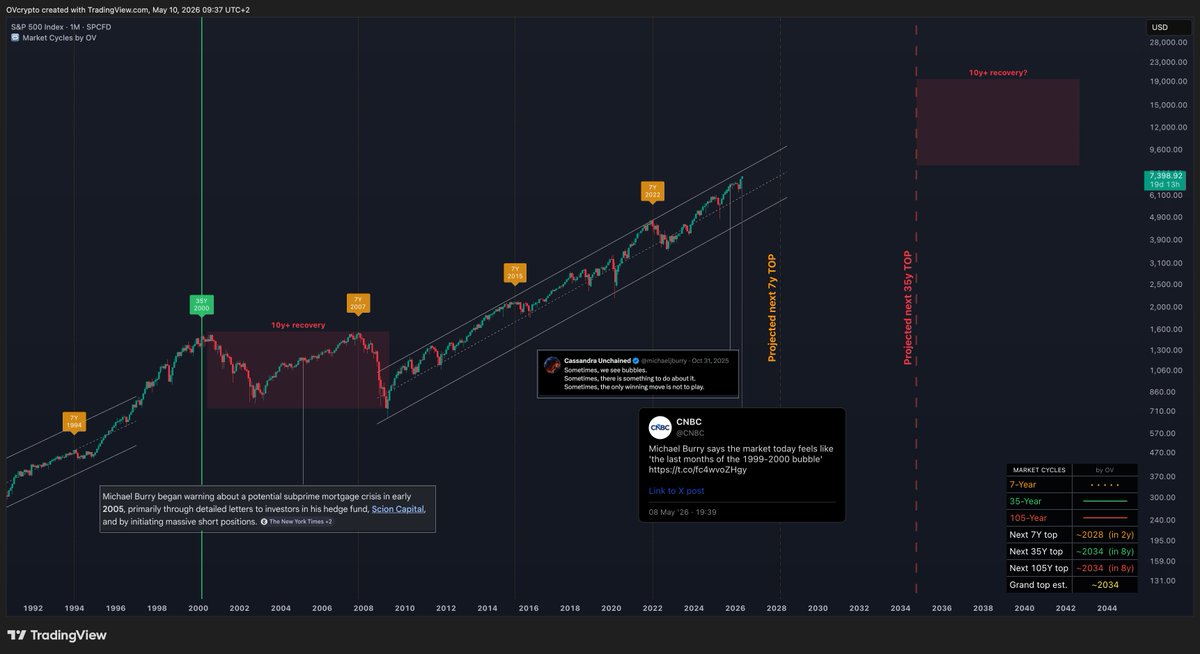
@InvestingAddict We are entering the Productivity Boom phase of the 35-year cycle. After that comes the bubble. This is just the 840-year Big Parabola, doing Big Parabola things.
DXY Monthly and Weekly Cycle
After what appeared to be a break down into a negative cycle, DXY rejected the negative stance at the mid-cycle (which is where it should happen, if it does). The result is typically a basing cycle (consolidation), and thats exactly what we got.
We are now slightly past the window for a weekly cycle low and we are getting signs that we will actually break upwards:
- Bullish Marubozu Candle right on the weekly cycle low timing
- 10 SMA closes
- 10 SMA re-test
- cRSI lower channel touch (not a full reset)
What gives this extra probability to break out of this range to the range above is that we are now in the mid-cycle low timing on the Monthly cycle. The Monthly cycle still shows a negative stance, so the expectation is that this should not break the high of early 2025, but retest some level in the range above, such as a PoC.
The hardest pill for bears to swallow:
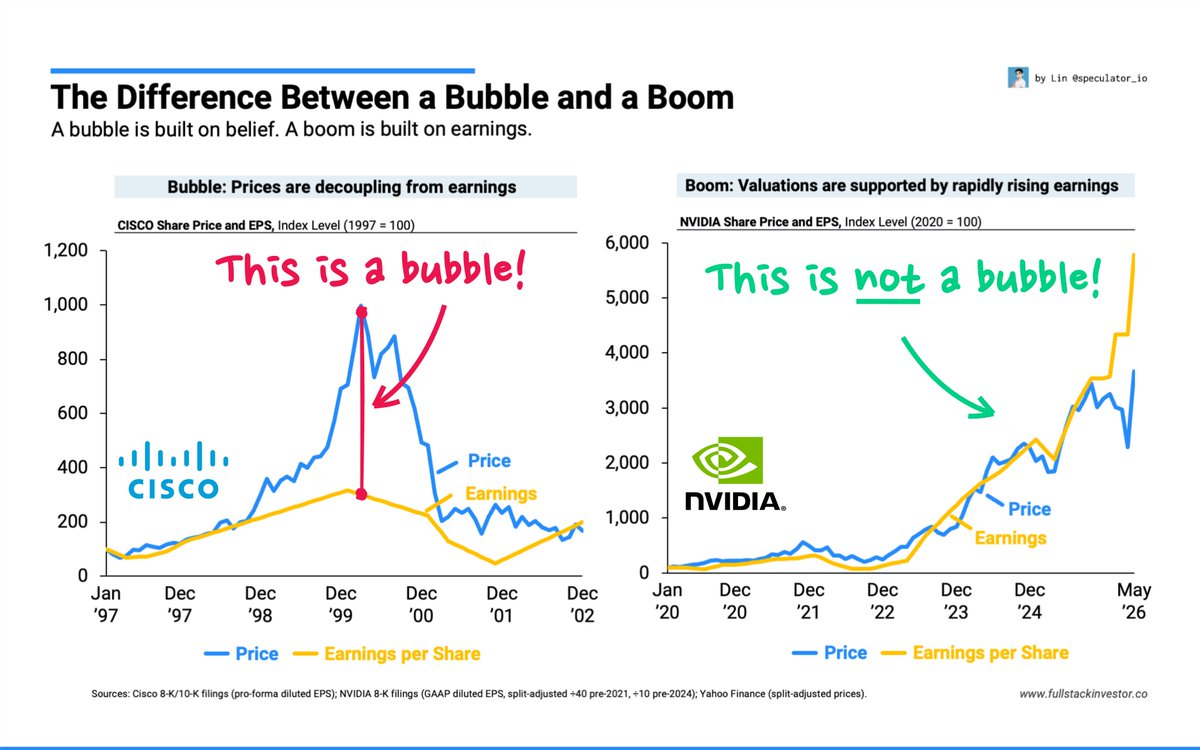
The S&P 500 is up +10.3% YTD, yet the forward P/E has fallen from 22.3x to 21x
This rally hasn’t been driven by speculative multiple expansion
It’s been driven by earnings estimates rising faster than stock prices
Broader market sell-off, i.e. the Risk Rhythm of the S&P 500, should be due in the second half of June and into July into a bottom of the 66-week cycle.
I assume you are talking about Copper (hg?), that will likely get modulated by the Risk Rhythm, but not to the same extent. We are in the early innings of a new ~5 year cycle for Copper.
This type of polarization is what is always seen about the new technologies of the RESM Cycle. Same thing with cars, same thing with the internet, also happened with bitcoin.
AI isn’t inherently good or evil.
It's a tool. Like every tool, the discussion requires nuance. It can educate, innovate, surveil, exploit, and centralize power depending on who controls it and how dependent people become on it.
The poison is in the dose... and the dependency.
@NewLowObserver Thanks for the shout out! Right back at you, always enjoy your historical documentation. Has inspired some new ideas for me several times.
Here is the planned book publication order (for now):
1⃣ A RESM Primer: The Master Hierarchy
▫️Detailing the frameworks of the larger cycles and the inter-cycle relationships
▫️The basic principles to know to use RESM Theory: offsets, phase tolerances, concordance windows, etc.
▫️Cycles from the 70-year cycle up to the 5040-year cycle. The 35-year cycle and smaller constituent cycles will be covered in the next book.
▫️Not a historical tome with a 1000+ references; A punchy rundown of the cycles with a few interesting and explanatory examples.
2⃣ The Risk Rhythm: RESM's Foundational 35-Year Cycle
▫️Covering the detailed trajectory of the 35-year cycle with the ~20 phased events within
▫️The smaller constituent cycles
▫️The mathematical foundations of the cycle
▫️Consideration to include the quantitative analysis of the Risk Rhythm going back to 1694.
▫️Price with a Capital P: The extremely important concept of the Risk Rhythm
--> I have been alluding to this sometimes calling it the "risk-on" rhythm or the rhythm of the SP500. It now has a proper name to go with the concept.
3⃣ The Big Parabola: RESM Parabola Theory
▫️The rise and fall of western civilizations over the course of the Age Cycle
▫️How this percolates down to the lower cycles manifesting in market events occurring that have "never happened", via telescoping parabolas
▫️A case to be made that ancient Egypt as a world power has been incorrectly classified.
4⃣ The Variant Cycle and the Researcher Trap
▫️The natural foundations of the cycles and how that creates the circumstances for variant cycles.
▫️Why these variant cycles stop researchers in their tracks, preventing them from seeing the bigger picture.
▫️Introducing nuances of the Deity and Episteme Cycles.
--> This one is still in conceptual development, and may take a long time to properly formulate.
As noted, the first 2 books will not be historical tomes with a 1000s of historical references. I know from experience, reading books like that can feel like a chore. Especially books that are covering a cyclical theory, it can become very repetitive. Instead, detailed accounts of the cycle instances and how they fit the cycle frameworks/phasings will be published via Instance Monographs, likely on a platform like Substack.
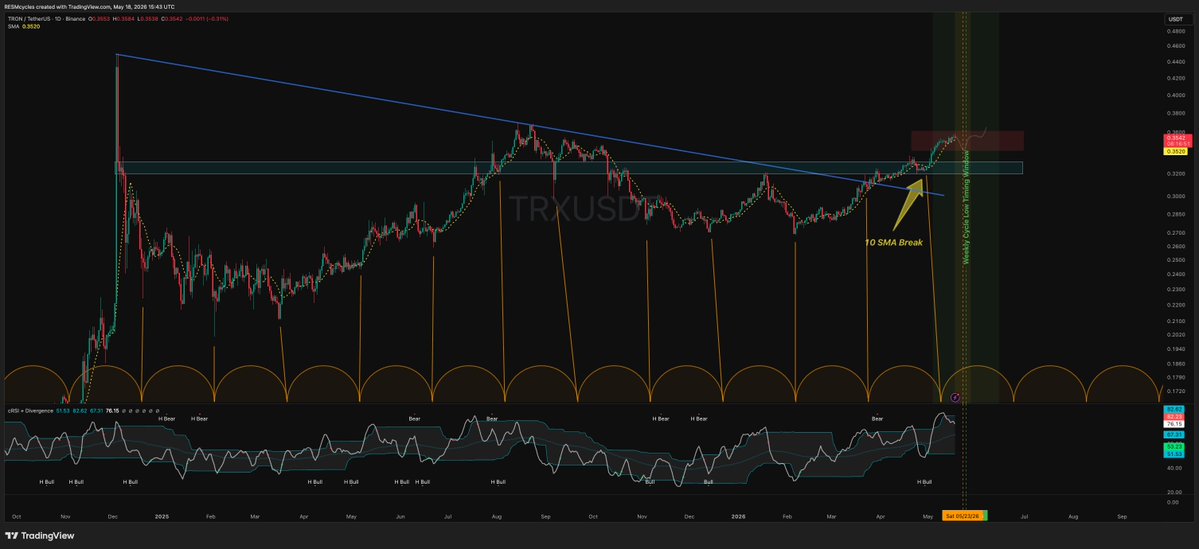
TRON Weekly Cycle
The daily cycle is not giving us any pullback and we are now at the expected on-time weekly cycle low time point.
TRON has been eating through thick resistance zones and now only has a few minor resistances before price discovery. This has the potential to have an outsized move if the weekly cycle is about to give a boost.
TRON Daily Cycle
TRON looks to have made a very early daily cycle low at the end of April, probably to get make in alignment with the weekly cycle low that is due at the end of May.
If we use the new daily low as the measuring point, a mid-cycle low for the daily cycle would like up properly with the expected weekly cycle low timing.
This could be the alignment we are getting.
66-week Cycle in the S&P 500
As anticipated, due to the rubberbanding from the out-of-sequence Iran War drop, it looks like we will be getting our seasonal high in early June instead of May.
r^2 is still at a very high 0.87
@LanceRoberts Its probably worth mentioning that the bubbles you mentioned were either significantly higher % spend for longer, or did not see earnings growth as return of capex spend.
Here's a chart for the bears, though it might not be what they want to see. $SPXU (Short S&P500). It really doesn't pay to be a bear except for brief volatility spikes. Even when market stalls they don't make money.
Anyways, analogs point to further downside for this garbage.
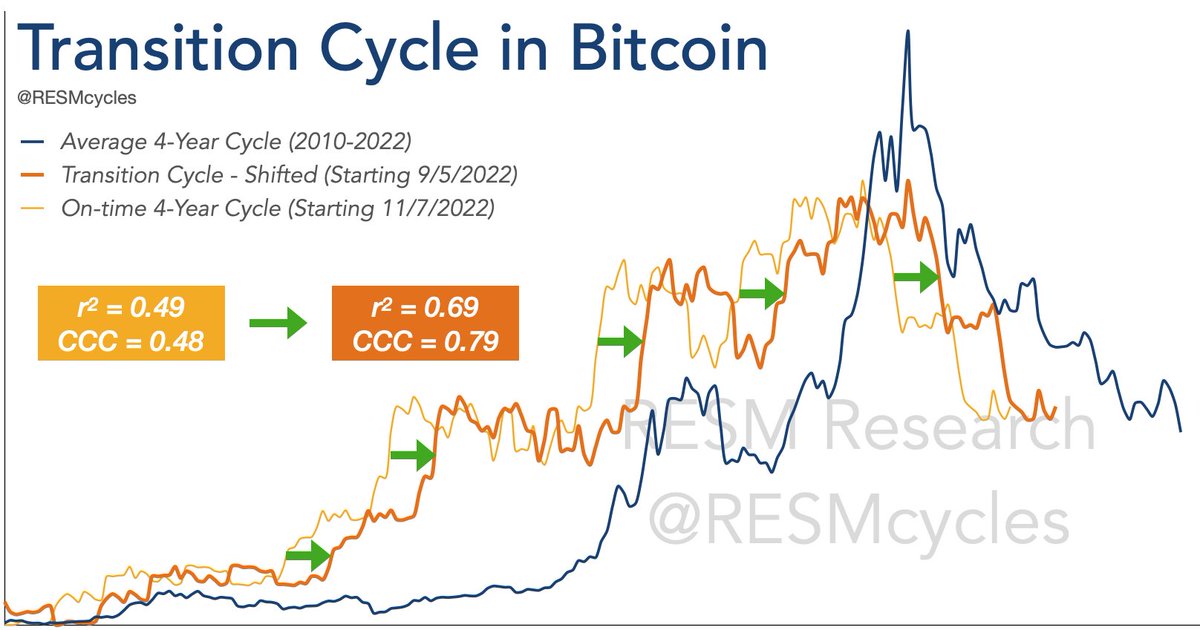
Transition Cycle in Bitcoin
Bitcoin appears to be experiencing what is known as a Transition Cycle in RESM Theory. This happens when a market is undergoing a frequency shift in it's dominant single-digit year cycle.
When this happens, the Transition Cycle's length will be roughly the average of the "old" and "new" frequencies. This has been documented on this account for the changing "business cycle" in US equities for 1896-2022.
In this case, all signs point to Bitcoin taking on the rhythm of the S&P 500, from the daily cycle to the weekly cycle. The current dominant frequency for the S&P 500 is 7 years, with the 2:1 harmonic being 3.5 years, which is what is relevant now. That would mean the this cycle's length will be about: (3.5+4)/2 =
3.75 Years
-or-
~45 Months
This would point to a cycle low in the ~August time frame, measured from the November 2022 low. This lines up well with the expected 66-week cycle low expected in late July for the S&P 500.
Now, the "old" frequencies do not disappear, they just have a lesser impact on price. This is why the 35/36 Year RESM cycle is so powerful. These two numbers have all single digit numbers as factors (except 8), so as the dominant frequencies shift on the lower time frames, the 35 year rhythm persists.
All this to say that we should still expect some modulation of the 4-year cycle on Bitcoin's price in October, but that may not be a new low. It may only be a swift correction/flushout.
bitcoin:native $IBIT
I want to announce that this account will be not be posting any more about the more actionable parts of RESM Theory until I have formerly published the Theory. This pertains to the 12-Year, 35-Year, 105-Year, and Technology Cycles.
I have been seeing some posts on X that are hitting a little too close to home. This may be paranoia. But, I am not going to get railroaded because other accounts have way more followers on X than this account does. This is my life's work, not someone else's engagement bait.
I will still post charts about daily and weekly cycles for major markets. And I will pivot to posting about the very high time frame cycles, as evidence for how powerful this theory is. The biggest cycle in the master hierarchy is 5040 years. We will look at things like epochs, ages, hegemony/fragmentation, and socio-economic paradigms.
Let me know if you think this is an overreaction.