We’re proud to announce our inaugural Advisory Board for the ResearchHub Journal.
Advisors from Stanford, eLife, and Mount Sinai are joining us to help shape the future of scientific publishing.
Meet the board 🧵1/5
“Researchers became content creators for big publishers.”
We spoke to researchers in our community about the peer review industry. Here is what they had to say:
Nature talked about it. And now I believe that @breath_Guy and I are the first to publish in the @ResearchHub@RHubJournal - the future of science!
https://t.co/lkkFrO9qMl
Currently working on revisions for our @ResearchHub preprint & hopefully the 1st publication in @RHubJournal. Peer-reviewers compensated by @ResearchHubF.
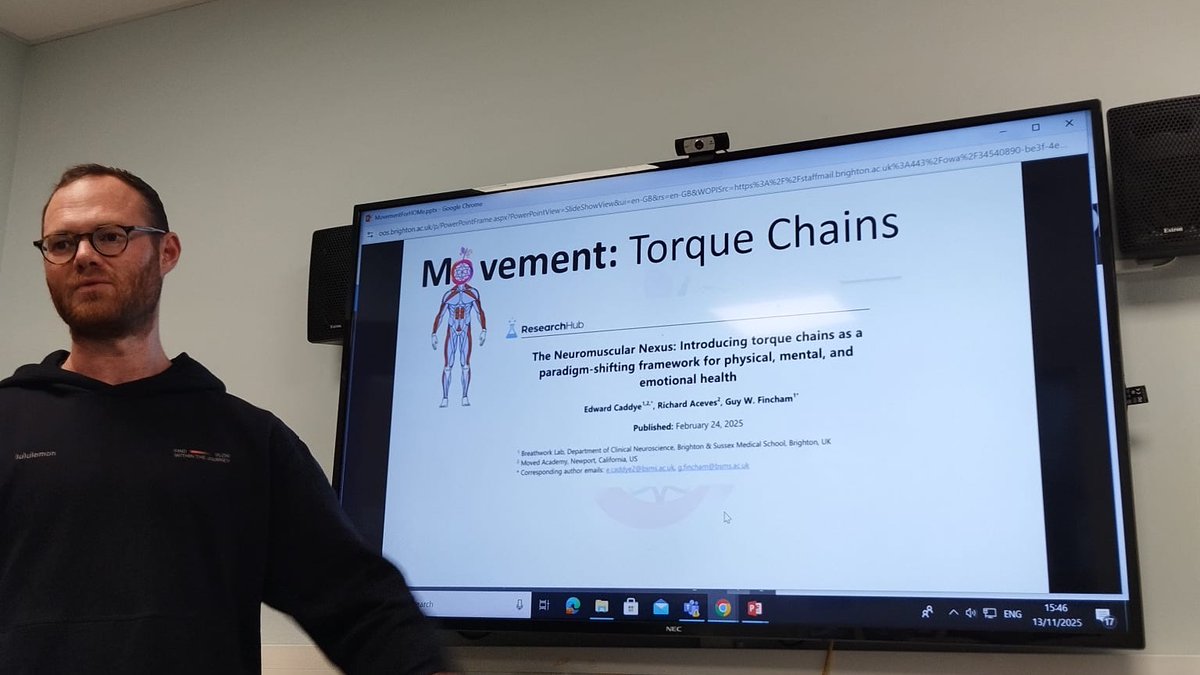
The first-ever submission to the ResearchHub Journal introduces a new hypothesis: neuromuscular "torque chains."
This framework proposes a link between movement, breathing, and nervous system regulation.
Could this reshape our understanding of pain, posture, and emotion? 👇
The Neuromuscular Nexus:
Introducing torque chains as a paradigm-shifting framework for physical, mental, and emotional health
Now on @ResearchHub as a short communication piece (link below to preprint).
Thanks for the @ResearchHub shoutout @MushtaqBilalPhD!
In addition to paying peer reviewers for their time and expertise, the @RHubJournal is accepting submissions for its first issue.
Learn more: https://t.co/gTlgpvH3r6
DeepSeek R1 is making headlines in the news and is being compared to OpenAI's o1. However, many have not read the preprint.
We invite you to evaluate the DeepSeek R1 preprint at @ResearchHub, and reward high-quality contributions with 150$ (in RSC).
https://t.co/6Pcp1ItMsV
Science should belong to scientists, not publishers.
That's why we created the ResearchHub Journal: an open-access platform where authors get rapid, constructive feedback through expert open peer reviews—and reviewers are paid for their work.
https://t.co/9tCLu24gZW
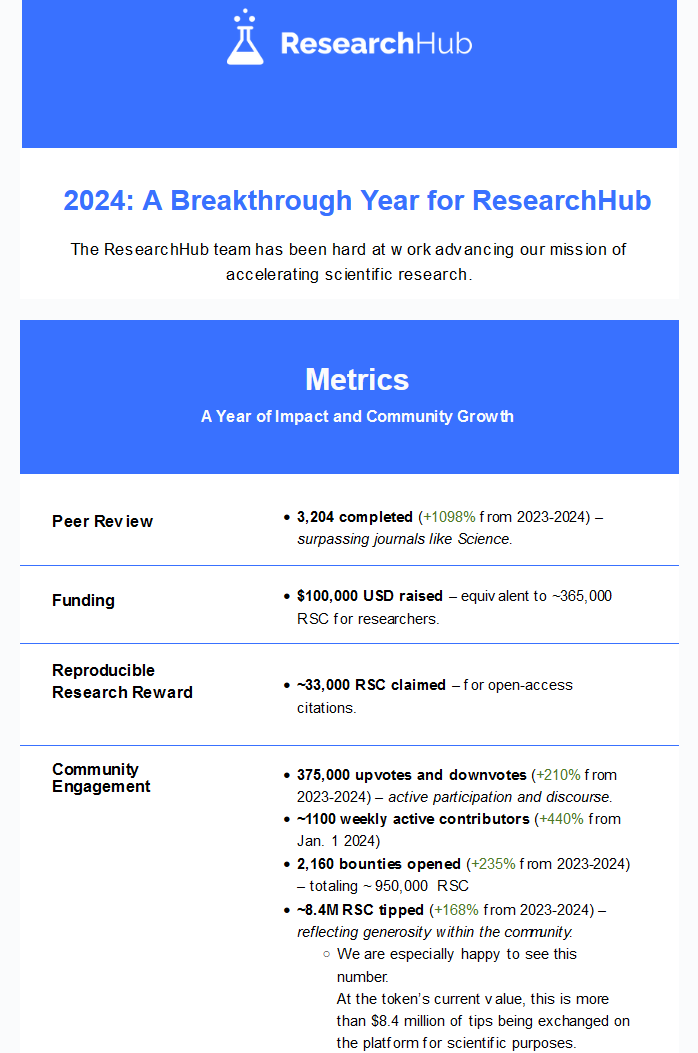
2024: A Breakthrough Year for ResearchHub
Hot off the press and delivered straight to the inboxs of our community members.
Curious about what we accomplished last year & what 2025 holds? Dive into the full newsletter below to find out more. 🧵
Traditional metrics like the journal impact factor often fail to accurately reflect quality and can be influenced by various biases. Our newly launched, open-access @ResearchHub journal adopts the PRC model, while paying peer reviewers. https://t.co/Yh9shySYIL
Science should belong to scientists, not publishers.
That's why we created the ResearchHub Journal: an open-access platform where authors get rapid, constructive feedback through expert open peer reviews—and reviewers are paid for their work.
https://t.co/9tCLu24gZW
I reviewed this interesting preprint for @GigaScience on @ResearchHub
The authors propose a new clustering method for high-dimensional biological data, applicable to flow/mass cytometry, scRNA-seq + multiplex imaging.
Check the preprint + my review:
https://t.co/hj8d9fDU94
Update - 10 | 2024/12/29
We built a demo app to ensure easy use of paper submission and workflow customization. What's next? We will up our game to produce analytics and utility tools for the community. Stay tuned for more updates.
Join the waitlist and be one of the first who can get hands-on with the app and help us do more human evaluations, pushing the boundaries of how Human and AI can accelerate science together.
Link: https://t.co/QkH2An927T
First milestone is up. Let's recap what we have achieved in the past 10 days: We have established a working Multi-Agents Infrastructure for AI Editors and Peer Reviewers driven by various SOTA LLM models. We have scanned through batches of scientific preprints and manuscripts, producing 200+ AI-generated editorial comments, reviewer personas, paper analyses, error identification, and ratings. All data is well recorded through our metadata tracing workflow. Keep an eye on the upcoming dataset release.