Naval put it bluntly: "By the time a stock IPOs, most of the alpha is gone. The adventure is gone. Public market investors are literally last in line."
He's describing a real shift. The median company went public at 6 years old in 1980. Today it's 13.
Seven more years of growth now happen behind a private-market door — before everyday investors are ever allowed in.
Should the best years of a company's growth belong only to the people who were already in the room?
Brian Armstrong is a public-company CEO saying the quiet part out loud: he wants more people to own his stock — so he's pro tokenization.
Meet the customer where they are. Don't alienate the people who want in.
Now apply that same logic to companies before they go public. If more owners is good business for a public company, why is the door still closed while a company is private — when the growth is happening?
Access shouldn't start at the IPO.
As a public company CEO, I'm pro tokenization of our stock for a simple reason: I want more people to own it.
Why would I alienate a potential new category of shareholders? It's just bad business. Meet the customer where they are.
Incredibly excited to welcome Emma Mondolino to @Dealmakertech as our VP, Marketing.
Emma has spent 15+ years helping brands connect with audiences at Twitter, Pinterest, Nextdoor and MediaLink.
At DealMaker, audiences can become owners.
Welcome to the team, Emma.
Customers love their favorite brands. But a lot of the value they create doesn't come back to them.
77% of Americans say customers should be better rewarded for helping a brand grow. That's not a marketing program. That's a capital strategy.
https://t.co/zeOU0L0lZe
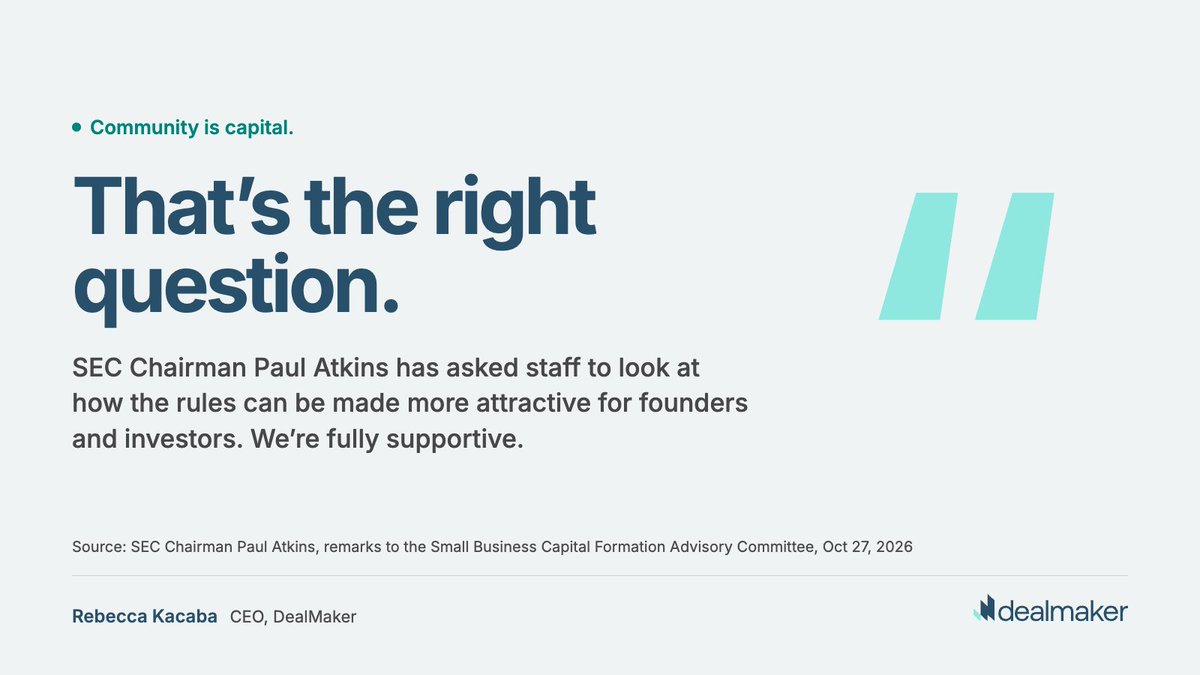
This week, SEC Chairman Paul Atkins asked staff to look at how the rules can be updated to reduce compliance burdens and be more attractive for founders and investors.
That’s the right question, and we’re fully supportive.
Community is capital.
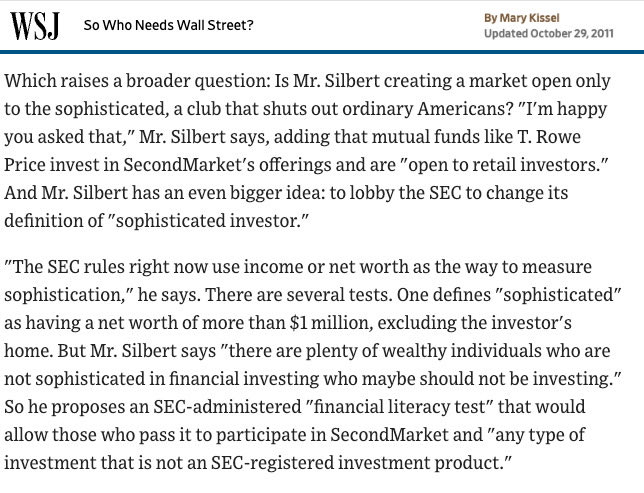
Barry Silbert said this in 2011: access to private markets should be a test, not a bank balance. 15 years later the SEC agrees. The gatekeeping era is ending — knowledge, not net worth, is how everyday investors get in.
Well said @DCGco
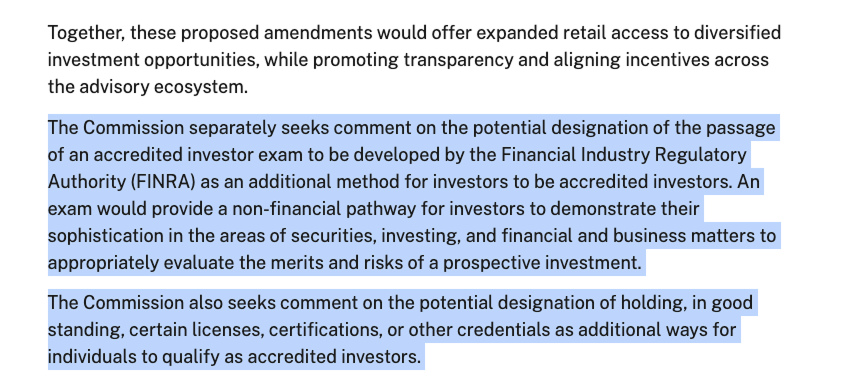
In 2011 @BarrySilbert told @marykissel at WSJ that he thought the SEC should let investors qualify for private markets by passing a test, not via net worth. Last week the SEC proposed exactly that. 15 years later, still a good idea.
Off the Startup Stage at Money20/20 — three VCs, one Axios reporter, one question: should everyday people get access to private markets? Two-thirds of Americans say they're deliberately locked out of the highest-growth investments. agree or disagree?
This is exactly what I'm debating tomorrow at Money20/20 — retail vs VC. Even @brian_armstrong the Coinbase CEO says it: retail has been missing out on private markets for too long.
It’s great to see the SEC proposing merit-based private market access in the US. This will be a huge step forward.
For too long, only the richest people have had access to the private markets. Retail has been missing out.
And over the last few years, companies have been incentivized to stay private longer (so retail has been missing out even more at best, or become exit liquidity at worst).
Future fun Roadster demos will include flying over the Snake River or maybe Grand Canyon and landing on its wheels and exceeding half the speed of sound
Flying cars are real. Retail has been funding this movement on DealMaker for years. But the future isn't just the car.
It's a world where everyday people don't just buy what's next — they own the companies building it.
Own the car. Own the company. Own the future.
Everyday people can invest in the brands they love.
But some founders are having to turn them away. 11 DealMaker raises came so close to the $5M limit that they had to refund investors.
We support @woodien’s petition to raise it to $20M.
Community is capital.
54% of Americans would invest in private companies if given the chance.
71% wouldn't know where to start. 64% didn't know it was legal.
@CathieDWood built ARK Venture to democratize exactly this access.
The access already exists. Nobody told anyone it does.
@profgalloway has argued the Dow and the Nasdaq are effectively a proxy for how the rich are doing.
51% of Americans told us the stock market is no longer the best place to build wealth. Only 14% fully trust financial institutions.
Read those together and it looks less like confusion than a conclusion.
The median company going public in 2024 was 14 years old. In 2000 it was 6.
Most of the compounding now happens before there is a ticker to buy.
I spoke to @Forbes about whether protection and access have to be a trade-off.
https://t.co/u70W4h5W3F
@vladtenev has argued anyone can buy a meme coin while accredited investor rules deem OpenAI and SpaceX too risky for retail.
We asked more than 2,000 Americans. 55% say those rules aren't a fair way to allocate access.
Democrats 52%. Republicans 54%. Independents 56%.
Nothing in this country polls that tight.
You can bet on a prediction market today. You can't invest early in the next OpenAI.
The rules deciding that were written in 1982.
@profgalloway, curious whether that matches what you're hearing from younger investors.
My piece in @Fin_Revolution:
https://t.co/cm9rjodGHX
Most of the industry still treats retail investors as a risk to be managed rather than a resource to be included.
Founders on our platform have raised $2.8B from their own retail base.
@woodien, curious whether that tracks with what you're seeing this year.
My conversation with @thefintechtimes :
https://t.co/DonOQD4apV
@vladtenev keeps making the case that shares in SpaceX, OpenAI and Anthropic shouldn't be reserved for the wealthy. Our survey shows what the public thinks of the alternative.
63% say the trillion-dollar AI IPOs will hand them an inflated price after insiders have taken the gains. And 36% would have bought OpenAI before it went public, if they could have.
They aren't against AI. They want in early rather than at the top.
@profgalloway frames the real divide as owners versus earners. Our new survey shows which generation landed on which side.
Support for letting regular people invest in AI is highest among adults 65 and over, at 78%. Gen Z is the lowest at 55%.
The over-65s hold $85 trillion in assets and 54% of U.S. stocks. Gen Z holds $6 trillion.
The generation that already owns the market wants everyone else in. The one that owns almost none of it has assumed the answer is no.