The main objective of our team is to discover novel therapeutic options for complex disorders with a focus on chronic kidney disease. Our head: @Yousof_Gheisari
Feynman on quantum mechanical nature of Nature
“Nature isn't classical, dammit, and if you want to make a simulation of nature, you'd better make it quantum mechanical, and by golly it's a wonderful problem, because it doesn't look so easy.”
Our online seminar about "CAR T-cell therapy in Nephrology: a paradigm shift"
Presented by Dr. Elina
Link: https://t.co/7D9XUA55Ml
Join us!
@Elina_Kaviani
AI Scientists are starting to actually do science. Not just answer questions. Not just run workflows.
Introducing AutoScientists: a decentralized team of AI agents that can generate hypotheses, design experiments, write code, test ideas, analyze failures, and revise strategy as evidence accumulates.
Because real research is not a to do list of tasks.
It is a living search process. Leads emerge, failures matter, teams form around what works, and priorities shift when evidence changes. Much like how a lab of scientists would work on cutting edge research together.
Across GPT training optimization, biomedical ML, and protein fitness prediction, this decentralized structure consistently does better research.
Learn more 👇
@GaoShanghua@marinkazitnik@KempnerInst@HarvardDBMI@Harvard
😃Honored to share our new collaborative study published in the Journal of Nephrology! 🎓💻
“Comparison of human vs AI-generated feedback: results from an online survey study in the GlomCon glomerular disease fellowship program.”
🔗 Read the full article here: https://t.co/oEkL2xEhNn
What happens when we directly compare AI-generated educational feedback to human-generated feedback in advanced medical training? In this study, we explored how learners perceived both approaches across several critical domains.
💡 Key Findings:
We discovered that AI-generated feedback performed comparably to human-generated feedback across multiple learner-centered outcomes, including:
🔹 Fairness
🔹 Constructiveness
🔹 Supportiveness
🔹 Utility for Improvement
The Big Picture: As generative AI continues to rapidly evolve within nephrology and academic medicine, its role is not to replace human mentorship, but to augment it. Thoughtful evaluation of how AI can enhance education and deliver structured, timely feedback will become increasingly vital in fellowship training.
😃 I am incredibly grateful to collaborate with such an outstanding team at the intersection of nephrology, education, and responsible AI implementation: Niloufar Ebrahimi , Zohreh Gholizadeh Ghozloujeh, Lawrence K. Loo, Pravir Baxi, Zhabiz Solhjou, Arun Rajasekaran, Zainab Obaidi, Arvind Singh, Rica Mae Pitogo, and Sayna Norouzi MD . 🤝✨@n0r0zha@SaynaNorouzi@MayoClinicNeph
🔗 Read the full article here: https://t.co/oEkL2xEhNn
Wisit Cheungpasitporn, MD, FACP, FASN, FAST
Professor of Medicine & Clinician-Scientist, Mayo Clinic
Leading AI Innovation in Kidney Care & Medical Education
#AIinMedicine #MedicalEducation #Nephrology #ArtificialIntelligence #GenerativeAI #GlomCon #DigitalHealth #KidneyEducation #MedEd #KidneyCare #FutureOfMedicine
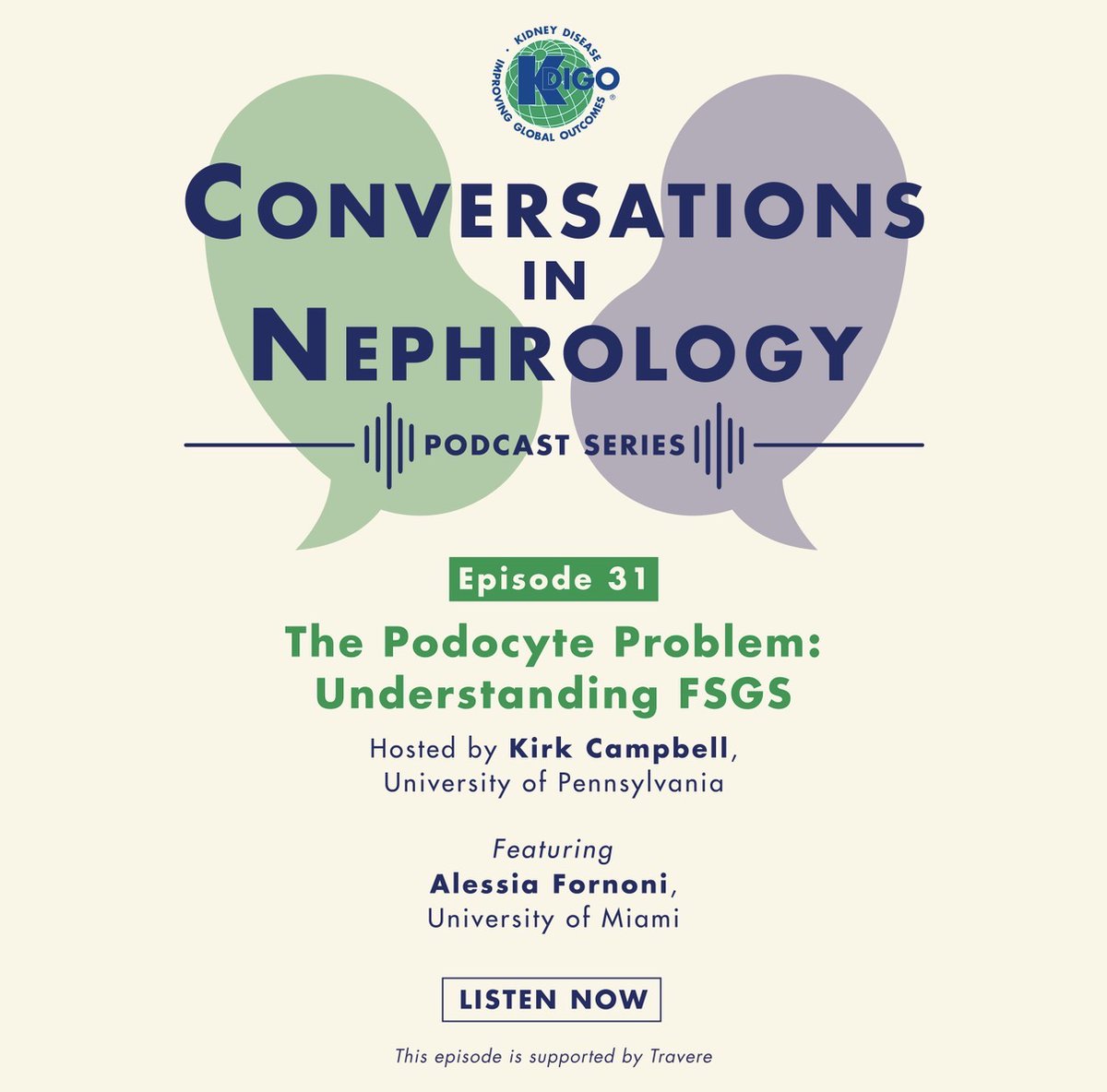
The new KDIGO Conversations in Nephrology FSGS podcast series is here!
Listen on your favorite podcast platform: https://t.co/HKj8cBVBWM
Hosted by @kirkcampbell, this 3-part series explores how advances in podocyte biology, proteinuria management, and targeted therapies are advancing the understanding and management of FSGS.
Conversations include:
• @MiamiAlessia on podocyte injury and disease mechanisms
• Dr. Laura Mariani on proteinuria reduction and the PARASOL initiative
• @jradnephro on emerging therapies and precision medicine in FSGS
A newly released AI tool has generated an atlas of more than one billion predicted protein structures and billions more protein sequences.
https://t.co/nThx75YHL2
“I've had some downturns in my career and various problems, but in fact all those problems turned into something even better."
In our official interview, 2025 physics laureate John Martinis admitted that he's had ups and downs, "But in the end, the thrill of doing science, the thrill of discovery, the thrill of writing a paper or giving a talk for the first time, is just so fantastic. All that is quite worth it.”
Watch our full interview: https://t.co/v0ziMFVZV2
Today was the RMRC annual evaluation visit.
Despite the many challenges along the way, we continue moving forward with confidence, commitment, and belief in our mission. No matter how difficult the path becomes, we will continue building, growing, and contributing to science.
Nature just published the most important paradox in AI and science.
And nobody in the mainstream is talking about it.
The paper is called "Artificial Intelligence Tools Expand Scientists' Impact but Contract Science's Focus." Published January 14, 2026 in Nature. Researchers from Tsinghua University and the University of Chicago analyzed 41.3 million research papers across the natural sciences spanning 1980 to 2025.
The finding fits in one sentence.
Scientists who engage in AI-augmented research publish 3.02 times more papers, receive 4.84 times more citations, and become research project leaders 1.37 years earlier than those who do not.
More papers. More citations. Faster career progression. Every individual metric improves.
And yet.
AI adoption shrinks the collective volume of scientific topics studied by 4.63% and reduces scientist-to-scientist engagement by 22%.
More output. Less diversity. More citations. Less collaboration. More papers. Fewer ideas.
Here is the mechanism the researchers identified.
AI tools are extraordinarily good at accelerating work in established, data-rich domains. They can scrape existing literature, generate hypotheses within known frameworks, and process large datasets in fields where structured data already exists.
Biology. Chemistry. Physics. Computer science.
They are useless or nearly so for pioneering work in data-scarce areas. Emerging fields. Genuinely novel questions. The kind of research that requires human intuition about where the interesting problems are, not pattern-matching against what already exists.
So scientists with AI tools rush toward the data-rich fields. Because that is where AI helps. Because that is where output is fastest. Because that is where citations accumulate.
The questions nobody has studied yet the ones that require human imagination and tolerance for uncertainty get left behind.
The rush to study generative AI is producing a feedback loop of topical and methodological convergence, flattening scientific imagination and crowding out the pluralism needed to keep research adaptive, resilient, and intellectually generative.
A separate companion paper published in Nature the same month made the implication explicit.
AI is rapidly accelerating scientific output but risks narrowing inquiry, weakening judgment, and undermining how scientists are trained.
Here is the most uncomfortable finding of all.
The researchers found that AI adoption reduces collaboration between scientists. When a tool can do what previously required a conversation with a colleague, literature review, data analysis, hypothesis generation, scientists stop having those conversations.
The serendipitous collision of two researchers with different expertise that produces a genuinely novel finding the kind of collision that has produced most of science's biggest breakthroughs, happens less often.
AI made science faster.
And in doing so, it may have made science smaller.
(Paper link in the comments)