Lew has told us for YEARS that his dream is to graze bison under solar panels.
We've been treating this with about as much seriousness as it deserves coming from someone who still needs help tying his own shoes.
But...I've always said, "never say never."
When we first started solar grazing with sheep, we were told it would never work. We started thinking about doing it with cattle. "Doesn't work." And obviously, both have worked out wonderfully for us.
And now here's a project at Standing Rock combining solar energy with buffalo restoration. We're certainly not rushing out to buy a bison herd. But we do have an impressive track record of proving ourselves wrong.
Lead, follow, or get out of the way.
Agrivoltaics is here. And it's only getting bigger.
https://t.co/ZbAli37QAD
For those of you who say "but solar grazing doesn't happen everywhere..."
Yes.
We know.
But it's coming.
@pvmagazineusa interviewed me recently for this piece covering the expansion of agrivoltaics nationwide. Give it a read.
https://t.co/8zVksymBms
Everyone complains that young people don’t get into farming anymore.
“Nobody wants to farm!” “They don’t want to work!”
Have we considered the possibility that there’s a will, but not necessarily a way?
Have we considered the possibility that nobody can afford to farm?
Average pasture rent in the Northeast is $43 per acre. For the 200 acres we graze, that would be $8,600 a year just to rent the ground, to say nothing of the fencing, fertilizer, seed, and other expenses to maintain that ground (or of our other operating expenses, which exist both in the presence and absence of solar panels).
Something that rankles me is when somebody from outside New York State presumes to know the exact economics of my business based on business models elsewhere.
In the West, for instance, ranchers who are grazing federal public lands pay a government-established fee of $1.69 per animal unit per month, which, if we were to extrapolate the math out for our particular operation, would work out to $338 per year.
Now, I understand Western rangeland and Northeast pastures aren’t remotely equivalent. I understand there’s a difference in forage productivity, acreage, infrastructure, and growing seasons. These aren’t apples-to-apples comparisons.
But they’re useful context. Western ranchers can access publicly owned forage through a federal grazing program. Farmers here in New York generally have to negotiate private leases at market rates.
We don’t have a federal grazing allotment waiting for us. We also don’t have the luxury of an affordable real estate market. The national average cost of farmland has risen 123% just in the last 20 years, to say nothing of all the other expenses involved with managing a farm.
Forgive me if I get a little spicy when I’m told, “You’re lazy, you don’t want to work, solar grazing is the easy way out.”
We don’t have the opportunity to graze public lands. We don’t have affordable farmland waiting for us to scoop it up. We have the opportunity to graze privately owned land beneath solar panels and to get paid for managing the vegetation.
Yeah. We’re going to take advantage of that.
Unfortunately, it’s the tale as old as time: everyone wants to save the family farm…until the family farm figures out how to pay the bills.
Full Substack Post: https://t.co/jwRCUnV8Gv
Wow!! Thanks to @foodtank for highlighting "Agri-Energy: Growing Power, Growing Food" as part of their Fall 2026 Reading List.
Truly humbled to have my book included among these outstanding titles below (and grateful for some reading suggestions to get me through this long snowy winter 😉 ).
Looking for your next great read? Food Tank's Fall 2026 Reading List is here, featuring 27 books exploring everything from farming, food justice, and nutrition to culinary traditions, climate change, and the future of our food system.
This season's books remind us that food is about so much more than what we eat. It's about our health, our histories, our communities, and our relationship with the land.
We're excited to highlight these incredible books and authors: 📚 A Practical Farmer’s Journey by Ronald Rosmann; Agri-Energy by Rebekah Pierce; All Hours by Kwame Onwuachi with Joshua David Stein; Banking on Groundwater by William Alley and Rosemarie Alley; Beans, Greens & Lentils by Hari Pulapaka; Black Farm Boys by Bobby J. Smith II, Ph.D.; Black Farmers in America by Mya Price; Captive Consumers by Chin Jou; Cooking Thai by Pim Techamuanvivit with Andrea Nguyen; Depression Cooking by Sonali Menezes; Famine in World History by R. Douglas Hurt; Food Heritage edited by Loic Bienassis and Fabio Parasecoli; Food Is Medicine by Dariush Mozaffarian MD DrPH; Food Sense by Christopher Gardner; Fundamentals of Flavor by Nik Sharma; Foods of La Frontera by Pati Jinich; Happy Snacking, Don’t Die! by Alexis Nikole Nelson; How to Cook Everything Vegan by Mark Bittman; Medicine for All People by Geeta Maker-Clark, MD, ABOIM (she/her); Plant Teachings from My Auntie by C’tasi, Geraldine Manson and Nancy Turner; Reining in the Bulls by Michael Marx; Saved by Seeds by Chris Smith; Seeding Hope by Jack Algiere; Sugar Coated by Marion Nestle and Lisa Sutherland; Sustainable Agriculture in Ukraine by Sergiusz Pimenow, Olena Pimenowa, and Lubov Moldavan; The Ecology of Food edited by Nicolas Bricas, Damien Conaré, and Marie Walser; and Wine Liberated by Adam Huss.
From the science of nutrition to the stories of farmers and the joy of cooking, there's something here for everyone.
Explore all 27 books and find your next read: https://t.co/WOdpg7M4Al
Whenever I post pictures or videos of the cows grazing solar, we are told, with absolute confidence, that cattle CANNOT graze on solar farms.
It’s a real headscratcher for me, since we have, in fact, been doing just that. But we’re obviously wrong. Because obviously the cattle WILL destroy the panels, they WILL rip out the wires, they WILL knock over the equipment, and probably dismantle the entire electrical grid and plunge the Eastern Seaboard into darkness while they’re at it. One cow gets a little unruly and we’ve got Mad Max with a little more manure.
Now, here’s the thing: as is the case with all dumb comments, there is a little bit of truth there: some cows WOULD do all those things.
If you unload a trailer full of cattle that have never seen an electric fence, that aren’t used to being around humans, into a solar array, if you turn them loose and just hope for the best…yeah. You might have a few problems.
Which is why we don’t do that.
We train our cattle to respect hot wire. We introduce them to fencing in controlled environments, on our pastures back home. We consider their temperament, as well as their stocking density and grazing rotations, with attention to their surroundings.
We don’t open the barn door, slap Tina on the ass, and tell her to get out there and enjoy that good clean American energy.
It’s called livestock management. And I know this may come as a shock, but different farms can manage the same species of livestock with wildly different results. A cow that has never respected a fence could very well make a mess of a solar array. But a cow like Tina here, who has been properly trained and managed, can graze without incident.
Does it mean there’s no risk? Of course not. Cattle are large animals with the occasional decision-making ability of a shopping cart with a broken wheel. But that’s why we manage them. We monitor them. We adjust our behaviors accordingly.
Humans have spent generations figuring out how to graze cattle around roads, buildings, expensive equipment, and other things we’d rather they didn’t destroy.
Just because YOUR cows might destroy everything doesn’t mean OURS will. Your management is not my management, Linda.
And respectfully, we don’t need a 47-comment explanation of what your cousin’s neighbor’s sister’s bull did to a gate in 1998 to understand how cattle behave. We can see it for ourselves.
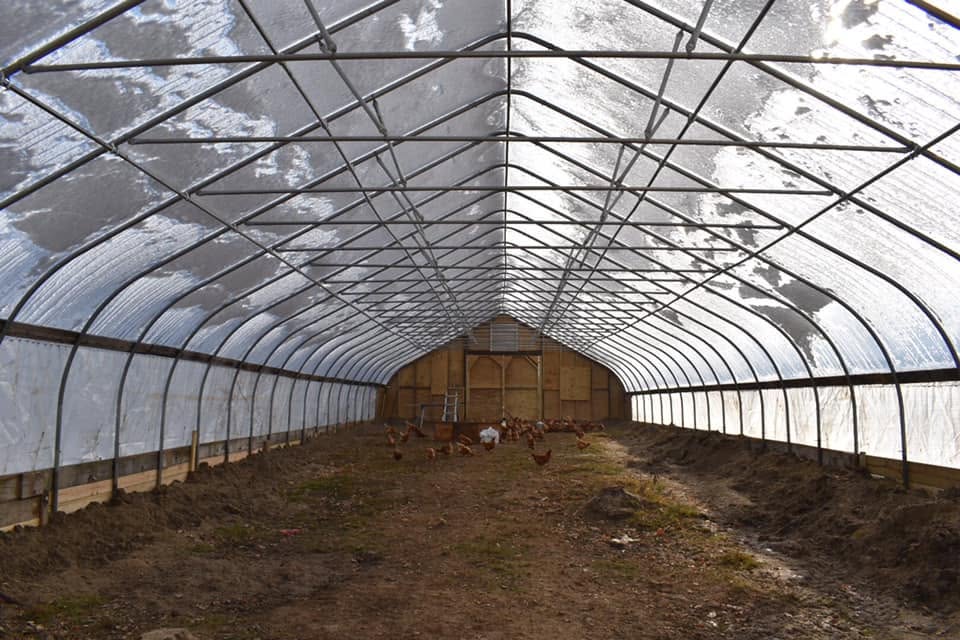
Throwback Thursday to the time in 2019 we decided we should purchase, disassemble, and reassemble an entire 30x96 hoop barn ourselves. 😬
When we first started the farm, we scraped by with smaller homemade barns and huts for farrowing and lambing. But once we started to expand, we had to build out, and a stick-built barn of this size just was not in the budget (still isn’t).
Luckily, some friends of ours were getting out of the greenhouse business and sold one of their old hoophouses to us at a great price, provided that we take it down and move it ourselves.
About five months of work later (some of the progression is evident in these photos), and we had a structure that has gotten ample use ever since, first for our small flock of Icelandics and laying hens (and an ill-fated experiment in growing tomatoes, more on that another day), and now as a dedicated lambing barn for roughly half of our ewes.
The ewes come home from solar grazing in the fall and spend the winter here, with additional access to fenced-in pasture on the home farm. They lamb in the barn (which stays nice and warm despite not being heated) and then head back out to graze in late April.
I’ve been informed, many times, that because we graze sheep on solar farms, we’re “suckling at the government teat.” (Those are my words. Usually the accusations aren’t quite as flowery, but do contain more expletives than I’ve ever seen written on a bathroom wall basically anywhere).
So here’s how our business works: a private solar company needs vegetation managed. We own sheep, carry insurance, have the equipment, and provide that service. The company pays us.
“bUt tHe SoLAr CoMPany gEtS tAx CRediTs!!”
Yep. Well aware. This is usually tied to the accusation that we, as the hired graziers, are freeloading off the taxpayer’s dime.
But let’s play that logic out.
Does that mean that, if you buy feed for your chickens at Tractor Supply, the corn in which was grown using federally subsidized crop insurance…that YOU are a freeloader?
Does that mean an electrician hired to wire a warehouse is inherently corrupt because the manufacturer paying them receives tax incentives?
What about the contractor hired to construct a commercial building for a company that received an economic development grant?
Or the truck driver utilizing public roads to deliver the materials needed for all the above?
How many degrees of separation from a tax incentive are required before someone is allowed to earn an honest living?
I don’t have the time or interest in investigating the tax records of every single person or company I have a financial transaction with during the course of the day. That’s exhausting. I don’t want to have to do a full “Law & Order" investigation every time somebody pays an invoice. (Special Victims Unit: Tax Credit Edition).
And I’m not campaigning to preserve solar subsidies. If policymakers decide to take them away, so be it. But the same logic should be applied to every other industry. We need to have consistency in these conversations.
Apparently, it's only an honest day's work if you can trace every dollar back through the economy and confirm that nobody, anywhere, ever received a government benefit.
Good luck with that.
Full breakdown of my thoughts (read it before ya bitch, please) here: https://t.co/jwRCUnV8Gv
A good faith discussion generally includes sources. I recognize I'm not entitled to anything. But my "interpretations of data" were fact checked by a team of editors, and that data is 30+ pages of peer reviewed articles, as cited in my book. https://t.co/TaBgTguC0X. I can cite my sources. I'm happy to do so. I haven't seen that from you yet, and while I recognize I'm not entitled to that, you're also not entitled to speak poorly of people you don't know and who have actually made a good faith effort to do the research.
Over the last few days, I’ve seen a lot of posts about John Rich coming to Upstate New York to help protect and defend “our farmland” from solar development.
And I think that’s wonderful news.
Because, surely, that means we’ve collectively decided to start helping farmers pay their property taxes, mortgages, equipment loans, insurance premiums, and all the other expenses required to keep “our farmland” in production.
Right?
There’s so much irony in this “movement.” There’s the irony that those rallying about the “environmental degradation” wrought by solar have absolutely nothing to say about the proven damages of continued fossil fuel use. Or those who complain about the aesthetics are quite mum about the appearance of a nuclear plant, coal mine, or natural gas refinery.
Or, perhaps one of the more entertaining, watching people who warn ominously of a looming “socialist takeover” of agriculture while simultaneously referring to privately owned farmland as though it belongs to the general public. Have we forgotten what socialism truly is?
In New York State, and elsewhere (the exception being solar development on public lands, which does not occur here and largely exists in the West, and is something I've already voiced my opposition to), solar developers can’t just show up, declare eminent domain, and start planting solar panels in someone’s hayfield. Even large-scale solar projects that go before the Office of Renewable Energy Siting must start with agreements from willing landowners.
In New York, no farmland is put into solar without the farmer’s sign-off. There is no exception to that rule. Not a single one.
So…are we suggesting that farmers are incapable of making informed decisions about their own property? That we’re a bunch of gullible country bumpkins who can’t read our own contracts? That we aren’t capable of consulting our own legal counsel with questions, of understanding the financial implications of a solar lease, or figuring out what’s the best choice for our land and families?
Are we planning to pass the hat around to pay for attorneys who can help farmers review those contracts? Because if you’re really, truly worried that we’re too dumb to make these decisions, by all means: I think a dedicated fund for legal counsel would be an excellent use of everyone’s time, money, and energy.
Truly, I’m glad that we all have this sudden, passionate interest in protecting farmers’ financial interests. I just wish that enthusiasm extended beyond TikTok and into real life.
I’m tired. I’m tired of listening to people rant and rave, people who have never had to sweat out the terms of an operating loan, or subsist on just four hours of sleep a night for months during lambing or calving or sugaring, or worry about how they’ll make the mortgage payment when milk prices continue to tank.
I’m tired of being called “a sellout” by people who have made themselves guardians of somebody else’s acreage while continuing to get their food not from farm stands and CSAs but from Walmart and DoorDash. I am tired of the complete and utter cognitive dissonance.
Look. If we want to advocate for farmers, or even for farmland, that’s great. But we sure as hell aren’t going about it the right way. The way to do it is not by saying, “Hey, have you considered making less money so I don’t have to look at solar panels?”
You want to support a farmer? Be willing to pay what food actually costs, not what the government says it costs. Be willing to trust farmers when they say they know what’s best for their land. Stop treating us like unpaid caretakers of the rural scenery you enjoy driving past.
And spare me the lectures about solar subsidies. Especially when those lectures come from content creators who are perfectly comfortable using taxpayer-funded agricultural grants to finance their “self-sufficient” barns with in-floor heating that they did not build themselves and have never been used to grow a single ounce of food to be sold to the public.
I’m all for protecting farmland. But I care a hell of a lot more about the farmers who own it.
Not every square inch of farmland needs to be put into solar. I’ve never argued that it should. I HAVE argued that these decisions need to be made by actual working farmers, not neighbors, not politicians, and certainly not social media influencers playacting as changemakers.
Farmland doesn’t remain in production through manufactured Facebook outrage, celebrity appearances, or inspirational speeches about how valuable American farmland is.
It stays in agriculture when somebody can afford to continue farming it.
We recently began the long process of moving the stock home for the winter.
One of the more common questions we get is what our operations look like when the grazing season is over. Sometimes, this is paired with a bit of derision that really serves no purpose beyond just highlighting an ignorance of what ranching is like in the Northeast; there’s an underlying “gotcha!” when we “admit” that we do bring our animals home for the winter and don’t keep them grazing solar sites year-round.
This may come as a surprise to some, but grass does not grow in January in Clinton County, NY, when there’s as much as two or three feet of snow on the ground.
Now, sheep are actually pretty good at finding forage beneath a little snow - they will paw and nose around to find any residual vegetation under a few inches. We do frequently stockpile graze sites later into the year as long as the growing conditions cooperate (a few feet is a different story).
This year, our management plan and the early season frosts we got just didn’t allow for much leftover grazing. So we’re bringing them back home, where we will finish grazing out any of the forage left on our home pastures and then hay-feed until the spring green-up.
The other reason we bring animals home for the winter, besides the weather, is lambing. While we know many producers who lamb on pasture; we prefer not to do it. It would add an extra management layer for us, and we prefer to keep them close by during this season in case problems come up. With several hundred lambs expected this year, having to drive offsite to tend to the flock would be incredibly cumbersome.
Plus, selfishly, I really like popping out to the barn for lamb snuggles and snoot-boops whenever I want.
While the rest of the garden now looks like a crime scene (RIP to my tomatoes and squashes, which took a final killing frost last weekend), the raspberries are in their Michael Myers era. Every time I think they’re finally dead, I turn around and…there they are again.
We’ve been harvesting several quarts, several times a week, since early summer, with only a brief hiatus when things were super hot.
Even though we’re now approaching Halloween and we’ve had several nights of freezing temperatures, these babies are holding on (so, too, are the bees; I learned the hard way a few weeks ago not to stick my hand blindly into a cluster of berries 😬).
Anyway - send me your raspberry recipes! I’m running out of ideas faster than we’re running out of berries.
We’ve discovered a serious problem with our solar grazing operation.
Despite the Internet’s repeated assurances that “nothing grows beneath solar panels,” our sheep have been violating the laws of photosynthesis, agriculture, and the rabid Facebook comment sections all summer long.
Each fall, we measure our rams to get an idea of who to retain for breeding, who to send to market, and to get a benchmark of our management that will guide our decisions in the upcoming year.
This year, we averaged 0.41 pounds per day across our ram group. For reference, Penn State and Washington State extensions cite typical pasture-raised lamb gains of 0.25 to 0.35 pounds per day.
Not bad for animals who are supposedly grazing their way through the tenth circle of Dante’s Inferno.
The lion’s share of the credit goes to Josh for excellent grazing management, but shade and rotation each played a big role here, too.
I explained more of the science of forage quality beneath solar panels in my latest Substack, complete with research, citations, and receipts. It's linked in the comments, so give it a read before you throw shade yourself. Our sheep have already made better use of it, anyway. 😎
https://t.co/LLLZjUUpSh?
@can3630894 Sure. But I also said transmission and generation are two different things governed by two different sets of laws. I did specify I was in NY, but that distinction remains the same.
Who pays to clean up a solar farm when it shuts down?
Ah, yes. One of my favorite questions, one I’m asked several times per post, in comments that smugly assert confidence without expressing a single ounce of critical thinking.
Now, here’s something that might come as a shock: we have regulations for this. Strict ones.
Let’s talk specifically about New York, since that’s where I’m writing from, but keep in mind that almost every other state has similar-looking regulations as far as solar decommissioning goes.
(Yes, I’ve researched it. I wrote a book on agrivoltaics and believe it or not, traditional publishers prefer manuscripts with cited sources instead of 200+ pages of “trust me, bro, I know a guy.”).
Back to New York.
Here, large solar projects permitted through the state are required to have decommissioning plans AND financial security to pay for equipment removal and land restoration. The financial guarantee is calculated using estimated cleanup costs, plus a 15% contingency, minus projected salvage value. The financial security must remain in place until the project is fully decommissioned.
Now, before you darlings start furiously typing your “gotchas,” NO, that doesn’t mean every solar installation automatically has a decommissioning bond. Projects under 25 MW are permitted locally, so towns can (and typically do) require their own decommissioning plans and financial guarantees. Requirements vary by municipality, and some are stronger than others.
Should every commercial solar farm have an enforceable cleanup plan backed by adequate financial security? Absolutely, yes. Should those guarantees be reviewed periodically to account for changing costs? Also yes.
Look at me! Acknowledging that regulations can be improved without pretending the entire industry operates under the honor system. (There’s that critical thinking at work, folks!).
So let’s talk numbers. NYSERDA examined more than 100 New York solar decommissioning cost estimates produced between 2021 and 2024. The average was approximately $50,000 per megawatt in 2024 dollars, before contingencies and salvage value.
For perspective, that's roughly $5 MILLION in estimated cleanup costs for a hypothetical 100 MW project. The actual amount of financial security required depends on the project's specific estimates, contingencies and salvage value.
And providing that financial security is the developer’s responsibility, tied to the project, and meant to protect communities if the developer fails to fulfill its cleanup obligations.
While we're expressing such enthusiastic concern about who pays to clean up energy infrastructure, I'd love to discuss something else.
In November 2021, the federal government authorized $4.7 billion to address orphaned oil and gas wells and another $11.3 billion for abandoned coal mine reclamation.
That's $16 BILLION in federal funding allocated to address legacy pollution from energy infrastructure, including sites where the original operators are no longer available to pay for cleanup.
And yes, the coal industry contributes to certain reclamation funds, and modern fossil fuel operations have their own cleanup requirements. Still, the historical cleanup bill is substantial enough that we're still committing billions in public funding to address it to this day.
Somehow, though, I can post a picture of a sheep or cow standing under a solar panel and immediately get interrogated about who’s going to clean everything up in 30 years.
Listen, I’m delighted we’ve discovered environmental accountability. I’m a huge fan.
But perhaps we could find the same enthusiasm for addressing the environmental damage we're already spending billions to clean up, rather than reserving all our outrage for a hypothetical solar farm that hasn't even been decommissioned yet.
I'm all for holding energy companies accountable. ALL of them.
Apparently, environmental accountability is controversial when you apply it equally. I'll update my invoice for my Big Solar Shilling accordingly.
I'm frequently informed that grazing sheep on solar farms isn't real agriculture because our sheep are supposedly “just lawnmowers,” and we're not producing an actual agricultural product.
Somebody better tell Meb, one of our herd sires.
He's currently working VERY hard to increase agricultural production, apparently unaware that he's supposed to just be mowing the lawn.
Enthusiastically, actually. Wildly inappropriate levels of enthusiasm.
He's attempting to turn every available lawnmower into approximately 1.5 lawnmowers.
The man has a business plan. Please respect it.
And I gotta say, his work ethic is inspiring. HR has, however, received several complaints from the ewes.
I’m still not convinced we are talking about the same thing. In most states transmission has eminent domain, not solar (or any other energy generation source). Transmission is required for all energy - but I agree that what you’re describing is a problem. It’s just not the same thing I’m talking about here.