Everyone should be able to access high-quality financial assets, wherever they live.
That's what tokenization unlocks: taking the best of US capital markets and making them available on a global scale.
The industry is still small compared with global finance, but the advantages are becoming harder to ignore. Traditional market infrastructure was built around fixed hours, closed networks and layers of intermediaries. It was never designed for 24/7 execution, programmable assets, composability or self-custody.
The needs of investors have moved faster than the rails underneath them. We're working to change that.
What gives me confidence is seeing how many different people are now pushing this industry forward. Founders are building new products, LPs are bringing liquidity, traders are finding new uses, and infrastructure teams are making the whole thing work.
It's a privilege to be in the trenches with all of you.
We are still early, and there is a huge amount left to build. It will also take time and effort for the old guard to get onboard. This is worth fighting for.
Jeonbuk Bank is the first regional bank in Korea to deploy Ripple Payments, replacing multi-day SWIFT transfers with near real-time, 24/7 cross-border settlement for its business customers. Our third Korean partnership this year, after Kyobo Life Insurance and Kbank, partnering on custody, wallet infrastructure and payments.
Korea’s leading financial institutions are building with Ripple: https://t.co/oSW94lTJ85
Since no one was keen on answering this question, I've took it upon myself to build a PUBLIC Dune query which uses FOMO's fee router in order to calculate the total profitability of all active FOMO traders (SOL) in the past 90 days.
The numbers:
> Out of the 292,531 wallets traded through FOMO in the last 90 days, 18,033 of them are in profit.
> Only 6.16% of ALL traders in the last 3 months were profitable.
The median trader is down ~$120. As a group they are down $1.26 BILLION. Of the 6% who are green, 88% made under $100. Only 25 out of 292,531 wallets made more than $10K
Query is public and linked below:
https://t.co/sClpsUG8wo
For reference, a "wagering platform" such as Rainbet with a 1% house edge sits at ~37% user profitability over the same time span.
.@AndrewYNg on @NoPriorsPod: "What used to take 6 engineers 3 months, can now be built in a weekend."
The startup bottleneck has flipped:
✅ Engineering: Faster + cheaper
❌ Product management: Still relies on gut + customer empathy
Crypto is becoming increasingly connected with existing businesses and it’s a good thing.
Every few weeks we see an example where crypto expands possibilities for existing businesses.
1. Either in the form of boosting the bottom line by saving costs or bringing additional revenue
2. Or by expanding TAM by letting companies reach new customers
AZ-COM Maruwa Holdings, a Japanese logistics company, buying a stake into JPY stablecoin issuer was an example of how crypto is merging with traditional businesses.
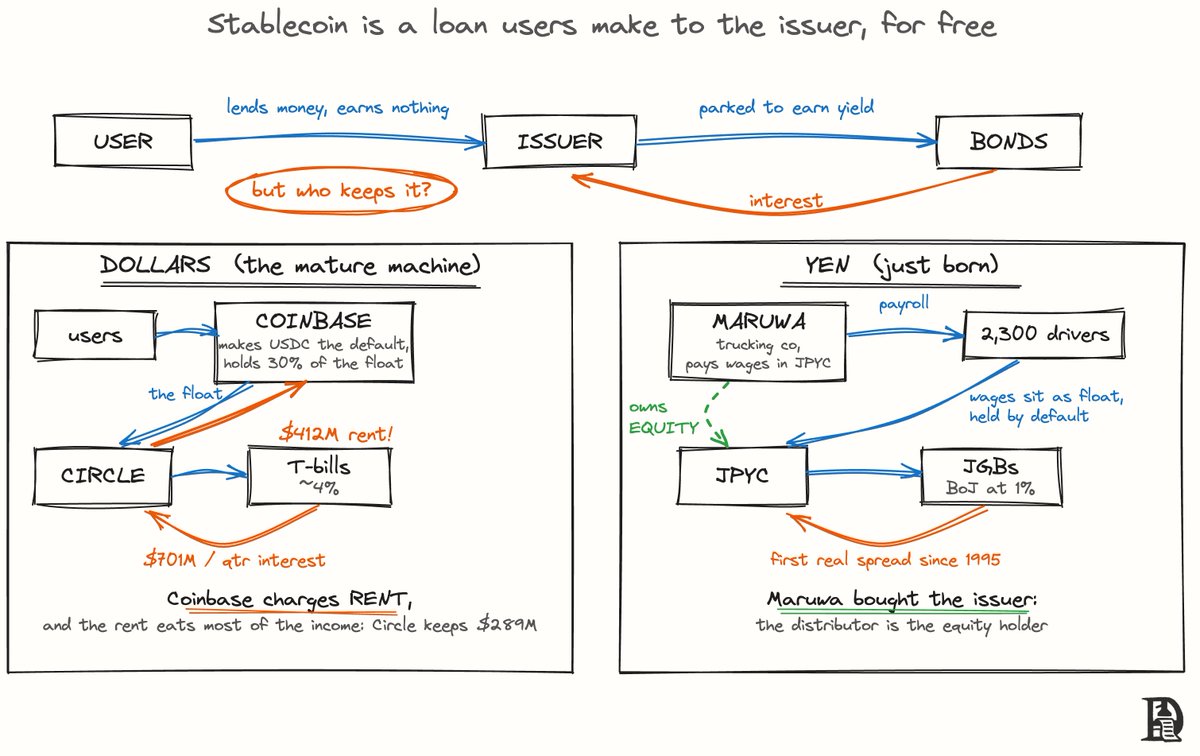
If you think about it, a stablecoin acts as a loan the user makes to the issuer for free. You give Circle a dollar, you get a token that doesn't pay you anything. Circle keeps the interest your dollar earns while sitting in Treasury bills. You forgo the interest for convenience. Everybody is happy. Circle can keep all the interest as long as it is dealing with many small holders (B2C). The equation changes when Circle has to go B2B2C.
Stablecoin issuers are like asset managers. Their income is directly proportional to stablecoin’s float. But the float needs a reason to grow, a reason for the end user to hold your stablecoin. This is where distributors enter the picture.
Circle pays Coinbase and Hyperliquid a significant chunk of the interest earned because, without Coinbase making USDC the default and Hyperliquid making USDC the collateral, the float itself would collapse.
For years, a yen stablecoin was pointless because Japanese bonds paid zero or less, so the free loan earned nothing. Then the BoJ raised rates to 1%, the highest since 1995, regulators let issuers hold government bonds in reserves, and the spread finally exists in yen. JPYC is the first registered issuer, and an investor in its new $38M round is the trucking company AZ-COM Maruwa.
Maruwa is JPYC's Coinbase. Both convert a captive capital from their audience into a stablecoin float. Coinbase's audience is people with exchange accounts. Maruwa's is its workforce. It runs payroll for about 2,300 drivers and contractors and pays them in JPYC. Payroll might be the strongest distribution channel money has, since salary is how money enters a person's hands in the first place.
Every payday, yen flows into JPYC's reserves. The drivers become holders by default, just as Coinbase users ended up with USDC. The issuer earns bond yield on every unspent day. Since payroll recurs monthly, the float is replenished.
Coinbase and Maruwa are different means to the same end. Coinbase charges Circle rent, and the rent now eats most of Circle's income. Maruwa bought equity in the issuer instead, so every yen of float it routes in raises the value of its own stake. Japan just put the distributor on the cap table from day one.
Users lend issuers money for free; rates determine what it is worth; and distribution decides who keeps the interest. So I'd skip the volume charts for now and watch who is responsible for the float.
Compute Trader is live.
If you buy or sell reserved GPU capacity, your deals now have somewhere to live.
Today a GPU deal is spread across spreadsheets, chat apps and email threads. Trader runs the whole deal in one place: organize RFQs, send proposals, negotiate terms, sign contracts. Private to your team.
Not a marketplace. Your desk, your contacts, your deal flow. https://t.co/ZTcTjYoeEM
This is huge!! I can see so many new markets that this can be expanded into, both with real money (football, basketball, esports) and social live streams (live reality shows). I wonder how the resolution mechanisms work here 🤔
You can now livestream & Livetrade your favorite tennis matches — exclusively within the Polymarket app.
We're honored to be named the Official Prediction Market Provider of the ATP.
Zellic just raised a $10M round to become an AI native security lab, and I think they're directionally right about where one of crypto's biggest opportunities is headed.
As onchain finance and consumer apps like Robinhood, Base, Fomo, Pump, and others continue to gain distribution, they'll increasingly compete by shipping more complex onchain products. That also expands the attack surface. I don't think the future looks like periodic security audits anymore
In a post AI world, security gets refactored into continuous transaction simulation, real time threat detection, formal verification, and AI systems that monitor every transaction before capital moves.
Users will eventually expect every onchain transaction to be secure by default. That means billions of dollars will be invested into AI native security infra that hardens wallets, protocols, agents, and consumer apps.
The strongest security companies will combine AI driven monitoring, cryptographic verification, and financial guarantees or insurance when things fail
The early years will be likely be messy. But once the security layer becomes reliable enough itll end up fading into the background and this will unlock the next generation of onchain apps and net new capital onchain.
I think one of the largest opportunities in crypto over the next decade sits at the intersection of AI, security, onchain infra, and finance.
After reading the @Lighter_xyz optimizations, any builder that approaches me pitching an offchain matching engine has my support.
Better to be relevant and compete – than die on the onchain hill.
There’s also a number of new dynamics that make the offchain matching story more compelling (ie segregated matching engines to comply with different jurisdictions).
And yeah, if all the activity settles back to @fogo every 40ms or so – the onchain “truth” and balance adjustments are still happening way faster than most chains. 🏎️
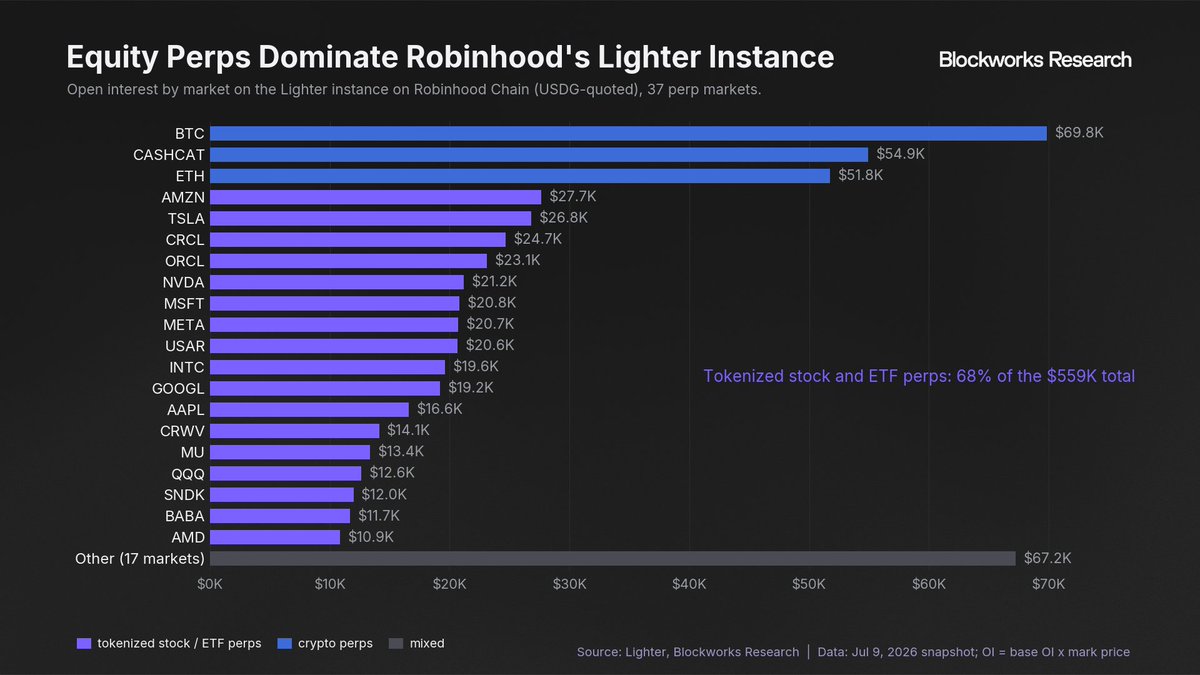
Despite the success of Robinhood Chain, Lighter's instance has achieved only $559K in open interest.
There are pros and cons to Lighter's partner integration strategy, but fragmenting liquidity across chains is never ideal.
Let's see how it plays out.
Proof is Starknet's incubator for investor-grade teams.
Selected founders get access to top VCs, mentors, masterclasses and workshops.
This is the Cohort 01 lineup:
these 24 accounts will ensure you never feel behind when building with AI:
@levelsio = constant shipping
@gregisenberg = AI startup workflows
@steipete = creator of OpenClaw
@marclou = shipping extraordinaire
@theo = great builder + hilarious takes
@trq212 = all things Claude updates
@thsottiaux = Codex & ChatGPT news
@Teknium = creator of Hermes
@rileybrown = everyday AI vibecoder
@elder_plinius = AI model jailbreaking
@AlexFinn = agentic setups + reviews
@atmoio = no-hype AI breakdowns
@MengTo = beautiful AI landing pages
@BrettFromDJ = AI design workflows
@DavidOndrej1 = no-BS AI analysis
@jackfriks = solo apps + real revenue
@EXM7777 = AI ops + systems
@eptwts = product prompts & hacks
@morganlinton = building with Grok
@doganuraldesign = design with Grok
@sharbel = agents, skills, and workflows
@AmirMushich = AI branding & creative
@KingBootoshi = vibecoding hacks
@kloss_xyz = AI systems architecture
follow them all and you won’t feel stuck.
Why LighterEVM ( ethereum:0x232ce3bd40fcd6f80f3d55a522d03f25df784ee2 ) Is Different From HyperEVM ( hyperliquid:native ) ?
In this thread:
➜ Lighter EVM vs HyperEVM
➜ Shared collateral explained simply
➜ Why builders should care
➜ The Ethereum advantage
➜ The biggest opportunity ahead
🧵👇
——————————-
Most people are looking at Lighter EVM and saying:
“Oh, so this is just HyperEVM but for Lighter?”
Not really.
The difference is subtle, but it could be one of the biggest design choices in DeFi.
⸻
First, understand what @Lighter_xyz already solved
Most Ethereum builders believed one thing:
❌ You can’t build a high-performance trading engine on Ethereum.
Why?
➜ Low latency needed ➜ Massive throughput needed ➜ Tight spreads needed ➜ Fast liquidations needed
That’s why most projects moved away from Ethereum.
@HyperliquidX built its own chain.
Many others built appchains. Lighter took a different route:
✅ Keep Ethereum security ✅ Keep Ethereum settlement ✅ Use custom ZK circuits to make trading fast
Result:
➜ One of the highest TPS systems in crypto ➜ CEX-like performance ➜ Ethereum-level verification
⸻
So What Is Lighter EVM?
Think of it like this:
Today, Lighter = Trading Engine
Great for:
➜ Perps ➜ Spot markets ➜ Order books
But developers can’t easily build:
➜ Lending protocols ➜ Stablecoins ➜ Yield protocols ➜ RWAs ➜ Consumer apps
because those applications need a normal EVM environment.
⸻
Lighter EVM Changes That
Now developers get:
✅ Full EVM compatibility
while still being connected directly to:
✅ Lighter liquidity ✅ Lighter markets ✅ Lighter collateral
⸻
Why This Could Matter More Than The Exchange Itself 👀
Most ecosystems look like this:
Trading Chain
↓
Bridge
↓
EVM Chain
Every time you move:
➜ Assets move
➜ Liquidity fragments
➜ Capital becomes inefficient
➜ Users wait
➜ Bridges add risk
⸻
Lighter wants this:
Trading Engine
↔
Lighter EVM
> Same ecosystem.
> Same liquidity.
> Same collateral base.
> Fast interoperability.
⸻
What Does “Shared Collateral” Actually Mean?
Shared Collateral, Explained Simply
You have $10,000 backing a perp position.
Normally, if you want to borrow against it:
➜ Withdraw
➜ Bridge
➜ Deposit somewhere else
➜ Borrow
Multiple steps. Multiple platforms.
Lighter EVM aims to let that same collateral power multiple applications at once.
>> Trade on Lighter.
>> Borrow on Lighter EVM.
>> Use the same capital.
You get more value from the same capital.
⸻
Lighter EVM vision:
You have:
➜ $10,000 supporting your perp position
At the same time:
➜ Lending protocol sees that collateral
➜ Stablecoin protocol sees that collateral
➜ Other DeFi apps can use that collateral
Without constantly moving assets. That’s a huge jump in capital efficiency.
⸻
Why This Matters For Builders
Lighter EVM isn’t just about trading.
It’s about giving direct access to Lighter’s liquidity and users.
Imagine building:
➜ Lending protocols where traders can borrow against their existing collateral instead of moving funds elsewhere.
➜ Stablecoins backed by assets and collateral already sitting inside the Lighter ecosystem.
➜ Yield products that put idle capital to work while staying connected to active trading markets.
➜ RWAs (stocks, bonds, real estate, etc.) that can interact directly with onchain liquidity and trading infrastructure.
➜ New financial apps that combine trading, borrowing, lending, and yield generation in one seamless experience.
The big opportunity isn’t another exchange.
The opportunity is building the financial products that sit on top of the exchange.
That’s how ecosystems evolve:
Trading → Lending → Stablecoins → Yield → Full Financial System.
Lighter already has the trading layer.
Lighter EVM is what allows builders to create everything on top of it. 🕯️