MD, MSc Eng. Clinical evaluation under EU MDR. I get medical devices through notified-body review, from the founder's first idea to the product on the market.
It was late, and the evidence tables were still open in front of me.
The pieces would not fit together.
A manufacturer wanted to update its State of the Art and extend its device to two new indications.
But the document had no method.
No structure.
No logic connecting claims to evidence.
The deadlines were tight.
Patching the draft looked faster.
It was not.
So I stopped trying to save the text.
I rebuilt the methodology from scratch.
First, I wrote down every clinical question.
Second, I mapped each question to the evidence that could answer it.
Third, I checked whether every claim followed from that evidence.
Fourth, I ordered the sections so each prepared the reader for the next.
Slowly, the file gained clarity and flow.
The lesson was not that a difficult draft needs more editing.
A draft without a method has nothing solid to edit.
If you inherit one, separate the questions, evidence, claims and structure before touching the prose.
Then rebuild those four layers in that order.
When the file went in, the reviewers raised no questions and praised the quality of the literature section.
Clarity did not come from polishing the mess.
It came from rebuilding the logic beneath it.
When you inherit a technical file with a weak State of the Art, what is faster: patching the draft you were given, or throwing the text away and rebuilding the methodology?
I write here about clinical evaluation under EU MDR.
Follow if that is your work.
✌️ Peace
Hatem
Your clinical evaluation expert and partner
A quality manager asked me how to survive a review when the assessor never calls to clarify.
Here is the thing most teams miss.
The assessor opens your file cold. He has never spoken to you. He cannot ask what your table means. He has other files waiting.
So when he has to hunt for something, he does not hunt. He writes a deficiency.
Most teams answer this by adding more. More pages. More studies. More annexes.
That is the wrong move, and the guidance says so.
MEDDEV 2.7/1 revision 4, Appendix A10, the release checklist, asks:
"Can the report be read and understood by a third party, does it provide sufficient detail for understanding the data that are available, all assumptions made and all conclusions reached?"
Read that again. Not complete. Understood.
Here is what I do instead, and you can use it tomorrow.
One question, one table.
The title of the table says exactly what is in it. Nothing else goes in.
Two columns. What the state of the art reports, and what my device reports.
Same endpoint. Same unit. Same follow-up time. Or the comparison is not a comparison.
One line under the table: pass or fail, and the source.
Then one sentence in plain words saying what it means.
That is it. The assessor reads one table and knows the answer. He does not go looking, so he does not write a deficiency.
Your file gets longer every review cycle. Does it get easier to read?
Follow for practical clinical evaluation guidance.
Most teams answer "do we need a clinician on the CER?" by hiring one. MEDDEV 2.7/1 Rev. 4 never asks for the job title. It asks whether the file can show the knowledge. Those are two different problems, and only one of them costs a headcount.
Expertise is not something you assert in a clinical evaluation report.
It is something the file has to demonstrate.
The report checklist asks two questions, and they land in two different places.
"Is the qualification of the evaluators included in the report and correct?"
That one lives in the report.
"Does the manufacturer hold a CV and declaration of interests of each of the evaluators and are these up-to-date?"
That one lives in the manufacturer's records.
Miss either and the demonstration is incomplete, however qualified the people actually are.
Then the harder half.
The guidance asks that the evaluators know the diagnosis and management of the conditions the device addresses.
The medical alternatives. The treatment standards. The device technology and how it is applied.
It offers specialist clinical expertise in the relevant medical specialty as an example of how that is met.
An example, not a requirement.
So the knowledge can sit across the evaluators as a group.
What you actually need is someone who can defend the clinical reasoning when a reviewer pushes on it.
If nobody on the team can do that, then yes, bring in a clinician. Not to satisfy a title on a form, but because the reasoning has no owner.
Which of the two is your file missing right now: the documentation, or the knowledge behind it?
Follow for practical clinical evaluation guidance.
Twice in one week, two real people told me they believed an information-only device has no clinical benefit of its own.
One device monitored a patient, while another produced output for separate software to interpret.
In both cases, the patient outcome depended on what happened next.
The Regulation defines clinical benefit more broadly.
MDR Article 2(53) includes “outcome(s) related to diagnosis” and “a positive impact on patient management or public health”.
An information-only device lives in those limbs.
MDCG 2020-1 makes the point explicit for medical device software: “the benefit of MDSW may lie in providing accurate medical information on patients”.
MDCG 2020-1 then gives three components of clinical evidence, in order:
Valid Clinical Association.
Technical or Analytical Performance.
Clinical Performance.
Many files begin with the second component.
They show that the output is accurate without first establishing why that output is clinically meaningful.
How does your team establish Valid Clinical Association before beginning analytical testing?
Follow me for practical guidance on clinical evidence under EU MDR.
I'm hiring! 🚀
Our Frontier Health team at @GoogleDeepMind is looking for a Research Scientist to build foundational AI & physiological world models for human biology.
Help us transform healthcare from reactive observation to proactive intervention. 🧬
🔗 Apply: https://t.co/qwxfpzMCZb
A complete clinical evidence file can still delay launch by months.
The cause often appears before the study, when no one defines what “enough” must mean.
By the time the gap reaches review, the report is finished and a launch date may already have been promised to the board.
MDR Article 61(1) says: "The manufacturer shall specify and justify the level of clinical evidence necessary to demonstrate conformity with the relevant general safety and performance requirements."
Neither the EU MDR nor MDCG 2020-6 publishes a threshold.
The bar goes in writing before the evidence is collected, and it has to reflect the state of the art in medicine.
You cannot run the trial first and draw the target around the results afterwards.
Where does your company’s evidence bar come from before a study begins?
Follow if you want to avoid expensive clinical evidence surprises.
Tired of the clinic but still love medicine?
Ten years ago I was a doctor too. Now I evaluate the medical devices doctors like you use every day.
There is a path most doctors never hear about: build a device, join a device company, or review one as a clinical evaluator.
Your clinical judgment is exactly what this field is short of.
Which one would you explore first: building, joining, or reviewing?
Follow if you want to see what that path actually looks like.
We released OpenMed v2.2.0! 🔥
This release connects the clinical data path: document intake, terminology grounding, FHIR R4, OMOP 5.4, structured privacy, hardened MCP/services, and local Maple + Compass runtimes.
12,185 Python tests passed.
A clinical investigation is usually the most expensive line in a medtech plan.
Equivalence is how teams plan to avoid it.
But for another manufacturer’s device, that plan depends on the other manufacturer giving you ongoing access to its technical documentation.
Start with gate one.
Article 61(4) applies this rule to implantable devices and class III devices.
For these devices, clinical investigations shall be performed unless the required conditions are met.
Gate two applies when the marketed device is your own.
Your new device must be designed through modifications of a device already marketed by the same manufacturer.
You must demonstrate equivalence in accordance with Annex XIV.
Your notified body must endorse that demonstration.
And the clinical evaluation of the marketed device must be sufficient to demonstrate conformity of the modified device.
It is not your declaration.
It is an equivalence demonstration endorsed by your notified body.
The notified body must also check that your PMCF plan is appropriate and includes post market studies.
Gate three.
This is the condition that belongs on the CEO’s desk.
If the marketed device belongs to another manufacturer, two additional requirements apply.
First, you need a contract with that manufacturer giving you full access to its technical documentation on an ongoing basis.
Second, you need clear evidence for your notified body that the original clinical evaluation was performed in compliance with the EU MDR.
That contract is not a regulatory writing task.
It is a commercial negotiation with another company.
No amount of internal clinical or regulatory work can create access that the other manufacturer has not agreed to provide.
So do not leave equivalence in the regulatory plan as an assumption to be sorted out later.
Put the access agreement on the CEO’s desk early.
Even with access, equivalence does not mean that another device looks like yours.
Annex XIV requires equivalence across all three families of characteristics.
Technical means similar design, use conditions, specifications, deployment, principles of operation and critical performance.
Biological means the same contact materials or substances, with similar contact and release characteristics.
Clinical means the same clinical purpose, body site and kind of user, with similar disease, population and relevant critical performance.
All three must hold to the extent that there is no clinically significant difference in safety and clinical performance.
The justification must be scientific.
The access to the supporting data must be sufficient and clearly demonstrated.
Founders and CEOs, what document proves that your assumed equivalent device is yours to use, who signed it, and what access does it grant on an ongoing basis?
Follow me for EU MDR decisions that belong on the CEO’s desk, especially what not to leave as an assumption.
Every week another vendor tells you AI will write your clinical evaluation report.
A peer-reviewed review published in April in Expert Review of Medical Devices found that submission content drafting is "mainly only supported by vendor claims".
The same paper says the understanding and practical application of AI in daily regulatory affairs work are "still in their infancy".
Early adopters mainly focus on basic tasks such as process automation for data entry.
Most regulatory affairs professionals, outside large organisations or specialised roles, still have limited hands-on experience with AI tools in their daily work.
And the confident adoption number you keep hearing needs context.
The 20 of 22 companies identifying AI opportunities were biopharmaceutical companies.
The number measures companies that identified areas of opportunity.
It does not measure anybody using anything.
There is also a deeper problem.
Training a model on FDA submission templates may produce poor results on EU MDR documents because the formatting requirements differ.
There are more than 70 regulated markets globally.
The model is only as relevant as the material it learned from.
Drafting is the obvious job.
It is not the valuable job.
The document is not the hard part.
The hard part is that your report cites a number.
That number came from a source.
Months later, somebody needs to check that the report and the source still agree.
Almost nobody is using it to check that the numbers in the report still match the numbers in the source.
I do the second one. It is slower, it is boring, and it is what survives review.
A reviewer does not test whether your prose sounds confident.
They test whether the number in your table is actually in the paper you cited.
They test the source.
They test the trace.
They test whether the evidence still says what your report says.
If you are a founder or CEO being pitched an AI regulatory tool, ask the vendor to show you exactly how it detects a changed number between a report and its cited source.
What answer did they give you?
Follow me for practical work on AI, clinical evaluation and EU MDR, including the checks that matter after the drafting is finished.
"No complaints" is not a safety signal.
It is a statement about your data collection.
A safe device and a device nobody asked about return the same number.
Zero.
That number cannot tell you which one you are holding.
When a PSUR opens with zero complaints, the reviewer does not ask whether the device is safe.
They ask what you did to find out.
EU MDR settled this twice, in two places, using two different words.
Article 83(2).
Post-market surveillance shall be suited to "actively and systematically gathering, recording and analysing" relevant data on quality, performance and safety, throughout the device's entire lifetime.
Article 2(60).
A systematic procedure to "proactively collect and review experience gained from devices they place on the market".
Actively. Proactively.
Both times you are told to go and look. Not to wait.
A complaint fails to arrive for five reasons. Not one of them is safety.
1. Nobody linked the event to the device
2. It looked like the disease progressing
3. The distributor passed nothing on
4. Reporting cost time nobody budgeted
5. The surgeon fixed it in theatre
So stop reporting a naked zero.
Say what you went looking for, and where. Say how many you asked, and how many answered. Then report what came back, including the zero.
A zero with a denominator is a finding.
A zero on its own is a blank page with a number on it.
Founders: what is the hardest part of gathering proactive data for your CE mark or FDA submission?
Reply below, I read them.
And if you are building a medical device company, follow me. I publish every day on what it takes to CE mark and clear FDA. Mostly on what not to do.
If your clinical evaluation ends at "the literature supports it", you are only halfway there.
The next questions are: which literature, on which device, in which population, measured how.
A file that answers only the first one comes back.
Most CE marking delays are not a clinical data problem.
They are a consistency problem.
The same device, described three different ways in three documents of the same file. Intended purpose, variants, claims. All slightly out of step.
That is what sends a file back.
🚨This is incredible.
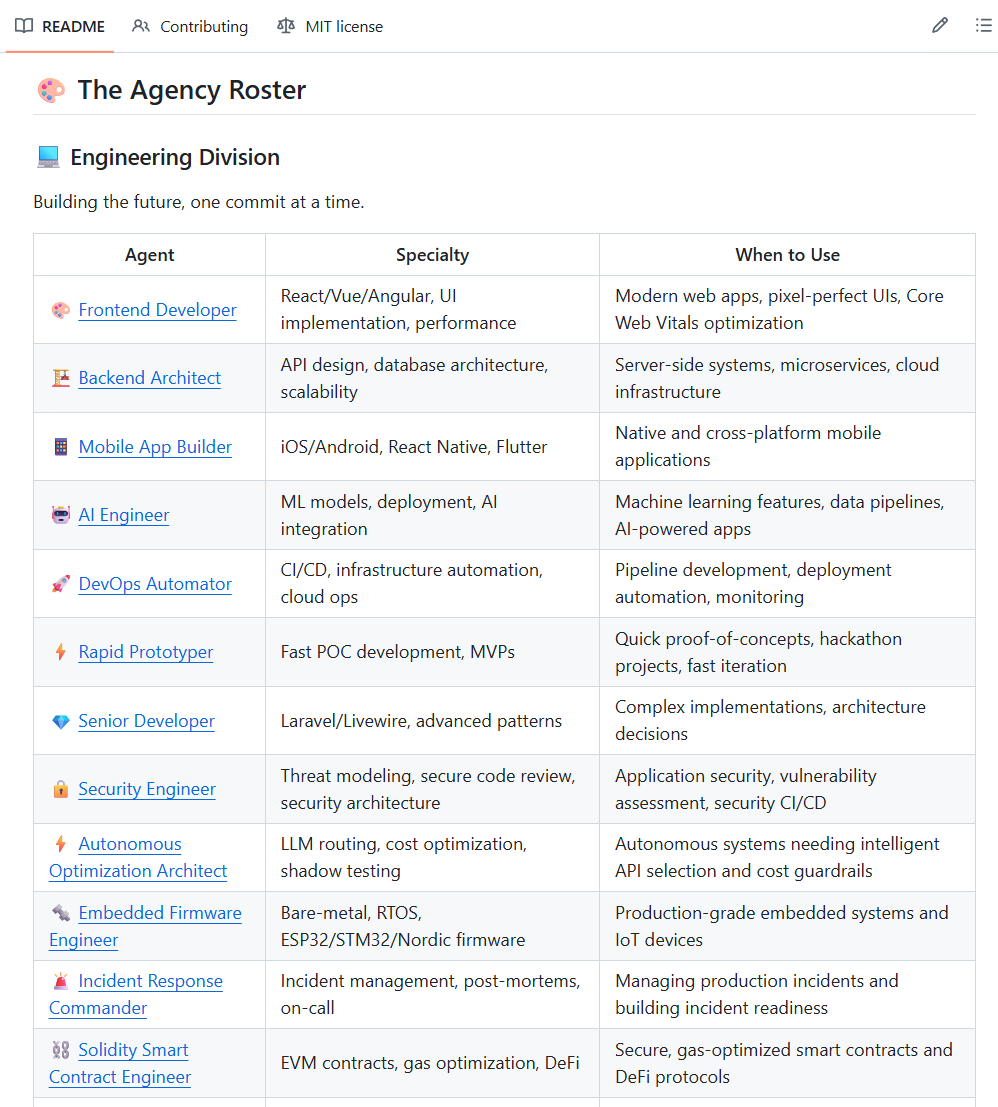
Someone open sourced a full company using AI agents.
Anyone can now run an agency instantly using AI.
Repo: https://t.co/mT1rL93LbD