Right now their 843,700 Bitcoin are worth about 57 billion, while all the senior claims ahead of common stock — 6.8 billion in debt plus 15.5 billion in preferred — total only 22 billion.
Bitcoin would have to crash below roughly 26,000 dollars for the Bitcoin value to equal what they owe senior holders.
The dilution everyone is worried about doesn’t change that collateral math. It just means common shareholders own a smaller and smaller slice of that big Bitcoin pile over time.
The Bitcoin themselves are still massively over-collateralized.
When shareholders get frustrated and sell, MicroStrategy can actually buy those shares back cheaper, which reduces the total share count. That increases how much Bitcoin each remaining share represents.
It’s a weird feedback loop — their aggressive dilution scares people out, the stock price drops, and then they can retire some of those shares on the cheap, which actually helps the remaining shareholders.
It’s kind of brutal, but it works as long as Bitcoin itself doesn’t completely collapse.
No, AOC, the American Revolution was NOT “against the billionaires of their time.”
It was against a large, distant, overly intrusive government that recognized no limits over its own authority to tax, regulate, and eat out the substance of the citizens it claimed to serve.
A little econ 101 for the silly socialists.
The natural state of the economy is deflationary. As humans we innovate, we become more productive so everything ‘should’ get cheaper to produce.
Well it does, everything you see getting more expensive is getting cheaper to produce but the inflation of the money supply is causing prices to go up.
So what is the mechanics of this, the two primary ones are:
1. Governments keep running deficits because democracy rewards them for lying and spending.
2. Banks create money out of thin air through lending and the people closest to credit get it first. Asset prices pump and wealth shifts toward those who already have assets.
When things go up in price, say energy due to war, this is not inflation. Some politicians say it is, but they are lying or stupid. That’s a supply shock. Inflation is always and everywhere a monetary phenomenon.
Inflation is good for the state, it wipes away their debt. The mechanics of inflation are good for the rich, because they have assets.
Inflation is terrible for everyone else - products get smaller, ingredients get worse and prices go up. It’s how companies manage inflation.
Inflation forces dependency policies so people can scrape by - minimum wage, energy caps, renters rights. They are demanded by the public.
But this the slow hollowing out of society, it is what breaks everything which is good. It puts pressure on a system which takes us from high trust to low trust.
Why do I make fun of @zackpolanski and the socialists? Because they will run this experiment on crack. The Green’s model as far as I can see is:
- Attack the productive class
- Reward the unproductive class
The problem with this is the rich will leave, the ambitious may leave and they will face the same question as both Labour and the Conservatives which is how do we pay for this? They will either have to raise taxes or borrow (print) more money, which accelerates the problem.
So we will get lower productivity, higher taxes, more borrowing and guess what, more inflation.
This is the exact mechanics which have destroyed every socialist state.
I get it, socialism sounds warm and fuzzy - nobody should go without, free stuff for everyone. But the end result is poverty and misery, as it has been every single time.
If you want jobs, good, medicine then you need a growing and prosperous economy which means unshackling the entrepreneurs.
There is no other option on the table. It is the only thing that has ever worked.
I haven’t voted in three elections. I will only vote if someone comes with a real economic plan which means a chainsaw to the state and driving growth.
From now on when you see a "quantum breakthrough" I want your first thought to be "okay, how did they classically precompute and encode the answer this time"
One of the wonderful things about AI is that it does make de-obfuscating bullshit much easier. https://t.co/ueATq2aoZx
It’s interesting to see how so many media outlets, politicians, and representatives of international NGOs lie so blatantly about El Salvador.
Anyone who has visited our country knows that tattoos are not only allowed, but very common. Many Salvadorans have them, even in highly visible areas: full sleeves, face, neck, hands, etc. It’s simply not true that people are required to cover them up.
It’s also false that tattoo artists have been arrested. There are hundreds of tattoo shops, and many are now doing better than ever, since they can stay open late without being extorted by gangs.
Tattoos aren’t even socially frowned upon. On the contrary, many people see them as body art and a form of personal expression.
What is prohibited are gang symbols, but not just in tattoos. They are banned in any form: on walls, in the media, even on graves.
This shouldn’t surprise anyone. In Europe, Nazi symbols are banned, and no one is outraged by it.
In fact, we only restricted them in the media for one year (during the height of the war on gangs) and they are allowed again now. Yet we were scolded by the “international community” for that temporary measure, while Nazi symbols have been prohibited in Europe for 80 years.
So which is it?
What is acceptable for them is not acceptable for us?
The European argument is that banning those symbols is necessary to prevent a return to a past they do not want to relive.
Well, that is our argument too.
You are being mislead by Project Eleven on Bitcoin Quantum and their new claim.
Part 4: Every "Quantum ECDLP" Demo Is Theater.
Here's the Proof. https://t.co/6mIgmuWu1e
I read the code behind the latest Shor's algorithm "breakthrough." Three fatal problems:
1. The private key is classically solved before the quantum circuit even runs. enumerate_group(G) brute-forces the discrete log, then bakes d*2^i as compile-time constants into the adders. The quantum computer isn't finding anything — it's being told the answer.
2. The "recovery" is a classical verify filter. Every shot is checked against d*G == Q. The candidates dict has at most one entry. The "mode across all shots" language is rhetorical — there's nothing to take a mode over.
3. The 17-bit "success" has a 27% chance from pure random noise. Author concedes fidelity ≈ 10^-244. All 20,000 shots produce unique bitstrings. Under uniform noise with a classical verify filter: P(hit) ≈ 1 - e^(-20000/65173) ≈ 27%. That's a coin flip weighted slightly worse than heads.
A real Shor-for-ECDLP needs coordinate-encoded reversible arithmetic (no classical lookup of d) and continued-fraction recovery (no per-shot verify filter). Nobody has demonstrated this beyond p=13.
Current qubit requirements for secp256k1: 1,193-1,450 logical qubits (CFS, Google QAI 2026). Current hardware: 48 logical. The gap is 25x.
The quantum threat to Bitcoin is real but distant. The demos making headlines today are classical computations wearing quantum costumes.
What is status of a Pubky Home Server app on @Start9 and @Umbrel and any other home servers? Working on a pubky protocol based app @getpubky@BitcoinErrorLog
In the light of #Easter, let us allow ourselves to be amazed by Christ! Let us allow our hearts to be transformed by his immense love for us! Let those who have weapons lay them down! Let those who have the power to unleash wars choose peace! Not a peace imposed by force, but through dialogue! Not with the desire to dominate others, but to encounter them!
ADAM BACK: “Blockstream has 20 person applied cryptography/security team working on the quantum issue basically full time, you can see that from the pace of R&D output, implementations, BIPs.
It's just insulting and FALSE to say bitcoin protocol researchers are "not doing anything.”
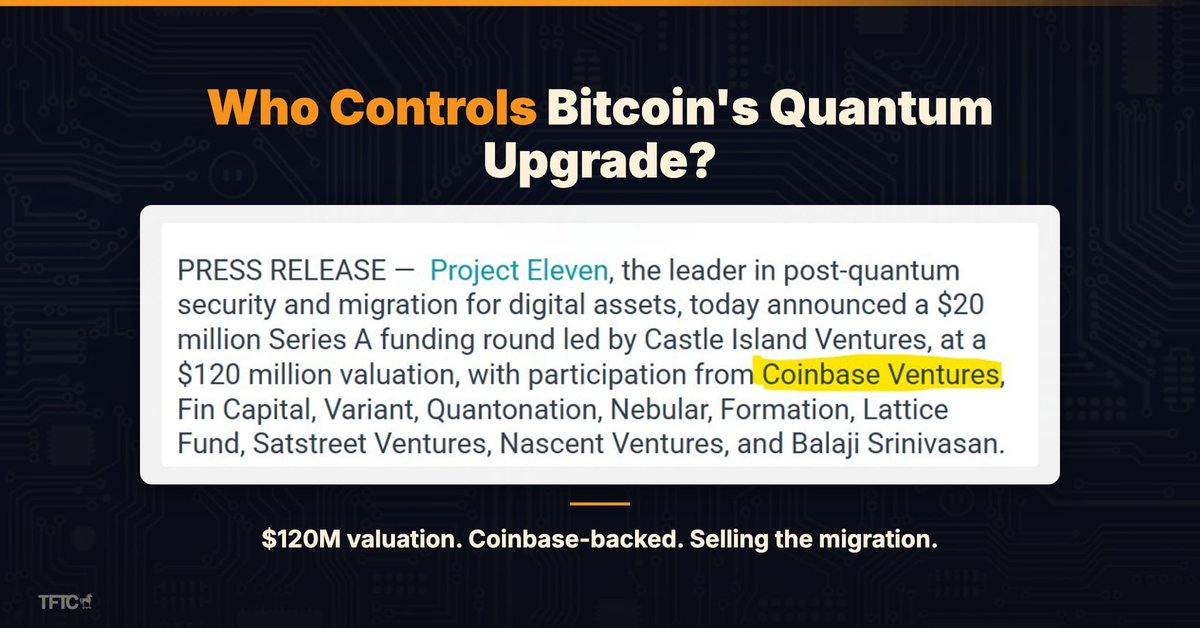
There's a company raising venture capital to "save" Bitcoin from quantum computing.
It's called Project Eleven, backed by Coinbase Ventures and Castle Island Ventures with over $26 million in total funding. They sell post-quantum migration services, which means the scarier the quantum timeline sounds, the more their product is worth.
Their research is technically sound. They published a prototype wallet demonstrating that BIP32 non-hardened key derivation, the mechanism every major exchange uses to generate deposit addresses, breaks under NIST's finalized post-quantum signature standard. The technical problem is real and eventually needs to be addressed.
The quantum timeline is narrowing. Google Quantum AI cut the theoretical ECDSA attack down to 1,200 logical qubits in a paper published last month, a significant reduction from prior estimates. Google set an internal 2029 deadline for post-quantum readiness. These are real developments and we covered them when they dropped.
But "the timeline is narrowing" and "this is an emergency" are two very different statements. The best entangled logical qubit count today is 96. Coherence time is measured in seconds. The attack requires days. The engineering gap between a theoretical paper and a working cryptographic attack remains enormous. Nobody has solved it. Nobody has announced a clear path to solving it.
Bitcoin developers have known about this for years, and the response has been exactly what you'd expect from a community that doesn't rush.
Jonas Nick and Mikhail Kudinov at Blockstream Research published SHRIMPS, a post-quantum signature scheme producing 2.5KB signatures, three times smaller than NIST standards, built specifically for Bitcoin's block space constraints. BIP-360, a quantum-resistant output type, is already live on a Bitcoin testnet with real transactions running through it. The estimated upgrade timeline is seven years, and the work is well underway.
The question is not whether Bitcoin needs to prepare. It does, and it is. The question is who controls that preparation.
When your lead investor is Coinbase, the company running one of the largest deposit address generation systems in the world, and your revenue model is selling the quantum migration itself, the incentive is to make the timeline feel shorter than it is. Urgency sells migration contracts. Methodical, open-source development does not.
If this dynamic sounds familiar, it should. In 2017, a group of companies including Coinbase tried to force through SegWit2x via the New York Agreement, an institutional push that tried to bypass Bitcoin's governance process. The community rejected it.
The risk here is not quantum computing breaking Bitcoin tomorrow. It's that manufactured urgency around quantum becomes the next lever institutions use to capture Bitcoin's upgrade path. If the migration ever does become genuinely time-sensitive, the pitch writes itself: "We don't have time for the community process. These tools already exist. Just use them."
Bitcoin's open-source developers are building the defense on their own timeline, with no product to sell and no investors to return capital to. That's the upgrade path worth trusting.