3) Approximately ~ 30 full-body weekly sets (or ~ 12 lower-limb weekly sets), equivalent to two sessions per week and two sets per exercise for eight lower-limb resistance exercises, is a reasonable and feasible amount of resistance exercise;
@SportsMedicineJ 2) While prescribing a high resistance training volume ( total-body: ≥ 61 weekly sets; lower limb: ≥ 27 weekly sets) may result in additional benefits for muscle strength;
Our last paper is online in @JSCRonline
Moderators of Resistance Training Effects in Healthy Young Women: A Systematic Review and Meta-analysis
Talita Molinari, @RadaelliRegis , @Rech_Anderson38 , @c_brusco Anna Markarian
https://t.co/I2La24EuH6
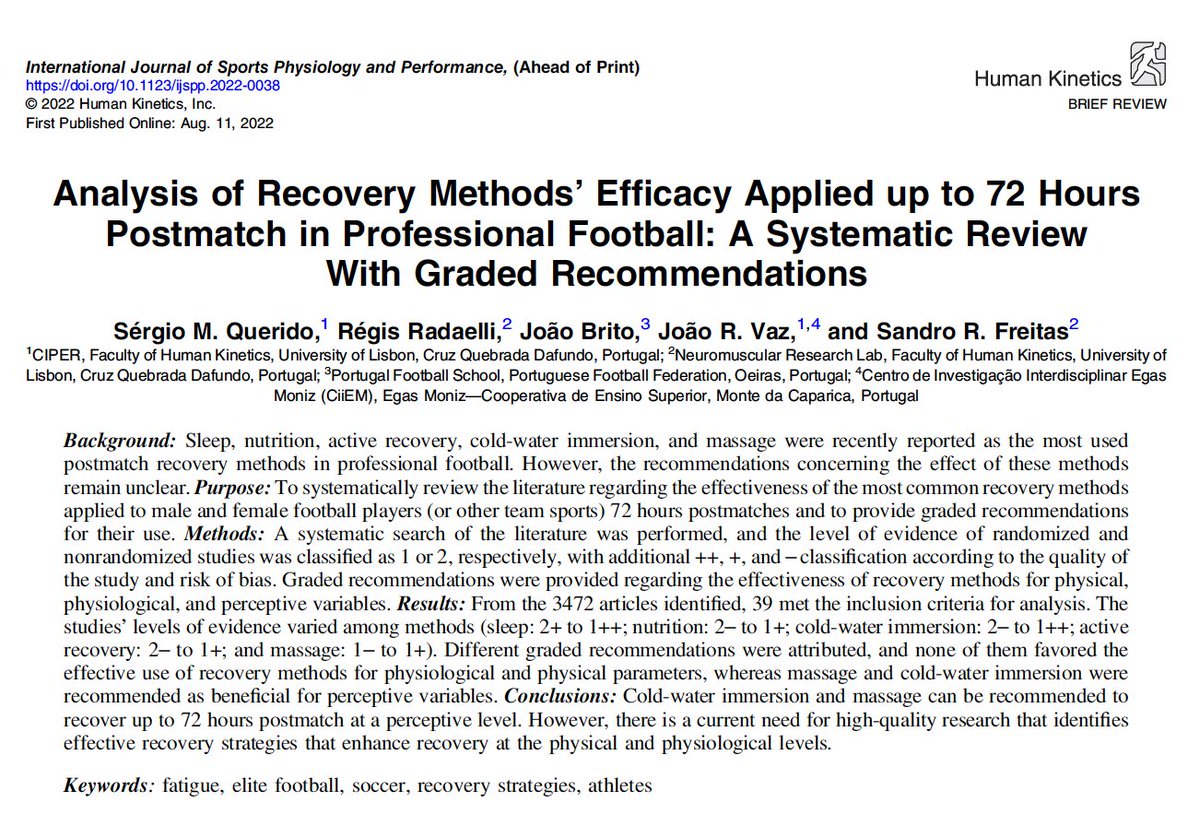
⚽️ "Cold-water immersion and massage can be recommended to recover up to 72 hs post-match at a perceptive level"
👉 A systematic review from @smquerido@RadaelliRegis et al, 2022
📂 Open Access: https://t.co/gOtY5eDrnk
Editor's choice article for the week: Effects of Exercise Training on Muscle Quality in Older individuals: A Systematic Scoping review with Meta-Analyses.
https://t.co/J98rtbqndo
3) Our findings indicate that resistance exercise prescription based on the velocity of contraction should be individualised in older adults to optimise improvements in the specific physical function outcomes desired.
Does high-velocity resistance exercise elicit greater physical function benefits than traditional resistance exercise in older adults? A systematic review and network meta-analysis of 79 trials is online @Pedro_Lopez1291@AndersonRech9@ProfRobNewton
https://t.co/ekgmXZ0Svj
2) high-velocity RT promoted greater improvements in tests with a time component (fast walking speed and sit-to-stand), and traditional RT was the most effective intervention for improving performance where participants had to work longer (30-sec sit-to-stand and 6-min walking);
💪Power Training Prescription in Older Individuals
📽️This video https://t.co/m6BpQKF5nk
📝Presents a summary of the recommendations published in @SportsMedicineJ
By @RadaelliRegis et al.