🧵Here’s a few facts I can’t stop thinking about after our hearing yesterday:
The ballot summary tells voters the homestead exemption is $250,000.
But that’s only true for one year…2028.
It’s $150,000 in 2027. Starting in 2029, it becomes $250,000 plus inflation forever.
So the one number voters are given is the one number that’s almost never true. Meanwhile, local governments must absorb ever-growing recurring revenue losses while inflation is also increasing their costs….of coarse that’s not disclosed in the summary and you have to ponder the amendment language to figure that out.
@TheMaineWonk Actually this is an ignorant argument. Employers determine sick leave policies whether private industry or government agencies. Why don’t you point out relevant policies vice clickbait.
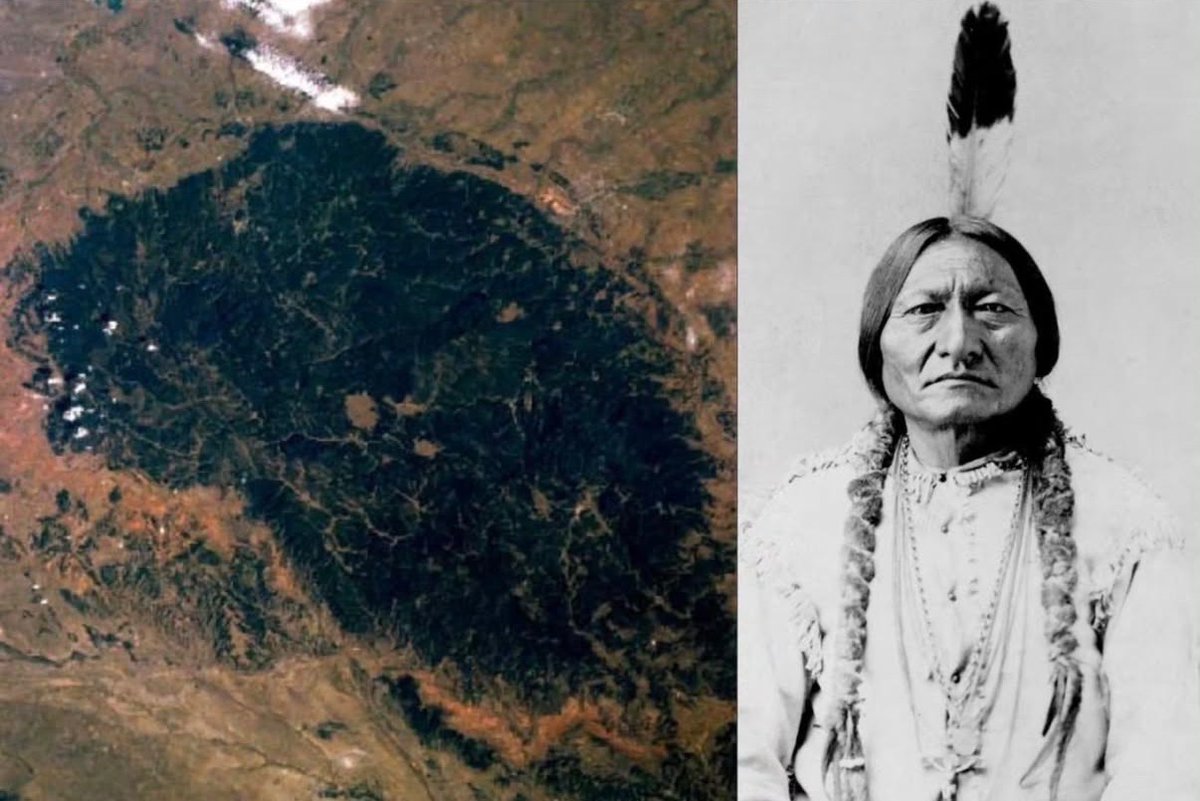
In 1980, the Supreme Court awarded the Sioux nations $122 million for the Black Hills, but the tribes rejected the payment, arguing that accepting it would end their legal claim to the land. As a result, the money remained in a federal account, where accumulated interest has grown the award to more than $1 billion.
The 1868 Fort Laramie Treaty guaranteed the Black Hills to the Sioux, but that agreement was challenged after Lt. Col. George Armstrong Custer’s 1874 expedition revealed the presence of gold in the region.
Thousands of prospectors flooded into the area despite the treaty’s protections. When the Sioux refused to sell the land, Congress passed a law in 1877 that seized the Black Hills without their consent.
In 1980, the U.S. Supreme Court ruled that the government had illegally taken the land and awarded the Sioux financial compensation. The tribes have continued to reject the payment, arguing that accepting it would surrender their claim to the sacred Black Hills.
The settlement has remained untouched for decades, growing with interest to more than $1 billion.
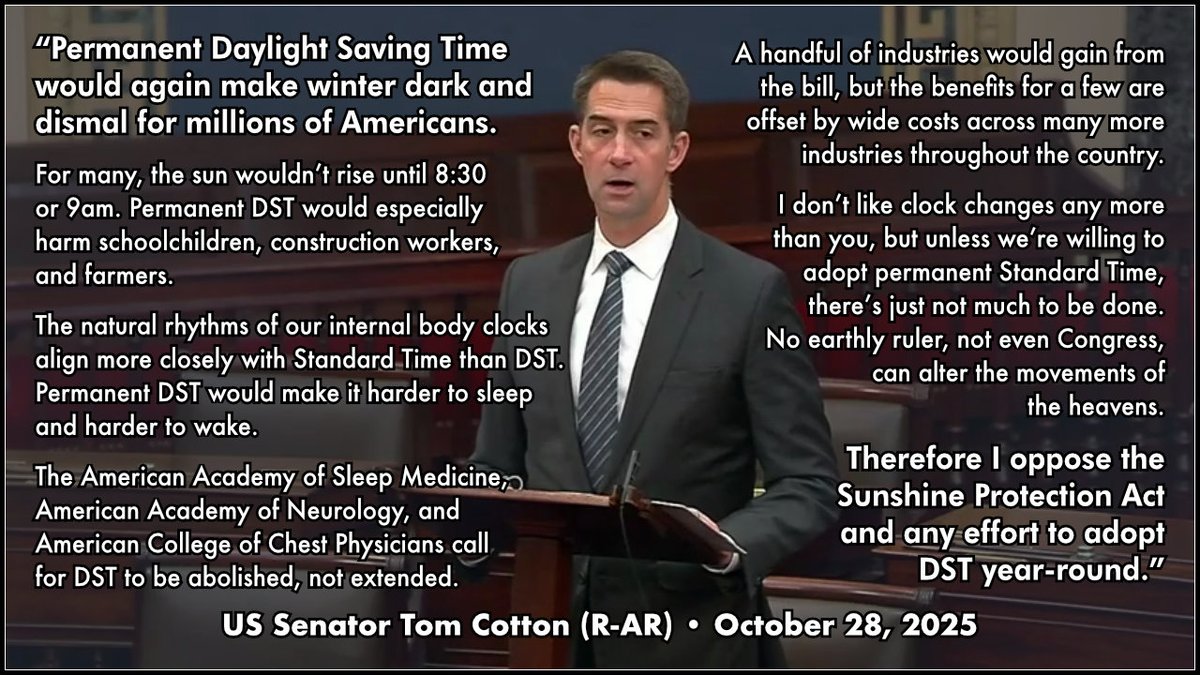
Thank you, @SenTomCotton, for stopping permanent Daylight Saving Time last year! Please stop it again this year, and replace it with permanent Standard Time!
THE FOUR PILES
by Michael Whelan
After Rebecca died on March 5, 2026, I couldn't bring myself to touch a single thing.
Her toothbrush was still beside mine.
Her slippers were still by the bed.
Her favorite sweater still hung in the closet exactly where she had left it.
Every room felt like she had simply stepped outside for a few minutes and would be walking back through the front door at any moment.
People think the hardest part of losing your spouse is saying goodbye.
It isn't.
Sometimes the hardest part is deciding what to do with forty years of a life you built together.
I couldn't do it alone.
So my family flew across the country from California.
Not to clean out a house.
Not to empty closets.
They came because they knew I couldn't carry that weight by myself.
Together, we stood in front of a lifetime of memories and slowly began creating four piles.
The first pile was for me.
These were the things that still felt like part of my heartbeat. Her photographs. Her jewelry. The clothes that still reminded me of the woman who filled this house with laughter, compassion, and unconditional love. These were never simply possessions. They were pieces of our story.
The second pile was for my family.
I wanted everyone who loved Rebecca to choose something that would forever remind them of her. A photograph. A favorite sweater. A keepsake that would allow a small part of her beautiful spirit to continue living in their homes and in their hearts.
The third pile was for her sister.
It is still waiting.
My family has returned several times. They cried. They laughed. They shared stories about Rebecca that made us all smile through our tears.
Her sister has never come.
I don't know what is in her heart, and it isn't my place to judge. Grief asks something different from each of us. Still, every time I walk past that untouched pile, I whisper to myself, "Whenever you're ready."
The fourth pile was the hardest.
The giveaway pile.
At first, I couldn't imagine anyone else wearing Rebecca's clothes or holding something that had once belonged to her.
Then I realized something Rebecca spent her entire life teaching me.
Love doesn't end when a heartbeat does.
Perhaps one of her sweaters will keep someone warm.
Perhaps one of her jackets will comfort a woman going through a difficult winter.
Perhaps something that once brought Rebecca joy will now bring hope to someone she never had the chance to meet.
Even now... she is still giving.
There is another part of this story that still feels impossible to me.
Rebecca's mother is now ninety-five years old and has been in home hospice for nearly four years.
Who could ever imagine that a mother would outlive her daughter?
Life has a way of rewriting the ending we thought had already been written.
As I looked around the room that day, I realized we weren't sorting belongings.
We were gently deciding where forty years of love would continue to live.
Maybe that is the final responsibility of those left behind.
Not to hold on to everything.
But to make sure the love our person gave this world never stops reaching other people.
Because in the end, that is what remains.
Not the clothes.
Not the jewelry.
Not the photographs.
Love.
Love is always the last thing left in the room.
Floridians, if you think the cost of living is high now, just wait until Data Center Donalds brings data centers to your neighborhood and jacks your utilities up by over 200%. We cannot afford Byron Donalds (even though his corporate donors can).
Vote @davidjollyfl for governor!
'Instructive': A federal judge repeatedly slapped down the Trump administration in an '8647' case, and James Comey's lawyers noticed https://t.co/x1DySswseb
@RonDeSantis No, he sided with medical evidence.. A brand new virus killing millions across the world. Of course you’re going to spew untruths wherever you think it will get a click. Quit trying to get a job from Trump and work for the people. You’d be successful if you did.
A guy who sold $1.2 million worth of products on Amazon last year told me where every single item comes from.
Alibaba.
The $35 wireless earbuds he sells on Amazon cost him $3.80 from a factory in Shenzhen. The $28 phone case that gets 4.7 stars cost him $1.40. The $45 LED desk lamp cost him $6.20. The $22 resistance bands cost him $0.90.
He doesn't design the products. He doesn't manufacture them. He doesn't invent anything. He finds factories on Alibaba that already make the product, orders 500 units with his logo printed on them, ships them to an Amazon warehouse, and lists them with professional photos and optimized copy.
His average markup: 440%.
He told me something most American consumers have never considered: "Every product you buy on Amazon with a brand name you've never heard of and most of the ones you have is available on Alibaba at the factory price. You're paying a middleman to put it in an Amazon box. The factory doesn't care who buys. They'll sell to you directly for the same price they sell to me. You just don't know how to find them."
He showed me 9 things most people get wrong about buying from Alibaba and the system that lets anyone buy from the same factories supplying Amazon, Target, and Walmart.
Here's the full playbook 🧵
A GRIEF THERAPY BREAKTHROUGH: I NEVER GOT TO BE A CHILD.
by Michael Whelan
Last week my grief therapist asked me a question that changed the way I understand my entire life.
"When was the first time you remember not feeling safe, Michael?"
I paused for what seemed forever.
I didn't answer with Rebecca.
I answered, "When I was a ten-year-old boy."
It was the 1960s. My parents had just divorced from a violent, hateful relationship, it was something families rarely talked about in those days. My mother packed everything we owned into an old Pontiac station wagon, and the four of us drove nearly 3,000 miles from Pittsburgh to Northern California.
There was no GPS.
She spread a paper map across the front seat and asked me where to turn next.
I was ten years old.
Looking back, I realize that drive became the story of my life.
I was always trying to find the way.
We moved into a rented 300-square-foot pool shack. We were the poorest family in town. Every afternoon I watched my mother iron her waitress uniform before walking the hundred feet across the parking lot to the little restaurant where she worked double shifts.
She was only a hundred feet away.
To me, she felt a thousand miles away.
The moment the door closed behind her, something changed inside me.
Anxiety took over.
My chest tightened until it hurt to breathe. My heart pounded so hard I could hear it in my ears. Every creak in that little house made me jump. Every passing car sent me running to the window, praying it was her. I lived with the constant fear that something terrible had happened and that I would be left alone forever.
At ten years old, I didn't know the words panic attack.
I only knew terror.
Every night I lay awake listening for the sound of her footsteps. Every pair of headlights sweeping across our window made my heart leap, only to sink again when the car drove past. Some nights I shook beneath the covers until I heard the screen door open.
Only then could I breathe again.
Only then did my body believe I was safe.
Before she came home, I'd clean the house.
Not because she asked me to.
Because I wanted her to notice.
I wanted her to smile.
I wanted her to tell me I'd done a good job.
By then I already believed there was something wrong with me. I struggled with severe dyslexia. I stuttered. An accident had broken my front teeth. I weighed barely seventy pounds and felt different from everyone else.
No ten-year old should ever be the 'man of the house.'
Then, when I was fifteen, my mother was diagnosed with terminal breast and lymphatic cancer. I slowly watched her fade away.
Some nights, after a few drinks, she'd look at me and say, "You're going to make it to the major leagues, Michael. You're going to save us."
She was trying to hold on to hope.
I heard responsibility.
From that moment on, baseball stopped being a game.
It became my job to save my family.
Children should never carry burdens that belong to adults.
But children don't know that.
I met Rebecca in the summer of '69.
For more than decades, she gave me something I'd been searching for since I was a little boy.
She made me feel safe.
And then she died.
For months I believed I was grieving only the loss of my wife.
My therapist helped me understand something that changed everything.
The crushing sadness...
The fear of abandonment...
The anxiety that grips me every evening...
None of it began the day Rebecca died.
I'd lived there before.
Rebecca hadn't created my sense of safety.
She had restored it.
Every night now, when darkness settles over this house, it isn't only a grieving husband sitting alone.
It's also a ten-year-old boy lying awake in a tiny shack, waiting for the sound of the screen door to open so he can finally breathe again.
If I could sit beside that little boy today, I wouldn't hand him a better map.
I'd put my arm around his shoulders and whisper the words he spent a lifetime needing to hear.
"This was never your burden to carry."
"You were only ten years old." 💙😢
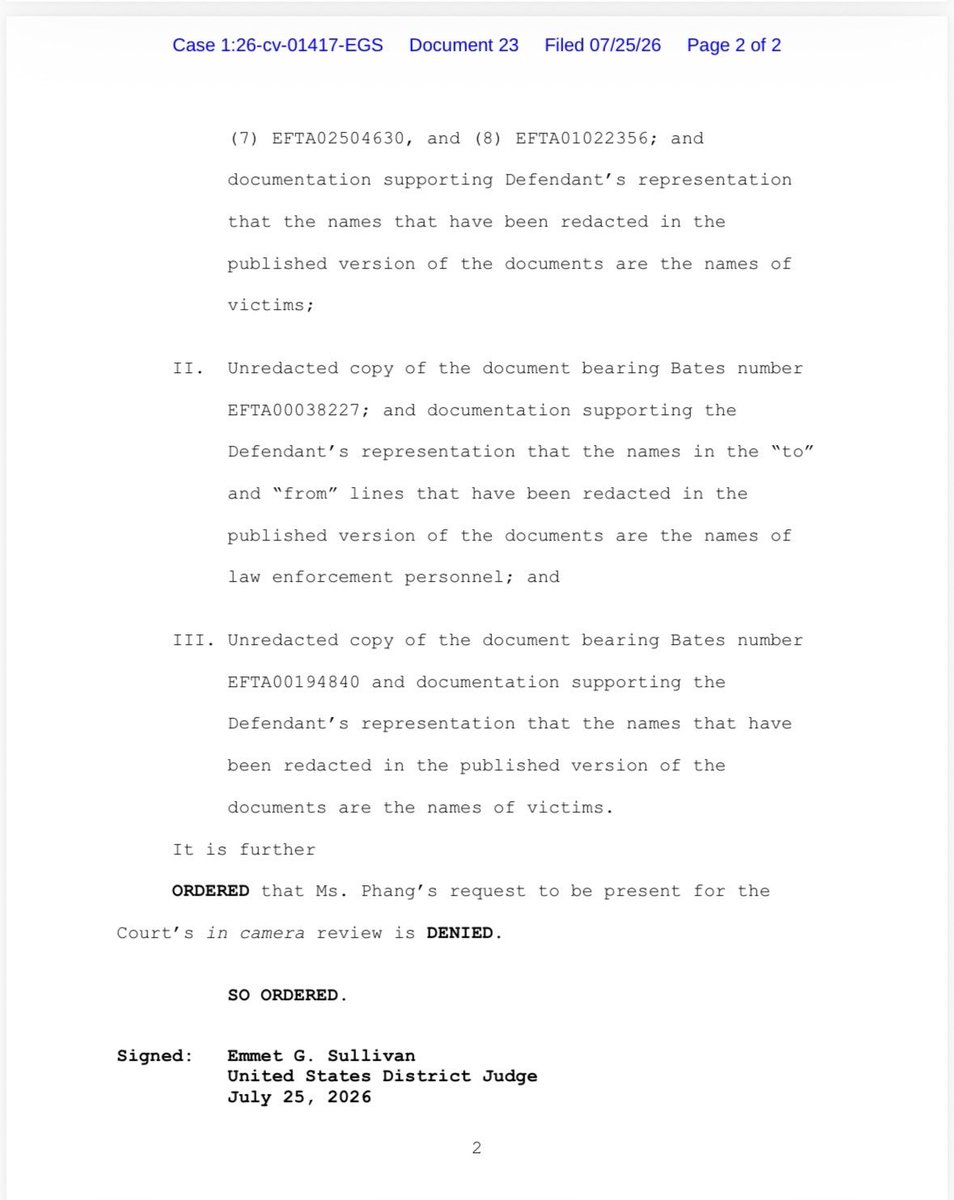
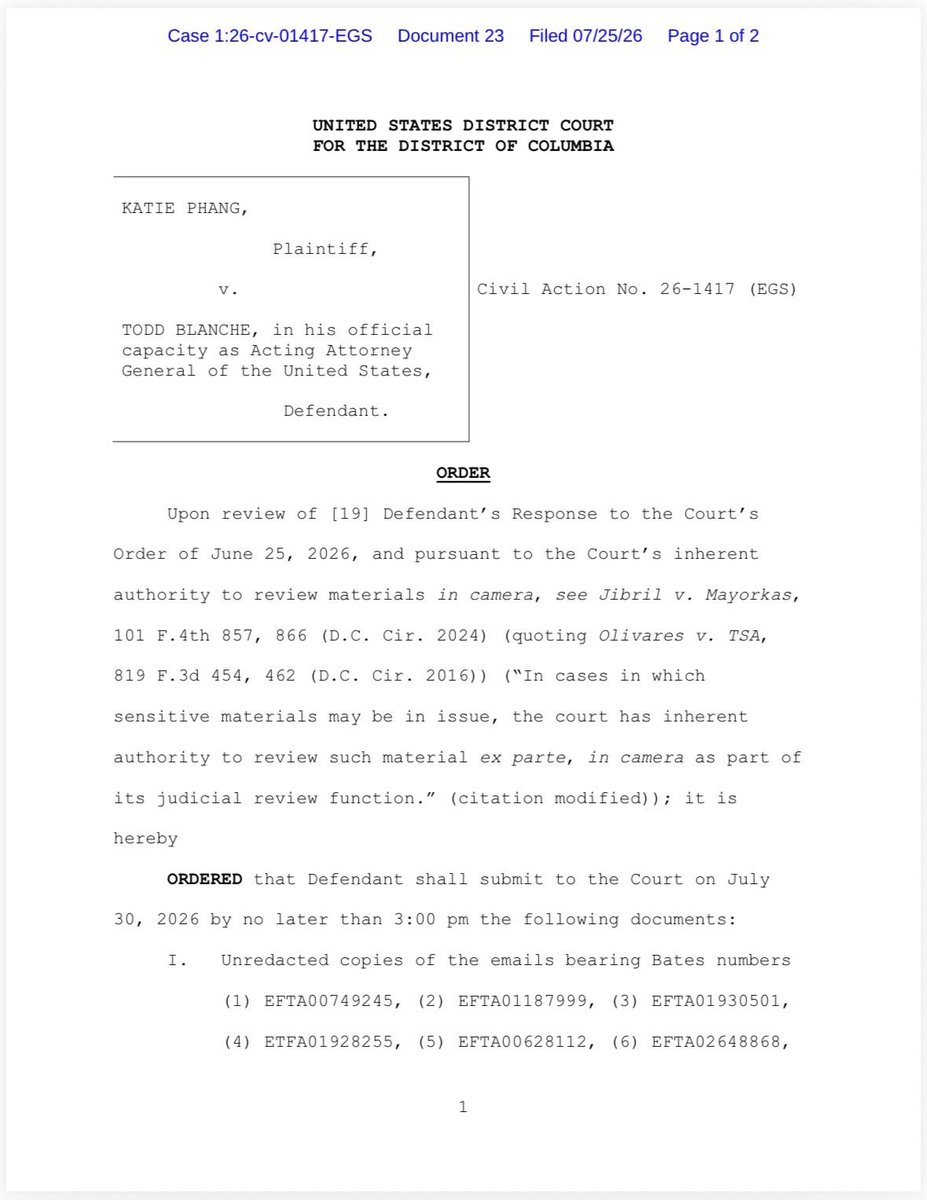
BREAKING: A federal judge has just ordered Acting Attorney General Todd Blanche to hand over the unredacted Epstein Files emails and documents for the court’s private review in MeidasTouch host Katie Phang’s lawsuit.
In a new order, U.S. District Judge Emmet Sullivan directed the Justice Department to produce the unredacted records in camera (for the judge’s eyes only) by July 30, along with documentation backing up DOJ’s claims that the names and other information it blacked out are, in fact, the categories of people it says they are.
That’s significant because the court isn’t simply accepting the government’s representations at face value. Judge Sullivan is requiring the DOJ to prove its redactions are justified by reviewing the underlying records himself. In other words—they’re not buying what the DOJ is selling!!
Katie Phang said that while the judge denied her request to be present during the in-chambers review, she said it was “worth the ask.”
This is another important step in the legal battle over the Epstein Files and whether the Justice Department has properly withheld information from the public.
Thank you, Katie! Remember to subscribe to her YouTube channel for all the updates: https://t.co/i8tFY7noLA
@Jenkins4Florida@RepHaridopolos He never answers emails and I have never found anything where he has town hall meetings in person. Always respectful with inquiries and nothing.