I have always believed that this space journey was never mine alone—it was Bharat’s journey to space. To give that belief a tangible form, I carried with me a few artifacts that embodied the spirit of our country.
These pieces, masterfully crafted by the brilliant students of the National Institute of Design, reflected the rich craft traditions of different regions of India—distinct in their origins, yet collectively representative of the nation as a whole. I was truly mesmerized by the depth of talent and thought behind their work.
And praise rarely gets higher than this: seasoned professionals at Axiom Space, who have already completed three international missions, said to me, “We’ve been doing this for a long time, but we’ve never seen such beautiful things go to space.”
That is the caliber of talent we have. That is the richness of culture we own.
My heartfelt kudos to the entire NID team—students and faculty alike—for their extraordinary work. It was an honor to carry to space the spirit of our country, shaped so beautifully by your hands. And now, I want these creations to reach every heartbeat of India.
I’m starting a series, where I’ll share each item in detail—and the story of why it earned its place in space.
#shux #space #india #axiom4 #shubhanshushukla
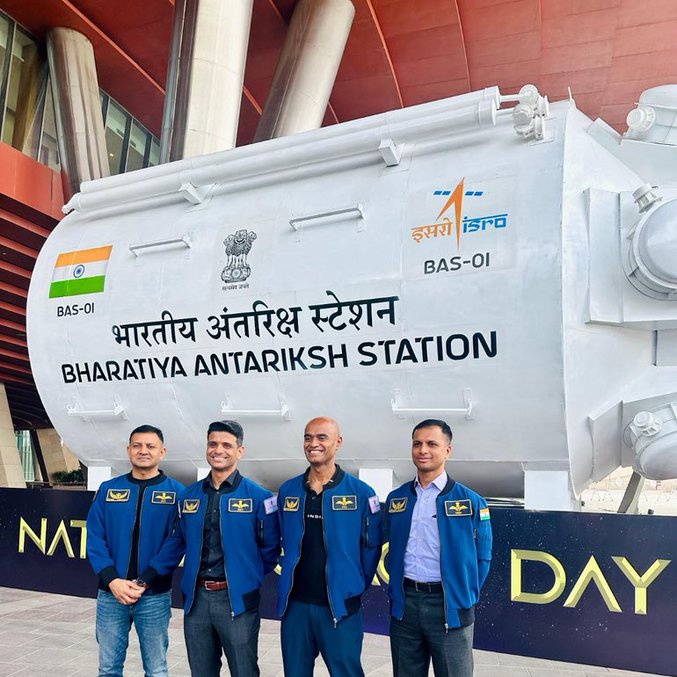
UPDATE ON Bharatiya Antriksh Station:
ISRO has finalised the overall configuration of the BAS-01 module, which is on track for launch in 2028. 🛰️
According to the Minister of DoS, Jitendra Singh, “overall system engineering of BAS-01 module and technology development activities of various subsystems are progressing well.”
The station is projected to become operational by 2035, representing a pivotal step in India’s evolving space program. The configuration was reviewed and endorsed by a National Level Review Committee, ensuring that the design aligns with the country’s long-term vision for human space exploration.
ISRO successfully conducted a key Integrated Main Parachute Airdrop Test (IMAT) for the Gaganyaan mission at Babina Field Firing Range, Jhansi, on Nov 3, 2025. The test validated the main parachutes under extreme conditions. #ISRO#Gaganyaan
For more information visit
https://t.co/r0bMFzN0xf
I’ll be back.” – The Terminator.
Yes, I’m sure you instantly heard Arnold’s voice in your head. But hold on—because what you’re about to see in this video is also the Terminator. Only this one isn’t hunting humans—it’s dividing the planet.
In astronomy, the terminator is the line that separates the day side of Earth from the night side. If you look closely in the video, you’ll notice this line slowly shifting across Earth’s surface.
Now, why is this line important? Well, for one, life on Earth dances to the beat of this day–night cycle. Plants photosynthesize by day, rest by night. Animals hunt, sleep, or pretend to work depending on whether it’s light or dark. Even humans—despite inventing electricity and coffee—still secretly obey this rhythm, which scientists call the diurnal cycle. In other words, without the terminator, life as we know it would be very confused.
But there’s more. The terminator also has geeky perks:
•Earth observation: The low-angle sunlight along the line casts long shadows, making features like mountains, forests, or even city skylines pop out more clearly. It’s basically Earth under cinematic lighting.
•Radio propagation: At the boundary, the ionosphere behaves differently, letting certain radio signals travel much farther. The three different layers D, E and F in ionosphere start shifting but still have heavy ionisation allowing communication over large distances. Old-school ham radio operators love this. It’s the original “international roaming plan.”
Now, astronauts? We can’t really use the terminator as our daily clock because, up here, we see it zip past us 16 times every single day. Imagine your day starting and ending every 90 minutes—you’d either never sleep or need a coffee IV drip.
So yes, that was a little space trivia for you. The Terminator isn’t just an Austrian cyborg with sunglasses—it’s also Earth’s most reliable timekeeper.
And on that note… Hasta la vista, baby.
#shux #space #axiom4 #shubhanshushukla #iss #isro
#india #ax4 #terminator
Ready for an ESCAPADE? 🚀
NASA’s twin spacecraft have arrived in Florida ahead of launch this fall! They’ll orbit Mars to study how the planet’s magnetic field protects it from space weather & drives atmospheric escape.
🔗 https://t.co/WbeTCxhnza
GSLV-F16/NISAR
Two Nations. One Mission.
🇮🇳 + 🇺🇸 = One mission to watch Earth. #ISRO#NASA builds, Earth benefits.
This marks a key milestone in Earth observation technology. Stay tuned as we bring you closer to the mission that watches our world.
For more information visit
https://t.co/Vgzdz4j90Q
#NISAR #GSLVF16 #ISRO #NASA
Tissue-integrated bionic knee restores versatile legged movement after amputation.
The new bionic prosthesis directly links to the body’s muscles and nerves enabling above-knee amputees to move with greater agility, precision, and sensory awareness.
.#Ax4 Pilot Shubhanshu Shukla has made history as the first astronaut from India to conduct a mission aboard the International Space Station, inspiring the next generation of explorers. @isro
Dr. V. Narayanan, Secretary, DOS/ Chairman, ISRO has launched the Bharatiya Antariksh Hackathon (BAH) 2025.
https://t.co/Cl90zIryIQ
Last date for submission of proposals is July 09, 2025.
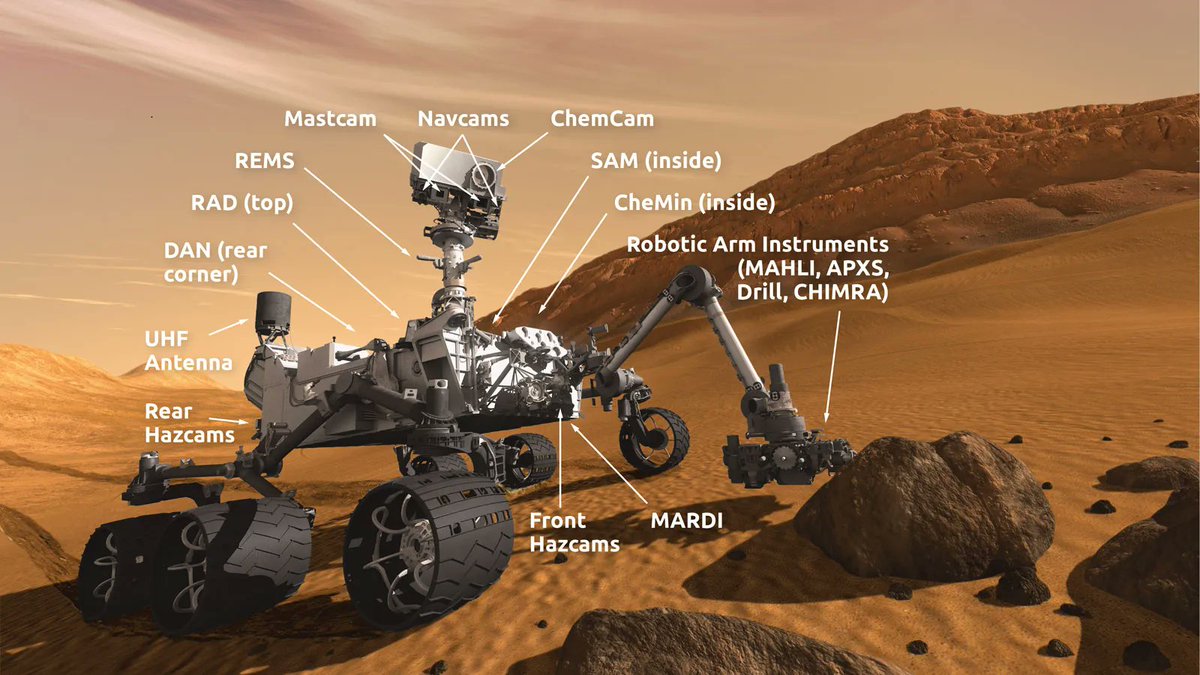
You know me as Curiosity, but my full name is “Mars Science Laboratory.”
I'm a lab on wheels: Built to analyze rocks, study the atmosphere, and hunt for signs Mars once had habitable conditions. It’s dusty work, but someone’s gotta do it!
Learn more: https://t.co/z3TZJ8Dj5z
NASA’s Lucy spacecraft is 1 day away from its encounter with the small main belt asteroid Donaldjohanson!
Lucy’s closest approach to Donaldjohanson will occur at 1:51pm EDT on April 20, at a distance of 596 miles (960 km).
LEARN MORE >> https://t.co/cmsRP00t5W
OroraTech Launches Wildfire Detection Constellation with Rocket Lab
OroraTech has launched the world’s first wildfire monitoring constellation with Spire Global, delivering real-time fire alerts and high-resolution thermal imaging. The eight satellites, deployed by Rocket Lab, provide critical data at night and during peak fire activity—times when public satellite data is unavailable.
🔗 Read more: https://t.co/0L34TzYxuu
#SpaceNews #WildfireMonitoring #SatelliteData #RocketLab #OroraTech