Lab at the Blizard Institute, QMUL, working on gene-environment interactions and their impact on health and disease in humans and other model organisms.
Check out this study in @ScienceAdvances by @deMendoza_Alex team, they discovered "Genomic incorporation of giant viruses is regulated by DNA methylation in unicellular eukaryotes. This bridges epigenetic regulation with deep eukaryotic evolution" https://t.co/88kxIQXK71
Congratulations to Eleonora Adami @Ele_Adami (https://t.co/5X8V0fuMHh) for winning £250 Amazon voucher for our new logo design competition for our new centre. Also, thank you, everyone, for sending their logo designs.
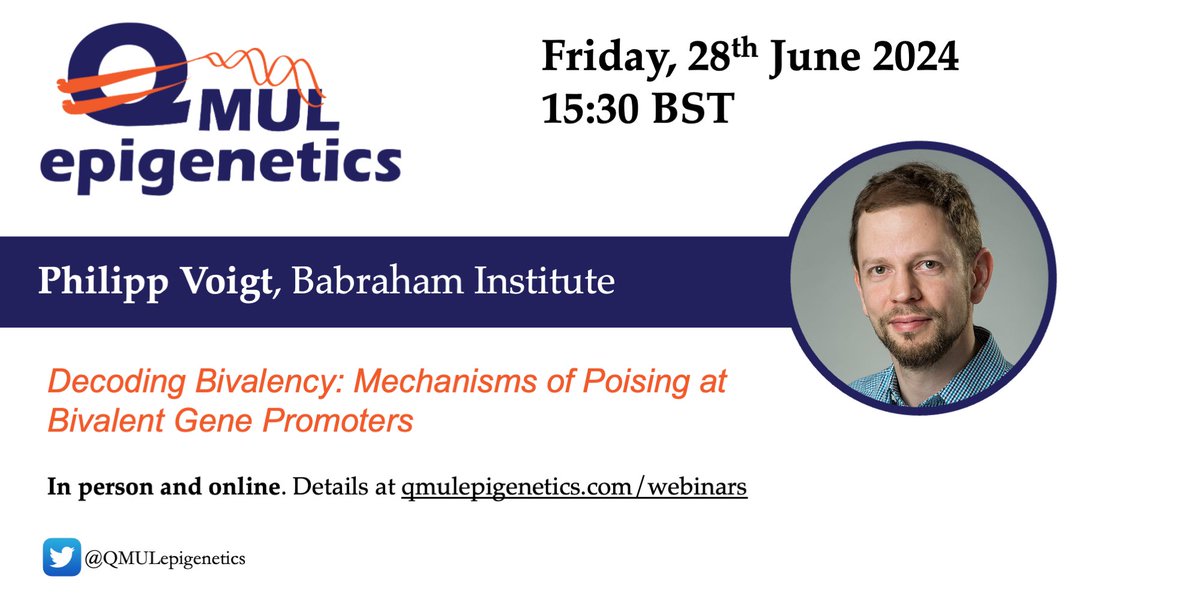
You are pleased to announce that Philipp Voigt (Babraham Institute) will speak at the @QMULepigenetics seminar series. Title "Decoding Bivalency: Mechanisms of Poising at Bivalent Gene Promoters" 28th June, 15:30 BST in person at @blizard_inst or online https://t.co/CbmwrgUFuM
🧵Excited to share our latest work, where we investigated how plants use DNA methylation to adapt to naturally fluctuating light regimes. Work led by the amazing @RobynAEmm and co-lead with @DrTracyLawson. great collab with @bechtis. https://t.co/pfLD3wgbfR @ResearchEssex 1/n
I´m thrilled to see our #LRGASP paper published in @naturemethods today. This is the work of many to benchmark long-read methods for transcriptomics, and a must-read paper for those using lrRNA-seq. Special thnks to @FJPardoPalacios and @TheBrooksLab (1/6)
https://t.co/xdLwq3LvLU
@frcbs_Tsinghua Looks like interesting work, but unfortunately completely neglected work by @PradeepMadapura's team, who last year demonstrated that LINE-1s act as distal regulatory elements: https://t.co/N1Fa30U5C6
This Sunday, June 2nd, I'll be at #eshg2024 in Berlin presenting poster about this. If you're around and want to have a chat, come see me at poster P17.072.A! Feedback extremely welcome ☺️☺️
QMUL Epigenetics 'Design a Logo' competition!
We are relaunching as the QMUL Centre for Epigenetics. Design a new logo for us & win a £250 prize! All details 👉https://t.co/8kfe2EizQX Deadline is 6pm GMT, June 6, 2024 and the competition is open to all. please RT
Forgot to say I'll be at the @Londonomics_net symposium this next Monday (May, 20th) giving a short talk about this work, in case you want to chat about it :)
Research led by @QMUL suggests that people with more copies of #rDNA have higher risks of developing inflammation and diseases during their lifetimes. https://t.co/U3a6ZgduEs
Analysis of previously unstudied areas of the human genome suggests people with more copies of ribosomal DNA have higher risks of developing disease.
🔗 Read more: https://t.co/PQJ7a0h8bl
@evans1_d
One interesting implication is that if rDNA genetic (and epigenetic) variation is ignored, then the associated phenotypes may seem to result from 'intangible variation' (rDNA variation occurs even in inbred mice).