Created a list of around 100 books that had major impact on me over the last two decades. These are also the books that I've re-read several times. https://t.co/GqWbFcc5HN
AI engineer roadmap for backend developers
If you can ship an API, a queue and a database, you're closer to an AI engineering job than most people with an ML certificate. The model call is one line. Everything around it is backend work.
Weeks 1-2: How LLMs actually work
- Karpathy's "Neural Networks: Zero to Hero". Watch "Let's build GPT" and the tokenizer lecture
- Jay Alammar's "The Illustrated Transformer" for the attention picture
- Count tokens with OpenAI's tiktoken before you count dollars
- Build: a CLI chat that streams replies and prints tokens and cost per turn
Weeks 3-4: Call models like an engineer
- Structured outputs with a JSON schema, then validate it anyway
- Timeouts, retries with backoff, streaming, fallbacks to a second model
- Prompt caching docs: what gets cached and why it cuts latency and cost
- Hugging Face LLM Course, first chapters, for the vocabulary
- Build: an extraction API. PDF invoice in, validated JSON out, with schema tests
Weeks 5-6: Retrieval on Postgres
- pgvector: embeddings inside the database you already run
- Chunking, hybrid search (keyword + vector), re-ranking, citations
- Build: Q&A over a real docs site that cites the exact chunk it used
Weeks 7-8: Evals, the part every roadmap skips
- Hamel Husain, "Your AI Product Needs Evals"
- Ragas for retrieval metrics like faithfulness and context precision
- Write 50 real test questions before you touch the prompt again
- Build: an eval harness that runs in CI and fails the build when answers regress
Weeks 9-10: Tools and agents
- Anthropic, "Building effective agents". Start with simple workflows, add agents only when the task needs them
- Lilian Weng, "LLM Powered Autonomous Agents" for the mental model
- Model Context Protocol docs: expose one internal API as a tool
- Build: an agent that turns a support message into a bug ticket, with a human approval step before anything is created
Weeks 11-12: Production
- Full Stack Deep Learning's LLM Bootcamp lectures (free)
- Log every prompt and response, track cost per request, p95 latency and error rate
- Rate limits, PII redaction, what happens when the provider is down
- Build: ship one project behind auth with a dashboard, plus a one-page design doc
How to use this:
- 6-8 hours a week. Build first, read when you get stuck
- Every build goes on GitHub with a README: problem, architecture, eval results, what broke
- Skip fine-tuning until the end. Most product teams need retrieval and evals first
- Pick builds that touch data you understand. Your own notes, your company's docs (with permission), public datasets
- If a week takes two weeks, fine. Don't skip the build
My take:
Queues, caching, idempotency, observability. The skills you already have are the job. The people who get hired can show an eval report, not a certificate.
Which week would you swap for your stack?
Matteo Vaccari claims that with agentic engineering we need to re-orient our testing strategy with broader-scope tests represented as data rather than code.
https://t.co/wSwCyMS5Gr
Long-horizon agents can automate tasks that take days or weeks, but much can go wrong. Kiran Prakash explains how durable execution allows agents to recover.
https://t.co/LUAR5OCl4M
NYU Prof. Aswath Damodaran, the world's leading valuation expert and AI skeptic, on the ‘AI will triple GDP’ hype:
“Real GDP growth has been lower globally over the last forty years than it was before PCs. All this stuff that claimed to make us more productive just redistributed wealth rather than make us all more wealthy.”
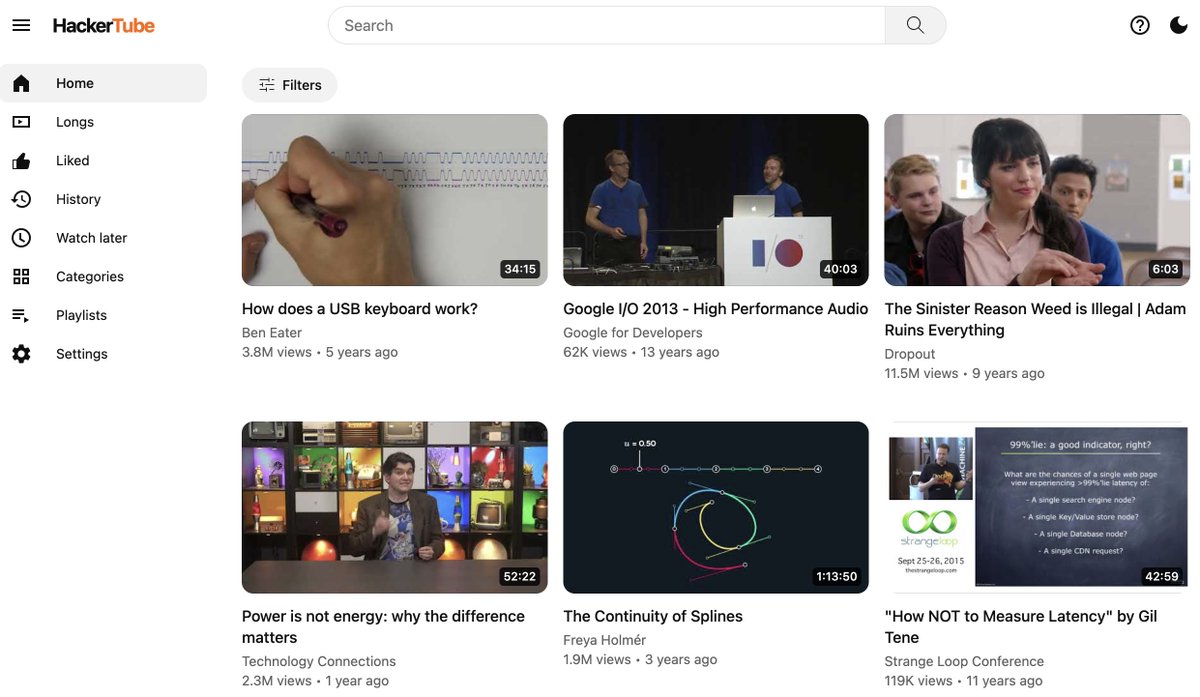
Weekend hack: HackerTube. I was annoyed with YouTube's recommendations so I had Claude filter down 43M comments over 20 years of HN to 6,454 videos that keep being recommended. *Significantly* better viewing experience, ~2 hours with Opus 5.5:
https://t.co/JIhXN7OSh1
- Excellent recs without any logins (state is kept in local browser session)
- Thumbnail is a representative frame from middle of the video instead of the super duper A/B test hyper-optimized user uploads
- Underlying data from the comment analysis as one zip file, point your Claude at it and ask for your own version
- HackerTube Longs ✊
A bit more on the process:
I use Claude Code (desktop app for Mac), Opus 5.5 on Medium effort as my default. I only talk to Claude and have it do everything, the only "manual work" I helped with in tandem was in the browser (reminiscent of MenuGen): 1) I had to create some kind of API key from Google Cloud UI to query YouTube for video metadata, 2) I booted up a VPS box for serving and 3) I bought the domain name. Once the box was up I gave Claude the IP and told it update, secure, harden, deploy and optimize the code, and it did the whole thing.
Many awesome projects that would have normally taken weeks/months even can now be few-shotted for breakfast. What else are we not thinking of.
Very excited to share Genie 4, our incredible interactive world model, bringing together real-time physics, reasoning, and audio! Simulations within simulations, makes you wonder just how deep the rabbit hole goes... I have a feeling we will be finding out soon enough...
What tasks should AI be trusted with, and when should humans remain involved? Designing those decision rights is one of the defining challenges of the AI era. Researchers at the MIT Center for Information Systems Research have developed a framework to help.
Learn more: https://t.co/NbTi0Vvd7Z
Last 3 overs of the epic knock of Virat Kohli in the Ind Vs Pak match, with scintillating commentary by the ausie commentator! 🔥 https://t.co/0UyuPYJLQJ
Here's my updated review of each personal agent:
1. Grok Bot
Pros: A team of bots is the easiest to understand. Free X access is amazing for research. Voice mode and the new Pages feature are great.
Cons: Email feature doesn't really work.
2. Muse
Pros: Free, best consumer UX, most meme-worthy avatar, and business calling is amazing.
Cons: Muse Wonder is good but Opus/Astra is better.
3. Claude Duet
Pros: Most proactive out of the box. Feels polished and simple to use. Arguably the best model behind it.
Cons: Missing some features in research preview, like being able to drive its browser.
4. ChatGPT Dots
Pros: Works inside ChatGPT, so it can drive all your cloud and local threads.
Cons: Much better than at launch but still buggy. Voice mode is slow to connect.
I've also tried Instinct and some of the other agents, but I don't want more than 4 at a time connected to my email.
📌 Don't miss my full Claude Duet review here for everything that it can do: https://t.co/EK28ETwWjD
Anthropic hired this engineer at $350K–$850K a year because he knows how to build harnesses for multi-agent systems
In a 12-minute workshop, he shows exactly how to build one from scratch
AI → Agents → Harness → Loops → Graphs
step 1 → start with the Claude Agent → the harness handles loops, context, and sandboxing
step 2 → separate the brain from the hands → reasoning in one place, tools in a sandbox, 60% faster to first token
step 3 → run it server-side and log every step → close your laptop and it keeps running, crashes resume from the log
step 4 → make failure cheap → retry dead sandboxes and replay lost context instead of starting over
step 5 → turn yesterday's logs into new memory and skills → the harness wakes up smarter
Anthropic calls this "dreaming"
Most people spend weeks building this by hand
You don't have to
Bookmark and watch it
Then read the full Opus 5.5 harness engineering guide below ↓
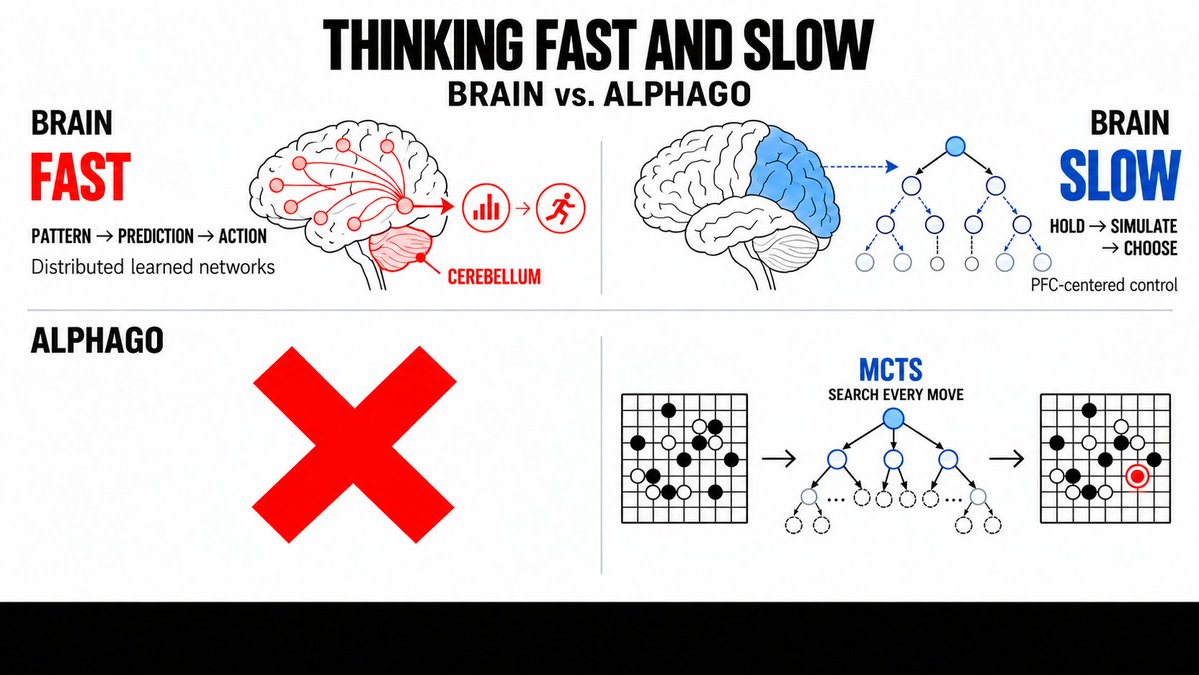
Remember Kahneman's Thinking, Fast and Slow?
The brain decides when to rely on learned patterns (sys1-fast/Cerebellum + distr. networks) vs. deliberate thinking (sys2-slow/Prefrontal Cortex). Energy and compute constraints necessitates efficiency.
Where is the System 1 for RL?
Ben Horowitz on treating your story as your strategy, and why founders often skip writing it even though it's one of the most important parts of the job:
"The story of the company is also the strategy of the company... In your mind, you're kind of adjusting that strategy a little bit at a time every day. But then a quarter later, it's actually pretty different than what you started with."
"So it's really important that you keep upgrading your story. The articulation of your story. I would definitely recommend it be in written form."
"Something that you can share with everybody in the company, and everybody you're recruiting, everybody you're trying to raise money from, all your constituents, every customer."
"The problem that I think founders have is it doesn't feel like work. Like, 'What are you doing today?' 'I'm working on my story.' That doesn't sound like work."
"Because it doesn't feel like work, people don't do it, but it's probably one of the most important parts of the job."
@bhorowitz w/ @speedrun GP @Tocelot
Must-read paper from Sakana AI on orchestrating coding agents for scientific research.
(bookmark it)
This is an important read with lots of useful insights if you are building multi-agent systems.
I like this work because it presents a concrete multi-agent framework and an end-to-end distributed pipeline that lets human researchers conduct computational research alongside modern coding agents.
What they did:
A development version of their system helped write a paper that was accepted as a main-conference talk at ALIFE 2026, after human verification and edits.
How they did it:
The Agentic Scientist splits a project into stages. Task drafting, ideation, planning, sandboxed experiments, baselines and ablations, analysis, and report writing each run on a coding agent that checks its own work. A meta-controller runs many of these agents in parallel and checks every stage against a rubric.
The ablations show that reliable autonomy depends on that orchestration layer as well as on the base model.
https://t.co/jOzTNOJB13
Chat with Paper: https://t.co/AZhJKXjcVL