Im starting to believe NP is just P with galactic exponents. So yes, P = NP might be true, but no, it won't change much in practice for cryptography etc. It just means we likely live in a simulation 😅
To elaborate -
If P = NP is proven & we get a practical polynomial-time algo for an NP-complete problem, modern cryptography largely collapses.
Most public-key systems (RSA, elliptic curves, Diffie-Hellman) rely on the hardness of problems that would suddenly become efficiently solvable. TLS, banking, digital signatures, secure messaging, and most of blockchain infra would become insecure unless built differently. Society would need an emergency global transition to new foundations - only info-theoretically secure methods (one-time pads) or certain quantum schemes would remain safe by default.
The upside is enormous: optimal solutions for logistics, scheduling, protein folding, circuit design, and countless optimization problems become feasible. But “polynomial time” can still be useless in practice if the degree or constants are huge, and a non-constructive proof would change almost nothing on its own.
But yeah - god help us if proven true.
Glad to see OpenRouter moving to privacy-preserving technologies! Privacy with pure math (like FHE) is the holy grail: you almost wouldn't have to worry about infrastructure security anymore, but its overhead compared to plaintext is still too large for business today.
That makes TEEs the only practical option right now: easiest to set up, with the lowest overhead.
But there's a big misconception about what TEEs actually offer.
By default, they encrypt VM memory, making it very hard for the host operator to inspect the machine and extract data. That helps when you don't trust the underlying provider (i.e. you are worried about AWS or Google looking in your VM). That's not the threat model OpenRouter is interested in here.
The main threat is bugs, misconfigurations, or exposed interfaces in the software itself allowing attackers to extract sensitive data, and a TEE does nothing to prevent that. Once you look past host-level snooping, the only remaining protection a TEE adds is remote attestation: a cryptographic guarantee of which exact software is running inside the machine.
Mentionning things like "encrypted TEE" (memory encryption is already built in) or "E2E encrypted" also oversimplify how TEEs work. Prompts still have to be decrypted inside the enclave to run inference. So, put the same vulnerable software that got hacked into a TEE, and you add zero security against software flaws; you just get a way to prove to users which exact software you're running.
The way to make this actually work is:
- harden and intensively audit the stack (with TLS terminating inside the enclave and attestation verified before routing),
- either open-source it with reproducible builds so anyone can verify the code behind the hash,
- or go the Apple / Google route: rely on trusted auditors and public transparency logs (like Apple's Private Cloud Compute) to vouch that a specific build hash is genuinely secure and privacy-preserving.
Either way, the security and privacy engineering has to be just as solid as if we were simply trusting providers to implement it properly. A TEE doesn't replace that work, it simply gives you verifiability that the audited stack is what's actually running.
So: Use of TEE to enforce ZDR and prove that this policy is respected sounds like a great match, this adds trust. But by no means do TEE add security / privacy by default. The encrypted memory feature is not that important.
Some thoughts on lattice security following Nigel’s paper:
1. this is likely not the only attack that will be discovered. If we could find this, then for sure the big AI labs have something better. We have some of the best lattice cryptographers in the world, but AI labs have unlimited computing power and access to models far more advanced than ours.
2. It’s likely sub-exponential attacks on lattices would require galactic levels of compute and memory, making them moot on classical computers and probably not tractable on quantum computers either. Good theoretical result, no impact in practice.
3. If anything, it might help us design even better lattice schemes, that are even more secure against PQAI. Which means faster FHE too!
4. even if lattices were completely broken, this would NOT put user funds at risk in the Zama protocol. Contrary to breaking ZK which allows double spending, breaking FHE “only” means revealing user balances, not stealing funds or double spending.
5. And if that somehow happened, we have a plan B, which would enable us to offer the exact same service without relying on lattices. It would have different tradeoffs of performance/decentralization, but it would allow us keeping all contracts as is, and simply swap out the FHE coprocessors for something else in the background.
Tldr; everything’s gonna be fine, lets keep building!
Ring-LWE is sub-exponential (at galactic parameters).
What does it mean in practice for lattice cryptography? Nothing for actual production parameters used in real cryptosystems such as those for PQ-encryption and FHE.
The result is the application of recent results on ETH, and similar results on ECDLP, to the Ring-LWE problem.
Cool result by @zama’s chief cryptographer, Nigel Smart
https://t.co/KZvJgTSrCr
Ring-LWE is sub-exponential (at galactic parameters).
What does it mean in practice for lattice cryptography? Nothing for actual production parameters used in real cryptosystems such as those for PQ-encryption and FHE.
The result is the application of recent results on ETH, and similar results on ECDLP, to the Ring-LWE problem.
Cool result by @zama’s chief cryptographer, Nigel Smart
https://t.co/KZvJgTSrCr
Deploying on the protocol is free and doesnt require a license. You only need a license if you want to use our tech outside the Zama Protocol, and yes, we will charge you money for that.
We also never pretended to build cypherpunk products, and have no interest in being Tornado or ZEC. Our goal is to build infra for institutional finance, and that comes with a very different list of requirements, including compliance etc. This has been our pitch from day 1, nothing changed.
Bitcoinjust hit the efficent mining cost, meaning all miners are in loss.
Other than the covid low this line never breaks, so I will buy.
Its the strongest support line that btc has.
Literally. It broke 1x in 18 years.
0/ Privacy on Ethereum has mostly been ZK-pilled, FHE allows a different kind of privacy - privacy that lives on shared state, composable across contracts, quantum secure and aligned with Ethereum’s core building blocks.
A guest thread by @arik_g from @zama
Zama is ON FIRE this week!
@Zama has had perhaps the busiest week of its entire existence. In the past few days alone, $ZAMA has announced partnerships and technical collaborations with...
- @plumenetwork
- @yield_xyz
- @NUVAFinance
- @YuzuMoneyX
- @Re7Labs
- @Ondo
- @saturn_credit
... to name just a few.
It's rare to see momentum like this from any crypto platform, let alone in market conditions like these!
Another important update: we are changing the way we distribute Zama incentives.
Instead of topping up the APY at a fixed rate, we are now distributing a fixed amount of incentives per campaign. This means the APY of a vault goes up if its TVL goes down and vice versa.
Read more here: https://t.co/acEU7y7xC2
Ondo Stocks now supported by Zama.
A new vault lends against Ondo Stocks while Zama’s encryption keeps individual deposit sizes and positions confidential.
Curated by Re7 on Morpho, the vault brings a new layer of confidentiality to onchain lending.
Big launch today! We listed 5 new exciting vaults giving LPs exposure to institutional RWAs and private credit onchain.
We are making Zama the best place to find and build composable yield strategies, without anyone knowing what you are doing.
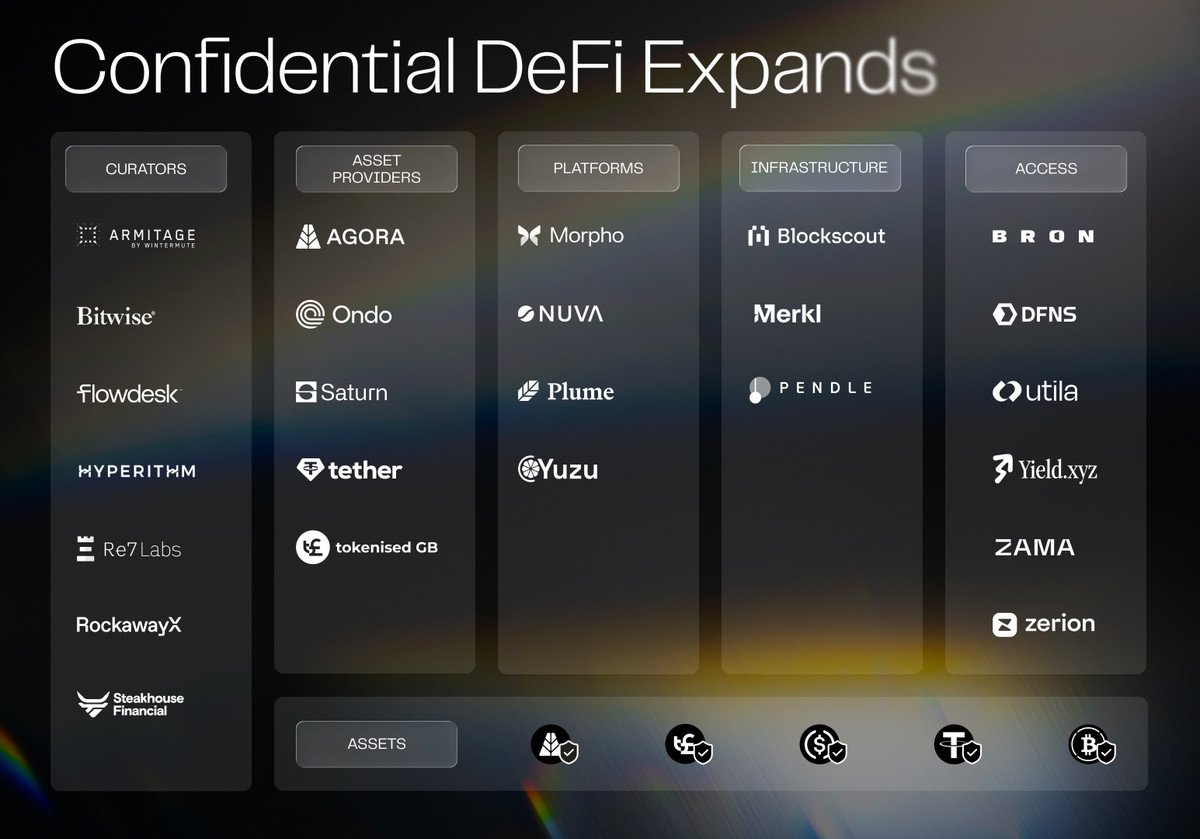
Confidential DeFi is expanding.
Today, we're launching 5 new confidential vaults across 4 platforms, each with a new strategy.
The first confidential vault was launched in June. By September, there were 16 vaults, with TVL reaching an all-time high of over $110M in October. Now Confidential DeFi goes beyond a single platform and into a growing ecosystem.
What's live:
- Re7 Confidential Ondo USDC: RWAs on @Ondo tokenized equities, curated by @Re7Labs on @Morpho
- BlackOpal LiquidStone II: private credit backed by Brazilian receivables, on @plumenetwork
- Saturn Confidential USDC: digital credit and Ondo Stocks, by @saturn_credit and @hyperithm, live on @Morpho
- HOME: private credit in U.S. residential housing loans, on @NUVAFinance
- Yuzu Confidential USDC: diversified USDC yield, on @YuzuMoneyX
All 5 vaults take Confidential USDC (cUSDC) deposits, and every depositor's position stays confidential onchain.
Beyond the vaults, a full stack of wallets, custody providers, and DeFi infrastructure now supports confidential tokens.
Powered by the Zama Protocol. Shield, send, deposit, earn, and swap confidentially at https://t.co/u8HcSVa8dH
Full announcement: https://t.co/G0hcJwVJ3j