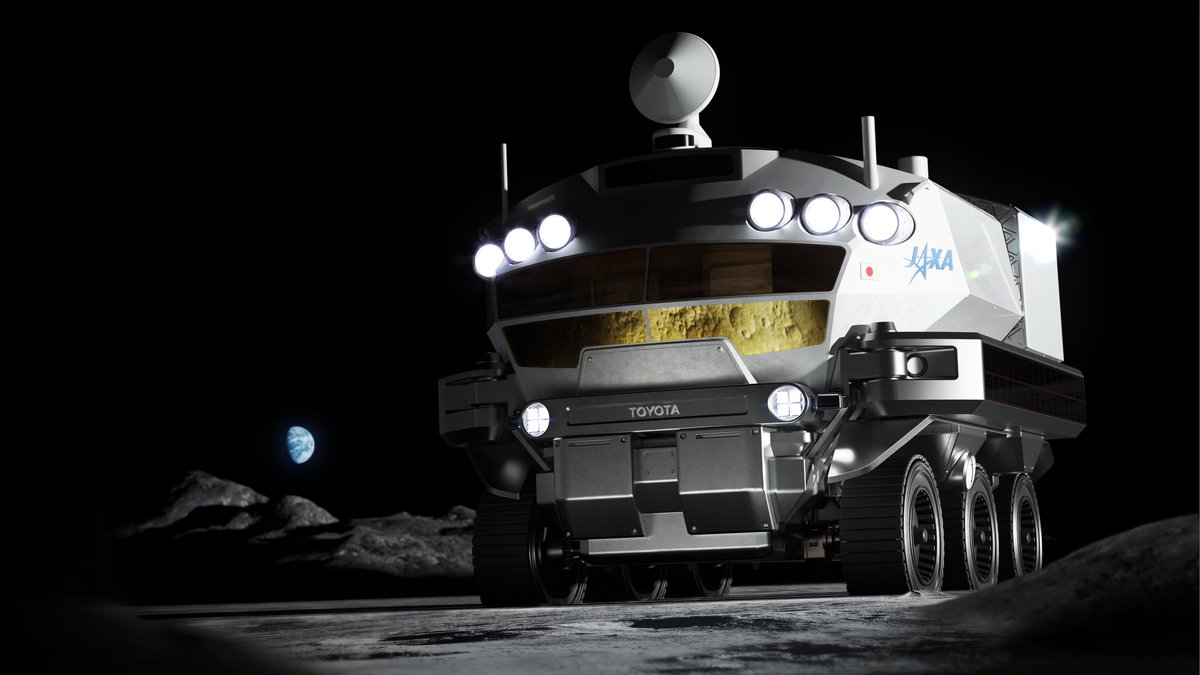
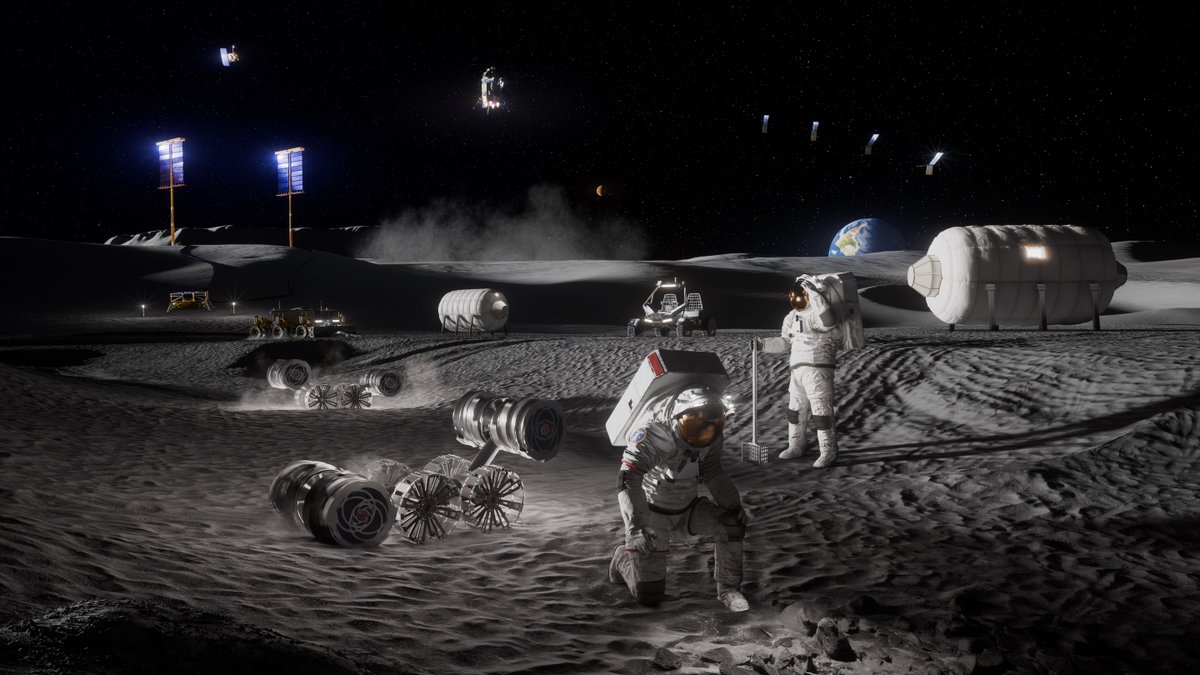
NASA has just launched a new website for its Moon Base missions, which aims to build a permanent $20 billion U.S. base on the Moon. @SpaceX's Starship rocket will play a big role in these missions.
"The Moon Base is a home away from Earth for Artemis astronauts who will live and work at humanity’s first lunar outpost. NASA is leading global teams of innovators across international space agencies, industry, and academia to build the Moon Base and establish an enduring human presence near the lunar South Pole for the benefit of all.
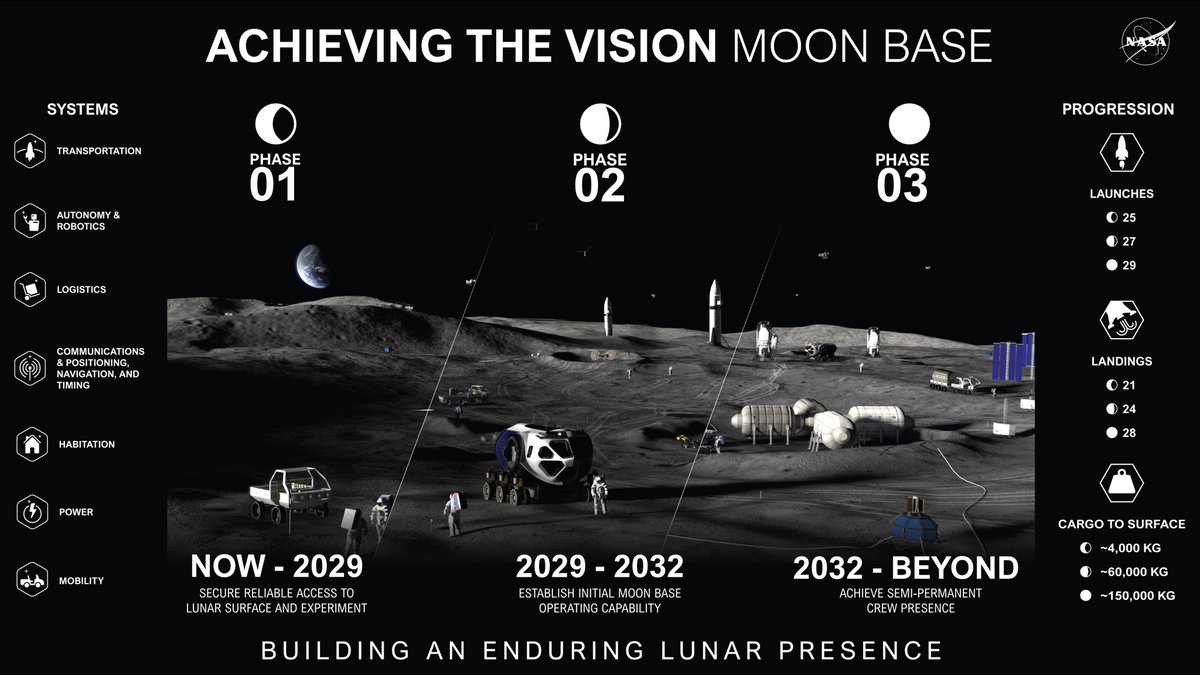
Phase One (Now–2029): Experiment and Learn
NASA will begin with a rapid series of robotic missions to scout the lunar South Pole region, test technologies, and prepare for surface operations ahead of future astronaut missions.:
• A major increase in lunar activity, with up to 25 missions, including 21 landings.
• Crewed and autonomous rovers for mobility demonstrations and surface preparation, along with four drones known as MoonFall and communications relay and observation satellites.
• Early demonstrations of power, navigation, communications, and nuclear radioisotope heater unit technologies designed to endure the long lunar night.
• Scientific payload opportunities integrated across landers and rovers.
• The first tangible footprint of Moon Base effort, with four tons of payload delivered to test what works on the lunar surface.
Phase Two (2029–2032): Early Habitation
By 2029, NASA will transition to assembling semi-permanent infrastructure and initiating early habitation and logistics operations:
• Deployment of expanded solar power systems and initial nuclear surface power capabilities, potentially including fission reactors and radioisotope power systems.
• Upgraded rovers, potential advanced MoonFall drones, and early habitation elements.
• Enhanced surface-to-orbit communications networks to provide reliable connectivity across the lunar South Pole region.
• Delivery of up to 60 tons of cargo through as many as 24 landings using low-, medium-, and heavy-class cargo landers.
Phase Three (2032 and Beyond): Sustained Human Presence
This phase will scale operations to achieve a true enduring presence, with routine crew rotations and continuous surface activity. This is when living and working on the Moon becomes a reality:
• Semi-permanent habitation modules with spacious interior for crew living and operations.
• Operational fission surface power systems capable of delivering steady, reliable energy through the long lunar nights, leveraging in situ resource manufacturing.
• Advanced logistics networks supported by crewed and autonomous rovers to keep the base supplied and functioning year-round.
• Delivery of up to 38 tons of cargo annually to sustain habitats, power systems, logistics operations, and major science outposts, enabled by low-cost reusable heavy-lift capabilities."
Moon base website: https://t.co/nefXl3J2FR
Scientists are developing a revolutionary form of spacecraft propulsion based on nuclear fusion, the same energy process that fuels the Sun.
Conventional chemical rockets currently require approximately 500 days for a round-trip mission to Mars. Such extended journeys expose astronauts to prolonged radiation, muscle atrophy, bone density loss, and other significant health hazards.
Fusion-powered rockets promise to transform interplanetary travel. Rather than relying on traditional chemical combustion, these advanced systems would produce thrust through rapid, controlled fusion reactions. In leading designs, powerful magnetic fields compress small quantities of plasma, initiating fleeting fusion events that unleash vast amounts of energy.
This energy would then heat and expel propellant at extraordinary velocities, delivering far greater efficiency and performance than today’s rocket engines.
According to current projections, fusion propulsion could slash Mars transit times to between 30 and 90 days one way.
The technology remains in its early stages. While researchers have successfully demonstrated key components in laboratory settings, a complete, operational fusion rocket has yet to be built. Substantial engineering hurdles persist, such as maintaining stable fusion reactions and engineering systems robust enough for the harsh environment of space.
Nevertheless, the promise is profound. Should fusion propulsion mature, it could revolutionize solar system exploration by making journeys to Mars, and beyond, dramatically shorter, safer, and more feasible than ever before.