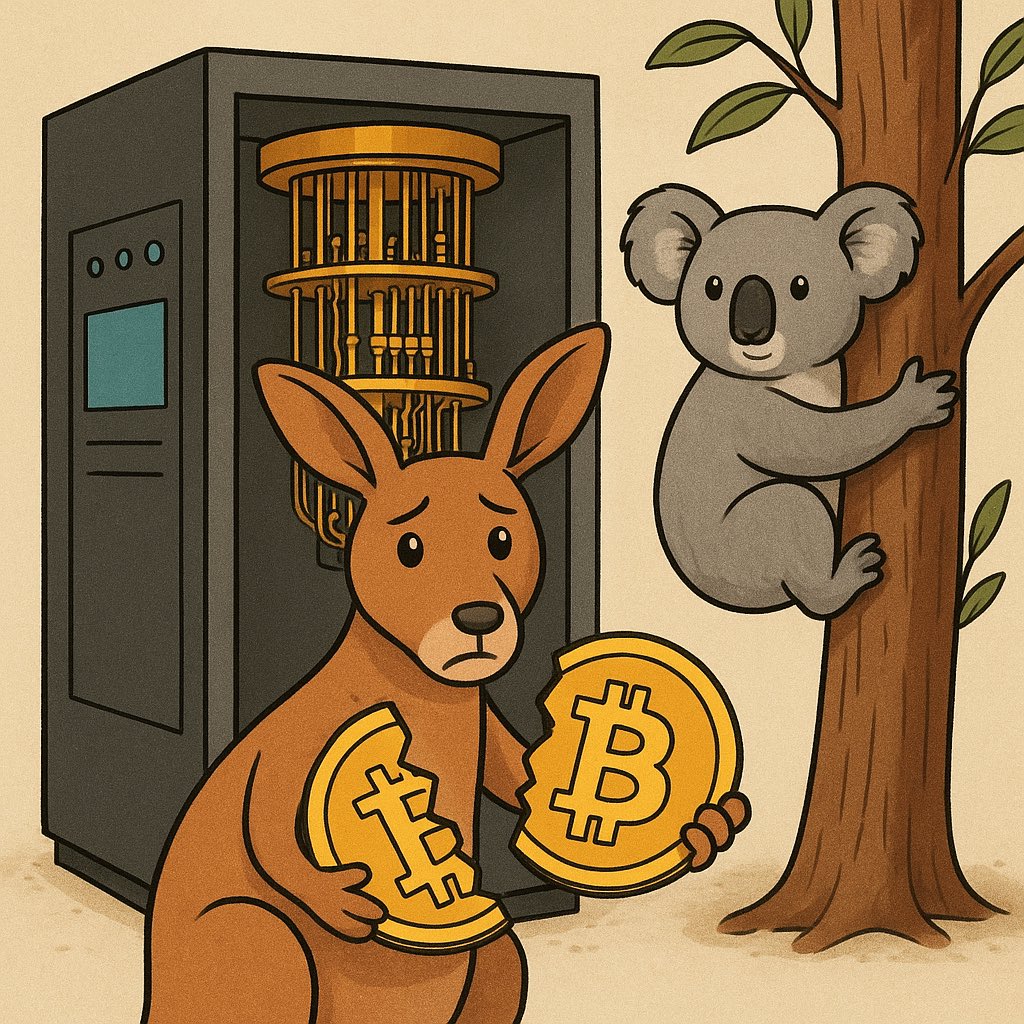
#Raqcoin
1.Quantum resistant
2.Multivariate Dig Sig with #zipcodinization
3.90-year Proof-of-Work
4.Reduce quarter every 4 years
5.Crypto-agility(Rainbow&UOV)signature,Convert between addresses of different security levels (7kinds)
GitHub 👇
https://t.co/0gWbW12KNC
A brief history of Quantum computers 👇
1905: Albert Einstein explains the photoelectric effect and suggests that light consists of quantum particles or photons
1924: Max Born uses the term quantum mechanics for the first time
1925: Werner Heisenberg, Max Born, and Pascual Jordan formulate matrix mechanics, the first formulation of quantum mechanics
1925-1927: Niels Bohr and Werner Heisenberg develop the Copenhagen interpretation, one of the earliest and most common interpretations of quantum mechanics
1930: Paul Dirac publishes The Principles of Quantum Mechanics, a standard textbook on quantum theory
1935: Albert Einstein, Boris Podolsky, and Nathan Rosen publish a paper highlighting the counterintuitive nature of quantum superposition and arguing that quantum mechanics is incomplete
1935: Erwin Schrödinger develops a thought experiment involving a cat that is simultaneously dead and alive, and coins the term “quantum entanglement”
1944: John von Neumann publishes Mathematical Foundations of Quantum Mechanics, a rigorous mathematical framework for quantum theory
1957: Hugh Everett proposes the many-worlds interpretation of quantum mechanics, which suggests that every possible outcome of a quantum measurement actually occurs in a parallel universe
1961: Rolf Landauer shows that erasing a bit of information dissipates a minimum amount of energy, known as Landauer’s principle
1965: John Bell proves that quantum entanglement cannot be explained by any local hidden variable theory, known as Bell’s theorem
1973: Alexander Holevo proves that n qubits cannot carry more than n classical bits of information, known as Holevo’s theorem or Holevo’s bound
1980: Paul Benioff proposes a model of a quantum Turing machine, a theoretical device that can perform any computation using quantum mechanical principles
1981: Richard Feynman suggests that simulating quantum systems would require a new type of computer based on quantum mechanics
1982: David Deutsch generalizes Benioff’s model and proposes the concept of a universal quantum computer
1984: Charles Bennett and Gilles Brassard develop a protocol for quantum key distribution, which allows two parties to securely exchange cryptographic keys using quantum states
1985: David Deutsch and Richard Jozsa devise an algorithm that can solve a specific problem faster than any classical algorithm, known as the Deutsch-Jozsa algorithm
1991: Artur Ekert proposes another protocol for quantum key distribution based on quantum entanglement, known as the E91 protocol
1992: David Deutsch and Richard Jozsa extend their algorithm to handle multiple inputs, known as the Deutsch-Jozsa algorithm
1994: Peter Shor discovers an algorithm that can factor large numbers in polynomial time using a quantum computer, known as Shor’s algorithm
1996: Lov Grover invents an algorithm that can search an unsorted database in square root time using a quantum computer, known as Grover’s algorithm
1997: Isaac Chuang, Neil Gershenfeld, and Mark Kubinec demonstrate the first implementation of Shor’s algorithm using nuclear magnetic resonance (NMR) techniques
2000: David DiVincenzo proposes five criteria for building a practical quantum computer, known as the DiVincenzo criteria
2001: IBM researchers implement Grover’s algorithm using NMR techniques and achieve a modest speedup over classical algorithms
2007: D-Wave Systems claims to have built the first commercial quantum computer, but its validity is disputed by many experts
2019: Google announces that it has achieved quantum supremacy by performing a calculation on a 53-qubit quantum processor that would take a classical supercomputer thousands of years to complete
2020: IBM demonstrates that its 65-qubit quantum processor can perform calculations beyond the reach of any classical computer
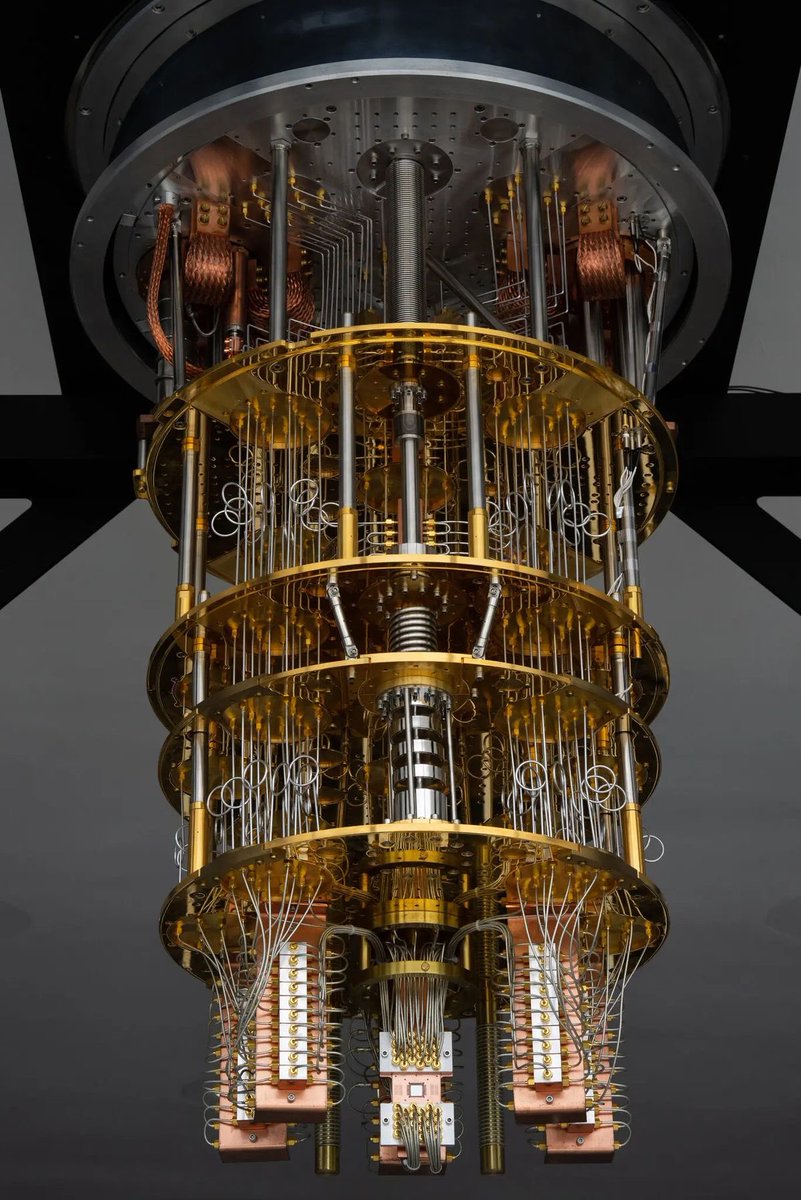
📷 An IBM QC photographed by James Estrin
Physicists discovered a quantum effect called retrocausality, where present choices seem to influence past events. In delayed-choice experiments, a particle’s behaviour appears shaped by measurements made after it travelled, as shown in Wheeler’s proposals and later tests like the delayed-choice quantum eraser. While it doesn’t enable time travel, it challenges cause-and-effect, sparking debate on how to interpret quantum mechanics and the deep interconnection of reality.
Quantum computing harnesses the principles of quantum mechanics-like superposition and entanglement-to perform computations. Unlike classical bits, qubits can represent 0 and 1 simultaneously, enabling massive parallelism. This makes quantum computers ideal for problems like cryptography, material science, and optimization.
⚛️ Gidney from Google showed a 20x reduction in the qubits needed to run Shor’s, reducing the count from 20 million to 1 million.
🐱 For reference, with our previous LDPC-cat architecture, we estimated it could be done with 100k qubits… 👀
🤔 So, how did they do it? 3 main tricks:
🧠 A clever algorithmic innovation drawing from number theory (Chevignard et al. 2024), enabling more efficient factorization of large numbers, cutting qubit needs by around 4-fold.
🧮 Storing qubits more efficiently using yoked surface codes (Gidney et al. 2023). This allows for each physical qubit to participate in multiple logical qubits, reducing the physical-to-logical qubit ratio.
✨ Making magic state factories smaller, thanks to magic state cultivation (Gidney et al. 2024). Magic states are essential for implementing all the gates we need for useful quantum computation. This method gets us these special states with fewer time and qubit costs.
But it’s not just about circuit optimizations, it’s about fitting the algorithm with hardware and making sure these tricks work well together. 🤝
🔍 The quantum era will begin when the systems we can build and control meet what we need to run useful algorithms. The first is increasing at a rapid pace while scientists come up with optimization after optimization to reduce algorithm resource requirements. 🚀
…Don’t sleep on cats, we're also working on the algorithms side to make useful fault-tolerant quantum computing happen sooner than what we'd expect, and the numbers will surprise you. 😉
Read the paper: 👉 https://t.co/knBego2g5f
Links to the previous papers in the comments 👇
#QuantumComputing #ShorsAlgorithm #Physics #Innovation
"Quantum computing will be THE seismic event for blockchains in the next 5-10 years"
Project 11 CEO @apruden08 and Andrea Rochetto, co-founder of @ephos_io discuss the development of quantum computing, threat model, and how to prepare. Thanks to @usv for hosting!
Reliable quantum computing requires progress across the full stack, from error correction to hardware.
With new 4D codes reducing error rates 1,000x, and our co-designed quantum system with @Atom_Computing, we’re bringing utility-scale quantum closer than ever.
#TechNews from the EU
The EU is urging member states to adopt quantum-safe encryption by 2030, focusing on Post-Quantum Cryptography and Quantum Key Distribution to secure critical sectors from future quantum threats.
https://t.co/Nilp2FQllF
Quantum computers offer only quadratic speedups for symmetric crypto, making AES & hashes safer than public-key systems.
#Cryptography#QuantumSecurity
#Raqcoin
1.Quantum resistant
2.Multivariate Dig Sig with #zipcodinization
3.90-year Proof-of-Work
4.Reduce quarter every 4 years
5.Crypto-agility(Rainbow&UOV)signature,Convert between addresses of different security levels (7kinds)
GitHub 👇
https://t.co/0gWbW12KNC
🚨 A quantum computer just solved a problem in 2 minutes that would take Earth’s fastest supercomputer over 7 million years.
The crazy thing about this is that it runs at room temperature!
Welcome to the age of photonic quantum computing.
Here’s why this changes everything 🧵👇
#Raqcoin
1.Quantum resistant
2.Multivariate Dig Sig with #zipcodinization
3.90-year Proof-of-Work
4.Reduce quarter every 4 years
5.Crypto-agility(Rainbow&UOV)signature,Convert between addresses of different security levels (7kinds)
GitHub 👇
https://t.co/0gWbW12KNC
#Raqcoin
1.Quantum resistant
2.Multivariate Dig Sig with #zipcodinization
3.90-year Proof-of-Work
4.Reduce quarter every 4 years
5.Crypto-agility(Rainbow&UOV)signature,Convert between addresses of different security levels (7kinds)
GitHub 👇
https://t.co/0gWbW12KNC
#Raqcoin
1.Quantum resistant
2.Multivariate Dig Sig with #zipcodinization
3.90-year Proof-of-Work
4.Reduce quarter every 4 years
5.Crypto-agility(Rainbow&UOV)signature,Convert between addresses of different security levels (7kinds)
GitHub 👇
https://t.co/0gWbW12KNC