Illegal Research Activities Driven Off
Chinese Marine Research vessel Xiang Yang Hong 22 was found in waters east of Taiwan between June 10 and 19. While lingering in the northeast of Taiwan, the vessel was warned off by Taiwan Coast Guard: "THIS IS NOT YOUR WATER. YOU DON'T BELONG HERE."
Activities of Chinese researxh vessels will be CLOSELY WATCHED. Taiwan is governing the water effectively and responsibly.
Taiwan's participation to 2026 Our Ocean Conference (OOC) encountered barbaric obstruction. Visas issued to scientists and experts were revoked at the last minute, and those managed to reach the conference were not allowed in, even their passports and phones were confiscated, their personal freedom infringed for an extended time of more than 20 hours.
The OAC strongly condemns the severe political interference, and calls for the OAC to honor its founding visions of professionalism and inclusive participation. As OAC Minister Kuan Bi-ling says, "the world's ocean needs deeper and wider cooperation. Political interference yields no benefit for ocean governance."
Taiwan's participation to 2026 Our Ocean Conference (OOC) encountered barbaric obstruction. Visas issued to scientists and experts were revoked at the last minute, and those managed to reach the conference were not allowed in, even their passports and phones were confiscated, their personal freedom infringed for an extended time of more than 20 hours.
The OAC strongly condemns the severe political interference, and calls for the OAC to honor its founding visions of professionalism and inclusive participation. As OAC Minister Kuan Bi-ling says, "the world's ocean needs deeper and wider cooperation. Political interference yields no benefit for ocean governance."
Chinese harassment around Itu Aba (Taiping): right after in Taiwan's east
Chinese two vessels' first intrusion into Taiping Island's prohibited waters reflects a continuous escalation of provocations. Totally unprovokes, China is systematically harrassing Taiwan. It also proves that what China did in waters east of Taiwan should be dealt with as a challenge to international order; Japan-Philippines talks was just an excuse.
#TaiwanCoastGuard #OACROC
🚨THE BASHI BREAKOUT: 🇨🇳#China has, for the first time, pushed a paramilitary sovereignty assertion past its own "10-dash line" & beyond the First Island Chain to challenge a maritime negotiation it isn't party to.
On May 28, 🇯🇵#Japan & the 🇵🇭#Philippines announced they would delimit their overlapping exclusive economic zones as prescribed by #UNCLOS. Beijing's answer was to send a flotilla through the Bashi Channel & into the open Pacific east of 🇹🇼#Taiwan, into waters that even its own most expansive maps don't (yet) claim.
The key is in which ships Beijing sent: China uses its navy to assert capability--what it can do by force. It uses its coast guard & other government ships as a paramilitary force to assert sovereignty--what it claims.
Not one ship in this flotilla was a warship, because this was a sovereignty claim.
That's what's really new here. For over a decade China used these same gray-zone tactics to assert sovereignty inside its South China Sea "nine-dash line". This week's action pushed somewhere new--going past even the 10th "dash" Beijing added to its 2023 map.
Beyond the First Island Chain.
This assertion was aimed not at Taiwan alone, but at two 🇺🇸US treaty allies. @China_MFA branded the Japan-Philippine talks "completely illegal and void", while a June 1 @globaltimesnews editorial called the idea "an extraordinary and almost unprecedented absurdity… akin to two neighbors sitting in your living room and discussing how to divide your backyard."
Note how China's "backyard" continues to expand. So, in fact, does its "living room".
What SeaLight's tracking shows:
🔹 From 1-5 June, CCG cutters Daishan (2502) & Baita (2304) ran the first clockwise patrol over 200nm east of Taiwan's easternmost island--well past the 10th "dash" on Beijing's 2023 map.
🔹 Late on June 7th, a second wave of 3 provincial Maritime Safety Administration cutters & a rescue tug pushed into the Bashi Channel. The formation entered Taiwan's restricted waters ~30nm off the southern tip, drew a 7-ship Taiwan Coast Guard standoff, then also pushed east.
Beijing's state media left no doubt about what it all meant, first with an official @XHNews/@globaltimesnews announcement, then a June 7 Global Times viewpoint column naming the operation "a sovereignty declaration with both legal significance and political signaling."
Taiwan's NSC chief @josephwutw named it "expansionism in disguise," Defense Minister Koo said it was "cognitive warfare." Both are quite correct.
But the deeper target is Tokyo, Manila & Washington DC, since if Beijing can run a paramilitary sovereignty assertion directly against two US allies' lawful EEZ talks in waters far beyond even its own claim lines, the real message is that China's maritime claims are not just expansive and ambiguous, they are unbounded.
📊 Tracking by @StarboardIntel
China is Singly Responsible for Unilateral Elevation of Tension; Protest is just a Fig Leave
China is raising regional tensions by operations of its coast guard, jointly with the "survey vessels", in the east of Taiwan. The following table shows the latest waves of provocation in fact started in early May, aggravating in to the "special maritime law enforcement operation", where we see CCG vessel over 10,000 tons dispatched to waters east of Taiwan between June 7 and 8. This has nothing to do with Japan/the Philippines proposed talks on maritime delimitation. China used that as a pretext to cover its irresponsible and aggressive actions. Taiwan Coast Guard will continue to take resolute actions in responding to the harrassment to safeguard Taiwan's sovereignty.
Consecutive intrusions into Pratas waters by Chinese vessels escalate regional tensions
For 3 days Chinese vessels intruded waters under the jurisdiction of ROC Taiwan around Pratas (Dongsha). On June 5 CCG Vessel 3501 entered into the territorial water, which was forced out by TCG Patrol Vessel 9, subsequently confronted by TCG Changhua, which was dispatched to reinforce. In the course of expulsion, TCG vessels broadcast to CCG 3501: "Your actions are breaching regional peace. It proves the peace alleged by China is a delusion. The international community do not support you. Instead, go back and fight for democracy for the Chinese. That's the correct way of making a contribution. Now stop and return immediately before we take necessary measures by law."
On June 6, Chinese survey ship New Silkroad 6 entered Pratas's water, which was expelled by TCG Kaoshiung and CP-1025 and CP-1082. This was another incident involving Chinese survey vessels following the incidents in May, when "Tongji" circulated Taiwan twice under the guise of "marine research".
TCG strongly condemn China for its provocative actions and reiterate that these attempts under the guise of "exercising jurisdiction" are in fact squarely infringements of regional peace and international order. TCG is determined and capable of defending our sovereignty and maritime security by all necessary measures.
Řád příznivých oblaků od prezidenta @ChingteLai vnímám především jako ocenění celého @SenatCZ. Byl to právě český Senát, který mě nejprve v roce 2020 a nyní opět v roce 2026 naprostou většinou hlasů senátorek a senátorů na plenárním zasedání podpořil a cestu na Taiwan a rozvíjení vztahů s Taiwanem mi naprosto jednoznačně jako předsedovi Senátu doporučil.
📸 Ethan Luo
📢 "Beijing’s flouting of international shipping norms in pursuit of dubious claims to territorial sovereignty have escalated progressively, partly because they have been met with an inadequate response. This must stop."
Our response to intimidation of 🇳🇱 vessel DE RUYTER 👇
【New Milestone for Taiwan’s Marine Conservation! 🌊】
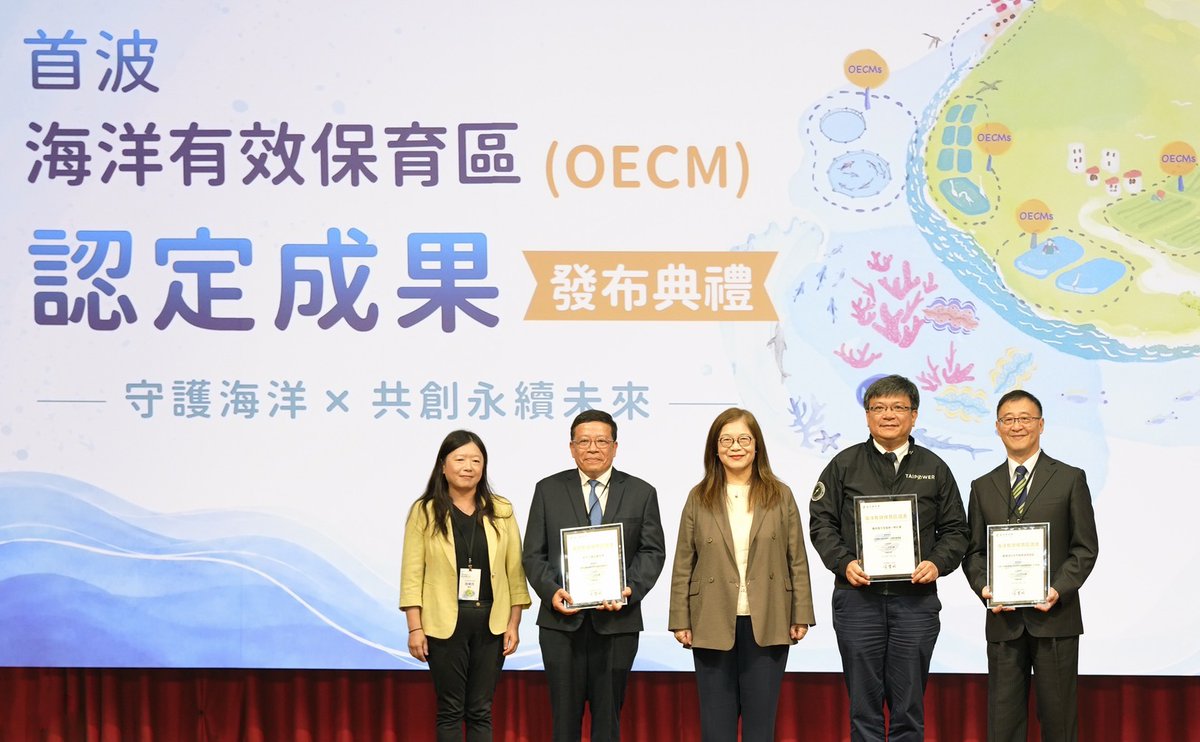
On May22, International Biodiversity Day of 2026, OAC Minister Kuan Bi-ling certified Taiwan’s first-ever Marine OECMs (CPC, TCC, and Taipower), witnessed by MOEA Minister Kung Ming-hsin.
Minister Kuan emphasized: "OECMs don't mean closing off the ocean; they mean ensuring 'good management' remains. It’s not about restricting development, but making sure development carries the responsibility of conservation."
Taiwan is among the few countries to incorporate OECMs into legislation under its Marine Conservation Act, praised by IUCN experts as "at the global forefront."
🌟 3 Pioneering Cases:
1.CPC Guantang: Protecting the algal reef ecosystem & Little Tern habitats.
2.TCC Heping Port: Eco-port balancing operations with coral restoration.
3.Taipower Wind Farm I: Infrastructure turned into thriving fish habitats.
Proving that economy & ecology can thrive together through ESG!
#InternationalBiodiversityDay
#OECM #MarineConservation #30x30 #Biodiversity #Taiwan
#Taiwan sits at the center of one of the world’s most dangerous geopolitical flashpoints. In this episode of Zoom In Zoom Out, J. Michael Cole joins Isabel Wang to discuss his book “The Taiwan Tinderbox.”
https://t.co/jBRmSZO8vB
🤝 Strengthening Ocean Literacy Partnership Across the Region
🌊 NAMR and KOSM Sign MOU 🌊
✍️ On May 19, the National Academy of Marine Research (NAMR) and the Korea National Ocean Science Museum (KOSM) signed an MOU to strengthen cooperation in ocean education, marine science outreach, exhibitions, and international exchange. 🌐
💡 As part of this partnership, students participating in the 2025 NODASS Ocean Big Data Contest are expected to join KOSM’s International Youth Workshop this June to share ocean data applications and connect with young participants from different countries. ✈️
✨ Through this collaboration, both institutions hope to inspire future ocean leaders and promote greater public understanding of the ocean. 🌏
#NAMR
#KOSM
#OceanLiteracy
#OneOceanOnePlanet
#NODASS
My argument in this piece is simple: Beijing is pressing foreign leaders to describe Taiwan in China’s language, while also keeping Taiwan’s own leaders from being heard on the world stage. The result is a dangerous distortion: Taiwan’s desire to preserve its democratic way of life is treated as a provocation, while China’s military and diplomatic coercion is treated as normal. But peace cannot be built on a narrative that blames the threatened for the threat.
Nansha "Nanyuan No. 9" Drill:Demonstrating Taiwan’s Humanitarian Rescue Capabilities in the South China Sea
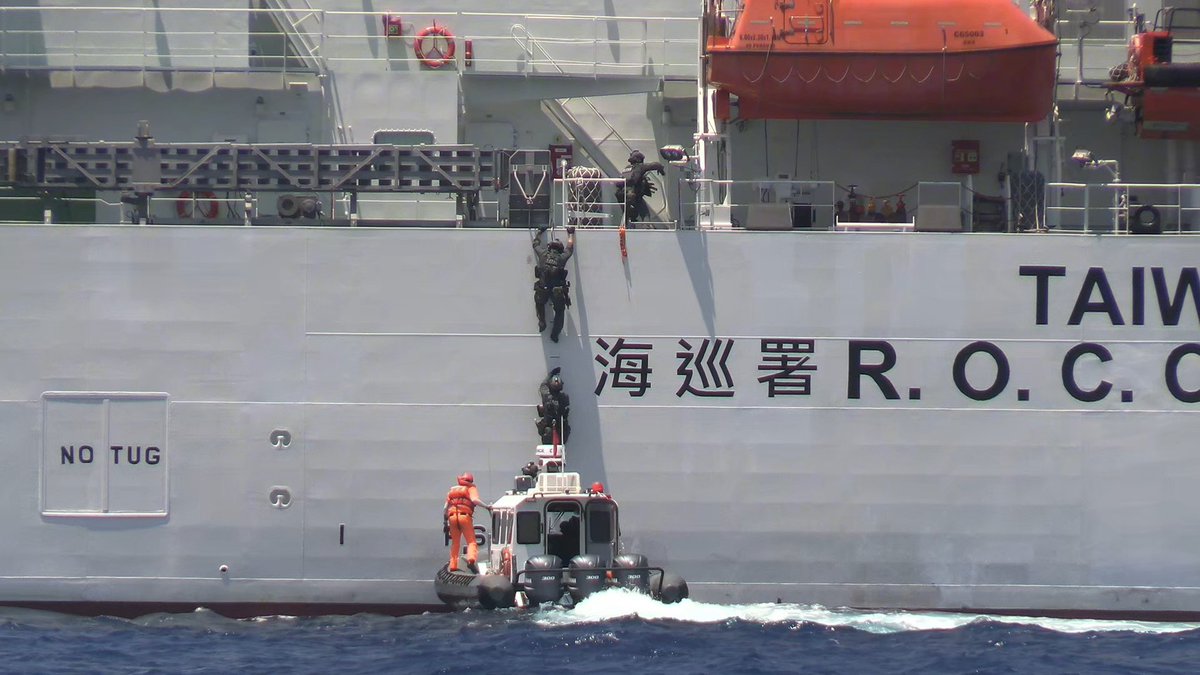
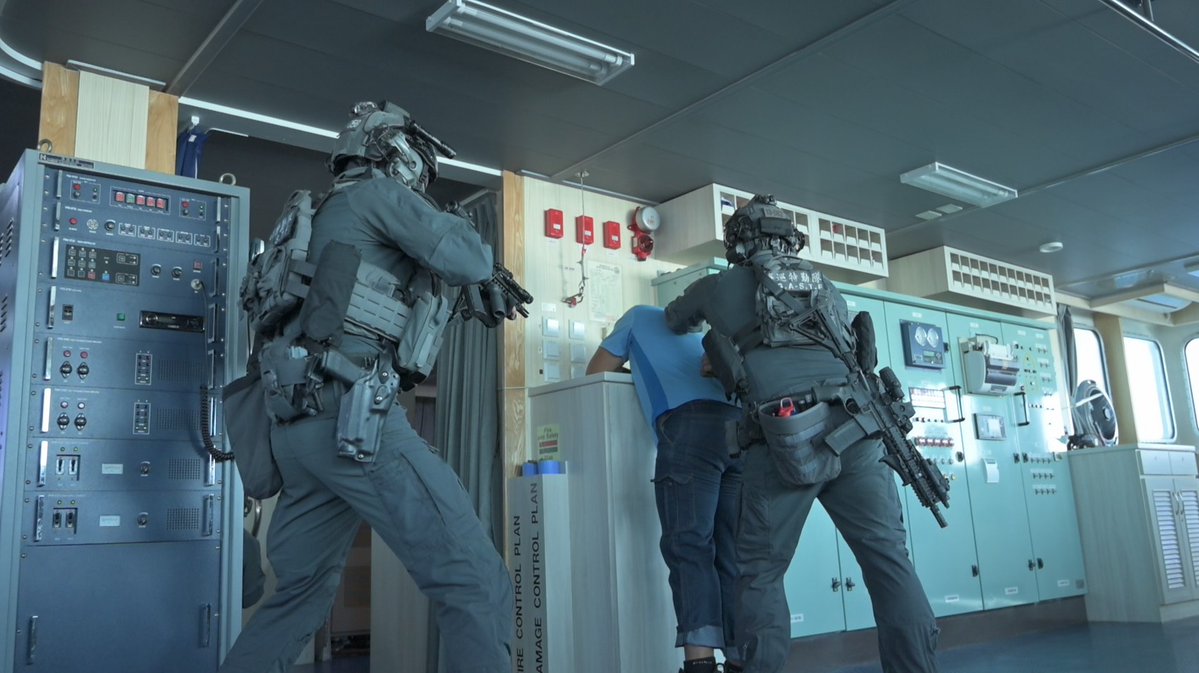
On April 21, 2026, Kuan Bi-ling, Minister of the Ocean Affairs Council (OAC), traveled to Taiping Island to oversee the “Nanyuan No. 9” exercise. The drill simulated a complex maritime disaster scenario involving a suspicious cargo vessel colliding with a fishing boat, resulting in a fire, multiple persons overboard, and an expanding oil spill. Through the use of satellite communications and real-time data transmission, the exercise demonstrated Taiwan’s integrated command-and-control capabilities, enabling authorities to effectively “see, hear, and direct” operations remotely. The Special Task Force of the Taiwan Coast Guard Administration also participated in a high-risk boarding operation in the Nansha area for the first time.
The exercise further incorporated support from military C-130 transport aircraft and remote telemedicine consultations, highlighting the effectiveness of regular preparedness training and rapid-response coordination during emergencies. Following the completion of Taiping Island’s new pier, the island is now capable of accommodating 4,000-ton-class patrol vessels and maintaining the regular deployment of 100-ton-class patrol boats, significantly enhancing maritime law enforcement and emergency response capabilities in the region.
The successful exercise demonstrated the effectiveness of interagency coordination and conveyed Taiwan’s strong commitment to transforming Taiping Island into a humanitarian assistance and logistics hub in the South China Sea. It also reaffirmed Taiwan’s determination to fulfill its responsibilities in international humanitarian rescue operations.
Taiwan’s President Lai Ching-te sat down with Nikkei one year ago for an exclusive interview. A lot has happened since: the rise of Cheng Li-wun, defence budget row, Trump-Xi summit... But our interview remains highly relevant, and illustrates Lai’s policy agenda and thinking 👇
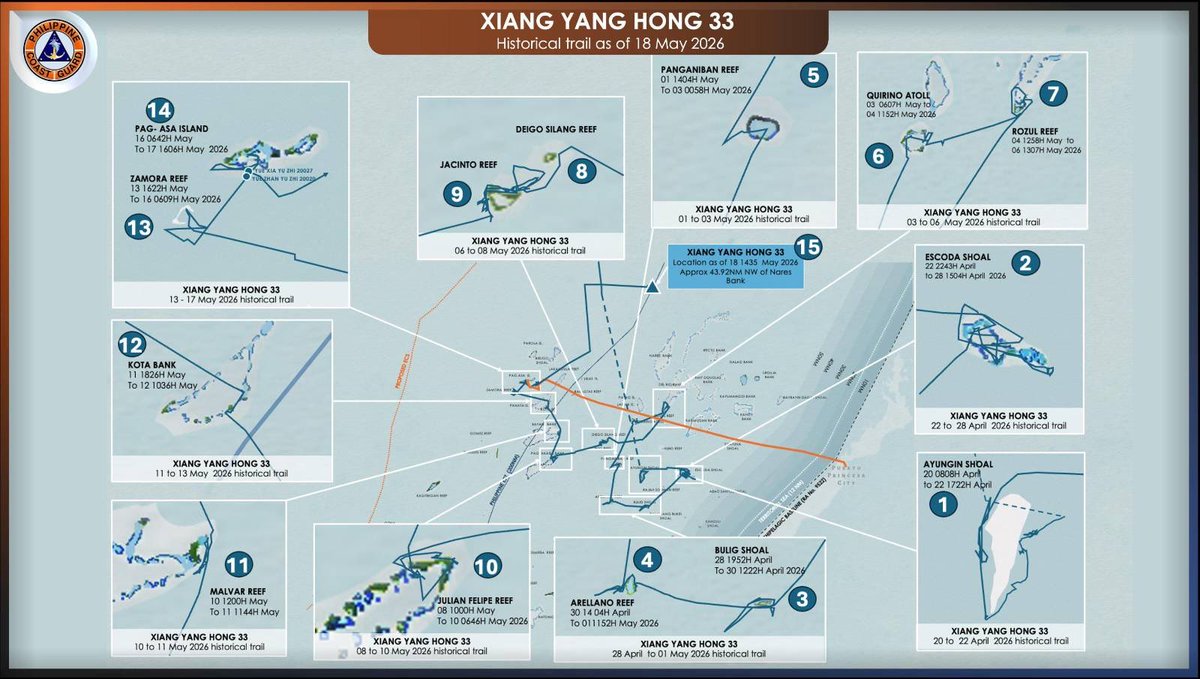
Xiang Yang Hong 33 belongs to a class of Chinese oceanographic research ships operated under the State Oceanic Administration/Ministry of Natural Resources. While officially classified as scientific, vessels in this family routinely collect data with clear dual-use value: bathymetry, water column profiles, acoustic propagation characteristics, and seabed composition — all directly relevant to submarine operations and anti-submarine warfare.
The track shows a deliberate, methodical sweep rather than a transit. Over roughly four weeks, the vessel touched at least 14 distinct features inside the Philippines’ Exclusive Economic Zone and the contested Spratlys before ending up northwest of Nares Bank.
The progression tells a story. It began on 20–22 April at Ayungin (Second Thomas) Shoal — the site of the BRP Sierra Madre and the most politically charged flashpoint in the area. From there it worked Escoda (Sabina) Shoal, another recent Chinese pressure point, then swept through Bulig and Arellano before moving up the western Spratlys: Panganiban (Mischief), Quirino (Jackson) Atoll, Rozul (Iroquois), Jacinto, Deigo Silang, Julian Felipe (Whitsun), Malvar, Kota Bank, Zamora (Subi), and Pag-asa (Thitu) — the largest Philippine-occupied island.
The vessel lingered in the Zamora–Pag-asa area from 13 to 17 May, with the Pag-asa segment itself running 16 May 0642H through 17 May 1606H. During that stay, two Chinese fishing/militia vessels (Yue Xia Yu 20027 and Yuezhan Yu 20020) are noted in close proximity — a telling co-location at the largest Philippine-occupied feature in the Spratlys.
Notably, Xiang Yang Hong 33 departed Pag-asa on the afternoon of 17 May — the same window in which the PCG conducted a MDA flight over the area. The timing is not coincidental. The vessel’s current fix at point 15 — 18 May 1435H, approximately 43.92 NM northwest of Nares Bank — confirms a now-recurring pattern: each time the PCG challenges it, whether by surface asset or aerial overflight, the illegal Marine Scientific Research (MSR) activity is halted and the vessel relocates.
The route hits every major Philippine-occupied or Philippine-claimed feature in sequence — Ayungin, Escoda, Pag-asa, Julian Felipe — features where Manila and Beijing have clashed in the past 18 months. The track itself is a statement of presence inside the EEZ.
The dense loitering patterns at specific reefs (the tangled tracks at Escoda, Julian Felipe, and Pag-asa) are consistent with detailed hydrographic and bathymetric survey work — multibeam mapping, sound velocity profiling, possibly deployment of expendable bathythermographs. This kind of data feeds directly into submarine navigation charts and ASW models for the South China Sea basin, which Chinese forces would need in any contingency involving the Bashi Channel or approaches to Palawan.
The co-location with maritime militia vessels at Pag-asa suggests coordination with the broader gray-zone presence rather than independent scientific work.
This deployment fits a now-familiar Chinese template: a research vessel conducts persistent, methodical MSR across contested waters under scientific cover, while militia and Coast Guard assets handle the visible pressure. What the 17 May departure demonstrates is that the template is not impervious — sustained Philippine presence, particularly aerial MDA, has a measurable disruptive effect. Each challenge forces the vessel to break station, abandon its survey grid, and reposition, degrading the continuity and quality of the data it can collect. Today’s track from Pag-asa to Nares Bank is the latest confirmation of that dynamic.
The fact that PCG is publishing a near-real-time historical trail is itself part of the contest: transparency as a counter to gray-zone ambiguity, and a public record that every Chinese MSR leg inside the Philippine EEZ has been observed, challenged, and interrupted.
China's claim of "indisputable sovereignty" over nearly the entire South China Sea, including areas within the West Philippine Sea (WPS), as reflected in its so-called "nine-dash line," has no legal basis under international law. The 2016 Arbitral Award, rendered under the framework of the United Nations Convention on the Law of the Sea (UNCLOS)-to which both the Philippines and China are States Parties-found no legal basis for China's claims to historic rights within the nine-dash line. The Award remains final and legally binding on the parties.